I was standing at the front of the class, in the middle of my history lesson. I was a new teacher, and in those early days it didn’t take me long to notice the distinctive energy that characterized a lesson going well. It was marked by easy flow of conversation, focused attention, interaction … At times such lessons seemed to sail along by themselves, with questions, and answers, and more questions propelling the learning forward. Time would slip away like a stream, completely unnoticed until the bell suddenly announced the end of the period. But on one particular day, things were not going as planned. Stilted energy. Halting flow. I was distracted by something important, and every sentence I uttered seemed to drop like a stone in front of me.
One student could not understand my lesson, and I knew it. She had joined our class that morning and was new to English. After introductions, welcoming, and community-building games throughout the morning, we found ourselves in afternoon history class. History can be a challenging subject at the best of times, with abstract concepts and events removed hundreds of years from current experiences. But now this bright student was sitting in front of me, knowledge and skills encoded in a language I was not speaking. She was so eager to learn, wide eyes watching me hopefully … and my heart sank.
I did not know what to do.
Although I had just returned from teaching ESL abroad and was knowledgeable in ESL instruction, the context here in the Ontario public school system was entirely different. Overseas, the students I taught were studying English as a separate rotary subject, much like students in Ontario study core French. “English” had its own designated period, and the sole goal was linguistic acquisition. Moreover, everyone in the class had the benefit of speaking the same first language, allowing full discussion and explanation of the language material. But here in Ontario, in a class full of English-speaking students, my new student had none of those advantages: she was not learning English for the sake of learning English; she was using it to learn math, science, history, art, health … How was I supposed to teach her all of these curriculum subjects when she was just beginning to learn the language? When she had no same-language speaking peers with whom to ask questions and clarify material? When she was in a culturally and linguistically unfamiliar place and school community?
I looked back at those hopeful eyes once more. I am not teaching in a way that she can understand, a loud voice was ringing out in my head. On repeat. Knowing very well what it was like to be in a roomful of people and be the only one not understanding what was being said, I had to switch gears. I hurriedly finished my lesson, and went over to work with her, re-teaching the topic as best I could and scaffolding language. But there were 25 other needs in that classroom as well, and only one of me. I couldn’t give anyone the time they needed like this. I needed to find other ways to include my new student in whole-class learning.
And that’s where PWIM comes in.
Ah, PWIM. I even like saying it that way. When sounded out it is almost onomatopoeia, a zippy word for a technique that gets your lesson going instantly. The acronym stands for Picture Word Inductive Model, and it is a tried-and-true strategy for teaching vocabulary and curriculum content simultaneously – in a way that is accessible to everyone in the class, including beginner MLLs. And the most amazing bonus? It requires almost zero prep time. The only thing you have to do is find a picture of whatever unit you are teaching … Canada in the 1800s. Desert Ecosystems. Healthy Eating. Or, in this case, the Life cycle of a Bird:
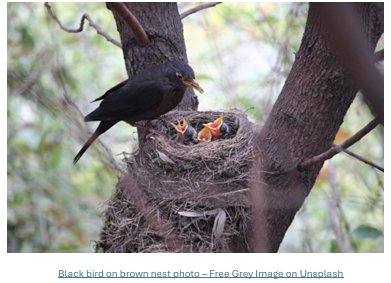
Projected in front of the class, this single image becomes a tool of engagement, with vocabulary learning, activation of prior knowledge, and curriculum teaching all rolled into one. Once the picture is up, the teacher invites students to name anything they see in the picture. In this case, students might say things like bird, nest, babies … The teacher writes the words as the students provide them, labelling the whole-class visual on the spot and even leading the class in chorally repeating the words for emphasis:
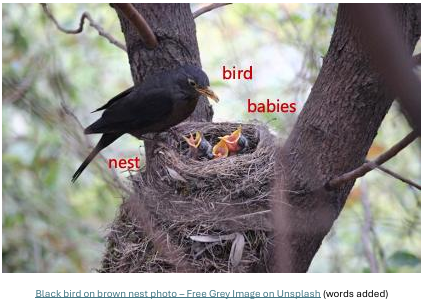
During this interaction, teachers also become aware of words students are not volunteering and may not know, and can then introduce them … perhaps words like chicks, down feathers, or talons … Great for building vocabulary they will need for the subsequent lesson and unit. And of course, let’s not forget translanguaging:
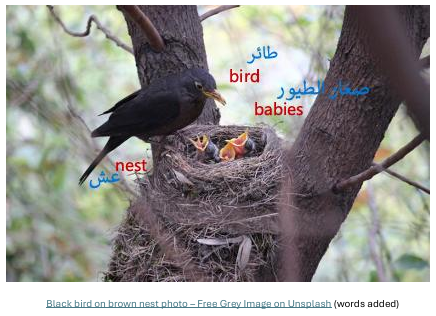
Including students’ languages in learning has immeasurable benefits, in terms of equity and inclusion, language learning, and overall academic performance. Research tells us that students who maintain and develop first language acquire English faster and do better academically than those who do not. In addition, a multilingual classroom creates a new, inclusive space for students, in which their linguistic repertoires and identities are recognized, reflected in the school environment, and integral to learning.
And this is what would have made a difference in my ill-fated history lesson. With vocabulary now pre-taught using the Picture Word Inductive Model (necessary for the MLL but great for everyone), the teacher now has a giant labelled visual to refer to as they teach the main lesson, pointing to items and visuals as they say them, reinforcing vocabulary, and enabling greater access to curriculum content than a purely verbal-linguistic lesson would have allowed.
At some point, we all look back on our beginning years in education and think, I wish I could go back and re-teach this lesson or that … Well, the history lesson I described earlier is one of mine. But I learned quickly, and have never stopped learning to be honest. There’s always more to consider, more to add to instructional approaches. Hoping this one, or an effective variation that you have discovered, becomes just one more way to include all students in your learning community.