
One of the biggest lessons I learned when teaching mathematics was the use of manipulatives. These lessons came from students in my class and a Math Learning Coach, which I was fortunate to partner with.
Student Attitude Surveys
Entering into junior grades for the first time, I wanted to get to know students’ feelings/attitudes towards mathematics. I had taught kindergarten for so many years, and now I was jumping into a new grade yet alone, being in a new division. Although I was a seasoned teacher in terms of seniority, I felt like year 1 all over again.
So, I researched and chatted with colleagues and the Math Learning Coach about surveys. I created a simple survey, and intentionally had a question about manipulatives as that was my learning focus for the year. The question was, “Who uses manipulatives?”
My jaw dropped and my heart ached when I read the responses. Students wrote that “students who only needed it” or outright wrote specific students who were MLLs and/or students with special education needs.
The words “if” and “needed” hit a little deeper. Those words echoed from me, “If you need it.”
Modelling
I wanted students to use manipulatives and not feel that it was a need but an integral part of learning. As the Ministry of Education states, “The use of concrete representations and tools is fundamental to learning mathematics in all grades and provides a way of representing both concepts and student understanding” (Ministry of Education: Some Considerations for Program Planning in Mathematics).
With that in mind, I knew I had to change that culture and the learning environment starting with me. I had to intentionally model the expectation.
My words changed from, “If you need manipulatives” to “Use the manipulatives to explain/represent/visualize” and a plethora of verbs to reengage students with manipulatives. Co-creating the culture began with me modelling the words, expectations and the norm.
C-R-A
I attended and presented at my first ETFO conference, which I highly recommend if you want to be validated and inspired. The ETFO Curriculum Conference focuses on “evidence-based practices and effective instruction” in Kindergarten while focusing on “intersectional feminism, women’s issues, and/or women’s contributions to child development” (ETFO) that connect to various topics presented. At the conference, a concept that re-surfaced was C-R-A (not to be confused with the Canada Revenue Agency), but a mathematical framework.
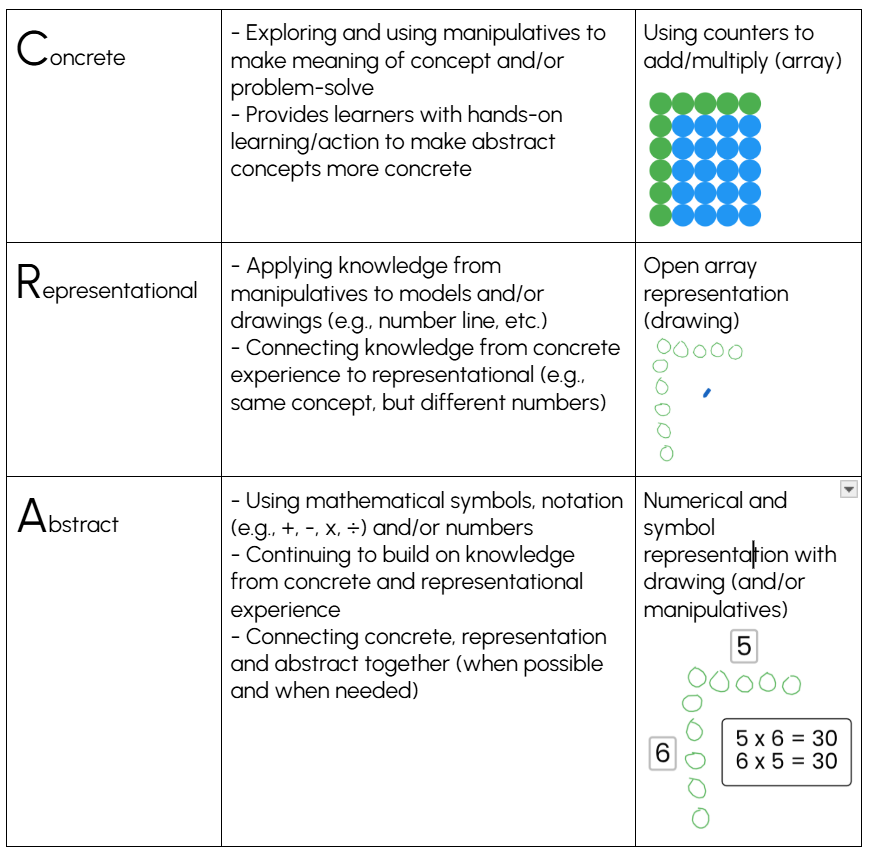
It’s not that I didn’t model concepts with manipulatives or through the C-R-A framework, it was that I was being more intentional. When I went to create a lesson, I would ask myself, “Have I included manipulatives for me to model? for students to use? If so, then, CRA would be my next check in leading up to a 3-part problem-solving math lesson. Have I provided opportunities for concrete-representational-abstract practice?
You might be wondering about how students in my class felt at the end of the year with this shift in instruction and learning experiences. There were a lot more “me” and “everyone” responses when asked about who uses manipulatives. To me, that validated that a small change in my practice made a significant impact on student learning and attitude towards mathematics. Use manipulatives not when you need, but in any chance that you get to model during instruction and assessment.
