Accommodations, Differentiated Instruction (DI), I think we can all agree DI is hands-down indispensable. Really, what could be better than those rich and varied instructional strategies that we add to our regular teaching, to meet the diverse needs of diverse students? It could be speech-to-text or other technology to help students with written output challenges; it could be sensory-friendly lighting or sound field systems; it could be providing alternative performance tasks to demonstrate learning, such as visual art, drama presentations, or oral assessments instead of written tests. The possibilities are endless. But no matter which accommodation is used, it’s safe to say that these pedagogical “extras” can only be a positive thing, and one hundred percent awesome all the time. End of story.
Except for the shoehorn dilemma.
Yes, shoehorns may be great for dealing with stubborn footwear, but metaphorically speaking (when it comes to inserting pedagogical supports into our classrooms) shoehorns may not always serve us well.
The potential problem arises when DI is an afterthought. If it is only used in a reactive way, with differentiated strategies shoe-horned into established learning programs in response to a new student suddenly needing them, it can sometimes – not all the time, but sometimes – have the unintended consequence of highlighting how inequitable the original learning space actually was. There are many instances in which this may occur, but here I will use ESL as an example: if a new multilingual language learner arrives, we may hastily scramble to add dual language books, multilingual classroom labels, and translation tools…while the other students in the class wonder why they are suddenly seeing these resources in their formerly English-only zone. Yes the change is good but, in some circumstances, the very techniques that are meant to create an inclusive environment may also shine a spotlight on who the learning environment was initially and instinctively constructed for, and for whom it was not; which students’ identities were automatically included in the classroom, and whose were not; and by implication, which students may inherently belong, and which may not. You know, those “different” kids who we now have to change everything for.
So the issue becomes not whether to use DI, but how and when. And using the MLL example above, I have some wonderings. What if it were normal to see, use, and discuss the value of other languages in the classroom, regardless of whether there are any MLLs in the class? What if every classroom used multilingual resources from time to time, giving students a chance to explore new languages they are interested in, or strengthen and complement their French program, or make cross-linguistic connections between English and other languages, thus deepening their understanding of English etymology, morphology, and spelling patterns? If it is “normal” to use other languages in learning, would we really be changing the learning environment so drastically if an MLL arrived? And instead of lamenting their lack of English in English-only classrooms, might that new environment encourage us (both students and teachers alike) to view that MLL as skilled and linguistically adept, and a perfect fit for our classroom? Perhaps class introductions might move from “He can’t speak any English, let’s help him” to “She speaks three languages! She can teach us a lot”.
ESL is only one area of consideration in building learning environments for everyone, but it raises an important question for educators: how can we ensure our learning spaces are equitable and inclusive from the outset so that any student might wander in unannounced and access the lessons and learning, and find a space that reflects their identity, already waiting for them?
With woefully lacking supports and funding, it would be quite difficult to anticipate and include all the learning variations we would want in any given classroom. But there are small ways, every day, we can move towards it, such as collaborating with colleagues, sharing ideas, reaching out to Special Education teachers, ESL consultants, and other specialists may broaden our awareness of the types of learning supports that all students need.
The Frayer Model is one of my favourites. Designed by educator Dorothy Frayer and her colleagues at the University of Wisconsin in 1969, this student organizer is meant to be used in vocabulary study, with the aim of enhancing students’ understanding of words by encouraging a deepened exploration of them. Students record the word right in the middle of the planner and, in the spaces around it, list not only its definition but also its important characteristics or features, as well as examples and non-examples. Here is a basic copy of the Frayer Model planner:
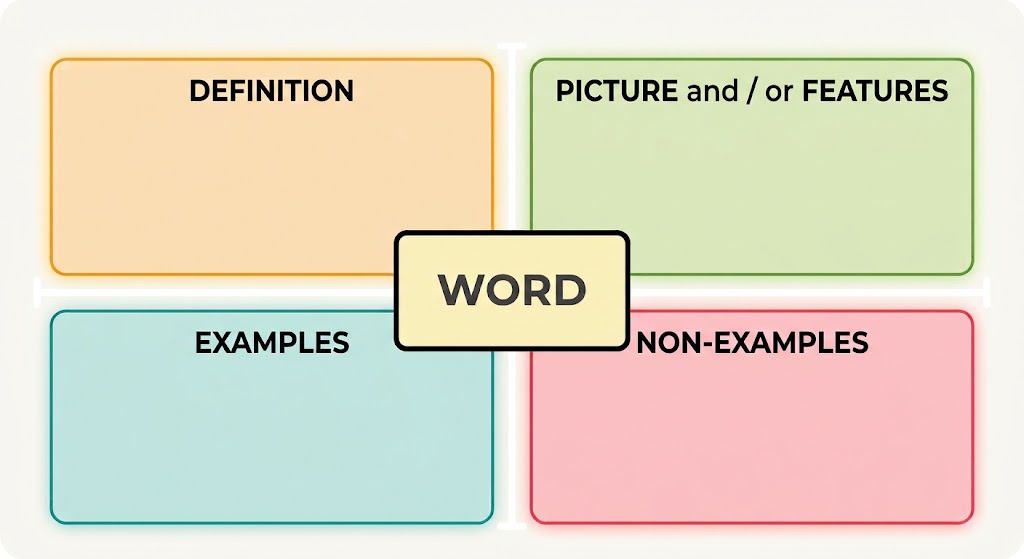
Template created with Gemini AI
And here’s the simple, beautiful addition to the planner that builds multiple languages into your learning program: just add a space for students to write the word in another language as well. Jim Cummins and Margaret Early offer their own variation on the Frayer Model in their book Big Ideas For Expanding Minds, with a spot for “Word in Home Language” as well as slight tweaks to the surrounding quadrants (having MLLs write synonyms and antonyms in the lower left quadrant instead of examples, and simply writing a complete academic sentence using the key word in the lower right quadrant). It is a great variation for MLLs, and you can check out their thoughts on page 60 of this useful book. But classroom teachers can use the traditional model above too, for everyone in the class, by just adding a space for “word in another language” and let the multilingual learning begin! Any student could check with their French teacher, a French dictionary or a translation app to find the French equivalent of their target word. Or if they speak another language at home and already know the translation they could record it right away in home language – or better yet, ask their parent or caregiver and do a little multilingual homework together. Students who speak only English could explore a language they are interested in learning. All rich and meaningful options for everyone in the class, not just MLLs, and a simple way to embed and highlight the value of languages in the classroom.
So as we begin establishing what our learning environments look like this year, I am going to consider the diverse ways I can use DI right now, even if there is no apparent “need” as yet. And honestly, I’m always learning, always uncovering possibilities that did not naturally occur to me, simply because they are not within my lived experience. But that’s the beauty of teaching, of creating better learning environments that include everyone, isn’t it? May new and beautiful discoveries find you this year too.
References
Cummins, J., & Early, M. (2015). Big ideas for expanding minds: Teaching English language learners across the curriculum. Rubicon Press/Pearson.