
As a math teacher, I often use my professional judgement* to select word problems for students. I want to see how students apply math for a specific purpose; whether an open question that allows for multiple entry points or whether I hope to elicit a certain equation. These word problems sometimes integrate one or two strands in math. For example, engaging in both measurement and number as students added side lengths to determine perimeter. There are great problems in the sample tasks of the curriculum that are designed to help students learn through problem solving.
If you’ve looked closely at the math curriculum, you will see one of the overall expectations has no accompanying specific expectations. Located in algebra, this expectation is named Mathematical Modelling. This expectation offers students the opportunity to: “apply the process of mathematical modelling to represent, analyse, make predictions, and provide insight into real-life situations”.
What is this and how is it different from the word problems I loved?
As it turns out, mathematical modelling is quite different. It’s a process based expectation, meaning that while students are solving a real life, messy problem, they are going through the mathematical modelling process. Students apply this process to various contexts, bringing in learning from other strands. This is different from other traditional problem solving in specific math expectations where a word problem leads students to solve a with a specific equation or strategy. In modelling, students look at a problem outside of mathematics and then use math to propose and revise their model.
To see the modelling cycle, look to the link that leads you to the curriculum and resources tab. You’ll find a graphic that helped me to think a little more about the mathematical modelling cycle.
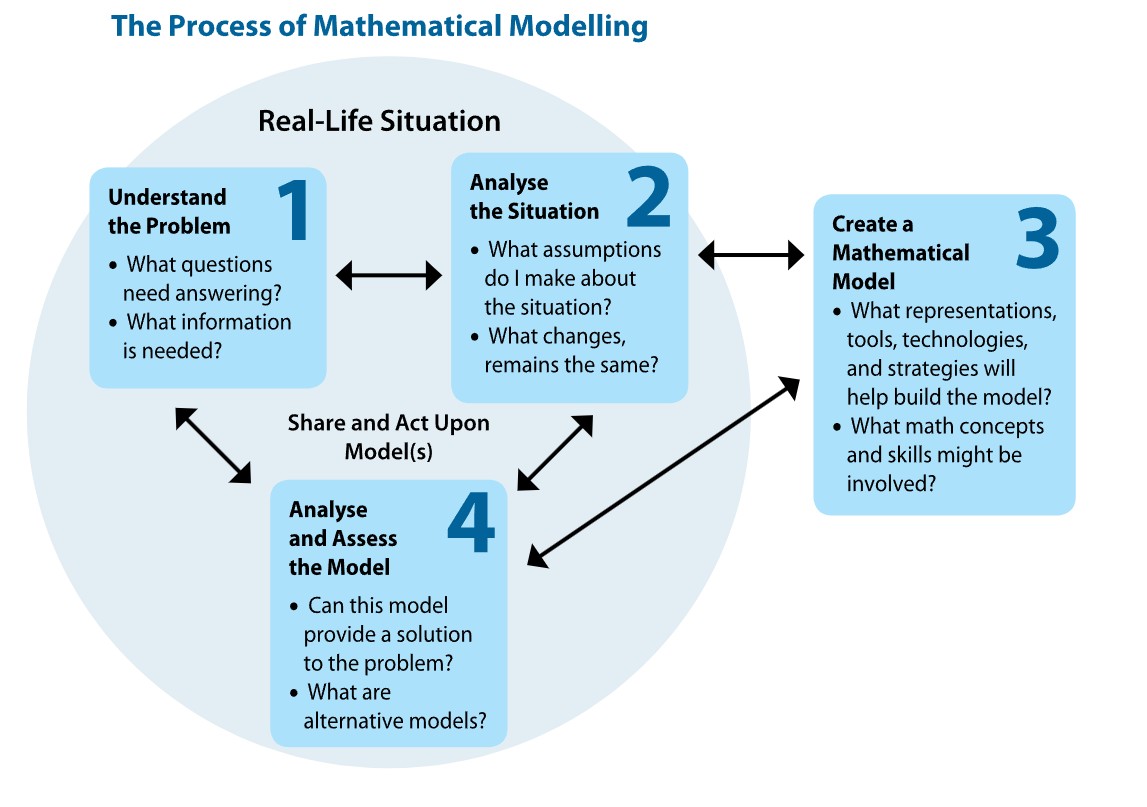
You’ll notice this is a repetitive cycle; meaning that the educator guides students to revisit the four components of mathematical modelling. The arrows suggest that each stage of the process allows opportunity for students to return to a previous stage and reflect on their model. Take a look at stage four, the stage where problem solving may be ‘finished’ with the ‘answer’. In mathematical modelling, students can and should revisit previous parts of the process and revise or reflect on their model.
This process mirrors real life and all of the messy ‘figuring out’ and decision making. It’s purpose feels different from a word problem where the expectation is the students extend patterns or use addition to solve how much money they spent at the movies. The focus in modelling is on the process of how we think through real life problems and can use mathematics to help us both question whether our model can provide a solution and look for possible alternative models.
As I explore and learn more about this overall expectation, I find myself growing as a math teacher. There are so many different ways to teach and learn math; so many different purposes for problem solving and questions to pose. I’m also learning about the ways that I use math in a real life context. Sometimes I’m estimating at the grocery store when trying to stay under my budget. Sometimes I’m solving a problem, such as planning a community event. While the second problem may not feel as ‘math-y’ as the first, I realize that math truly happen everywhere.
*Professional Judgement- Judgement that is informed by professional knowledge of curriculum expectations, context, evidence of learning, methods of instruction and assessment, and the criteria and standards that indicate success in student learning. In professional practice, judgement involves a purposeful and systematic thinking process that evolves in terms of accuracy and insight with ongoing reflection and self-correction. Growing Success policy (p.158, 2010, Ministry of Education)