
Photo of Alison Board

Meaningful Connections

Learning in a classroom has its challenges and restrictions, especially for a diverse group of learners who like a hands on approach. I often hear adults say that they would rather do something than read about it. Children likely feel the same way, though don’t express it in those words. Experiences like a visit to the Apple Store (as Carmen blogged earlier), are opportunities that connect the student’s learning with a realistic context. Some excursions are very controlled and are presented as a program, but an excursion that connects learning in the classroom with a real context or environment is more meaningful for the learner.

When planning for a combined grade one and two class, I looked for commonalities in the curriculum that could be approached similarly or in the same context. At the time of planning, I was also reading a variety of articles that ranged in subject from nature deficiency in children to mindfulness in the classroom. I came across one article that demonstrated the value of science notebooks for observation and inquiry. So, in September every student in my classroom received a blank notebook that was introduced as a “field journal”. Every week our class takes our science lesson outside with field journals to observe what we have learned in a real world setting. The children date each entry and record their observations and questions using pictures and words. A ravine that is located within a block from our school provides a rich context when looking for signs of the water cycle or evidence of the sun’s energy. We have also carried our journals around the school to find examples of energy use and consumption by tracking how many classrooms use their lights, some lights, or rely only on the light from the windows. The use of the field journals is effective because they are purposeful and the children are investigating their environment with specific intent. When we discuss their observations back in the classroom, the children learn from each other as their perspectives or findings differ. Often, new questions arise, which leads to more investigation or research.

Although it has only been two months since the introduction of field journals, it has become routine to our science program and the children look forward to applying the knowledge acquired in the classroom to their own natural and constructed surroundings. The journals integrate concepts and skills that we learn from other areas of the curriculum such as language, visual arts, and mathematics. But best of all, the children are visibly engaged in their learning while making meaningful connections to their world.


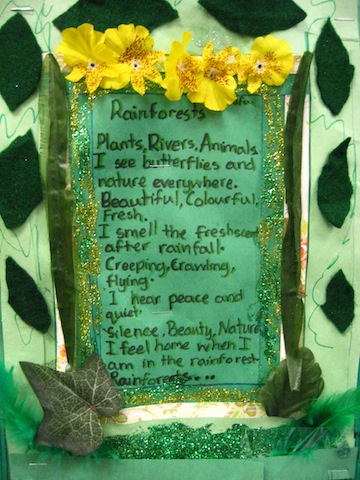
"Rainforest" Sensory Poem

Weaving Inspiration Into the Curriculum

One of the most rewarding aspects of teaching is the creativity and inspiration we can weave into the curriculum to bring deep and meaningful learning experiences for our students (and ourselves!).  This past week my class enjoyed an art lesson integrated with media, oral communication, and writing expectations.  It served as a perfect example of how students become more engaged when our lessons are filled with what inspires us.

A friend of mine emailed me a phenomenal video depicting the sheer beauty, simplicity, and breath-taking scenery found in nature around the world.  It moved me deeply and I knew I had to somehow share it with my students in a meaningful way.  I decided to use it as the foundation for an art lesson.  We have been exploring cool and warm colours, texture, and patterns.  We watched the video and had a class discussion using sensory prompts (I see…, I hear…, I feel…, I smell…).  The descriptions were profound and all the students were eager to share their thoughts and feelings!

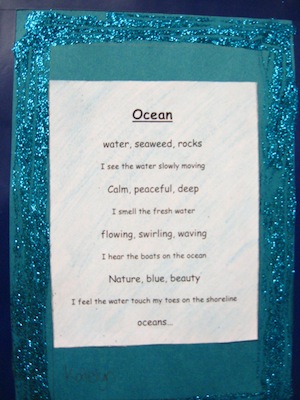
Next, students chose an aspect of nature (ocean, rainforest, sunset, etc.) to create a frame for a sensory poem using warm/cool colours and different textured paper.

Lastly, using a template as a guide, students created their sensory poem.  Students were encouraged to experiment with word choice and powerful images to portray their scene.  I cannot begin to describe how excited and proud they were to share their art and poetry with me and each other!  At the end of the experience, they asked to watch the video again.  I gladly shared it once more and silently thanked my friend for the inspiration that created a beautiful teaching opportunity.

"Rainforest" by Wafa Hakim

Rainforest

plants, rivers, animals

I see butterflies and nature everywhere

beautiful, colourful, fresh

I smell the fresh scent after rainfall

creeping, crawling, flying

I hear peace and quiet

silence, beauty, nature

I feel at home in the rainforest

Rainforest

"The Ocean" by Katelyn Tam
"Sunset" by Darshak Patel


Photo of Carmen Oliveira

Finding Opportunities for Learning Outside the Classroom

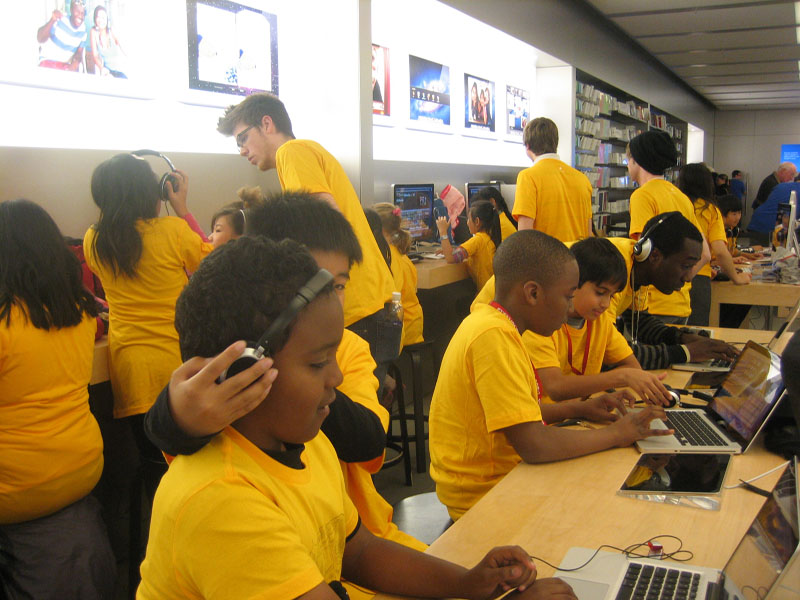
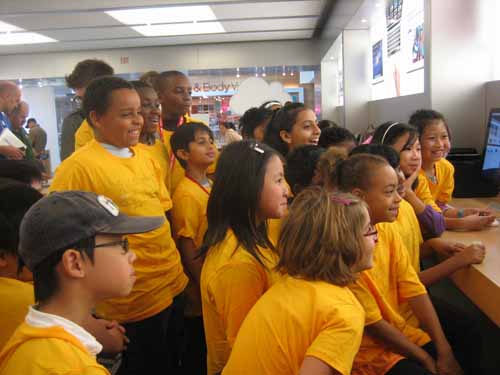
This week we participated in an excellent real world learning experience outside the classroom (and it was almost free!).  My Grade5/6 class has been exploring biographies, memoirs, and looking at the features and format of recounts.  We have also been using our MacBooks to support our learning in various ways.  An opportunity arose to bring the two together by visiting an Apple store to learn how to create an iMovie in the form of a biography about each student.  The entire trip, including transportation, came to $1.50 per student.  It ended up being a meaningful, incredibly fun, and real world learning experience for everyone!

This year, our division is committed to creating as many of these powerful learning opportunities as possible for our students because the enthusiasm, eagerness, and results we see back in the classroom support the belief that applying concepts and new learning to real life experiences is what creates long-term understanding.

When you begin to explore all the possibilities to have students apply classroom learning and experience in a real world setting, with a little creativity and investigation, it’s amazing how many opportunities are out there!  The only expense our students had was the bus trip to the Apple store for $1.50.  In return they received lessons and support from a team at Apple, a free t-shirt, the opportunity to use the latest technology to create their iMovie, and a certificate of participation in the program!  It can’t get better than that!

Students working with the crew at Apple


Students watching their video biographies!