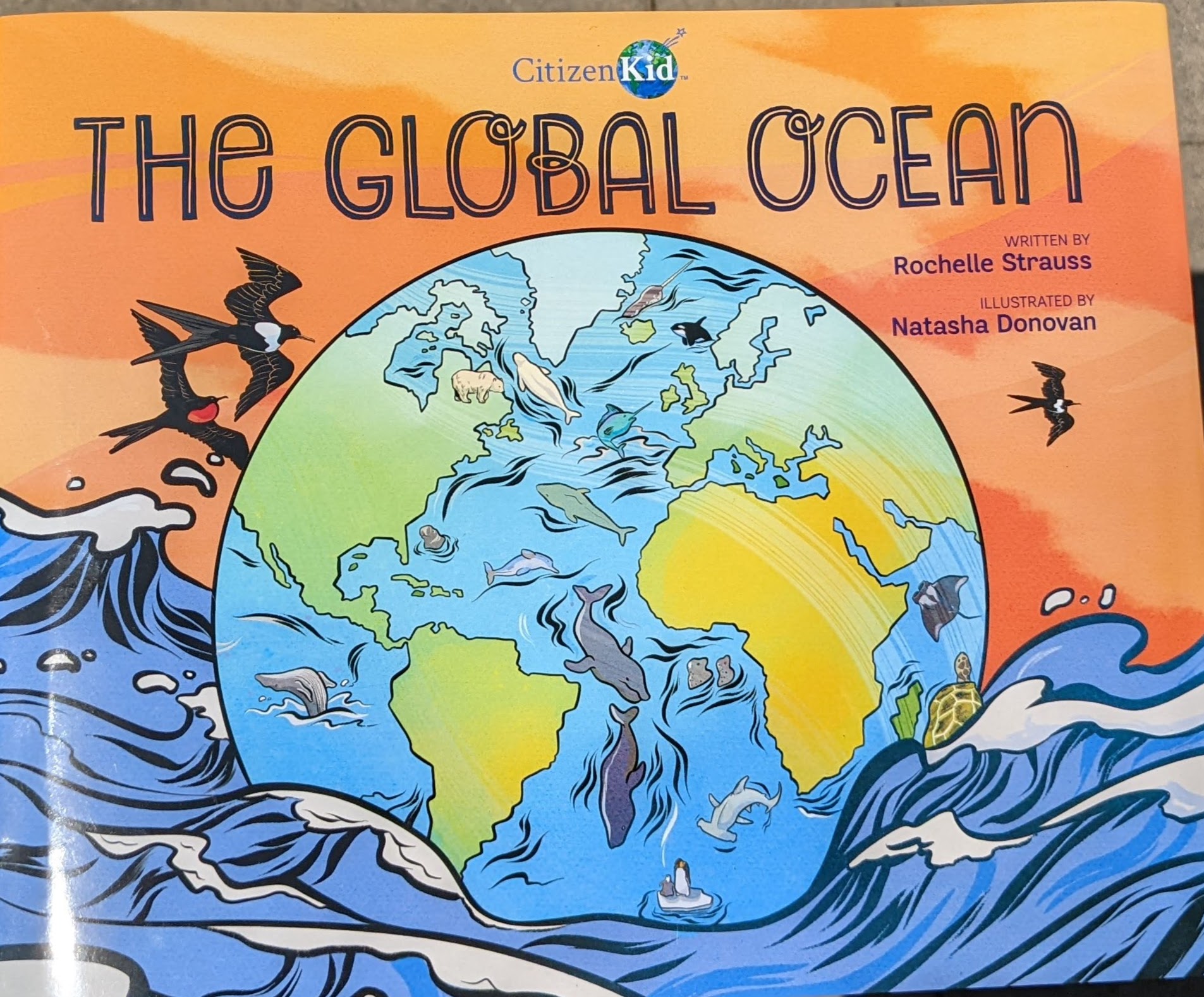
D id you know that World Oceans Day is June 8th? Neither did I! That is until I read Rochelle Strauss’ new book, The Global Ocean. As a long-time fan of Rochelle’s other books – Tree of Life and One Well – I was overjoyed to hear that she was writing a new book and couldn’t wait to get my hands on it. In this post, I write about my new learnings as I consider ways to use this book with students.
The Global Ocean? I Thought There Were 5 Oceans!
Situated in different parts of the world, I always thought of oceans and their wildlife as being separate and unique, without thinking of the interconnectedness of the different bodies of water. Sure, I understood that one body of water flowed into the next but I compartmentalized them thinking of the Pacific Ocean in the west and the Atlantic Ocean in the east. Distinct and separate, mainly due to geography and/or climate. Page 7 of the book brought home the reality of a Global Ocean in sharing about the 1992 cargo ship that fell overboard, spilling nearly 28 000 animal bath toys into the ocean. Over the next 20 years, tracking the rubber ducks was an incredible real-time science experiment on how all of the ocean basins are connected. The results and hearing this blew my mind!
Plastics!
For years I’ve shared about the Great Pacific Garbage Patch and had conversations with students about actions we can take to ensure that we aren’t contributing additional waste into our waterways. We’ve talked about plastic bags, straws and can holders and how they impact wildlife when they enter oceans. Years ago, we also had lots of conversations around products that contained microplastics that were used as exfoliants. I hadn’t realized that there are plastics found in many common human-made fabrics. What blew my mind when reading about plastics was the fact that “with every load [of laundry], as many as 17 million tiny plastic fibres get washed down the drain” (pg. 21). What?!?! I got out the calculator and further realized the impact of my actions and have made a commitment to change by being cautious about what I purchase. Tips are peppered throughout this incredible book but I have to say that pages 26 to 35 really offer some fantastic ways to bring about tangible change.
Why Students?
Sections of this book share about the actions of young people who are making a difference. Individuals speaking out. Groups creating projects. I’ve said it before and I’ll say it again, children really are the most incredible people on the planet. When they learn of injustice or see something that needs to be made right, they are eager and get creative to bring about change. Much like the interconnectedness of the oceans, when students learn about how their individual actions can have a global impact, they get excited and want to do more. Inherently, children like to know that their actions can change the world and add to the greater good. I love that this book makes learning approachable and I am seeing so many uses for it within the classroom. Students are eager to act. How might we support them in learning and in turn using this eagerness to bring about change in our world?
This is seriously an incredible book that I think every educator should read, for their own learning and also help students in understanding the importance of our actions on the environment. Students are open and ready to make changes that will result in a better world for everyone. Through incredible texts like these, there’s so much learning and inspiration that can happen, that will lead to much-needed action, and ultimately change. June 8th is World Oceans Day. What action will you take?