The Teacher Down the Hall

During these longer nights and shorter days, I often find time to reflect on my own journey as an educator. Coming up on 25 years very soon (gulp!), I can honestly say that I am not the same educator I was at the beginning of my career or even the same as I was five years ago.

Earlier this year I wrote a post about professional learning and realize as I reflect on my career that I also need to acknowledge the teachers down the hall. These educators have influenced and shaped my vision about students and teaching in so many ways through their mentorship, their permission to be human, and their examples as leaders. I want to dedicate this post to the teachers down the hall whose influence and teaching extended beyond students and to colleagues.

One of my favourite educators would always remind me, “You are human.” Teaching can be overwhelming and is often described as the job that never ends. I know there are times when I felt I could literally work 24 hours and still not have “finished”. However, we also need to understand that we are human. We need to give ourselves some grace for the weight of the work we do and know that we need time to recharge. Setting boundaries for work doesn’t make us bad teachers, it means we are humans who deserve the time for necessary self-care.

An intermediate colleague I worked with once asked me, “If you’re not having fun, how do you think the students feel?” In the light of all the curriculum expectations and data collection, it’s hard to remember to ensure that the class community enjoys their time together. Whether it’s engaging in community building, sharing funny stories, or a cool science experiment, having fun makes the learning environment a comfortable and safe place to be. It helps to build relationships between students and educators. One teacher I worked with always greeted his primary class with a morning joke and that was always brought up by students years later at every grade eight graduation. Those small moments where we have fun are sometimes the small moments that have a big impact.

Another mentor teacher would always tell me, “We teach children, not just curriculum.” It is so important to know each child that we share space with during the day. To recognize that they hold different identities and experiences, acknowledging that those factors influence how they feel seen at school. As teachers we all want students to feel welcome and that school is a place they belong. Getting to know and accept students’ full identities, such as cultural heritage and neurodiversity and everything in-between is necessary to create that feeling of belonging.

Working with another colleague, I learned “Be passionate about your own learning!” Teaching is a practice and one that we strive to get better at doing each year. Learning more about teaching strategies, resources, and new pedagogical research are all ways we can fuel our own professional learning. Trying new strategies helps to deepen our understanding of subject matter and to stay excited about teaching.

I reflect on those conversations and am so grateful to those teachers who gave me a shoulder to lean on and a listening ear. When I think back on the last two decades, it seems like no time has passed since my very first class. I feel like that same new teacher on the inside, though I have been shaped by different experiences and growth – much of that due to conversations and mentorship from those teachers just down the hall.
The Shape of Things

We’re having fun with shapes! In kindergarten, grade 1 and grade 2, we have been exploring, sorting, and comparing 2-D shapes using a variety of tools.  Here’s what we’ve been up to for the last couple of weeks.

In some classes, we started off on a shape scavenger hunt to see which shapes we could identify in our learning space. Students were excited to identify different shapes in the room and magazines. Many were impressed by how many items they could find that were shapes that they knew the names of. The face of our clock is a circle. The lego bins in our class have faces made out of rectangles. The books on our shelves and our SmartBoard also have rectangular faces. We identified a lot of rectangles in our space. 

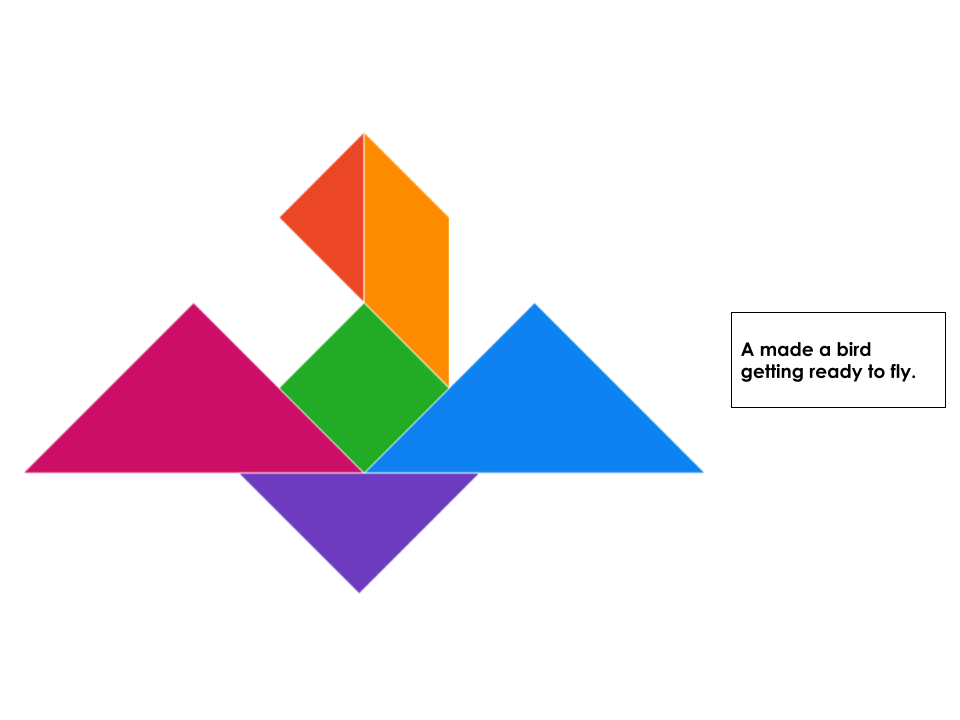
After identifying shapes that we could easily name or identify, we started talking about composite shapes. The tangram is a Chinese puzzle made from a square cut into seven pieces: two large triangles, one medium-sized triangle, two small triangles, one square, and one parallelogram. After discussing the properties of these shapes and congruence, the students were really amazed by how these 7 shapes could be put together to make a square. Many tried to flip and turn the shapes to return them to the original square and realized that it was a little tricky. After having some time to play with the tangram, students had the chance to try and see what they could create other than a square. They were then introduced to tangram puzzles and their minds were blown. After having the chance to physically manipulate the shapes, we took our skills online. Exploring Mathigon’s Tangram Builder, students had the chance to see how they could piece together the shapes to compose pictures and designs using these 2-D shapes. 

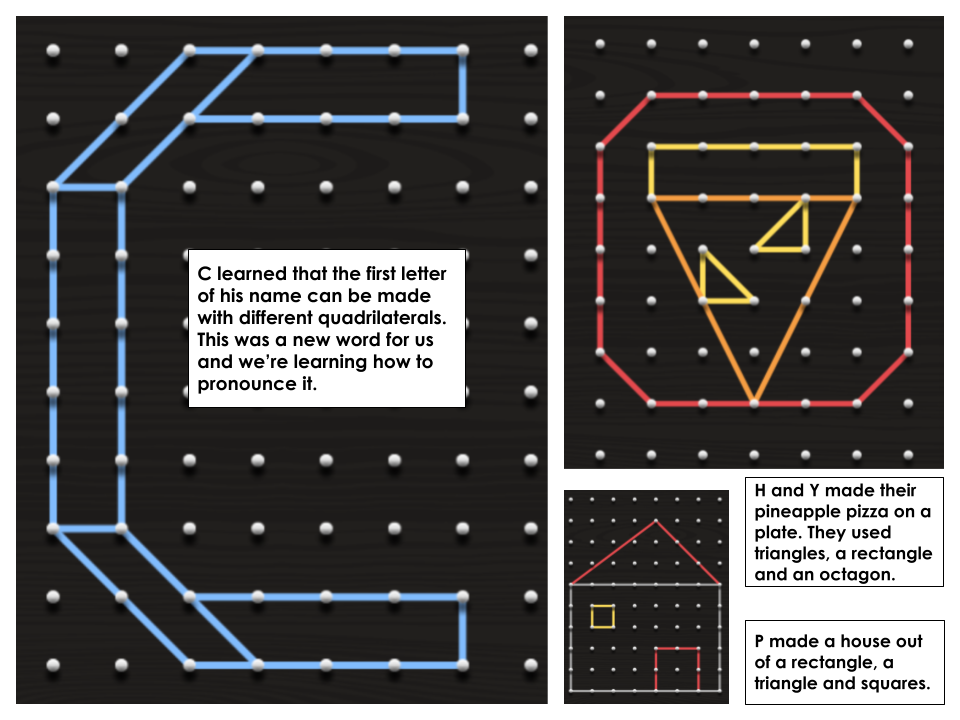
We have also been exploring what we can make using geoboards. Using the Math Learning Center’s Geoboards, students were given a few challenges and rose to the occasion. Here are just a few of the challenges we explored:

  •  Using your geoboard, make a shape that satisfies a rule (i.e., four sides; all equal sides; greater than 4 sides). What’s the name of your shape?
  • Using the geoboard make the letters in your name. What shapes did you use?
  • Create a picture using 3 different shapes. Describe your picture and the shapes you used. 
  • Make triangles of different sizes. Describe the differences between your triangles. 

We’re having a blast exploring shapes. This has also been a great reminder for me as to the importance of having manipulatives that students can move around and use as well as incorporating technology. We’ve explored with both and while some have really enjoyed using the online tools, there have been some who automatically gravitate to the physical tools in our space. Either way, we’re learning and having fun in the process.

Mental Health Activities

January 25th was an important day to talk about mental health as each year, “Bell Let’s Talk Day” reminds us all that conversations are such an important part of our day as educators. As educators, it is our duty to ensure the mental well-being of each of our students is thought about daily. Some students keep their feelings inside and some claim to be happy 24/7. How do we dive deep into these important conversations and make sure that we are providing opportunities for our students to speak out? Here are some ways to get talking about mental health without making it the central focus. Starting small to get kids talking.

Math Activity

My students were looking at topics to create an infographic about and as a class, decided the most important infographic that should be on display in every intermediate class was one about mental health. So students looked for statistics related to youth mental health in Canada. They found fractions, percentages and various facts that told a story about the mental health of youth in Canada. They shared these infographics with their peers and discussed many important facts. Then, yesterday I pulled up the website about “Bell Let’s Talk Day” and students found many statistics on this page that they had used in their own infographics. We looked at the resources available and then talked about resources to help within our own school (Positive space groups, social worker, clubs, talking to teachers, etc.)

Drama Activity

I wanted to try an activity with my grade two and three students yesterday that connected to their mental health and it went very well. I encourage you to try it out with any grade in a future drama class or just as a class activity. Here is how the activity worked:

A student would be selected to be the actor and that actor would have some sort of problem that they were needing help with. Some examples are:

  • Getting a bad mark on a test
  • Getting into a fight with their best friend
  • Their best friend was moving
  • They felt sad but did not know why
  • Their goldfish passed away

It was actually challenging to think of situations that would not be triggering for students. I made sure that the actor was okay with the situation and then they proceeded to act out their feelings towards the situation. Then, they would pick three friends from the audience who would one at a time come up and try to make them feel better. It was incredible to hear all of the solutions that their friends had. Students who had not participated in drama class in the past put up their hand for the first time. They were excited to come up and comfort their friend. After the lesson, I asked the students if they could use these strategies in real life and they all agreed that they could. I know this activity comes with a risk of students having to be vulnerable but I think it was useful. I even heard a student say, “I wish I had gotten that advice a month ago!” I loved this activity and hope to try it with my intermediate students in the future.

Language Activity

As report card season is in the midst, I decided to try a different reflection activity this term. I asked students to write one word or sentence  on a cue card that best described their feelings towards report cards. This was an anonymous activity as when I collected the cards, I did not ask them to write their names on them. I then handed out a random card to each student. I asked them to think about why the student had written down that word/sentence. What could have been going through their head? Can you relate to what they wrote? Why or why not? I often hear grumblings about report cards around this time of year so I thought this would be a good chance for students to get it all out. An optional part of this activity could be having students share their word at the end if they felt comfortable doing so.

Art Activity

Last month, we were lucky enough to have someone from the Art Gallery of Hamilton come in to our classrooms. We were involved in a four week program working with watercolours with a focus on mental health. Students completed watercolour techniques in a very relaxing environment, using tape, string and tissues to create different looks. This was my favourite part of the day as every student felt connected to their work and rarely left to access a different space. Students were proud of their work and loved the simplicity of this. The arts have a way of making everyone at peace and I look forward to incorporating more periods to just create without a given set of rules.

These activities are just a few I have tried over the last month or so and I am always looking for new ways to get my students feeling comfortable around their peers and with themselves. I would love to hear about more if you have some that have worked in your own classrooms. I hope to include some photos once I am back in the classroom next week so stay tuned.

January Thoughts: On Practicing Self Care

As educators, I have always thought we have been rather blessed to have at least 2 New Year’s celebrations a year: the one that comes every September, and the one that comes every January 1st. For me, both of these days brings about a slew of self-care goals: to exercise more, eat better, cook more, be more social, or even look more “put together”. More often than not, I start strong, and regress just in time to reset for the next new year.

After years of cycling through all of my “new years” – and never really ever making any permanent lifestyle changes – it occurred to me that I wasn’t putting enough effort into my own self-care. In fact, I mistakenly believed that self care was something that would be instinctive, or simply happen without any expenditure of energy. What I have realized is that real self care comes with work.

This year has been exceptionally busy and Meg, the gym manager invited me to the dreaded new year fitness and nutrition challenge. The gym manager, a very young, fit and enthusiastic woman probably about half my age texted me with a flurry of fire and muscle arm emojis.

“Book the challenge! Commit! Are you in? Yassssss 🔥🔥🔥💪💪💪”

I honestly couldn’t picture myself cooking a whole other menu of food on top of what I was regularly preparing for my own family, all while regularly attending early morning workouts and of course, doing a full time job.

“You can do this. 🔥🔥💪💪Train insane or never change ayeeeee ☠️”

In that moment, I realized that there would never be an “ideal” time to embark on a lifestyle challenge. I had always wanted to clean up my diet and increase my fitness, but always made sure I was way too busy to ever do it in earnest. I had bought into a narrative in which I was the busy teacher-mom that was way too overburdened to do anything for myself. This narrative, I decided, needed to end.

I relented, said yes, and promptly scheduled my body scan so I could get the cold hard facts on what I specifically needed to improve.

Sure, I can book a vacation, a spa visit or an evening at a favourite restaurant and be practicing a version of self care where I feel I have carved out some “me time”. But these moments are fleeting, and end as soon as the bill is paid. These one-off events are fantastic, but do not bring any transformation. The kind of self care that brings lasting change means being consistent, and rethinking the way I approach my work as an educator.

As teachers, it is all too easy to throw ourselves into an endless workflow. In schools and school boards, there are always more things to do than people to do them. The key is knowing when to stop so you can have the energy to funnel to attempt manifesting your own personal goals.

You may be wondering, did I succeed? Did I indeed manifest?

To be honest, it is too early to tell. What I do know was that it was indeed liberating to simply stop answering emails, planning lessons, and reading yet another book on assessment to get to bed early enough to make a 5:45 am workout and make a protein smoothie. And if learning how to interrupt my endless workflow is the only thing that comes out of this whole experience, I will have achieved something truly transformational.

Thinking Beyond the Exit Card

One of my favourite ways to gather assessment is through thinking prompts. I love it because it gives me a quick snapshot of a child’s thinking at that moment. At the beginning of my teaching career, I used to use exit cards to determine whether or not students could understand a concept. Asking them to answer a question or to complete a parallel task were the common types of exit cards I used. As I started to reflect on my teaching practice and student learning, I felt this type of assessment had a certain finality to it. I was trying to find out what the students retained from lessons, but this didn’t leave a lot of room for student voice and reflection. These types of questions seemed content focused. As I became more interested in having students think reflectively about their own learning, I began to change the questions I used and while it took some time and a lot of modelling, these prompts became an important part of assessment that informed my own practice.

Reflecting on Learning Styles

Some thinking prompts help to elicit responses about students’ learning styles. They can be a great tool to arm students with the vocabulary and knowledge to advocate for their identities as learners. I always found this strategy most helpful in meeting student needs, honouring their voices, and being able to help make learning accessible for them. At the beginning of each year, I would begin by sharing about my own learning style with students. For example, I am a slow thinker so I need process time. I am a visual learner and like to learn by seeing things in math. If music with lyrics is playing, I get distracted easily. Sharing these examples empowers students with the knowledge that not everyone learns the same way and it’s okay to need different spaces or accommodations when we are learning something new. Prompts that help students to consider their own learning styles may include, “I could focus or learn better when….” or “I find it was easier to (use ……. strategy) because…..”

A few years ago in a grade four class, we were working on exploring sound. After designing and building musical instruments, I asked the students to finish the sentence, “I could focus on building my instrument better when…” The answers ranged from students who liked frequent check-ins with me through their progress, to those who worked better when they could talk with their friends, to others who liked being able to draw out their design before building. It was interesting for me, as the educator, to be able to see the variety of conditions the students wanted to do their best work. I used the information gathered from those exit cards to prepare for our next experiment and organized spaces in the classroom where students could choose to work based on their reflections.

A Change In Thinking

Sometimes I choose certain sentence starters when I want to encourage reflective thought. It allows me to see where the students’ thinking started and also asks them to reflect on their learning. In my classes, it usually takes some practice and modelling to use these prompts effectively. I would model my own thinking out loud for students during large group discussion. While reading aloud, I would often pause and explain how something changed my mind about a character or prediction and emphasize that when we have new information, our ideas may change. My favourite thinking prompts that encourage this type of response include, “At first I (thought)…. Now I (think)….because…” or “My thinking shifted when….”

I have found this opportunity for reflection gives students a chance to really engage reflectively in their learning and also provides valuable information for me. One year, we had worked with different representations of fractions and I had asked students to think about the prompt, “At first I thought…. Now I think… because….” One of the students shared the idea, “At first I thought fractions looked like pizza, now I think fractions look like linking cubes because the cubes are the same size and pizza slices are not always the same size.” This was far more interesting to me. In the past, I might have asked students to draw a representation of a few different fractions and looked at which representation they might use. With this response, I could see which manipulative was most influential to shift their thinking. I could also see they understood that fractions should be equal parts of a whole. As feedback for me, I could see the representation that helped to build their understanding and I could use that to inform future lessons.

When I think back to being a student, I wonder how I would have responded if I had been asked those reflective questions as a student myself. Would it have still taken me until university before I knew more about my learning style? Would it have changed my relationship with teachers to know that they really cared about what I thought and how I learned? What I love about these thinking prompts are that there is no definitive right or wrong answer; all the answers encourage students to know that I care about their learning, their thinking, and their ideas and that getting the right answer isn’t the most important thing to me. And maybe that’s the real lesson I want them to learn.