
Students who don’t like to dance

Have a class that doesn’t like to dance? Me too! If my class had a choice, they would rather do anything other than dance! Instead of forcing this group of really reluctant kids to dance before they were ready, I decided to take a different approach this year. Below is how I managed to get my group of anti-dancers moving and shaking one month into term two.

  1. The very first day together all we did was talk about their feelings towards dance. I listened closely to their concerns that dance is very embarrassing. I also listening to their concerns that they would be made to move to music that they found boring or really, really awful, as my one student put it. All in all, I spent day one with my students just listening to their reasons why they didn’t like dance.
  2. On day two, I came back to them and honestly told them that learning dance was not an option at school but that I had heard all of their concerns and had some ideas on how to address their problems with dance. I made a commitment that they could always choose their own moves, own music and that they wouldn’t have to share until they were ready.   (The music comes from a pre-approved list of songs that students submitted to me.)
  3. On day three, I reassured them again that I would never put them in a position where they would be forced to dance in front of other people until they were ready.
  4. On days four and five, everyone made a dance on an app. There is a free dance app that is hilarious, called Toca Dance. Everyone’s dance was hilarious and we laughed and began to look at some of the movements that the dancers made on the app.
  5. On day six, Students watched videos of dances that they liked and shared and spoke about what they liked about the dance.
  6. On day seven, we watched a VERY simple dance together and analyzed it. We saw that there were five moves, some locomotor and some non-locomotor. Their job was to create their own dances with five moves, both locomotor and non-locomotor. Some kids chose funny moves like those from the app and some chose serious moves. All students choose their own music.
  7. On day eight, students created their own dance with a partner to a piece of music of their choosing.


The most important lesson for me was taking the time to understand my students’ feelings. This was a group of students that really wanted to make their own creations and not have their creative process dictated by the teacher. They also really needed a safe place to make their creations. Once both of these needs were met, lots of boogieing and shaking started to happen.
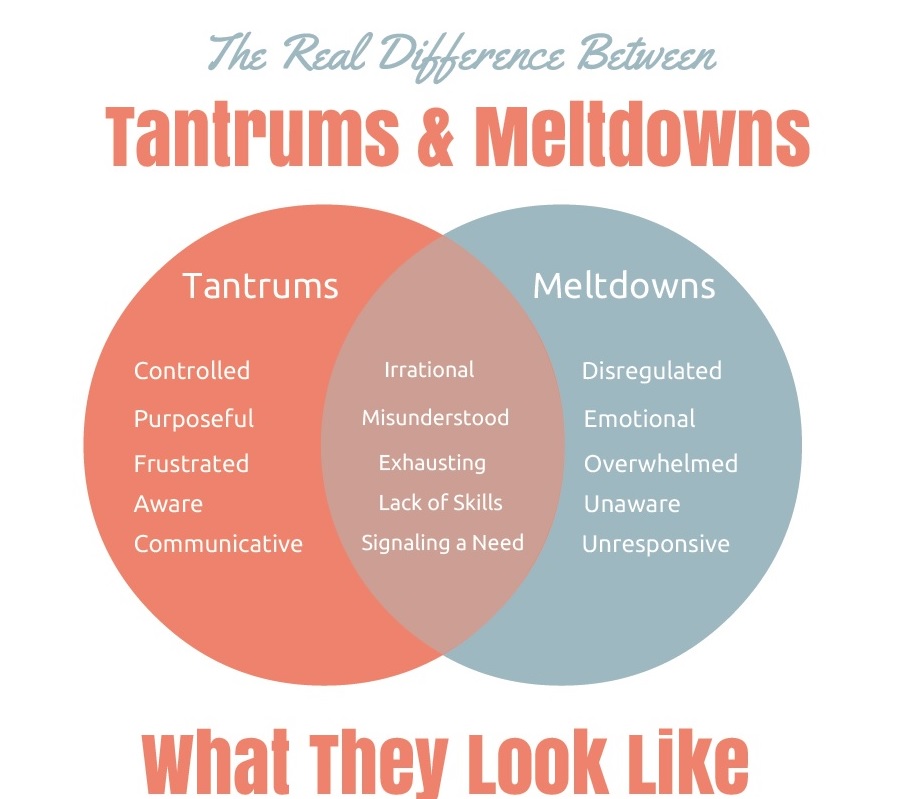
Dealing with Students using Behaviour Management Training

tantrums meltdowns

Source: The Real Difference Between Tantrums and Meltdowns http://lemonlimeadventures.com/the-real-difference-between-tantrums-and-meltdowns/ via @lemonlimeadv


Dealing with Students Using

Behaviour Management Training

The purpose of Behaviour Management Training for ETFO Members is to deal with the growing incidents of violence in schools and workplaces.

As I wrote about earlier in December 2017, there is research to support my own anecdotal observations of increased violence in classrooms. Based on information from ETFO (Action on Violence in Schools), ETFO members are increasing facing violent incidents in schools and workplaces. This violence increases physical and mental harm to both adults and children. With violence, teaching and learning is disrupted. Teachers and students can develop anxiety that violence will occur again.

ETFO’s Professional Relations Services published a PRS Matters Bulletin #98 addressing training offered to teachers and education workers by school boards. I have not been “officially” trained in these areas but I have used some of the strategies. The programs mentioned in the bulletin are copied directly from the bulletin and are listed below:

Crisis Prevention Intervention (CPI) – This program has a focus on prevention and strategies designed to “safely defuse anxious, hostile or violent behaviour at the earliest possible stage.” “Disengagement skills” are demonstrated and practiced to train educators to remove themselves and others from dangerous situations. Participants are trained to recognize when it is appropriate to physically intervene and implement holding skills to manage aggressive behaviour.

My experience with CPI: I have removed myself and my students from my classroom due to hostile or violent behaviour. To prepared, the students and I talked about our classroom evacuation plan (without the student with special education needs present) and the students came up with the “retreat” signal word. We practiced getting out of our classroom and either lining up or going to a neighbouring classroom to be safe. This worked well and kept all safe and no students were physically touched in the process.

Behaviour Management Systems (BMS) – This program stresses early prevention and intervention techniques. It aims to teach effective and safe physical intervention techniques. The BMS training framework is made up of four phases, one of which is the “Action Phase.” During the action phase, practitioners can “intervene physically” through a series of blocks or releases or by containing the student (i.e., by wrapping “your arms around the student”). There are four written cautions in the workbook specific to containments that mention “positional asphyxiation” and students incurring “a dislocated shoulder.”

My experience with BMS: I have not had much experience with BMS. I have blocked students from leaving a classroom or running down a hallway but I have never touched any students. Personally, with or without training, I will never be comfortable using physical contact to intervene with student behaviour, especially when injury can happen to the student or to me.

ETFO believes that behaviour management training should be voluntary and should be done within the instructional day. Members are not required to sign any waivers with respect to training or in using physical retraints.

As noted in PRS #98, using physical components of BMS and CPT could put members are risk of a possible investigation from the Children’s Aid Society (CAS), and/or Ontario College of Teachers (OCT) or the College of Early Childhood Educators (CECE).

For further information, please contact your local ETFO president or Professional Relations staff in Professional Relations Services at 416-962-3836 or 1-888-838-3836.

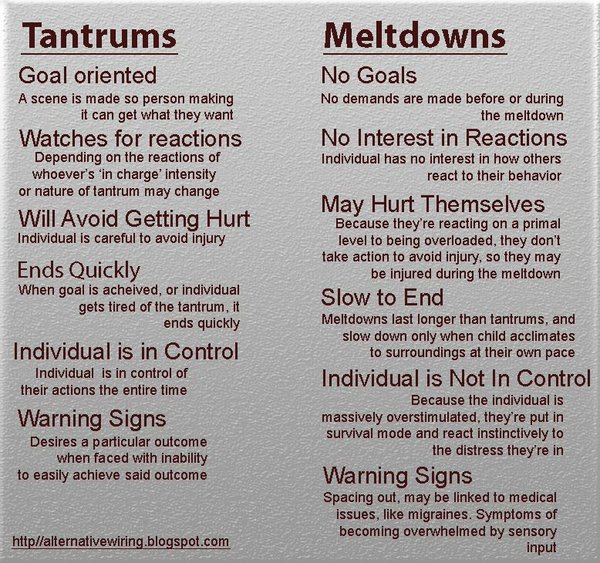
I did come across a chart to help distinguish between Tantrums and Meltdowns Posted on Twitter @ONTSpecialNeeds

trantrums and meltdowns

My best advice is to reach out to a supportive colleague for help as this is where I get the most help and support when dealing with challenging student behaviour!

And in the end, it’s up to you as an educator to use your professional judgement to keep your students and yourself safe.

Collaboratively Yours,

Deb Weston