
Just immerse Multilingual Language Learners in English, they’ll soak it up before you know it.
Don’t worry, children are wired for language acquisition; they’ll pick up English quickly.
Young children are like sponges! Just keep talking, they’ll absorb whatever you say.
I have heard these types of statements my entire career. They pop up not infrequently in ESL discussions and seem to imply (at least on some level) that when you have a beginner MLL in your class, it’s fine to carry on as usual. That a classroom teacher can continue instructing and speaking as they normally would. That mere exposure to words will result in the eventual learning of them. That English is largely being “soaked up” with no intentional scaffolding or supports necessary. While young children do have some inherent advantages in acquiring language, the “sponge” approach to language acquisition may require some unpacking… Consider the following excerpt from a grade 4 science lesson:
Look at this big rock everyone! This is obsidian. It is a deep, rich black and very smooth. And this smaller one, it’s called sandstone. It feels rough but I love its vibrant orange. Over here we have another smaller one, lapis lazuli. What a vivid blue! And glossy… Look at how the light reflects off it. Oh, and feel the rock’s texture…it’s smooth isn’t it? Not at all like this one, it’s name is pumice… so sharp and porous and rough! This pointy pink one over here is named quartz…
The above lesson intro seems fine so far. The teacher is using realia, holding up actual rocks and minerals as they speak. Perfect for engaging students and demonstrating concepts. There are also some rich and varied Tier 2 and Tier 3 vocabulary in there, always helpful for expanding student lexicons. Yes, by all accounts, this short script could effectively begin a grade 4 lesson on rocks.
But what about a beginner MLL sitting in the class? Would any of this rich language and meaning be accessible to them? Maybe. Maybe not…
Notice how the grammatical structure changes in every sentence – the teacher uses five different grammar constructs to achieve one purpose: introducing rock names (this is obsidian … it is called sandstone, here we have lapis, it’s name is pumice, this one over here is named quartz…). While fluent speakers of English may follow this chain of sentences easily, a beginner MLL may find this jumble of constructs confusing. They may be able to expertly name items in varied ways in their first language but may not yet have learned even one way in English and need support to do so. And notice how the teacher jumps about from colour to size to texture to lustre… So is “pointy” a colour? Is “blue” a texture? Is “smooth” a size? What may be a language-rich description for fluent speakers of English soon becomes a confusing maze for MLLs, with so many linguistic twists and turns it may be difficult to glean any new words from it.
Instead, at least for part of the lesson, the classroom teacher could use a patterned, repeated, and predictable construct to introduce rock names. In addition, if the learning task involves sorting by texture, an initial focus on those adjectives rather than an onslaught of all descriptors at once may help beginner MLLs understand more linguistic and academic content in the lesson:
This is obsidian. It is smooth. This is lapis lazuli. It is smooth. This is sandstone. It is rough. This is pumice. It is rough.
Couple the above with gestures, choral reads for emphasis, and sorting of physical rocks by trait on a graphic organizer, and you have a turbo-charged recipe for language acquisition and curriculum access. And the above speech need not be a robotic read either. I have seen teachers deliver patterned sentences like this with panache, slowing their rate of speech, pausing dramatically, and adding expression and flair that would engage even the most determined naysayer. Some are more subdued, adding the sentences with natural ease. Everyone finds their own style eventually.
So how do we determine which language to intentionally highlight in our lessons? Establishing the level of English proficiency of your student, in collaboration with your ESL teacher or system ESL staff, is a first step. From there, Jim Cummins and Margaret Early offer a helpful planner for teachers, that assists in isolating not only the academic content they deliver to the whole class, but also the related language and linguistics objective:
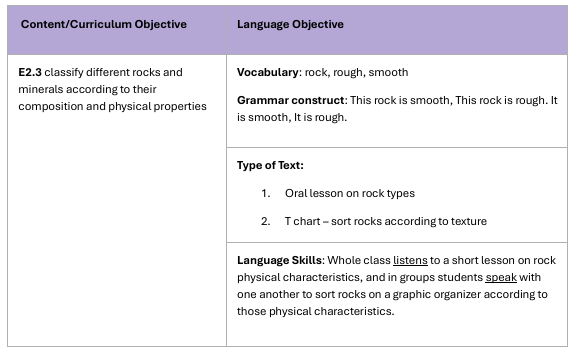
I love this planner because it encourages consideration of the types of tasks and texts that occur during lessons, and which vocabulary and language structures are likely to emerge from them, that the MLL will need to know. The planner helps us to clearly identify both the curriculum and language objectives in any given lesson and emphasizes that they are related. Learning language and curriculum hand-in-hand, as the saying goes… And if you want to explore this type of planning further, ETFO offers an excellent guide: Program Adaptations for MLLs.
So, should classroom teachers speak in patterned and repetitious ways throughout the entire lesson? No, of course not. I have seen brilliant educators seamlessly weave in highlighted and intentional patterns of speaking in their lessons, at just the right moments, ensuring there are entry points and growth in the lesson for everyone. It just takes a little practice to find your stride. And so with use of realia, gestures, and language scaffolding, MLLs do begin to “soak up” the language … but not because of mere proximity. Rather, they absorb it because the teacher makes it comprehensible.
There are many ways to intentionally highlight language in lessons, the above is just one example. But beyond improved curriculum access and linguistic development, perhaps the most important benefit of such lesson delivery is student well-being. Being able to understand and participate in the same lesson as your peers is essential to belonging, and knowing you have a place in the classroom community. So whether you are teaching students in the classroom, ESL tutorial groups, or a pineapple under the sea, good luck highlighting those beautiful words that welcome all your students into the lesson.
References
Cummins, J., & Early, M. (2015). Big ideas for expanding minds: Teaching English language learners across the curriculum. Pearson Canada.