Discipline used to mean something good

Discipline

The mere mention of it conjures up deeply personal memories. Other than infancy, there are very few times in our lives when we act without discipline. STOP signs, social media, and schedules are all prime examples when it is required. And then there’s discipline as it relates to school. For me, it started with stories shared by my mom about a one room school house where the headmaster sadistically silenced students into submission with a switch. Shudder. I clearly remember the rows on a dusty chalkboards replete with repetitive reminders of our recalcitrance. In the 70s, my grade 6 rotary teacher allowed students to pick the paddle with which he would use to discipline us. He had a collection in the corner. Speaking of corners, many were filled with kids “rewarded” with a change of scenery and a new hat for their misgivings. It was a different time and we were afraid.

Discipline varied from year to year and teacher to teacher. Perhaps it was to keep us off balance or that a constant was simply not possible. I’ve experienced 100% of them myself, and was tied to a chair in grade 1 for good measure. Thankfully, I haven’t seen 80% of these types of discipline since beginning my career as an educator in 2009.

In 2017, discipline has evolved to lost recesses, extra work, isolation from peers, loss of privileges, the walk of shame/glory to the office to see the principal, expulsion, and yes still, the writing of lines.* Have students become better behaved or have educators become better at classroom management? Ask yourself, “How does discipline happen in your school?”

In my classroom, a collective establishment of behavioural expectations has been crucial. With my students involved there is democracy, their voices are heard, and this then becomes the standard for everyone to uphold. At it’s heart, discipline must be founded in respect and responsibility where students contribute to and are expected to make good decisions at all times.

via https://www.flickr.com/photos/st3f4n/4193370268 CC BY-NC-SA 2.0

So how in 2017, where a JK to 12 education is mandatory and free for all, why then are things like the one below still happening?

| The state of Arkansas Corrections department carried out the unprecedented  execution of 4 prisoners in April. Really?|

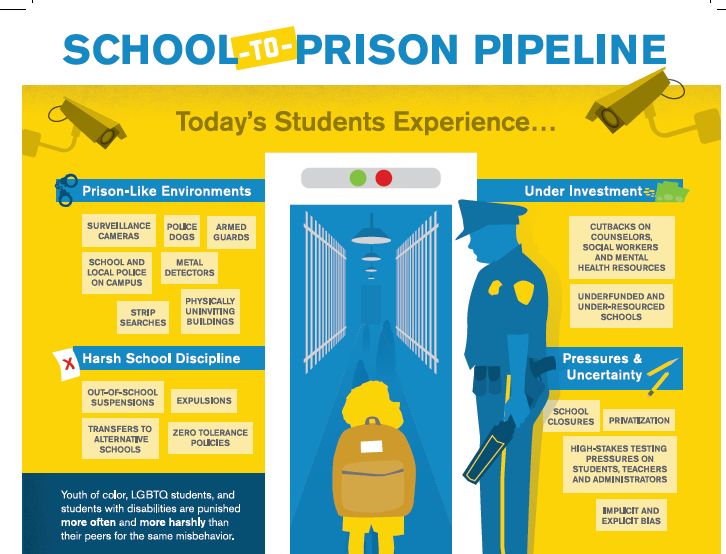
This got me thinking about discipline, law, crime, law enforcement, punishment, society, and then, without fail, back to education. I wondered how any society built on the rule of laws, which are guaranteed for the protection and benefit of all, fails itself so frequently? Does education contribute to the school to prison pipeline with outdated methods of discipline?

Would it not be easier to rearrange the order of this equation in order to place education and society first? Could schools be funded as highly as prisons in order to end this destructive cycle?  Did you know that education receives approximately one tenth of the funding per student as the prison system does per inmate? This gap cannot continue if we expect to grow happy, healthy, and whole learners.

Can we return to discipline’s original Latin disciplinawhere it means method, instruction, and knowledge instead of scourging and flagellation? If we put knowledge and instruction over control we could restore discipline to its positively intentioned origins? I am positive the investment in education will lead to greater opportunities for everyone while reducing crime and prison populations.

I wanted to stretch, if not challenge, thinking with this reflection on discipline. Specifically, how this word, through its meaning and deeds, effects everything we do in education. Assuredly, any discussions of discipline require rules, boundaries, and consequences. But after all, isn’t that what it’s here for? Perhaps, in the spirit of the word, it can be so much more if we choose to use it positively instead to preserve power.

Thank you for reading. Feel free to share your memories in the comments section below.

Please read on if you’d like a little more.

* A switch history

Remember the axiom. ” Spare the rod and spoil the child.” Banning the Strap delves into the history of discipline and banishment of corporal punishment in Canada.  Looking on our neighbours to the south, New Jersey was the first state in the USA to abolish corporal punishment in 1867 with Massachusetts coming a close second doing the same in 1972.

Thought this was interesting from our friendly neighbourhood land of the free.
via https://www.pinterest.com/edweekpress/

Attainable goals

In my first couple of years of teaching, I was so overwhelmed. I felt like I was doing everything wrong and not helping my students at all. I was so focused on lessons that didn’t go exactly how I wanted, that I totally missed out on all the positive things that were happening in my class. I was incredibly hard on myself and my expectations were way too high.

I looked at the first ALP that I wrote as part of my NTIP recently and I can see those overachieving expectations in the goals I set:

1)      Deliver a language program that meets the needs of all learners, engages students and uses assessment and evaluation to drive instruction.

2)      Deliver a math program that follows a three part lesson plan, allows multiple entry points and encourages rich math conversations.

Looking at these goals now, I realize that there were too many things that I was trying to accomplish at once. What I have learned is that when you try to do everything perfectly, you end up being a grumpy, unproductive teacher. I have learned that focusing on one thing at a time produces much better results. Also, becoming skilled at developing a three part lesson or creating an environment that encourages rich math conversations takes time! Reading professional books, attending workshops and the implementation of new knowledge take thought and reflective practice. This cannot be accomplished in one day, week or even a year.

What I have since learned is that everything is not going to be perfect – not by a long shot – and that you really need to set reasonable goals for yourself that are attainable. When I finally came to this realization, I decided to focus on improving one thing per year. Of course, working towards competency in language and math instruction were my first two goals. I also decided to focus on developing good management and climate techniques. After I had a handle on these items, the focus became other things like better parent communication, stronger programming for my English Language Learners and developing creative thinkers.

Two years later, my goals looked like this:

1.     Continue to learn good classroom management strategies

2.     Continue to learn from collaboration with colleagues, including lesson and unit planning.

3.     Continue to learn best practices in assessment and evaluation.

Seven years into my teaching career, my annual learning plan is reflecting a shift into some leadership goals:

1.      Mentor a student teacher through their practicum

2.      Mentor new teachers in their first years of teaching through a blog called the “Heart and Art of Teaching and Learning”

3.      Continue to learn best practices in music instruction by attending workshops and conferences.


Take the time to celebrate the success that you have had and make achievable goals!


Helping English Language Learners in Music

Music Class can be tricky to navigate for our ELLs (English Language Learners). Although music is really fun and engaging, learning lyrics to songs and terms for describing music can be challenging to remember.

Lyrics to songs can be difficult for ELLs as there are often slang words, incomplete sentences or words that are used in unusual ways. Lyrics manipulate grammar rules and each genre can have its own style of communication, depending on its origin. In addition to lyrics, vocabulary for music has the same challenges as many content subjects, which is that the vocabulary is often not used in daily life. You don’t hear people talking about how forte, vivace or legato a song was. As the vocabulary is only used for such a small portion of their school week, it is very hard to internalize. 

My student population has around 70-80 percent of students on the STEPS of Language Acquisition. In trying to help my ELLs be successful in music class, I have used the following:

1)      Song selection: My team is very selective when choosing songs to sing in class, and we are always looking to make sure songs are not too long, often repetitive and that new vocabulary is not too overwhelming for students to learn.

2)      Patience: We take time to let students internalize one section of the song before we move onto the next. If we are learning a song that is a little longer, we only focus on one verse for part of a class and visit the next verse in subsequent classes.

3)      Visuals: There are diagrams and visuals to support students in discussing music. (You can find mini posters about the elements of music on the website Teachers Pay Teachers).  Also, illustrating a song can help solidify meaning.

4)      Actions: We often add actions to many songs to help us understand the meaning of what we are singing.

5)      Cooperative Learning: We do some whole group and teacher led instruction to learn some new vocabulary and lyrics. However, more often, students work together as pairs or groups towards internalizing the lyrics and their responses to music.

6)      Use music that represents the culture and language of your students: Using songs from a student’s culture allows them to feel valued and they become the expert in the room.  Finding authentic arrangements and scores can be difficult. Making a connection to a member of the community that can help you is a very important asset.

7)      Make it fun: Ultimately, music should be a fun way to engage with language. So encourage the students to enjoy themselves!

Even though music can be challenging, it can also be very supportive when learning a new language. About 15 years ago, I decided to move to Japan to be a teacher. I ended up loving it so much that I stayed there for three years. In my own personal journey of learning a new language and writing system, music played an important role. I listened to a lot of Japanese music and bopped and bounced along to the music in my home, car and at school. New vocabulary stuck in my brain from the songs that I heard, and I enjoyed learning how new vocabulary was written in Kanji (the Japanese writing system) from the inside of CD covers. Listening to music was great as it was the one Japanese activity in my day that didn’t require a response from me. Music can play a very important role in the acquisition of language.  

Imparting a Love for the Creepy Crawlies

I remember when I was about 7 years old, I worked really hard to capture a huge toad in our backyard. I found a clean pickle jar in the garage then carefully scooped him up and carried him inside to the kitchen to show my mother. It was a classic, “Can I keep him?” moment, but my mom convinced me to let him go because his family would miss him. That made sense to me, and so, back he went.

I learned years later that my mother, who had kept a calm, kind voice throughout our brief discussion, was not at all a fan of reptiles and that she had had a case of the heebie jeebies after I left the kitchen. I had no idea because she never showed it and I imagine that that is one reason why I never had a problem with creepy crawly creatures.

Fast forward to today, and I am mindful of the way I treat and discuss bugs – not just the pretty ones like butterflies and ladybugs, but also the hairy, slimy and alien looking ones –  with my kindergarten students. Many of the students live in apartment buildings and do not often get a chance to dig in the dirt, climb trees or splash in puddles. A few families may have home gardens and compost bins, but the majority don’t have the luxury. So when it comes to getting down with the small creatures that crawl or slither, we are thrilled to see that a few students who used to shriek and recoil at the sight of a spider or worm are now hanging around when someone finds a bug, curious to see what the creature is and what it does. For example, today, a jk student found a curled up centipede. She showed it to everyone and carried it around for most of our Outdoor Learning in the morning. She was so excited when the centipede got used to her hand, then uncoiled itself and started crawling in her palm. She asked for a bucket and carried it around for much of the day, understanding that she would have to put it back where she found it so that he could survive.

April offers many opportunities to teach respect and care for bugs. We have begun to notice tiny ants on the floor in the classroom at this time of year. At first, many were repulsed by the ants crawling around near the doorway to the outside, but the other day, while waiting in line to go out, we noticed that a group at the end of the line had all picked up tiny ants to let them crawl on their hands and arms. Playtime will occasionally come to a halt if someone notices a small bug crawling on the floor. Immediately, space around the bug is cleared of people and toys until a solution is found to save it from being accidentally stepped on. Often, I will grab something handy to scoop up the bug and put it outside (our windows do not have screens). Since the students have seen us do that with spiders, beetles and ants in the classroom, they are now doing it themselves. It was wonderful to see a little girl carefully use the book she was reading to rescue a spider and help him escape outside.

While it is not necessary to have a love of creeping creatures in order to impart a respect for them, it definitely helps. Students will want to show you what they’ve caught, and it is hard to share in their excitement if the thing they crawling in their hand turns your spine to jello. Not all bugs are adorable or beautiful, and some can be genuinely hard to love – especially if there is a serious “Eeeewwww” factor or they sting or bite, but teaching respect for all insects is considered essential for encouraging young children to become guardians of nature. Moreover, it is a small step, albeit an extremely important one, towards having compassion for all living things. The following articles support this perspective and have some at-a-glance information about some common bugs you may find in your school yard;

Teach Your Kids to Love (and respect) Bugs!

Teach them to love the insects

In the yard last week, a student found an enormous dew worm after a big rain – the worm was as long as a garter snake and almost as thick – not as cute as the wee red wrigglers we have in our vermicompost because the student needed both hands to hold all of it – but fascinating, nonetheless. The worm/snake was gently carried and cared for, and although there was a request that we put him in our classroom worm compost bin, the big guy was finally, but reluctantly, left outside, “Because his family would miss him.”

Daily Physical Activity: When, How and Why?

I’ve been thinking a lot about DPA lately. We are required to provide our students with 20 minutes of physical activity on days when they don’t have physical education. Many times, this time is used as an extra 20 minutes outside before recess or time playing movement games on the smart board inside. It’s become a part of our daily routine as teachers and something that our students know and expect – trust me, they never let me forget!

At a recent staff meeting focusing on positive school culture and wellbeing, my principal posed us with some questions. When do we do DPA? How do we do it? And most importantly, why?

Often times, our instructional schedule dictates when DPA happens in our classroom, but I’ve been thinking – is that really best for our students? Having that 20 minutes of activity at a guaranteed time every day is great for our routines and planning our day, but is that best for the needs of our kids? Is DPA the most effective and meaningful when it happens when we can see that our students need it? I think it comes down to the teacher and most importantly, the group of students. Some students probably benefit more from knowing when DPA will happen in their day. Some students, such as my active bunch of grade twos and threes, need it at very different times in our day. The activity and attention level of my classroom fluctuates greatly throughout the day based on the kind of learning they are engaged in. DPA benefits my students the most when I can notice their changing behaviour and ability to self-regulate, and respond with a break for physical activity.

Another thing I’ve been thinking a lot about is the “how” of DPA. How are kids spending these 20 minutes of time? What is the best way for them to spend it, and is there even a best way? Aside from a good old soccer or basketball game, there are a ton of resources that provide ideas for active large group games or video programs such as Go Noodle, Kids Zumba or Cosmic Yoga to follow along to on the smart board. The options are endless.

I tend to do something a little bit different. Inside of my grade two and three students who are intelligent, critical thinkers and wonderful young adults, I see kids – young kids who are meant to be playing. The play I refer to isn’t guided or adult-directed, either. My students are in their happiest, most natural state when they are given the freedom to be outside and to direct their own play. So when my class has DPA time we head outside and I tell them that as long as their bodies are actively moving, they can play whatever they want to and I love to watch what happens. In a previous post I talked about how students, even in older grades, still engage in dramatic play and how valuable this experience is for them. When we are outside, just my class on the playground, my students have the freedom to create meaningful play in a calm and relaxed outdoor environment. Most of the time, they are all engaged in a few different things – dramatic play (right now, they are right into role-playing Harry Potter characters which has me in stitches every time), super hero play or they are engaged in a game they created on their own (think of the skills involved in this – problem solving, leadership and logical planning). We are very lucky at our school to have a small forested area on our grounds and we will often take our DPA time there, where the students build their play into the forest setting, often using branches and natural features to build forts. To me, this is the most valuable DPA time because my students are getting their much needed physical activity but they are also getting time to de-stress, be autonomous, and just be kids. When we come back inside from this, they are ready to learn.

This brings me to the “why“. It’s obvious why our students need DPA. Our students’ attention spans are a limited resource, like a gas tank. After a certain period of time their gas tanks run out and they no longer have the ability to attend to learning. Engaging them in physical activity increases their heart rate and gets oxygen flowing to all areas of their body, but most importantly their brain. This increased oxygen to the brain not only acts as a preventative measure to anxiety and depression, but it “refills” their attention span gas tanks and is scientifically proven to increase their academic performance.

DPA isn’t only about promoting physical fitness. It promotes mental health by reducing anxiety and puts our students into a calm, mindful state that sets them up for success when its time to learn. This happens especially when we, as teachers, are purposeful with how, when and why we initiate it.


Mathematical Mindsets

At my school, a grade three teacher started a book club where we all chose a math book and we read it and meet every three weeks. The book that at least ten of the teachers chose is called “Mathematical mindsets” by Jo Boaler. This is a must read for all math teachers worldwide. By following her principles and reading her strategies, math can become an exciting subject for all students. I have read the book and I have fallen in love with all of her teachings. The number one thing I have spent my time on is dividing my students into math groups. My students spend half of math class in their math groups and the second half working individually on what they just learnt. The four math groups work the following way:

Organizer- this student keeps the group together and focused, making sure no one talks to people outside the group

Resourcer- this person is the only one that can leave the group to collect things that the group needs

Understander- this person makes sure all ideas are explained and that everyone is happy with them. If you don’t understand, you can ask whoever had the idea.

Includer- makes sure everyone’s ideas are listened to; invite others to make suggestions

The goal is to ask your class low floor/high ceiling questions so that everyone has the chance to reach the fullest levels of mathematical understanding.

I suggest all math teachers pick up this book immediately! I cannot wait to sure more from the book in future posts.

Emotions, Context and the Reluctant Writer

One of the biggest challenges I face is getting my students to enjoy and take risks with writing. Too often they get bogged down with the fear of not knowing what to write or nervous about experimenting with vocabulary they do not know how to spell. There are two critical approaches I take in helping my very reluctant writers to engage in the writing process. The first is to help them understand the stages of writing (Idea, Plan, Draft, Edit/Revise, Publish and Share). Each stage is explored and its purpose discussed and demonstrated in multiple ways. Once a student understands that the edit/revise stage occurs after you are able to get your ideas, thoughts and/or feelings into print form they become more likely to take risks in getting their ideas out. When they give themselves permission to let their ideas free flow without word-by-word critiquing, the quantity and quality of their work improves. A completed draft version allows them to separate I have good ideas and can write from I need help in making sure my writing is correct and ready to share with others. I also experience a huge drop off in the question “How do you spell _____________”.  That focus typically grinds the creative process to a complete halt.

The second element that greatly assists me in helping my reluctant writers is to as often as possible design a writing focus around an event relevant to their life. This may be something going on in their school community like writing a persuasive writing piece on allowing students to wear hats in school. It may be a news event from their community or a global situation that will help connect my students to a bigger audience.

Several years ago when the Chilean mining catastrophe occurred we had taken time to have it as a part of our morning circle conversation. That lead to a brainstorming session on what might we do to help out. The final decision was that we could write letters of support to them.  I found the address to the Chilean Embassy in Ottawa and we mailed our letters to them. The power of the contextual relevance automatically tapped into their emotions. When emotions are involved in the learning process the lesson, the message, the focus becomes more consolidated in their cognitive realm. A magical bonus on this project was that my class received a letter from the Chilean Embassy acknowledging our letters and honouring the efforts of my students. Our next writing unit was accepted with little or no resistance.

For Earth Day – A Chance for Environmental Custodians to Show What They Know

Knowing that I have a worm composter in my kindergarten classroom, two girls (grades 1 and 2) came up to me last week as they walked in from recess holding a bucket of earthworms. A bucket. Full of worms.

They asked me if they could join these worms with the ones in my classroom, and I had to tell them, “No”, that just as there are different kinds of fish or dogs in the world, so are there many different kinds of worms, and these two kinds were very different, not to mention the fact that the worms in the bucket had been born in the wild and that is where they should remain. The students were a little disappointed by my answer, especially after all their hard work delicately harvesting about 2 cups of worms, so I suggested that they could introduce them into the gardens in our courtyard (outdoor) classroom. The girls headed into the courtyard, found a spot near a tree and gently dumped the contents of the bucket on the ground. They were very proud of themselves and told me they knew about how worms help us so they felt that they had really helped the worms, too.

While I was on lunch duty in their classroom a while later, the girls were still eager to talk to me about the worms – evidently, the vermicomposter makes me some sort of expert in the way of the worm. Anyway, they told me that they were just getting started. The girls had BIG PLANS. They wanted to start their own Worm Care Service, since they know exactly what worms need. “Great!” I said, as I realized what a great inquiry-based learning opportunity this was, “Maybe you should make some posters and business cards telling people what it is you do.” This got them even more excited and they wanted to get down to work as soon as they finished eating. Even though selling a worm care business may not be a realistic venture, there is the fact that the girls could at least have an opportunity to share their knowledge about worms. And that is how the idea of a Children’s Fair to showcase students’ environmental interests and projects has come to be added to this year’s Earth Day Celebration. Being the first time at my new school, it will start out with just one or two tables, if we’re lucky, showcasing students and their nature-conscious projects and hobbies. The Fair is open to grades 1 to 6, and all the students will get a chance to visit and ask questions and learn from each other.

Having done something like this last year at my previous school on Earth Day, I had forgotten how rich an experience it was for the students involved. I realized afterwards that it had been so successful because it was an opportunity for students to do something at school which had no rubric or assessment attached to it, and for which they were highly motivated. Last year, all I did was call a meeting together asking students how they would like to participate in the Earth Day Celebration. That’s when things just started to morph into them wanting a way to share their knowledge or expertise about the environment. At the meetings, there were lots of ideas and “Can I…?” questions. In the end, not everyone was ready to set up a table with items and information, but at least it got them to consider the possibility that something they know or do could be of some interest and value to their peers and the adults in their life. This year, I don’t know what expertise we will showcase, but If someone has a feather or rock collection they are proud of, if they know how to fold newspaper into compost bin liners, or if they know how to make bird calls or care for worms, then the Children’s Fair is the place to show what you know.

The stretch

It’s April. Phew! We made it through Winter. OliverWendellHolmes

It’s official because geese are honking on the playground. There’s more daylight, the snow is not staying on the ground, and my classroom is buzzing from the promise of Spring. Students’ activity levels are coming to life as the weather warms; even though, they’re prohibited from using the grass(mud/chance for grass to grow)or running on the tarmac(overcrowding).

Energy levels range from abundant to absent, as any teacher would attest. Our class is making excuses to learn outside. I love it when they ask and am happy to shift instruction and inquiry to outdoor mode. A sort of”Education on la Grande Jatte” with apologies to Seurat.  There’s movement happening in the halls, and it’s not only the students this time. It’s educators too.

An annual migration of staff is in full flight. One that can only be equated to something akin to the trade deadlines in professional sports. Teachers and administrators are being moved, receiving their teaching assignments for the new year, or are actively seeking new opportunities. Whether it’s a move to a brand new grade, a new school, a new role in admin, or retirement; thousands of educators will find themselves in new spaces come September. Or is it a rut? So, like death, taxes and dishes left in the staff room sink – change is inevitable.

In March, teachers were told of their teaching assignments for the year ahead. Like the birds returning from the south, administrators were tasked with considering staff requests, future growth/decline, fit, and a host of intangible staff dynamics. Some teachers have discovered that the nest has been blown out of the tree. Some are learning, with a measure of surprise and uncertainty, how a change has happened which was contrary to their absolutism of choice(s). Yes, there are people who would go out of their way to avoid change. They have their reasons and are respected for them. However, there are still others  who will be welcoming new opportunities with excitement.

It’s always a good time for a change when the dust in your classroom is older than the students.

By Stromcarlson (Originally uploaded to en as PD by Stromcarlson) [Public domain], via Wikimedia Commons
Let’s consider a sample scenario that could playing out right now with a veteran teacher in the same grade for 5 or more years. Add to this fact, s/he has been in the same physical space for that long. Now, think of the upheaval and umbrage that might underscore the news they’re being shifted to a new grade, a new room, and maybe even a new teaching team?

Some might think that this educator was being shifted as a form of punishment. While in fact the move is the breath of fresh air. Yes, there is uncertainty and people hate that, but there is also freedom. Think of it like changing the air filter of your furnace. You would never keep the same one in place for a year let alone 5 or 6?

So this Spring, choices can be met with acquiescence or anticipation. Whichever view you choose will shape your thoughts and practice for the coming year. Will you stretch beyond your walls or will you barricade yourself behind your dusty desk?

Now before any harsh replies, keep in mind that the goal of our job has never been to become the comfortable automatons of education, but to stretch as lead learners in our schools. It is the very idea and excitement of change that should set us a light in our teaching practice.

Last year I wrote a piece entitled Time for a Change where I share advice and encouragement about stepping out of our comfort zones as educators if you want to read more.

and something else

There is another side to this thought that reflects the turnover of educators in struggling/poorer schools in England. This two page graphic made me wonder whether this might correlate to our inner-city or First Nations Metis and Inuit communities are facing the same issues of teacher turnover, and therefore are creating an educational vacuum in our own country? http://www.bristol.ac.uk/media-library/sites/cmpo/migrated/documents/howlongteachersstaying.pdf I’d love to know your thoughts about this.

Drama in the Classroom: The Good Kind

When thinking of drama as a subject in our curriculum, it is easy to think of it only as a skill that can be learned and mastered. There are a lot of fundamental concepts that we teach – role play, character, relationship, time and place, tension, focus and emphasis. Our students love creating scripts, making tableaus, improvising, performing and playing all of those fun drama games. Not to mention the social and personal skills that children learn when engaging in the creative process! Some students excel in dramatic arts and love to perform, but that isn’t what its all about.

Aside from being its own subject, I (mostly) see drama as a meaningful instructional technique. When we no longer think of drama as a stand-alone subject and consider it a teaching tool, we open our programs up to wonderful things. By incorporating dramatic arts into all subject areas, we are handing students a powerful processing and communication tool. We are also increasing their engagement, motivation and adding physical activity to our teaching. Dramatic role play combines so many important functions at once – physical movement, facial expression, verbal and nonverbal communication and self awareness. The best part about using drama as an instructional technique is that it is dynamic – it can be applied to nearly any concept. The most natural fit for drama tends to be in language arts, as it so closely relates to storytelling. I’ve found, though, that some of the best drama experiences come when I incorporate it into my mathematics, science or social studies instruction.

Last week, my grade twos transformed themselves into atoms and moved themselves around the classroom, filling the space as a liquid, a gas and then a solid. I could see, right in front of me, their understanding of the concept when they changed their body movements and direction of movement to reflect the different properties of the states of matter. In math, we used drama to process concepts in our money unit. My students created a store, took turns being cashiers and customers, and used money manipulatives to make transactions. The process was entirely student directed, and allowed me to both observe and engage in their role play. By role playing and taking on the characters of customers and cashiers, they were applying their math learning to simulated real world situations. The opportunities and ideas are endless.

Every child can engage in drama. Dramatic play is a natural part of childhood and there is little difference between children playing superheroes on the playground and children engaged in drama activities in the classroom. Any Kindergarten teacher or Early Childhood Educator could list dozens of skills and schemas being process by a child engaged in dramatic play. Dramatic play is how children process the world around them. It’s also easy to think that dramatic play is something only early primary students engage in – but if you listen closely on the playground, you’re likely to find that even our older students are creating and leading their own dramatic play. Last month, during some free time outside, I was delighted to observe my grade three students pretending to be Early Settlers in Upper Canada. Our play structure suddenly became a log cabin and students took different roles as blacksmiths, carpenters, fishermen, hunters, farmers and school teachers. This was their natural way of internalizing and processing the concepts they were exploring in social studies. As teachers, we need to remind ourselves that drama is not only a skill to be mastered, but a natural method of communicating, processing and relating.

Unfortunately, drama is often a rotary subject and is not taught by homeroom teachers. I challenge you not to let that stop you from using drama as an instructional tool in your teaching! You’ll be amazed at what your kids will do.