
Curriculum Night

Every year when curriculum night rolls around, I feel challenged. Well, let me clarify. I feel challenged in my hope to ensure that the evening is meaningful for students and their families. I understand that parents are interested in finding out how their child is progressing but with 4 weeks under our belts – and sometimes less than that – I know what I’ve seen so far is often just a tiny glimpse into a child’s potential. We’re still getting to know each other, learning routines and quite frankly, expectations that we may have of each other. So whenever the conversation starts about what we are doing for curriculum night, I ask myself three questions: 

  1. What works for our school community?
  2. How do I encourage students to move freely within our classroom space with a sense of confidence, showing their families what they have been learning?
  3. How can I help parents see this evening as an invitation to open communication and collaboration for this year’s learning journey?

In this post, I’ll share my thoughts on each of these questions.

What works for our school community?

Students, families and the community should be at the forefront of what we do in education. As such, considering all members of our community in planning curriculum night is essential. Being new to my school and school community, it was really important for me to understand what usually happens in order to determine what I might consider doing. I’ve been in schools where the expectations have been formal presentations during particular timeslots and in others where less formal meet-and-greets where handouts are provided. I have found that every school is different. Not only that, but the pandemic has also opened our eyes to what might be done virtually to support a variety of families. This year we went with a less formal, in-person, meet-and-greet where parents popped in and out of classrooms and were free to move around the school at their leisure. During the hour, I found that there were times when there were lulls and then periods when the room was packed and buzzing with excitement. Families felt free to come for parts of the evening when it was ideal for them and had the freedom to not stay for the entire time and I found that worked best for our school community. 

How do I encourage students to move freely within our classroom space with a sense of confidence, showing their families what they have been learning?

This year, I teach prep and although I have a fairly large room, it’s often hard to have student work from all classes on display. As of late, we have been working on design thinking projects that are all in various stages. The kindergarten students and the grade 1/2s all have their animal habitats built and those were on display but the 2/3s and 4/5s have most of their plans and work in piles together as many are just beginning to design prototypes. That said, I tried to consider how students could show parents that they have been learning skills to help them solve real-life problems in a way that was fun and engaging. Our Lego challenges at the beginning of the school year were a great success so I gave out another challenge to students and their families and the builds were on. Families created together and students walked them through their solutions with joy and confidence. It was really great seeing families working together to solve a problem and the rich conversations that came of it. I think it was an opportunity to lighten the pressure of coming in and meeting the teacher and gave students the chance to feel right at home with something familiar that they could share with their families. It was so nice to see some students return later in the evening to sit and build with their families.

How can I help parents see this evening as an invitation to open communication and collaboration for this year’s learning journey?

Being new, this was the first time meeting many families. Because of our Lego challenge, I did enjoy that there wasn’t the pressure of a formal presentation.  I chose to create a slideshow that was on a loop and noticed that many families – while building – were taking a look and jotting down information on how we could connect. I have a classroom blog that I use to update families on what we get up to in our classroom and many noted that it was a great way to start conversations about what students are learning and doing on a weekly basis. I also let parents know that my door is always open and that I look forward to working with them in supporting their children this year. For the few who were asking for specifics, I asked if we could set up a time to speak and also mentioned that progress reports and interviews are coming up soon and that would give me more of an opportunity to get to know their child and for us to have the chance to have a more meaningful conversation.

How does curriculum night work in your school? What considerations are made when planning the evening? Please feel free to share as the more we know and are able to consider, the better we become in our practice. Based on our curriculum night this year, I’m excited to work with students and their families for a successful year of learning.  Hope you are too!
smashing pumpkin spiced thinking – school edition

I can almost hear it now, the sound of the last pumpkin spiced anything be sold and the leftovers being shipped back to the warehouses for next year. I am positive that the chemicals that make up these products have a half life and will ensure it’s best before date does not expire for another decade or more.

Who buys this stuff? To my knowledge, I do not think anyone in my circle of friends has ever been excited about pumpin spiced goodies and drinks. Cue the relief. Not that there is anything wrong with it. We all go through a curious phase or two in our lives, but once the trance wears off it’s usually back to the status quo.

Have you ever been persuaded to try something that you instantly regretted afterwards? At first, you think you like it because how could all that hype be wrong? Once that fades and the taste kicks in you’re left to be alone with your decision(s). I mean where would we all be without the gift of knowledge regret provides us?

I’ll give you an example: Hammer pants  One of many the blessings of being a certain age is that any evidence of my bad decision making has not been digitally preserved. Case in point with this late 80s fashion craze. I am sure that it seemed like a good idea at the time.

Speaking of good ideas at the time

Starting out as an educator, all of those years ago, I came with my own set of bags packed full of the way that I was going to lead my class. Inside that luggage were many positive, and unfortunately, negative experiences and I was determined to repeat what worked and bury what didn’t. What could possibly go wrong?

What I quickly realized in those first years was there were already several well traveled paths to follow along that started to be seen as ruts rather than pathways to success. I found myself trying to shape my students around the resources in the building rather than the other way around. Things went well, teach, practice, test, and repeat, but it came with a cost. Those lessons never felt like they were relevant to my students. They lacked depth and scope for a number of reasons, some of which are on me as a new teacher, and others because they fell within the “We’ve always done it this way” space.

When my second year rolled around it was easy to follow along the well worn path once more, but instead of proceeding safely along with so many others, I made a decision to wander off to see what else was out there. Don’t get me wrong, I could still see the trail to provide some cardinal directions, but my detours began to provide us all much richer and diverse perspectives. It only took a year to realize that there were many paths to create and pursue that could edify both students and their teachers.

I began to seek out others who wandered off in their spaces and ended up connecting with an insightful and supportive global professional learning network or PLN. All these years later, I am thankful for the connections and kindness that helped me navigate off of what was the norm and around some other ruts that needed avoiding.

Where do I find these amazing folx?

For me, it started out at school board level events and edtech training sessions. It didn’t take long before I joined Twitter when it became a truly global cohort. Yes, Twitter can still be used for good and not evil despite its new owner and legions of misinformed malicious account holders exercising their free speech without facts or accountability. End rant.

I joined weekly discussions via #edchat and then #etmooc and then #CnEdChat to start and started following some of the more experienced and supportive educators on the platform. As time went on, I started a blog called What and Why are Everything to hash out some of my thoughts. Our weekly Q and A discussions on Twitter became sources of great perspective and growth which continue to inhabit my practice to this day. It was almost like I was given permission to be the teacher I wanted to be rather than another educator flattening the well worn path.

What started happening was the democratization of my classroom through student directed learning, Genius Hours, and the use of videos to enhance the scope of my instruction. What better way could there be to bring an expert into the class room with the click of a button rather than read through a text book that had been written years beforehand.

This shift in thinking helped me realize the static and fluid natures of knowledge that we have to balance each day for our students and ourselves. It also moved me past some of my negative experiences as a student. I appreciate how some of the things I went through empowered me not to repeat them just like I would never buy a pair of Hammer pants or pumpkin spiced anything again.

Remembrance and Reconciliation

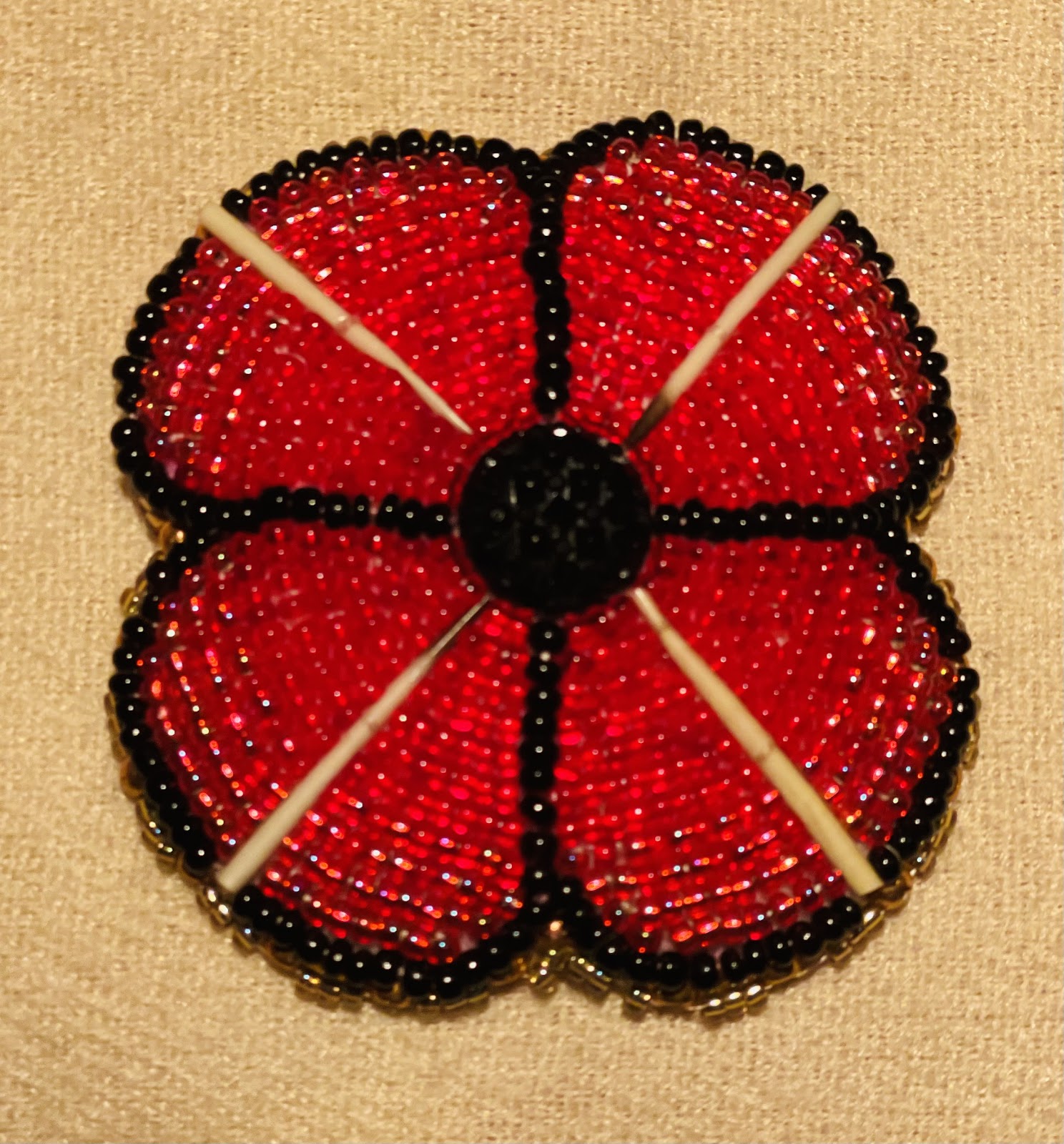
As we approach Indigenous Veterans’ Day, November 8th and Remembrance Day, November 11th I will proudly wear my handmade poppy by Anishinaabe beader and artist, Erin Gustafson of Couchiching First Nation.


The poppy serves as a reminder to take time to reflect on the courage of those who fought and many who died to protect our rights. In doing so, I vividly recall the story of one particular soldier.
The day a typically soft spoken, mild mannered, young girl presented her Heritage Fair project and stood in front of her classmates and proudly and confidently shared a story about a man she admired was a day I wouldn’t forget. It was about ten years ago when I, along with her classmates, first learned about Francis Pegahmagabow, my student’s grandfather (in hindsight, perhaps it was her great or great-great grandfather). Nonetheless, the sense of pride she felt while speaking of her hero was evident.

While some stories of Sergeant-Major Francis Pegahmagabow or the lives of others like him can be easily found with a quick internet search, the resonating effects of hearing these stories from direct ancestors are astonishing.
Still today, I remember the smile that crossed that young girl’s face and the pride that oozed out of her as she spoke about her family. What stood out to me then, and still today is the fact that Pegahmagabow fought to protect Canada at a time when Indigenous People were denied the rights held by most other Canadians. Can you imagine being denied the rights your partner, child, sibling, family member, or friend risked their life to protect? That is the case for many Indigenous People of that time. And when Pegahmagabow returned from war, he continued to fight for the rights of his people. He fought for civil rights for Indigenous People within Canada.

In 2016, many years after his death, a bronze statue was unveiled in Parry Sound, Ontario honouring the Anishinaabe World War I sniper, Francis Pegahmagabow. Another pride filled moment for my former student to share stories about her ancestor. These stories and others like them must be highlighted within our classrooms, painting a more accurate picture of the contributions Indigenous People play in our country’s history.

As we move through the time of remembrance and reconciliation, please seek out opportunities to honour Indigenous Peoples by sharing stories like those of Francis Pegahmagabow. Go Show the World is a fabulous book written first as a rap song by Wab Kinew. In it he describes some of his Indigenous idols, allowing others, especially young people to see themselves represented in their heroes. I urge you to share your story and provide opportunities for students to do the same. It’s incredible what we can learn from one another.