
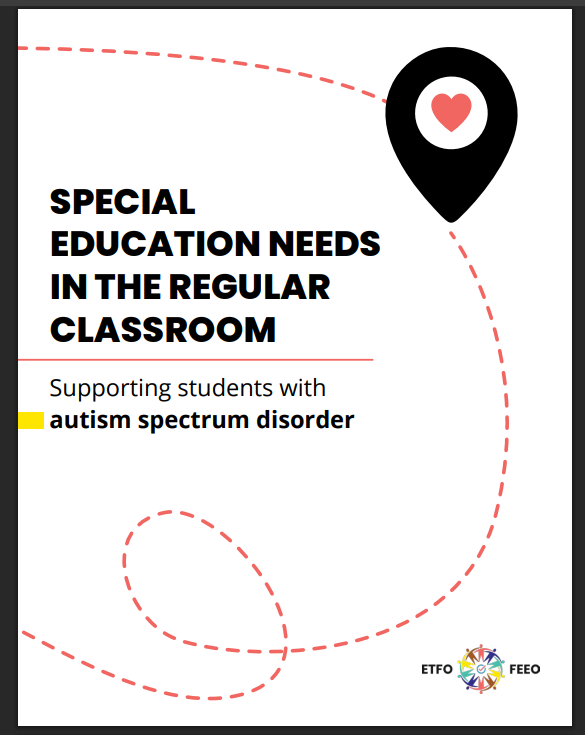
Special Education Needs In The Regular Classroom – Supporting Students with Autism Spectrum Disorder
Hello Fellow Travellers,
This conversation builds on previous ones that colleagues have had through ETFO and ones that I have also engaged in with you. I am going to share what stands out for me in the resource highlighted below
:
Beginning with the front matter, the following aspects are important signposts.
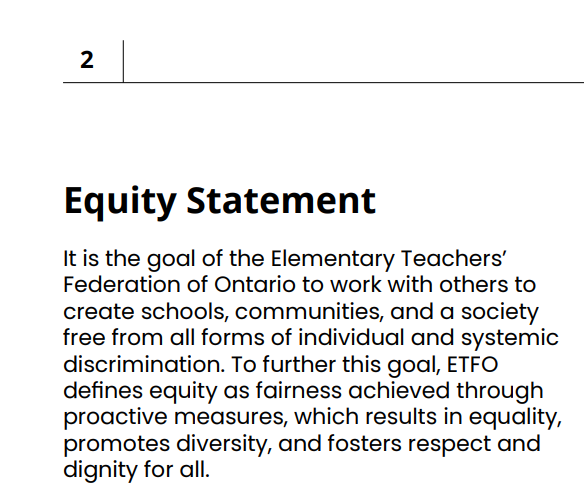
The Equity Statement reminds members of the goal of the Elementary Teachers’ Federation of Ontario which is “to work with others to create schools, communities, and a society free from all forms of individual and systemic discrimination” (p. 2). These system partners would be families, educators, paraprofessionals, external service providers etc.
Page 4 highlights the importance of Universal Design for Learning by emphasizing that while this resource supports the inclusion of students with autism spectrum disorder in the regular classroom, the information and tools highlighted here are useful for all students. The strategies and practices we apply from this resource are geared towards supporting all students.
That said, if some students need individualized support, educators can reach out to families, to Special Education Resource Teachers, centrally assigned instructional coaches, consultants etc.
I always find that when I ask families which strategies work for them at home and in social spaces, this strengthens my practice, wherever it is possible to adapt these strategies to a classroom environment.
The section on Autism Culture and Community highlights some key aspects as below:
| The Resource Says This | Some Considerations |
| Use of the term autism, as we know it, began in 1943 (it had been associated with schizophrenia prior to this, starting in 1911). A lot has changed since then. The results of research, clinical work, educational policies, and listening to the voices of the autistic community have helped educators learn more about autism. | As all families and communities in Ontario may not have had access to the professional learning that educators have received, they may be at a different point in their understanding around autism.
It is therefore important to see these differences as opportunities to strengthen community engagement with Autism Ontario’s local chapters and school board resources in multilingual and culturally responsive ways. Different is not deficient. Different is different. |
| The current shift toward identity-first language is being led by the autism community itself due to its affirming quality and alignment with validating an individual’s identity and sense of self.
Referring to a person as autistic, then, is a gesture of acceptance and recognition that the identity has value. When in doubt and when possible, ask the person with autism how they would like to be described. |
Given their age and trajectories, students may not yet be able to determine how they would like to be described.
Also, families and students who have been caught in intersectional oppressions may see these well intentioned attempts at naming and questions about how the naming should be, as one more layer of being marginalized based on their experiences before or their apprehensions of what can happen. Going by Universal Design for Learning, if good for all practices are implemented, then all students will benefit. |
| Many autistic people prefer the terms “high or low support needs” to “high or low functioning,” as the latter implies underlying judgment about an individual’s capacity and potential. | Here, it is important to pay attention to the fact that when we say high and low support needs, it is also important to embed instructional approaches into our daily practice that provides opportunities for the student to achieve their fullest potential.
What does that look like during integration into other subject areas? What does member to member professional collaboration need to look like for student outcomes to be equitable and for ongoing growth and independence? |
Severity Assessment of Autism Spectrum Disorder
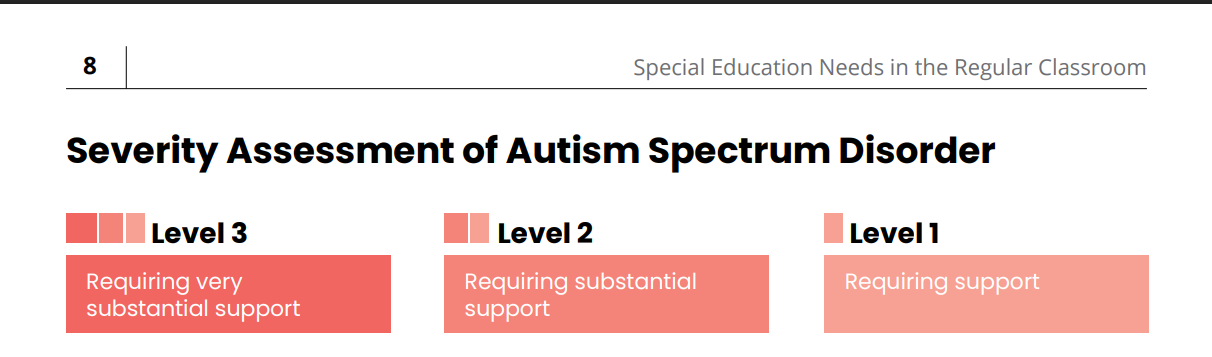
In my school district when we, as centrally assigned consultants present professional learning, we address this matter in this way:
Although diagnostic documents state that a student is at a Level 3, 2 or 1, students’ strengths, independence and need for support can be fluid from day to day also and can change over time. So a student who is deemed Level 1 may need more support than what their diagnosis indicates if they are in an unstructured setting such as an annual athletic event on a field trip or if they are experiencing a change in their home or school environment with a parent being away on a trip or an educator or preferred adult at school is away for the week.
Human systems are fluid as are our students’ needs.
This is important to note because otherwise the paperwork can flatten and overshadow the student and their humanity.
Access Is Important
At some of the schools with whom I am partnered, members have printed a copy of this resource for their work room. Easy access means that they can refer to this resource to support instructional planning, to guide professional conversations within educator teams, as well as for reference during In School Team Meetings or School Support Meetings etc.
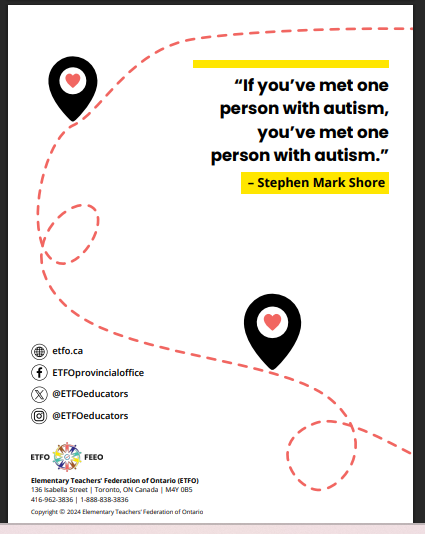
Consider printing out this quote so that even when you are away, other educators who work with your students can take up your equitable outcomes mindset with them.
Read Part 1 of this blog here
Read Part 2 of this blog here.
Note: This resource is available at ShopETFO and also digitally on the ETFO member site. Click here.
In Conclusion
ETFO Voice articles and other documents explain that “Professional judgement is defined, in part, as “judgement that is informed by professional knowledge of curriculum expectations, context, evidence of learning, methods of instruction and assessment, and the criteria and standards that indicate success in student learning.”
These resources will continue to strengthen members’ Professional Judgement so that all students can experience positive opportunities for learning and well-being from year-to-year irrespective of their socio-economic status and the advocacy skills of their parents and caregivers.
With You, In Solidarity
Rashmee Karnad-Jani