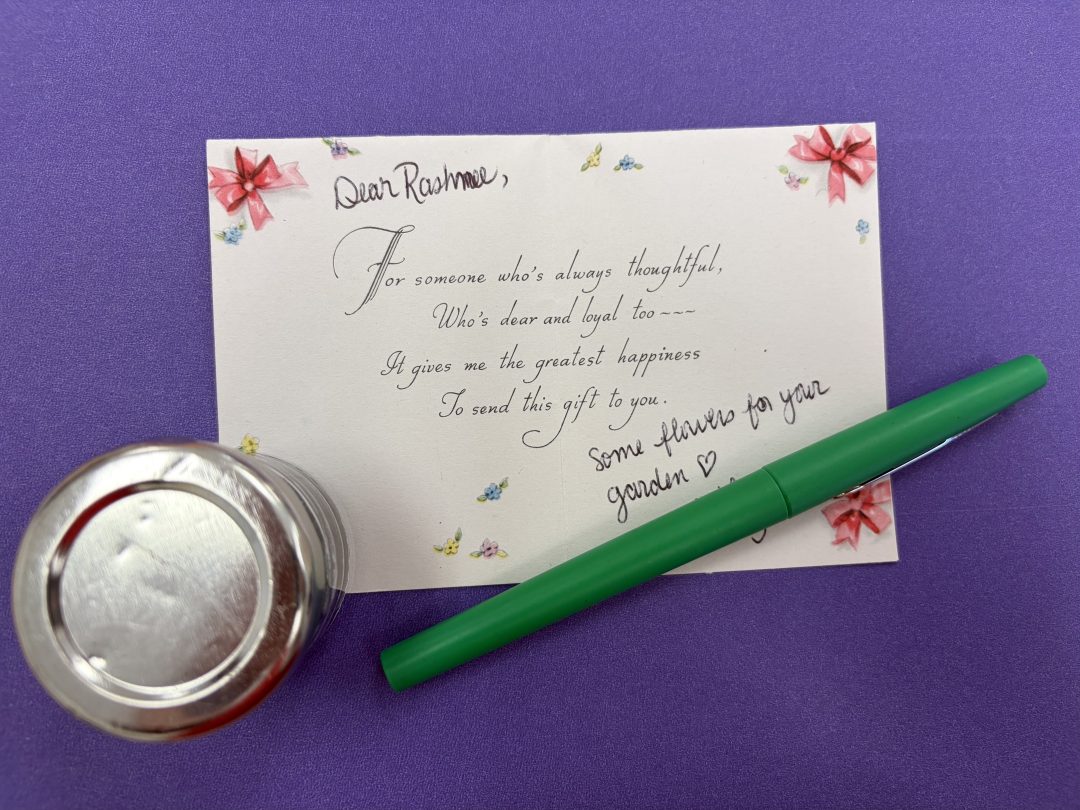
A greeting card with a small jar with a steel lid on the bottom left and a green pen on the bottom right hand corner of the note,

Of Fall Planting and Receiving Mail


Once again, my fellow travellers I am speaking with you through the analogy of gardening. Nature and seasonal changes are comforting in their reliable predictability, after all. 

Fall planting is key for all those who garden in this part of the world or elsewhere. Gardeners and farmers plant bulbs including garlic now so that there is a harvest later when warm weather comes.

It’s been some weeks since we went back to school, you and I. Amid all the precarities and poli-tricks, the necessary work is being done by all of us in various roles as strive for student achievement and well being. 

The Cost of Everything

One reality that stands out at this time is that everything is expensive and some or many families in all our schools are also experiencing the rising costs of prices for everyday items that their children need on a daily basis.

The Unrelenting Pace of Work and Taking Time to Pause 
Everywhere, ETFO members
are experiencing the relentless pace of work. We don’t slow down. Instead, you and I tend to keep going to get through whatever needs to get done because the next day brings another wave of tasks.
This is more than ever, a time to pause and ponder.
I promise myself everyday, I shall not crumble under the demands that these times are placing on me, and neither will you. We will stand together and we will move forward. But for that to happen, for us to stay strong while we need to take care of ourselves and one another. We have to reach out to one another, because sometimes, we feel wobbly.

My Work Is More Than My Job Title

I am a Special Education Resource Teacher (SERT) in my school district. That said, my everyday work is more than my job title. One part of my job is to collaborate with colleagues who teach exceptional students and will report their achievement. I coordinate IEPs* by curating the curriculum expectations, accommodations, instructional strategies and resources that the team of educators supporting that student have shared. I also offer strategies and resources for consideration. Notice that I didn’t say “I write IEPs” as it is a collaborative process. 

Member to Member Communication

Now, here’s the important point: as an ETFO member I am mindful of not directing the work of colleagues. Therefore, I don’t pick their subject expectations and accommodations for them. If they’re reporting on a subject area then it’s their professional judgement that is directing what is included in that program page. We do have collaborative conversations and we work together. The key aspect of my role is not just my job knowledge and expertise but the navigation of delicate passages through the colleagueship landscape. 

Deadlines and Deliverables: IEPS Go Home Within 30 Working Days

When IEPs go home is a key deadline in Ontario and a legally mandated one. As someone who has been a SERT for 20 years and a teacher for more, I am able to pivot quickly and manage my time. This often comes with much reduction of other activities including self care. During these days and evenings, I withdraw from many things as the job demands this of me.  Like your labour, mine too is largely invisible.  

And Then I Got Mail

On October 20th, 2026, IEPs went home and I came to the mailroom where my mailbox is my work hub. I saw an interoffice courier envelope. I opened it and I felt a warm surge of joy! It was a note from a dear friend who was a consultant in the Student Services  department with me. She was checking in to see how things were going. It was a joyful moment for me. 

That evening, the commute from work was longer than I expected, with much traffic and many twists and turns for errands I’d put off until the IEP deadline was met. I finally reached home and messaged my friend with a thank you. She sent me an IG post with a quote that spoke about planting gardens instead of dying on hills as a metaphor for what one does to stand by an unwavering belief. 

I have the note beside my couch and I pick it up on some days, just before the sunrise peeks through the almost bare branches in the distance.

Let us plant seeds in the Fall, so we have flowers in June. This term 1 IEP will be that Fall Planting.

With You, In Solidarity

Rashmee Karnad-Jani

P.S:

*I understand that not all Ontario school boards work with IEPs this way. This is my reality  

Please review ETFO’s guidelines, The Individual Education Plan: Advice to Members for more information about IEPs.

Supporting Special Education Needs: Part 3

Special Education Needs In The Regular Classroom – Supporting Students with Autism Spectrum Disorder

Hello Fellow Travellers,

This conversation builds on previous ones that colleagues have had through ETFO and ones that I have also engaged in with you. I am going to share what stands out for me in the resource highlighted below

:

Beginning with the front matter, the following aspects are important signposts.

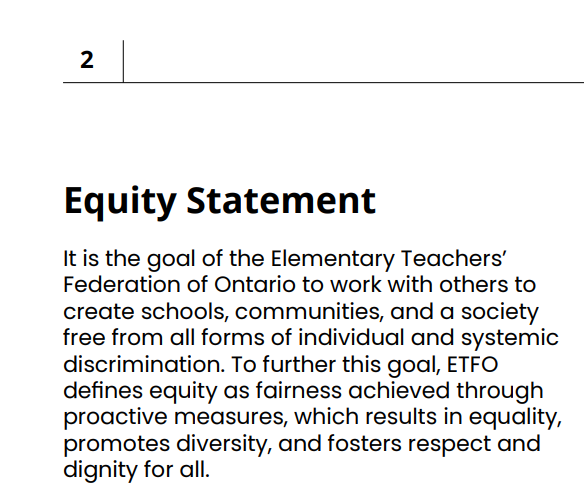
The Equity Statement reminds members of the goal of the Elementary Teachers’ Federation of Ontario which is “to work with others to create schools, communities, and a society free from all forms of individual and systemic discrimination” (p. 2).  These system partners would be families, educators, paraprofessionals, external service providers etc.

Page 4 highlights the importance of Universal Design for Learning by emphasizing that while this resource supports the inclusion of students with autism spectrum disorder in the regular classroom, the information and tools highlighted here are useful for all students.  The strategies and practices we apply from this resource are geared towards supporting all students.

That said, if some students need individualized support, educators can reach out to families, to Special Education Resource Teachers, centrally assigned instructional coaches, consultants etc.

I always find that when I ask families which strategies work for them at home and in social spaces, this strengthens my practice, wherever it is possible to adapt these strategies to a classroom environment.

The section on Autism Culture and Community highlights some key aspects as below:

The Resource Says This Some Considerations
Use of the term autism, as we know it, began in 1943 (it had been associated with schizophrenia prior to this, starting in 1911). A lot has changed since then. The results of research, clinical work, educational policies, and listening to the voices of the autistic community have helped educators learn more about autism.  As all families and communities in Ontario may not have had access to the professional learning that educators have received, they may be at a different point in their understanding around autism.

It is therefore important to see these differences as opportunities to strengthen  community engagement with Autism Ontario’s local chapters and school board resources in multilingual and culturally responsive ways.

Different is not deficient. Different is different.

The current shift toward identity-first language is being led by the autism community itself due to its affirming quality and alignment with validating an individual’s identity and sense of self.

Referring to a person as autistic, then, is a gesture of acceptance and recognition that the identity has value. When in doubt and when possible, ask the person with autism how they would like to be described.

Given their age and trajectories, students may not yet be able to determine how they would like to be described.

Also, families and students who have been caught in intersectional oppressions may see these well intentioned attempts at naming and questions about how the naming should be, as one more layer of being marginalized based on their experiences before or their apprehensions of what can happen.

Going by Universal Design for Learning, if good for all practices are implemented, then all students will benefit.

Many autistic people prefer the terms “high or low support needs” to “high or low functioning,” as the latter implies underlying judgment about an individual’s capacity and potential. Here, it is important to pay attention to the fact that when we say high and low support needs, it is also important to embed instructional approaches into our daily practice that provides opportunities for the student to achieve their fullest potential.

What does that look like during integration into other subject areas?

 What does member to member professional collaboration need to look like for student outcomes to be equitable and for ongoing growth and independence?

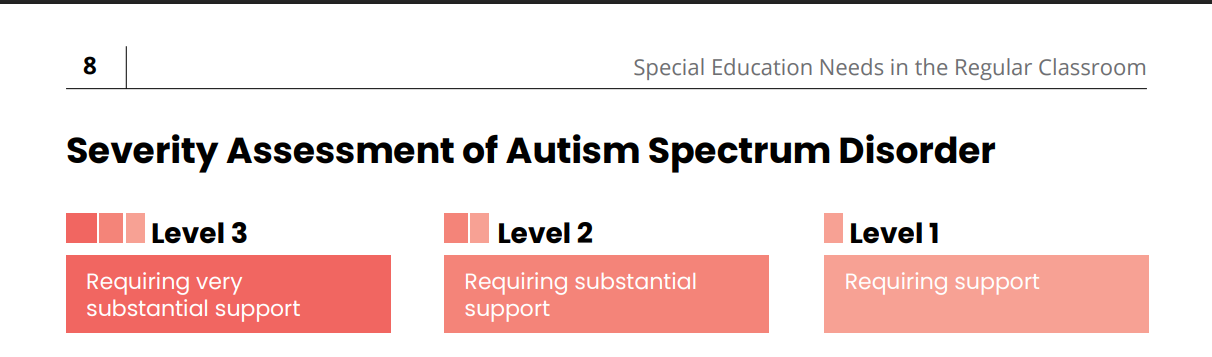
Severity Assessment of Autism Spectrum Disorder

In my school district when we, as centrally assigned consultants present professional learning, we address this matter in this way:

Although diagnostic documents state that a student is at a Level 3, 2 or 1, students’ strengths, independence and need for support can be fluid from day to day also and can change over time.  So a student who is deemed Level 1 may need more support than what their diagnosis indicates if they are in an unstructured setting such as an annual athletic event on a field trip or if they are experiencing a change in their home or school environment with a parent being away on a trip or an educator or preferred adult at school is away for the week.

Human systems are fluid as are our students’ needs.

This is important to note because otherwise the paperwork can flatten and overshadow the student and their humanity.

Access Is Important 

At some of the schools with whom I am partnered, members have printed a copy of this resource for their work room. Easy access means that they can refer to this resource to support instructional planning, to guide professional conversations within educator teams, as well as for reference during In School Team Meetings or School Support Meetings etc.

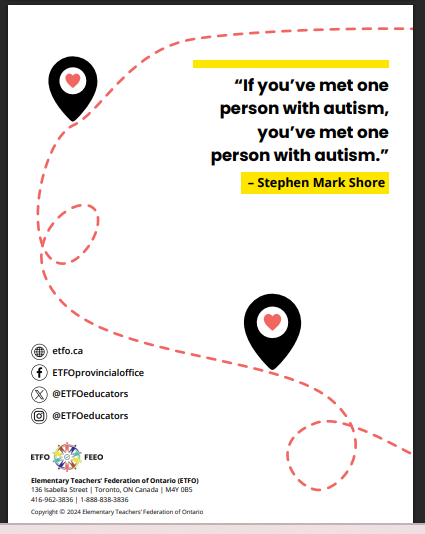
Consider printing out this quote so that even when you are away, other educators who work with your students can take up your equitable outcomes mindset with them.

Read Part 1 of this blog here

Read Part 2 of this blog here.

Note: This resource is available at ShopETFO and also digitally on the ETFO member site. Click here.

In Conclusion

ETFO Voice articles and other documents explain that  “Professional judgement is defined, in part, as “judgement that is informed by professional knowledge of curriculum expectations, context, evidence of learning, methods of instruction and assessment, and the criteria and standards that indicate success in student learning.”

These resources will continue to strengthen members’ Professional Judgement so that all students can experience positive opportunities for learning and well-being from year-to-year irrespective of their socio-economic status and the advocacy skills of their parents and caregivers.

With You, In Solidarity

Rashmee Karnad-Jani

Why Do We Organize for Public Education? 

Hello Fellow Travellers,

It is May and things are getting busier. Spring is being elusive. Dawn is dark and a bright day may end with a dull dusk. 

At this time, more than ever, when the waves of “What Just Happened in Ontario’s Education?” dash over me, I need something to look forward to and hope for. As do you, I am sure. 

 On my long commutes, I listen to podcasts and I recently turned to Elementary: A Podcast from ETFO once again. 

What always makes me smile on this podcast is listening to the voices of students because that is how each episode begins. This makes me sit up straighter and realign my purpose with the possibilities I can catalyze with students, colleagues and families, directly or indirectly.

 A Recent Podcast

One such episode that is extremely important especially as we move through May and June is the conversation on why we (must) organize for public education. It features the keynote speaker from ETFO’s Political Action Conference Dr. Lana Parker who speaks about protecting and defending public education. The title is “Why We Organize for Public Education

Key Points of This Podcast

  • Dr. Lana Parker holds a PhD from York University in Language, Culture and Teaching. Her research and writing focus on ethically informed pedagogy. 
  • The podcast highlights the reality that the underfunding of public education in Ontario did not happen suddenly and has “accumulated and accelerated over time”.
  • Beginning from Mike Harris’ government in the mid-1990s when Board funding models were changed there has been, Dr.Parker says, “a slow erosion of the education funding envelope”. 
  •  The podcast also highlights some effects of under-funding such as staff shortages, the nudge towards fundraising that school communities experience to make up the shortfall, the backlog of professionals such as support educators educational psychologists and other registered health professionals, as well as a decline in experiential learning and the arts. 
  • A demand for fees for extra curricular activities that make such important opportunities inaccessible for students based on their families’ means which widens the gap for their well rounded schooling. 
  • Educator burnout (we know this)

What stood out for me was the introduction of a critical idea of responsibilization → where beyond what you are responsible for, educators are made responsible for things that are out of our control due to underfunding.

Responsibility        →→ →→→→→→→→→→ →→ →→       Responsibilization                                (In this gap lie emotion, fatigue etc.)

The fatigue comes from being pulled between what one can do and what one is tasked to do due to underfunding.

 Why Does This Matter?

The website for Building Better Schools website has an Education Cuts Tracker. 

While there is talk out there in general about education cuts it is not until you type in the name of a neighbourhood school and see the numbers, does this harsh reality connect differently.

Although my children are no longer in school, I entered the names of schools in my neighbourhood.

I sat and looked at the screen for a long time. 

These are my neighbours’ children and grandchildren, these are the students who ride their bikes and wave to me as I walk in the park, these children are the future.

What Can You and I Do?

We can show up. We can participate. We can invite others to join us.

 You do not have to wait long because All Member Meetings are happening.

All Member Meetings

Find Your Meetings here, register to attend as needed, do tell your colleagues and friends from across the province, share on socials.

If you are a member of my ETFO local, I will see you there. 

Some Related Resources:

Class Action: How Ontario’s Elementary Teachers Became a Political Force

Labour Movement

Connect to your Labour Community 

Educator Organizations

Labour Organization Solidarity with Education Workers

ETFO and the Labour Movement

Let’s talk.

With You, In Solidarity.

Rashmee Karnad-Jani

Supporting Special Education Needs: Part 2

Hello Fellow Travellers,

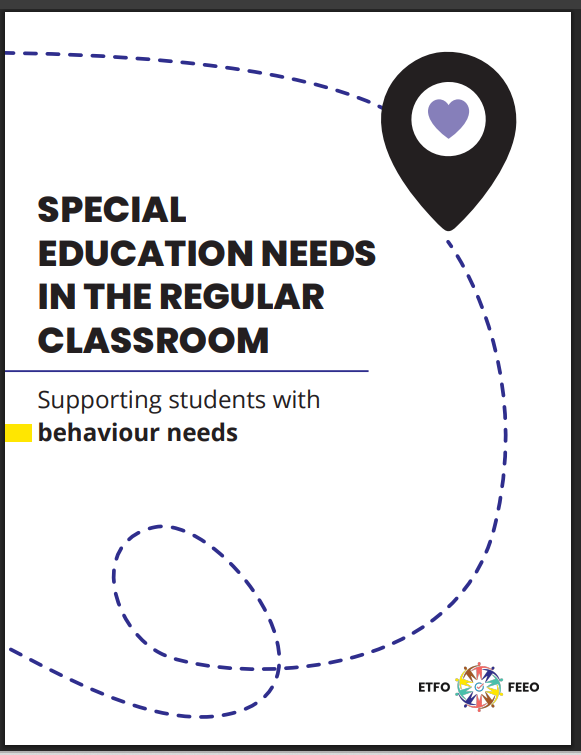
In continuing our conversations around supporting special education needs, I am delighted to foreground the ETFO resource Special Education Needs In The Regular Classroom: Supporting Students with Behaviour Needs.


Firstly, this resource is an important one because it is written by ETFO members for ETFO members.

Also, it aligns with the work that we do in our classrooms and it honours ETFO’s definition of  professional judgement stated as “judgement that is informed by professional knowledge of curriculum expectations, context, evidence of learning, methods of instruction and assessment, and the criteria and standards that indicate success in student learning.”

1st Section

This resource begins with the Equity Statement and outlines ETFO’s Equity Initiative as well as highlights the definition of an Anti-Oppressive Framework. The “Why’ of the contents become visible right at the outset and prepare the reader to engage.

Table of Contents

The table of contents is outlined as follows:

  • Who Receives a Behaviour Exceptionality?
  • Building a Trauma-Informed Practice
  • Special Education in Ontario which highlights two key policies Policy/Program Memorandum 156 and Policy/Program Memorandum 145.
  • Addressing Student Needs
  • De-Escalation Strategies
  • References & Resources

Key Aspects

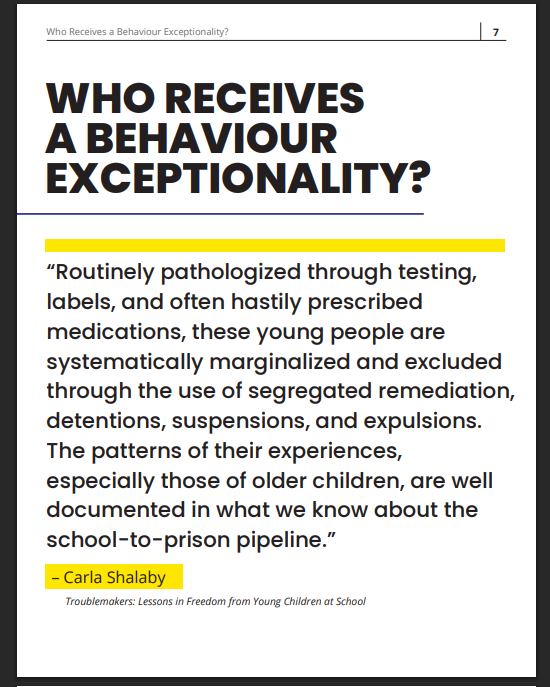
A quote from Carla Shalaby’s book “Troublemakers: Lessons in Freedom from Young Children at School” calls to the change maker in all of us. I especially pay attention to “the patterns of their experiences, especially those of older children, are well documented in what we know about the school-to-prison pipeline.”

The simple question “Who Receives A Behaviour Exceptionality?” invites reader to step outside the everyday busy-ness of our work and think deeply.

What did you think about?

Who came to mind?


Diagnoses and Details

The resource also highlights the different diagnoses that students receive through the Diagnostic and Statistical Manual of Mental Disorders and discusses some with links to websites that invite educators to learn more.

Mental Illnesses  

In this section, the resource discusses the following:

  • Anxiety Disorders
  • Mood Disorders
  • Eating Disorders
  • Personality Disorders
  • Disruptive Behaviour Disorders

Applying an Anti-Oppressive Lens to Behaviour Needs

This section, placed right after  the different categories of mental illness, brings the reader face-to-face with the human aspect of our work. It invites educators to think intentionally and deeply about why it is important to apply an anti-oppressive lens to behaviour needs in this way:

“A behaviour exceptionality and the diagnoses related to it may require ongoing observation and report. However, the language used by society to describe behaviour is value-laden and soaked in judgment. As educators, we must utilize an anti-oppressive framework to guide our observations so that we can be as objective as possible.”

This resource reminds us that anti-oppressive practices are not theoretical terms, book clubs  or hashtags. They are actions that we need to do.

You and I have to do the work of anti-oppression.

These are important reminders.

Reflection Section

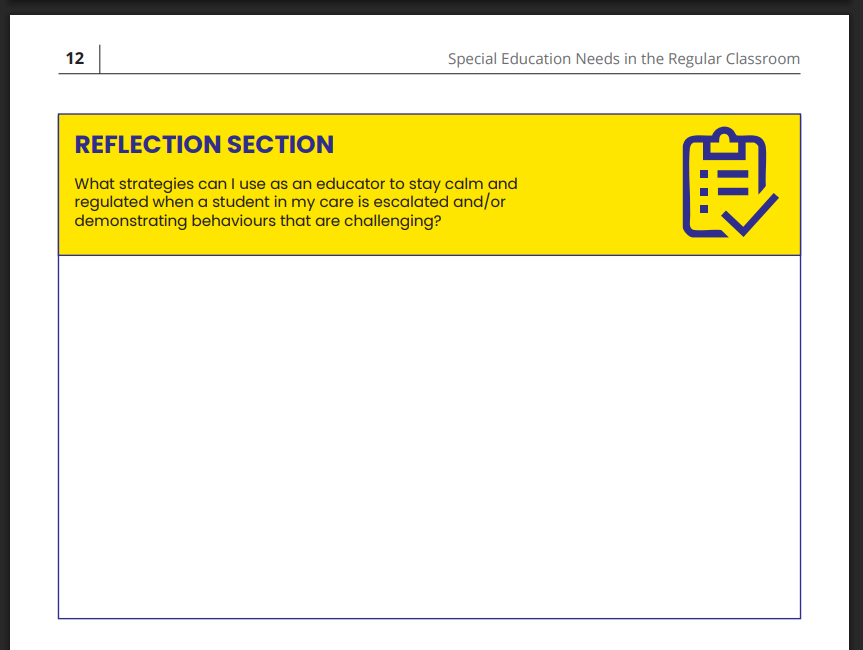
There is space in this resource for each one of us to turn our gaze inwards and to ask questions such as “what strategies can I use as an educator to stay calm and regulated when a student in my care is escalated and or demonstrating behaviours that are challenging?”

I liked this one as it brought me to a moment of calm which I use when working with students in classrooms or when I am in less structured spaces such as outside at recess or in the hallway.


 At The Heart

What resonated for me at the heart of this document are these words:

“Our goal with this resource is to support educators in exploring and redefining discipline protocols from a place of opportunity, with the initial perceptual shift on adult well-being as a cornerstone. Recent research emphasizes that true discipline for our students begins with an adult whose brain feels safe, calm, and still.”

Please read, implement, talk about and share this ETFO resource with colleagues in your professional learning network.

I for one, am delighted that in my school district, on the January 30th PA Day, all of us got to engage with this resource and that it has been showing up in collaborative conversations in many school teams with whom I am partnered.

Much appreciation to the contributions of ETFO members, Lisa Dunbar and Joshua Dickson who have been acknowledged on the page 2.

With You, In Solidarity

Rashmee Karnad-Jani

Read Part 1 of this blog here.

Note: This resource is available at ShopETFO and also digitally on the ETFO member site. Click here.

Building On, Building Together

Hello again,

It is already the middle of the school year. Time to look back and look ahead. Earlier this month I read Colleen Elep’s piece “Knowing The Learner Matters: All About Multilingual Language Learner (MLL/ELL Variability)” on this blog with much interest.

The opening paragraph stands out immediately and invites readers to think deeper and look inward at assumptions we may tend to make or others have made and passed on to us: “When we think about Multilingual Language Learners, also known as MLLs (or ELLs), it can be tempting to view them as a uniform group with similar needs and experiences. In reality, nothing could be further than the truth. MLLs are an incredibly diverse group of students who bring a wide range of cultural and linguistic backgrounds, identities, educational histories, and lived experiences to their learning”

Although the writing outlines many signposts and how-to aspects that are very helpful to classroom practice, I went looking for something that connects the writer’s entry point with mine because I wanted to not just read – I also wanted to sharpen my skills. And I stopped here…

Supporting Multilingual Language Learners with Possible Special Education Needs

This resource, shared in October 2025, has an easy to understand, conversational title that considers possibilities and also highlights partnerships. It is an invitation to collaborate and to sit together as teachers to think through students’  strengths, needs, family background, educational experiences, migrations trajectories and do something about it – together and professionally.

The starting lines indicate that “This member-developed resource provides useful information about how to support MLLs with possible special education needs. The program brief may be leveraged when MLLs are not experiencing success with ongoing ESL/ELD supports” which means that the ESL/ELD supports have to be implemented first.

The link to the resource brings the reader to a document that states these important aspects right at the outset which we all need to remember because there may be a risk of rushing which though well intentioned mostly, can be premature identification into special education programmes and states this: “When multilingual language learners (MLLs)1 are developing the English language skills required for success with the Ontario curriculum, it can be difficult to determine if some of these learners may also have additional learning needs, such as an Ontario Ministry of Education-recognized exceptionality”

The definitions of exceptionalities are important to review and there is also a caution there, as teachers, as educators, we do what we are trained to do – we teach, we gather evidence, we collaborate with colleagues who can guide our practice and we seek support in collaboration with families and other experts in our school districts.

We do not offer diagnoses.  This resources helps greatly to keep us on our path.

Also, educational work is best done in community with collaborative colleagues. This we know.

The Multi-Tiered Approach 

I especially liked the info-graphic and the video series. The former makes it easy to understand what is needed at each stage and the page states that more resources will be added, so let us check in regularly as we learn together.  The video series allowed me to see the possibilities of rich and respectful professional conversations on how to support at Tier 1, Tier 2 and Tier 3 that are also known as Good for All, Necessary for Some and Essential for a Few.  It is always professionally strengthening to hear ETFO colleagues talk about the rich possibilities available to us in the work we do.

I invite you to engage with Colleen’s blog post and then make your way to the resources shared above. Do share back how this worked for you in your spaces. And please share this piece with others who may be interested to read and learn …

With You, In Solidarity

Rashmee Karnad-Jani

Day in the Life of an In School Support Program (ISSP) Teacher

It’s the start of the school year and my first month as an ISSP teacher. The learning curve is steep. Every day feels like a crash course—deciphering acronyms, understanding systems, getting acquainted with new resource staff, front-loading Individual Education Plans (IEPs), coordinating schedules, and supporting our youngest, newest learners in their transition to school.

By 8:00 a.m., I’m already in the school, sorting through my to-do list. First on the agenda: tackling Individual Education Plans. Going into this role, I knew how to write my own IEPs. However, supporting other educators with the variety of IEPs in the building, I quickly learned that it was going to be a whole new level of complexity. Each student’s needs are unique, and collaborating with multiple teachers to ensure accommodations and modifications align with their teaching practices requires both patience and understanding. It wasn’t just about the paperwork—it was about truly understanding each student’s profile and finding ways to bridge gaps between the curriculum and their learning needs.

Writing IEPs is both an art and a science. Balancing academic and alternative goals with accommodations and modifications requires careful thought and precision. These documents are living roadmaps for success, but they don’t happen in isolation. I’ll spend much of the next few weeks sending surveys and meeting with parents, students, and other educators to ensure every voice is heard and every need is addressed.

In my experience, one of the most challenging yet rewarding parts of this role is presenting at Student Resource Meetings (SRMs). These meetings focus on discussing support plans for students, and they’re both exciting and nerve-wracking. It’s not just about presenting data; it’s about advocating for my students and ensuring their needs are prioritized. Today, I’m preparing for two SRMs scheduled for the following week. The next few days will be spent making parent phone calls to invite them to attend and inputting referrals into our system. The stack of documents beside me includes work samples, assessment data, and notes on strategies that have shown success so far. Preparation is key, as having all documentation ready can make these meetings smoother and more effective.

By mid-morning, I’m in classrooms supporting small groups. Establishing a consistent routine has been a game-changer. My students now look forward to our time together, which creates a sense of stability for them—and for me. The students I work with benefit from a combination of life skills development, as well as targeted reading and writing support. Activities like folding towels, matching socks, opening and closing containers, and sorting and washing dishes build functional independence. In reading and writing groups, we strike a balance between supporting classroom assignments and using an intensive reading program to foster growth.

By lunchtime, I continue to field teacher questions, solve a handful of small incidents, and celebrate a few little victories. One student mastered a new skill, another used a calming strategy independently, and a third opened up about their challenges. These moments are the heart of my work. They remind me why I’m here—even when the paperwork feels overwhelming.

The afternoon is a blend of small group instruction, one-on-one support, and consultations with colleagues. Collaboration is the cornerstone of this role. I work closely with classroom teachers, educational assistants, and specialists to ensure we’re all aligned in our approach. It’s truly a team effort, and while the pace can be demanding, the shared sense of purpose keeps us motivated. Together, we weave a web of support that empowers students to thrive.

As the day winds down, I’m back at my desk, reflecting on what went well and what could be improved. The to-do list for tomorrow is already forming in my mind: editing IEP drafts, following up with a parent, and preparing materials for a new intervention group. The work never truly ends, but I’ve learned that balance is critical. Self-care isn’t optional in this role; it’s essential. Whether it’s a walk after school, a moment of mindfulness, or simply shutting off my laptop by 4:00 p.m., I make time to recharge.

Being an ISSP teacher isn’t easy, especially at the start of the year. The systems, acronyms, and sheer volume of responsibilities can feel overwhelming. But it’s also deeply fulfilling. Every day, I’m reminded of the incredible resilience and potential of my students. They teach me as much as I teach them. Together, we navigate the challenges and celebrate the successes. It’s a journey, and while the road is bumpy, it’s one I’m grateful to be travelling.

ETFO’s Special Education Needs in the Regular Classroom: Supporting Students with Autism Spectrum Disorder is a useful resource for educators. It covers topics, including autism spectrum disorder, and offers information, access points, and guiding questions to help teachers implement effective pedagogy. 

For ETFO members, the handbook is available for free digitally on the member site. However, it is also accessible to the public in print through the ETFO website. Check it out here: Special Education Needs In The Regular Classroom: Supporting Students With Autism Spectrum Disorder.


that kid

Created by DALL-E
a-class-photo-of-faceless-students-in-the-styles-of-Monet-Rembrandt-Kandinsky-and-Warhol prompt by author

I was thinking about that kid and I found myself getting emotional. 

You know the one. We all do. Whether the name(s) or face(s) you thought of are in your class this year or not. We all have one or two students who popped in there almost immediately. I am not going to sugar coat this either because it got emotional. When I think about that kid, my feelings range quite widely here. Anger, joy, sadness, peace, et al have all staked their claims in my amygdalae and other rose coloured spaces in my emotional thought centre.

My first “that kid” came when I was quite new to teaching. I probably owe them an apology for pushing too hard about their studies without considering how hard it must have been to be truly trying their best, but not meeting the expectations of which I was thoroughly* convinced were so clearly taught and put within reach. Like I mentioned above, an apology has been uttered on a couple of occasions for that learner into the universe. 

There are two other feelings that happens sometimes, relief and angst. Relief that you were able to make it through a year together and grow. Angst over what I missed or, straight up, got completely wrong. My most recent that kid reads like this: 

Is quiet – too quiet.
Sticks to the sidelines as if crazy glued there.
Struggles to start something, and struggles even more to finish.
Whether it is a transition, a sentence, or a math challenge mine has got me thinking about what I need to do differently next time because there will be a next time no matter how hard I work to learn the lessons from the past to use now and in the future.

As teachers, I’ve noticed that we tend to be pretty hard on ourselves much more often than we realize or care to admit. It’s who we are as reflective practitioners who seek to make things better for our learners. I have noticed that we fret far more about any flaws in our work even when there are few if any cracks in our foundations. We are constant works in progress alongside our students and we wear it on our sleeves when it doesn’t go well. 

Sometimes, that kid gifts you some victories too. You see, all that time spent investing in that kid can turn out to be a life enriching moment for you as an educator and even more so for that kid as a scholar. Since my first that kid nearly 15 years ago, I have marveled at hearing from students who are completing degrees at amazing schools and starting to write the next chapters of their lives. This week I ran into a student who will be doing just that.

To be honest, it wasn’t all sunshine and lollipops with this particular that kid. If poor choices, bad behaviour, and work avoidance were credit courses, this learner would be top of the class. Fast forward 6 years and they are about to begin a very challenging degree program at a top university. That could have only happened with significant support, responsibility, accountability, and commitment. In other words, the exact opposite to where they were back then. So what turned this scholar around? How did the switch get flipped, and who did the flipping? I was certainly thrilled to receive such news knowing that there would be more good things to come as a result of them finding their stride as a student. Whoever helped this “that kid” turn over a new leaf has changed one young person’s life not for good, but for great. 

I am also aware that there are some who will never get to experience an about face like the that kid above, and I need to take ownership of that and work to improve going forward. Maybe my next that kid will not fall through the cracks through their education? I know that there is always room to improve what and how we do this job of ours. I know that teachers have countless conversations in order to find and fit the complex puzzle pieces we know as students together. I know that there is no single strategy or approach that will reach 100% of our students. What we need to remind ourselves is that we come pretty close to perfection, and we do it across a decade plus of siloed collaboration, between the panels, whether we realize it or not. 

When you think about it, each of our students could have as many as 50 teachers over their K to 12 careers. Of course homeroom teachers occupy the bulk of those first 10 years yet that still means there are countless points of influential interaction to be had between an entire cast of educators all working in concert to make sure each that kid gets and gives the best. 

This job asks us to accept and understand that we often will never know how the work we put in with our students will support them in the future. Closure is not a luxury many elementary teachers ever have once our students move onward and beyond our schools, but that should not bring us down because there is always that kid who takes the time, after several years have gone by, to reach out and connect again: to share how much they appreciated what was taught to them in and out of the classroom all those years ago. 


*On a random note: the word thoroughly breaks down into tho roughly. So now my idea of thorough will always be considerate of whether I was thorough or tho rough

class placements

A Renoir or Matisse inspired impression of a classroom filled with students from all over the world standing, discussing, and solving a math problem together -by Dalle 2 with prompts from author

Now that the April showers and May flowers happy times are done. It is time to get serious about September folx. Wait what?! That’s right, it’s class placement time again. 

I for one am super stoked to be sending 29 unique and empowered learners on to their next grade. If it was possible, I would keep this group together as they have grown so well together since the start of the year. Sure there were some bumps in the sidewalk along the way to this point, but they are to be expected when 29 individual personalities occupy a space for an extended period of time. I can only look back with gratitude to the team of teachers, SERTs, and admin who took the time to curate this group. 

It is in that spirit that I wish to do the same for the lucky, and I mean that sincerely, educator(s) who will be teaching  my current class this September. Firstly, I filled out the little squares with names, academic levels, IEP yes or no, MLL yes or no, unidentified behavioural issues, preferred collaborator(s), non-preferred collaborator(s), and gender. Filling out these cards each year constitutes the most continuous handwriting of my year.

Admittedly, my cards looked like I was writing with my non dominant hand because they were a mess. Scratches, misspellings, and my scrawling will not make it easy on anyone however outside of the superficial look I think we did a good job setting our students up for success. This was especially important as our school is adding new classrooms and we want to be supportive of the new teachers who will be joining us too. 

Avoiding perfect storms is always a good idea, but even the best of intentions can create them in classrooms. I have seen a new teacher arrive at a building along with a new admin or two only to discover that a mix that looked balanced on paper was going to be far different in real life. I know this happens with students coming from primary F.I schools grades 1 and 2 specifically. The sheer logistics of a multi-school class placement exercise can be onerous on all involved. As such some perfect storms are bound to occur. The interesting thing about class placements, is that in the room right next to the hurricane could be cool breezes and calm even though they were placed by the same team of educators, SERTs, and admin. 

This year, we wanted to continue the thoughtful groupings while expanding the opportunities for our students to collaborate with like minded and supportive peers. We have also had to reckon with students returning to classrooms who were once provided SSC support for Language and or Math in the path. To this point, there will have to be a wait and see approach, but class placements will need to be considerate of how much support will be available for those individual learners with modifications in the IEPs. There will need to be an added layer of time to ensure no one falls through the cracks. 

In the past, EAs, CYWs, MLL teachers, and SERTs have been stalwarts for students, but with SSCs closing and teaching assignments being re-allocated, I imagine that there will be a few storms as adapt to the changes ahead as it seems they will be joining in classrooms. I love the multiple-educator potential here, but am not sure there will be enough of the aforementioned to cover the numbers of students requiring support. This is not even factoring in the additional levels of distraction that can occur. I know with a cautious approach that allows time, check-ins, and some one on one support, things could work out for student(s) and educator(s). 

In order to help a smaller class size would be a great first step. Accompanied by a well written IEP this shift could lead to some meaningful re-integration of students into homeroom classes. There will be clouds from time to time, but with strategic thinking around class placements now, the chance for a positive start in September is achievable. Happy placement meetings.


learn unlearn relearn teach…

To continue: learn some more, unlearn even more than you did before, teach even better, and then repeat.

I am not sure whether it is possible to enjoy anything more in my professional life than teaching – other than learning. Insert witticism here asking why then are students not jumping out of their seats when they are probably being taught something new everyday? I can see it now if it happened; a level of shock on the faces of teachers at what might be considered too disruptive, but oh the joy. All jesting aside, I believe it is within all of us to express and foster this type of joy in everything we do related to life at school.

Imagine if students bristled with excitement at each opportunity to learn something new rather than some of the blank stares and foreboding filled faces that silently shared that work was the only thing on their minds instead of the profound potential that can occur as new neural pathways are paved? What if that happened at a staff meeting? Maybe I am asking too much for that previous line?

Nevertheless, I still like learning new things – preferably by choice rather than prescribed. Not only does new knowledge strengthen my understandings and scalable skillsets, but being a learner helps me see teaching through a different lens from the seat of a student. For me, this is where the excitement happens along with a healthy dose of discomfort too.

Perhaps teaching and learning are simply sides of the same coin? Maybe it’s solely my intuition as an educator/lead learner taking over because nothing brings me more happiness and relief to finally arrive at another of life’s learning destinations only to realize it was merely a stop to refuel along the way.

What some might perceive as a bumpy ride filled with uncertainty and uncertainty is not a fact I wish to conceal from you. Agreed, it has taken some time to arrive at a reasonable level of comfort with this discomfort.  However, I have also realized that it was in each of those moments when I gained the most in perspective and understanding in my roles in the classroom.

Before that happened though, there were some demons to slay. Finances, fatigue, and giving up a bit of family time on occasion. Once these three things were balanced, I was able to focus on some really important AQ courses that I would highly encourage all teachers to add to their transcripts. My top pick is below.

Spec Ed Pt 1 has to be your goto first AQ.* When I took this course, I was working in a French Immersion school where the IEPs were usually for gifted students. Accommodations were for depth and breadth, but the learning about Growth Plans, ISTs, IEPs, IPRCs etc. was invaluable to support my students in the classroom. Since then, student needs in FI or significantly more complex and the role of SERT which was more geared towards supporting students back into the English stream is now focused on shaping the learning spaces to fit the students where they are within their French Immersion experience.

Spec Ed Pt 1 also came with some excellent classroom strategies that are thankfully still in my toolkit over a decade later. Of course once you have SpEd Pt 1, you might as well complete the set with Pt 2 and your Specialist. Don’t fear being forced into the role of SERT just because you have these qualifications. Think of them as gifts of knowledge for you to support every student that steps into your classroom throughout your career.

I vowed to refuse the job if ever asked to be a SERT fearing I would be placed in a space where I would not be able to survive, and then all of that changed 5 years ago – an offer I could not refuse. Stepping into the unknown discomfort zone that is the SERT role has been nothing short of transformational and invaluable to my practice in and out of the classroom. Working with students, peers, families, and system folx has been extremely rewarding even though pretty much clueless for the better part of my first two years. Thankfully, a mentor teacher and supportive admin were there to help me decode the work.

I guess this brings me back to the title of this post learn unlearn relearn teach.

I knew there was more to learn after my B Ed was completed and I entered the classroom. I unlearned some sticky habits and thoughts about student abilities and behaviour from my own schema and schooling by relearning from the experiences and wisdom of others, and now continue to apply new knowledge to my teaching.

That’s it for now, I have to go unlearn something to make room for more lessons ahead.

Next month look for a companion post about AQs and other cool goings-on at ETFO entitled ‘all good things on Isabella’.

*Did you know that ETFO is offering AQs for Special Education this Summer? Click the link to learn more.

Support for Students with Special Educational Needs

I believe that Ontario school boards should provide more support and attention in identifying each child’s level of development, learning abilities and specialized needs. This would help to ensure that educational programs are designed to accommodate their social, emotional and academic needs and also facilitate their growth and development.

The truth is that many students with special education needs are not getting the support and access to services that they require to succeed. The lack of support has had an even bigger impact on students who face additional systemic barriers. Students need access to educational assistants, behavioural counsellors, child and youth workers, psychologists, and speech and language pathologists to help them learn and thrive in today’s realities. The number of students being identified with special educational needs is increasing. Unfortunately, in most cases, the system doesn’t reflect that change and the necessary funding to adequately support all students is just not there.

Creating an inclusive classroom culture that fully supports the needs of all students is often met with many challenges and barriers in today’s classroom environment. In my guidance and coaching roles, I build teacher capacity to help address students’ social, emotional and academic needs, and co-construct teaching strategies that support students with a wide spectrum of special educational needs. One of the greatest challenges I often see has to do with class sizes. Many of the classrooms I support have an average of thirty students with diverse learning needs, and often with only one teacher in the classroom. In this current learning environment, access to resources, specialized and/or individual instruction and support staff are often limited and sometimes none-existing. We need to reconsider and address the inequities in class sizes, if we truly value each and every student and the well-being of staff and students. 

When working with teachers, I focus on creating an inclusive classroom culture that includes knowing who the students are, building trusting relationships and ensuring each student feels a sense of belonging in the learning community. In partnership, we analyse data we collected to identify the learning gaps of each student. We co-construct lesson plans that are differentiated, embedded in the Universal Design of Learning model and are culturally relevant and responsive to the lived experiences of students. In spaces where there are a high number of students with specialized needs, I find it helpful and advantageous for me to know who my students are, to have a highly structured learning environment and to set clear expectations for a successful learning environment. Working in collaboration with the classroom support staff as well as families is also paramount to student success.


How do I support students with special educational needs?

  • Get to know individual students’ strengths, needs and interests
  • Consider the diverse needs of all students in the classroom when it comes to the learning environment, instructional practices, and assessments for, as and of learning
  • Develop the class profile for all students that includes their identities, as well as their social, emotional and academic needs
  • Using the principles of Culturally Relevant and Responsive Pedagogy (CRRP), Universal Design for Learning (UDL) and Differentiated Instruction (DI), backward-design your program with the big ideas in mind
  • Consider how to best use Assistive Technology to support student learning in the classroom and at home


For additional resources, visit ETFO’s website on class sizes and special education and

ETFO’s Building Better Schools