Years ago in graduate school, specifically in my MEd programme at York University, I had taken a course on Gender, Race and Social Class especially because the last concept was important to me.
I’ve always known that class is the secret ingredient of oppression in addition to and intertwined with the BIG ones.
Social class always worsens the other oppressions that people experience.
One of our assignments was observing public pedagogy how do you spread a message in society and connect with people about what matters most? At the heart of my learning, this was my takeaway. We can have plaques and posters, hashtags and bumper stickers.
Public Pedagogy is just a big word for “talking to people” and talking to people is an excellent and sustainable way of influencing ongoing action for social justice in education.
How I Was Raised Informs How I Show Up
At the All Members Meeting at our local on June 4th, President Mastin reminded us that the complexities of communities is a key factor. We know this based on how our working conditions are impacted by the needs and strengths of the communities whose children are in our classrooms.
Some children have less.
Some children need more.
A gift card of 750/- does not make this reality go away.
I know about social class from living in a monochromatic demographic in all the cities I’ve lived in and travelled to in India. So I know what I’m talking about.
This knowing comes from being taught to notice and name. It comes from being invited to feel the discomfort of observing social inequities.
It mainly and above all comes from being raised by parents who reminded me: “Rashmee, look around you. What do you see and who has less than you do? What can you do to change this?”
A Sunny Breezy Saturday Morning
So here’s what happened this Saturday morning.
A neighbour is getting some work done in their backyard and the contractor pulled in to the street. I don’t usually see them as I’m at work long before this time.
Is That Your Sign?
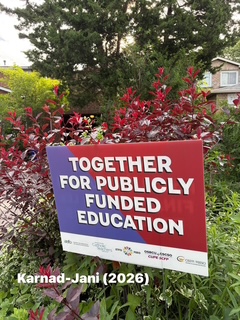
Lawn Sign That I Picked Up at Our Local’s All Members’ Meeting.
The gentleman pointed to this sign and asked what’s now the subheading above.
“Yes”, I replied.
“That’s very important to speak about and stand up for”, he commended.
I moved the conversation further, or what’s a weekend for? (A little Robert Browning inspiration there).
“Do you see here”, I asked… “It’s all the unions who represent who work in publicly funded in education.”
“Oh, I didn’t know that”, he responded. “My wife is a retired teacher. All of us need to talk about this.”
Deepening The Dialogue
Then I offered, “Would you like a lawn sign? I have some in my car”
“Let me check at home. I’ll knock on your door if I’d like one”, he said.
“I’m at work on Monday. I’ll leave one for you on the porch before I leave.” I offered.
I also mentioned that I also have a button if that’s preferred.
Theory to Action
My public pedagogy course was in 2011. It is the doing of it that matters in the everyday work.
Whether with an ETFO YR banner at the Markham Cricket Academy ground thanks to the initiative that came to fruition through our Political Action Committee, or this conversation as I was outside, I continue to convert the theory into action and I am inviting you to join me.
Why Should I Care?
… people may ask us if you like me, walk through your spaces wearing your red shirt on weekends.
This Is What I say
I understand your question.
My children aren’t in school anymore.
Not everyone in our communities is a parent.
But we all know children, we know of children.
I say this because James Baldwin reminds us of this:
“The children are always ours, every single one of them, all over the globe; and I am beginning to suspect that whoever is incapable of recognizing this may be incapable of morality.”
Walk With Me, Fellow Traveller
Take one small step with me.
Talk to just one person.
Then one more.
Then one more.
Because…
Talking to people matters.
Making this work a human connection matters.
Reaching out with a “would you like a button” matters.
Publicly funded matters because children matter, families matter, educators matter.
As we engage in distance/remote/online/emergency learning Educators are being inundated with resources and tools to use in their virtual classrooms. It isn’t easy to decide which would be most effective and which ones are safe for teachers and students to use. There is no one size fits all answer to this but there are a few things that I do in order to narrow down my choices of whether or not to use a particular digital tool or resource:
I search for tools that are designed by Canadian or better yet, Ontario Educators and where possible, data is housed in Canada.
I look at whether or not the tool will still be free after the COVID crisis is over or whether it has always been a free tool. I honestly don’t mind paying for a tool from the outset but I don’t really like the whole free trial thing. I also don’t want to pay some kind of a monthly fee. One time price, please! I don’t want to love a tool so much while it is free and then have to pay for it when I go back into the classroom.
I look at whether or not it is a one time fee or negative billing. I won’t give anyone my credit card to start a free trial for a tool.
I search for tools that I know will be supported by my ICT department. Anything that wants access to email contacts in my school board is a non-starter.
I search for tools that inspire collaboration and creativity. I’m not one to sign up students for a gaming platform that is really just an engaging math drill.
I look at bang for my buck (even if it is free). Is it a versatile tool? Does it allow for different forms of communication? Can I embed audio and video? Is there an opportunity for a variety of feedback methods?
I look at the Privacy statement. Although I am no expert in this, I can generally tell when something has red flags. Anything that is attached to third party social media platforms like Facebook is a non starter for me.
Right now while there are so many sign ups and passwords for students, I stay away from platforms that want to create student accounts and want information apart from an email.
I look to see if it is a Microsoft or Apple Education certified product? I know that for the most part, those tools are trustworthy.
I look at user reviews and YouTube tutorials. I want to know what the pitfalls are of something before I invest time and/or money.
At the end of the day no tool is perfect and few tools are unlikely to meet the specific needs of each and every student in your classroom. However, I hope that what I do when choosing a tool might guide you to the most effective tools in the over abundance of resources that are floating around out there.
We brought another amazing decade of learning to a succesful close with passion, creativity, and purpose. For ETFO it has been 21 impactful years in the service of public education, students, and educators.
It’s my 11th year as an ETFO member, and I am looking back at the past decade with some mixed feelings. Perhaps it is a function of the time of year when all of the best and worst lists are being shared in the media? Regardless, I am thankful to be an educator who works with wonderful students and amazing staff at a great school.
On the other hand, I am also intrepid about what is continuing to widening gap between student needs and the resources with which to support them. What will the future look like if government cuts and policies changes go unchallenged? This got me thinking about how instrumental the work of ETFO is to supporting us and I found myself browsing through pages of resources, messages, and initiatives via etfo.ca
Whether you are newer to the profession or a veteran educator, I thought it would be a good idea to look back at the positive impacts made by our union that have helped us get us here, and as we prepare to for 2020.
Let’s take a moment to break down some of the numbers from 21 years of ETFO:
Membership ~ Let’s use 75 000 as the mean number of teachers from past to present.
Days of Instruction ~ 21 years x 190 days = 3990 days
Minutes (days x 300 minutes of instructional time x membership) ~ 8.9775 x 10 ^10 minutes
For the sake of my own brain, I am going to say a lot of learning has occured as a direct result of tens of thousands of past and present caring ETFO educators. Millions of moments curated that have culminated and contributed to millions of positive impacts in and out of classrooms. Millions of moments where struggles turned into opportunities and hard work paid off. Millions of students who have gone on to do amazing things. Millions of lessons learned with millions more still to come.
Without becoming too nostalgic, I think it’s a great time to take stock of all the amazing things that have happened that have ensured the voices of elementary educators will be heard. 21 years on the shoulders of giants who have stood tall in the face of adversity to prepare a way for future teachers to succeed. To all of those who have taught before and alongside me, I am grateful.
Grateful for:
21 years of lessons learned in and out of the classroom.
21 years of remaining on the cutting edge of technology and ongoing teacher training
21 years of inclusivity and equity
21 years of looking out for the safety, mental health, and wellbeing of our membership
21 years of dispelling myths with facts
21 years of commitment to something bigger than themselves
21 years of standing up for students, their families, and to make public education better/stronger
21 years of fighting against the malicious mandates of socially and fiscally tyrannical governments
21 years of solidarity
Such success is something to celebrate. Especially, with a strike mandate of 98% in favour this past Fall. Our collective voices and our profoundly positive professional impact will not be dismissed or ignored.
While certain media factions seek to villify our profession, we know that we possess the power to light the way for public education well into the coming decades. When elected officials undermine our collective good in the short term, we remain focused on the future by standing together now. Side by side, ours are the shoulders to stand on.
As I shared earlier in this post, the numbers show that the possibilities grow everyday an ETFO educators enters a classroom. Bring on 2020!
Cheering you on everyday and looking forward to celebrating an even better future in education. Thank you for reading.