Years ago in graduate school, specifically in my MEd programme at York University, I had taken a course on Gender, Race and Social Class especially because the last concept was important to me.
I’ve always known that class is the secret ingredient of oppression in addition to and intertwined with the BIG ones.
Social class always worsens the other oppressions that people experience.
One of our assignments was observing public pedagogy how do you spread a message in society and connect with people about what matters most? At the heart of my learning, this was my takeaway. We can have plaques and posters, hashtags and bumper stickers.
Public Pedagogy is just a big word for “talking to people” and talking to people is an excellent and sustainable way of influencing ongoing action for social justice in education.
How I Was Raised Informs How I Show Up
At the All Members Meeting at our local on June 4th, President Mastin reminded us that the complexities of communities is a key factor. We know this based on how our working conditions are impacted by the needs and strengths of the communities whose children are in our classrooms.
Some children have less.
Some children need more.
A gift card of 750/- does not make this reality go away.
I know about social class from living in a monochromatic demographic in all the cities I’ve lived in and travelled to in India. So I know what I’m talking about.
This knowing comes from being taught to notice and name. It comes from being invited to feel the discomfort of observing social inequities.
It mainly and above all comes from being raised by parents who reminded me: “Rashmee, look around you. What do you see and who has less than you do? What can you do to change this?”
A Sunny Breezy Saturday Morning
So here’s what happened this Saturday morning.
A neighbour is getting some work done in their backyard and the contractor pulled in to the street. I don’t usually see them as I’m at work long before this time.
Is That Your Sign?
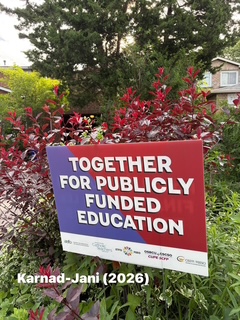
Lawn Sign That I Picked Up at Our Local’s All Members’ Meeting.
The gentleman pointed to this sign and asked what’s now the subheading above.
“Yes”, I replied.
“That’s very important to speak about and stand up for”, he commended.
I moved the conversation further, or what’s a weekend for? (A little Robert Browning inspiration there).
“Do you see here”, I asked… “It’s all the unions who represent who work in publicly funded in education.”
“Oh, I didn’t know that”, he responded. “My wife is a retired teacher. All of us need to talk about this.”
Deepening The Dialogue
Then I offered, “Would you like a lawn sign? I have some in my car”
“Let me check at home. I’ll knock on your door if I’d like one”, he said.
“I’m at work on Monday. I’ll leave one for you on the porch before I leave.” I offered.
I also mentioned that I also have a button if that’s preferred.
Theory to Action
My public pedagogy course was in 2011. It is the doing of it that matters in the everyday work.
Whether with an ETFO YR banner at the Markham Cricket Academy ground thanks to the initiative that came to fruition through our Political Action Committee, or this conversation as I was outside, I continue to convert the theory into action and I am inviting you to join me.
Why Should I Care?
… people may ask us if you like me, walk through your spaces wearing your red shirt on weekends.
This Is What I say
I understand your question.
My children aren’t in school anymore.
Not everyone in our communities is a parent.
But we all know children, we know of children.
I say this because James Baldwin reminds us of this:
“The children are always ours, every single one of them, all over the globe; and I am beginning to suspect that whoever is incapable of recognizing this may be incapable of morality.”
Walk With Me, Fellow Traveller
Take one small step with me.
Talk to just one person.
Then one more.
Then one more.
Because…
Talking to people matters.
Making this work a human connection matters.
Reaching out with a “would you like a button” matters.
Publicly funded matters because children matter, families matter, educators matter.
We go from here and there through our day. Sometimes, we go to new places around our usual work location, whose address we enter into our devices so that we arrive promptly with time to spare, even. So one day recently, I thought I was just going to work.
The Context
Since December 2024, two colleagues and I have been collaborating with consultants in another department to work on a key resource that has helped many and will continue to help more students and educators as we move forward. Sometimes in March, just before a series of professional learning sessions, we met again. We had to get through a lot.
The Necklace Started It
I have always loved necklaces and I always wear one when I’m not in classrooms. This was one such piece.
My Necklace From Mumbai
As colleagues from the other department came into the meeting room one of them complimented me on my choice. I thanked her and added, “It’s from Mumbai. Like me”.
A dear friend with whom I’d attended school (Grades 9-10) had gifted it to me from her collection when she visited last summer. But I didn’t have time to share that as we were at work, you know. We had a lot to do.
My colleague smiled warmly and asked, “Where in Mumbai?”
Where in Mumbai?
At the end of that long and busy week, my heart skipped a beat: In 21 years of working in education and 23 years living “here”, no one had ever asked me “Where in Mumbai?”
“Dadar”, I said.
My colleague told me where she grew up and I reminisced that I used to go shopping in that neighbourhood and had fond memories of some beautiful silver jewelry pieces I had bought there. I had also worked nearby to where she’d grown up. We talked about these places we both knew from what seems like another lifetime.
The glow of that conversation stayed with me and now we talk about books and authors and other things when we are in the same place, warming lunch.
Why This Question?
I have many friends in many spaces at work. We have lots of conversations and have many fond memories over the years. We talk about books, family (ours), pets (theirs), dreams and many other things.
Yet, just one question “Where in Mumbai?” has stayed with me differently. It is as if a locked door has sprung open.
Some points that come into view for me that I want to share with you, my fellow traveller.
I think about how we, as educators, recognize intellectually that the whole child comes to school.
Yet many of of us aren’t able to bring our whole selves to work.
I/we don’t talk about everything that makes me/us complete because either there’s too much to do, or more often, I/we don’t think anyone else knows of that place, that food, that fragrance and so on
I am sure there are many more meanings that will come to the surface for you and me when you read this. Do share.
There’s A Ghazal (Poem) For That
So here are some lines from a ghazal written by Gulzar and sung by Jagjit Singh that explain that feeling of perhaps being The Only One in a space. These lines explains the feeling of a solitude that I couldn’t put into words until that question “Where in Mumbai?
“Aainaa dekh karr tass-allee hui
Humko iss ghar mein jaan-taa hai koi”
The Translation Goes Like This
I was reassured when I looked in the mirror
That someone knows me in this house.
Thank you, dear colleague- friend who has memories of Mumbai. Not identical ones, but just like I do.
I can’t wait to see you again.
Fellow Travellers, I wish you such unexpected and pleasant encounters in your work spaces.
And if you know Mumbai, or Goa, please write back.
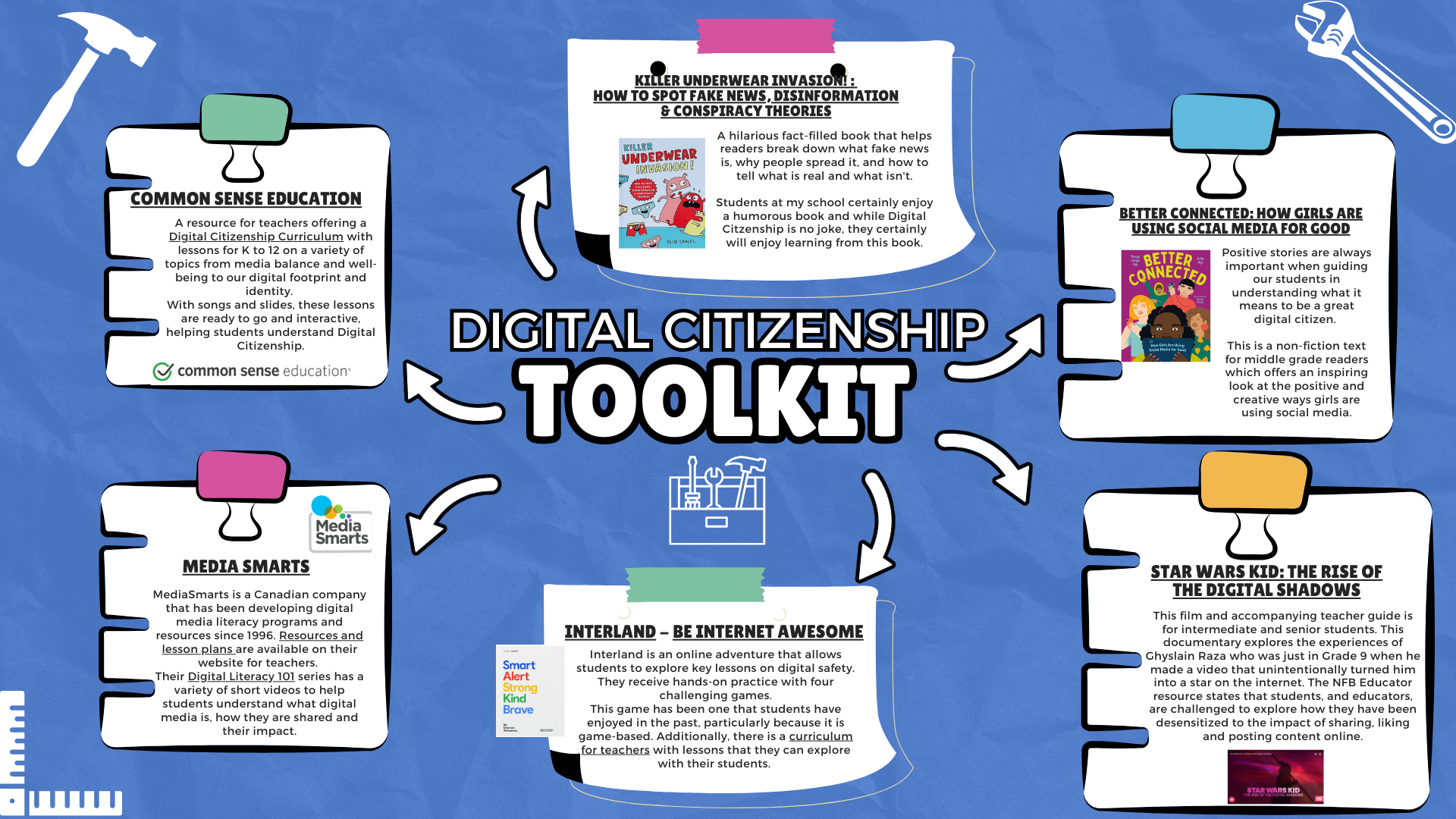
I love it when a good plan comes together. I’m currently taking my Teacher-Librarian AQ and was recently tasked with creating a Digital Toolkit with resources for Digital Literacy. Considering October marks Media Literacy Week and Digital Citizenship Day, I thought it was serendipitous as it gave me the opportunity to reflect on past tools that I have used with students and consider what else I might use. In this post, I’m sharing the resource and a few other ideas that we might use with students.
My Digital Toolkit
By no means is this an extensive list. I tried to get a few different types of resources to include in the toolkit – digital, books and a video. I also tried to include information for teachers and students. Click on the image below and you will be able to access a PDF version of the file. The links are live and will take you to the resource.
Additional Resources
Listed below are a few other resources that I found particularly helpful when reflecting on activities I wanted to try with my students. Please check them out!
Lego Build and Talk – Great conversation starters for families around Digital Citizenship. Lego Gloom Busters is an online activity to help children learn about online safety. Lego Doom the Gloom is an interactive experience to build online safety skills. Lego Smart Dash is an online game to teach children how to make the internet a safer place.
PBS Learning Media – Digital Citizenship Lessons for a variety of grades
Media Smarts – Media Literacy 101 – Simple videos that support students in learning the key concepts of Media Literacy. Videos include a question or challenge at the end for students to consider what they have learned and/or a real-life application.
While we’re close to saying goodbye to October, there’s an ongoing need for students to further develop their Media Literacy and Digital Citizenship skills. I hope that you may have found something new or useful to use with your students.