End of Year Celebration

To celebrate the end of the year in our Full-Day Kindergarten classroom, we opened our doors for parents and guardians to share our successes. We scheduled it for a half hour in the morning at entry time. The children helped plan for the celebration by taking home invitations, creating a welcome sign for our door with the word welcome or hello in various languages that reflect the home languages of our students. The children also were invited to wear traditional clothing that reflected their heritage on the day of the open house. We were thrilled to have so many parents come to our casual event. They sat around the room and watched our morning circle – as we always start the day with sharing how we feel. Then the children moved to the tables where their writing portfolios and art folders were displayed. They were so proud to show their work! Then the children moved around the classroom as guides, showing their parents their work that was displayed and their favourite learning centres.

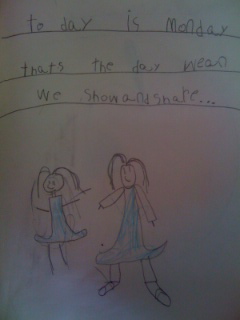
In the afternoon, one student drew a picture of her and her mother and wrote,”Today is Monday. That’s the day when we show and share…” She said she was happy to show and share her work and classroom with her mother.
Kindergarten Learning Buddies

In January, my Kindergarten class began regular weekly meetings with another class in the school. I was new to the school this year, and Reading Buddies were not formally assigned as they are in some schools. The first few months of the school year had been hectic, as I was new to the staff, the FDK program was just being introduced (with wrinkles to smooth out), and the students were adjusting to the demands of a full day of routines and a new environment. As I got to know the staff, I found that I shared a similar teaching style and inquiry approach with the Grade 6 teacher, Mrs. Robinson. In early December I approached her with the idea of bringing our classes together as “Learning Buddies” – an idea that she welcomed. We made our plans to start meeting in January on a weekly basis for a double period.

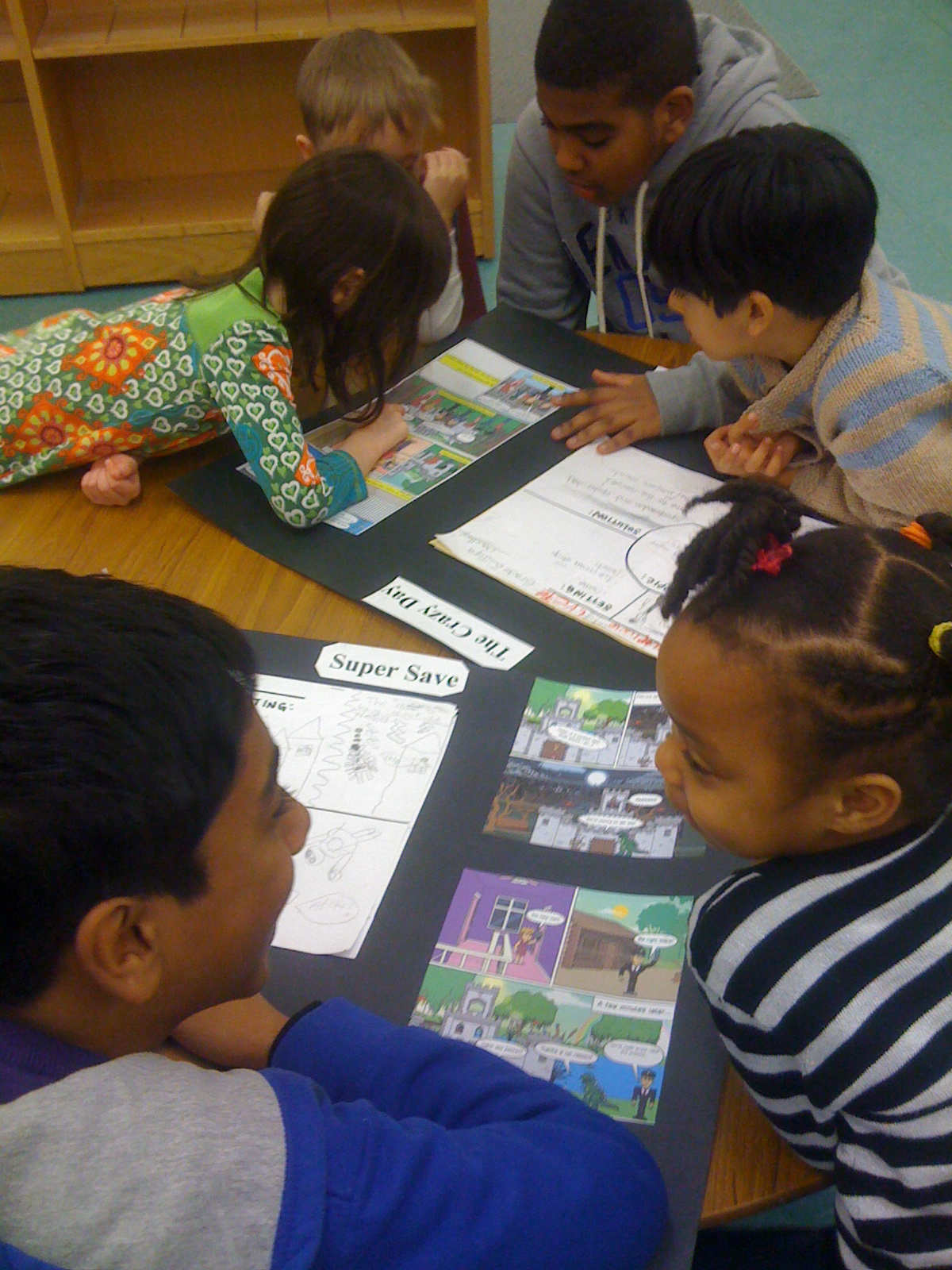
The initial meetings were mostly unstructured. It allowed time for the students to get to know one another. Mrs. Robinson and I had previously matched our students based on their needs. I have a few students with communication needs and others with behavioural concerns who would benefit by being matched with empathetic, patient and consistent students from the older class. There were adjustments in the matches that we made, and when students are absent we casually add their partners to another grouping. This relaxed approach makes it easier for the little ones to adjust, and we find the students in the classes are getting to know more than just one student. They tend to team up into small groups now, and we provide opportunities to allow for this development of relationships.

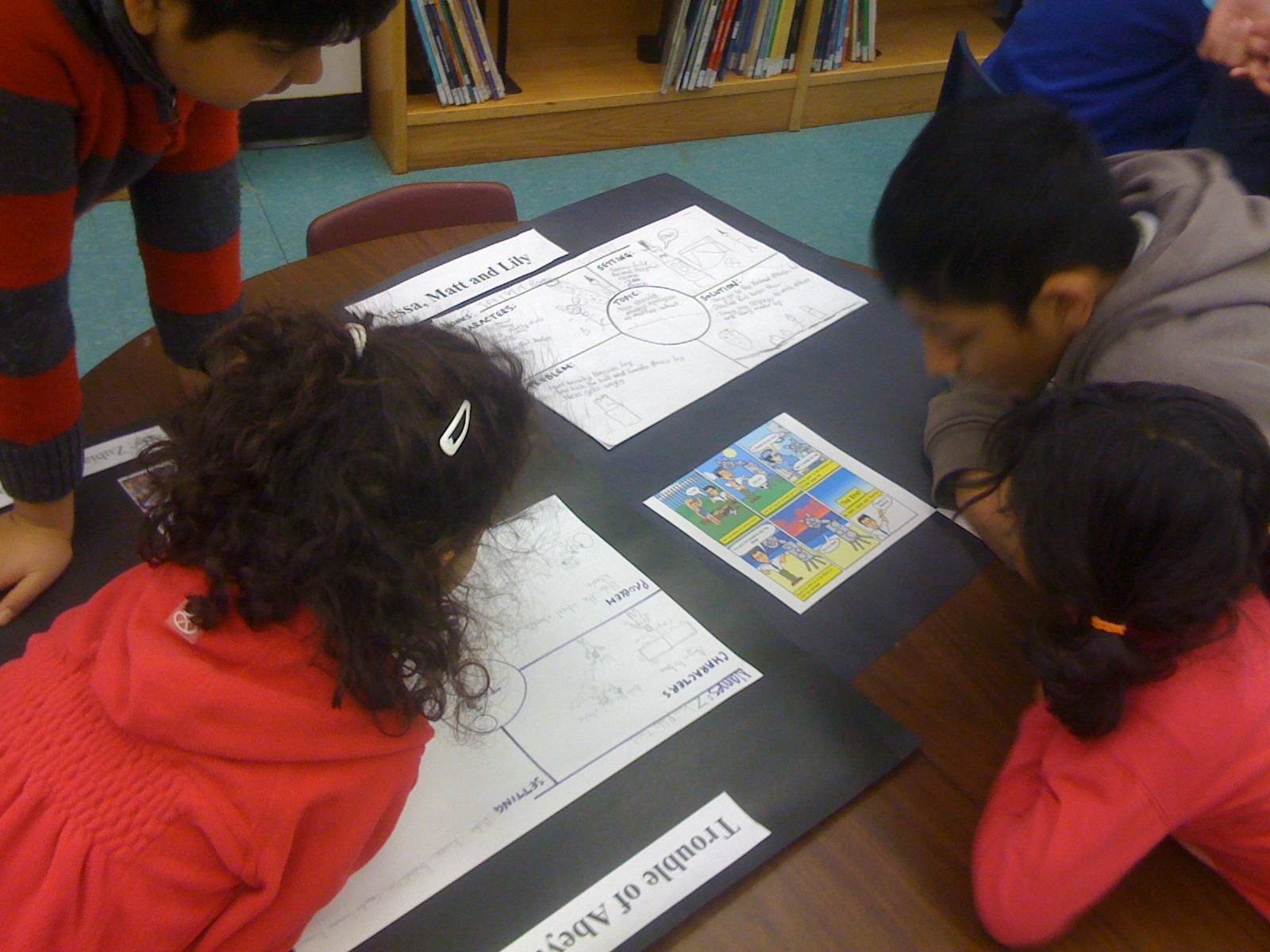
After a few meetings with the students sharing books and getting to know one another, we introduced a project that would integrate language and technology. It included the following:

  • brainstorm/create a story with your Learning Buddy
  • use the graphic organizer provided to record the topic, setting, characters, problem and solution (Grade 6 students write and Kindergartens can write or draw pictures to represent their ideas)
  • use 4 to 8 box organizer to draft story into a comic strip, adding speech bubbles and caption
  • create comic in Bitstrips program using laptops provided
  • teachers print one page comics in colour and take photos of Learning Buddies
  • arrange original plan, completed colour comic strip, and photo of Learning Buddies on bristol board for display
  • participate in a Gallery Walk of the completed work
The outcomes of this project were positive for all involved. We found that the students were engaged at all meetings. We noticed that the older students respected the input of the younger children and there was observable collaboration in their work. The Kindergarten children were able to retell the stories that they created and in addition to understanding the beginning, middle, and end – many also understood the concepts of setting, characters, problem and solution. Mrs. Robinson has noticed how her Grade 6 students have taken on a more responsible attitude with this role and they are genuinely interested in working with the younger students. We plan to meet regularly until the end of the school year. We have just started a topic/project about the environment that will hopefully include some outdoor gardening. This connects to the curriculum that both classes can extend separately in their individual classrooms.


Integrating Arts, Language, and Science

In my last post, we left off with an inquiry about snow and ice, which ultimately led to water. It wasn’t that the students were particularly interested in water, but it seemed a natural segue from ice to water, and I had a particular book in mind that I wanted to read to the class. We had also learned about cycles (big idea) in various forms since October, such as the cycle of the seasons and the weekly cycle and daily cycle. To initiate our topic about water, I first asked the students, “Where does water come from?” Some of the responses were:

“Water comes from sinks.”

“Water comes from waterfalls.”

“Water comes from the sky.”

I then read the book titled, All the Water in the World by George Ella Lyon. It is a book that captures childrens’ imagination and interest. I read it to the class a few times. Each time we discussed the descriptive words. We also created a diagram of the water cycle.

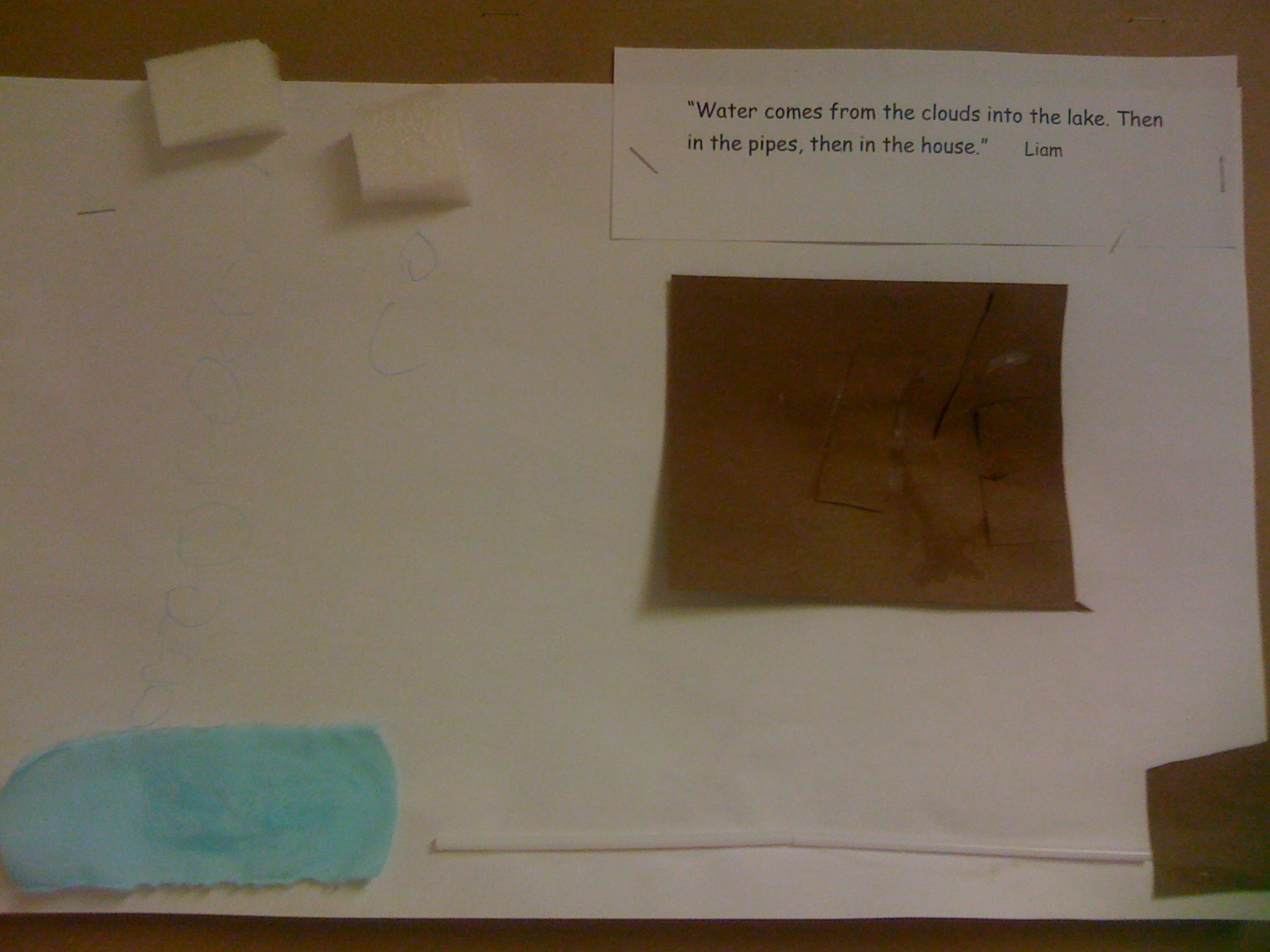
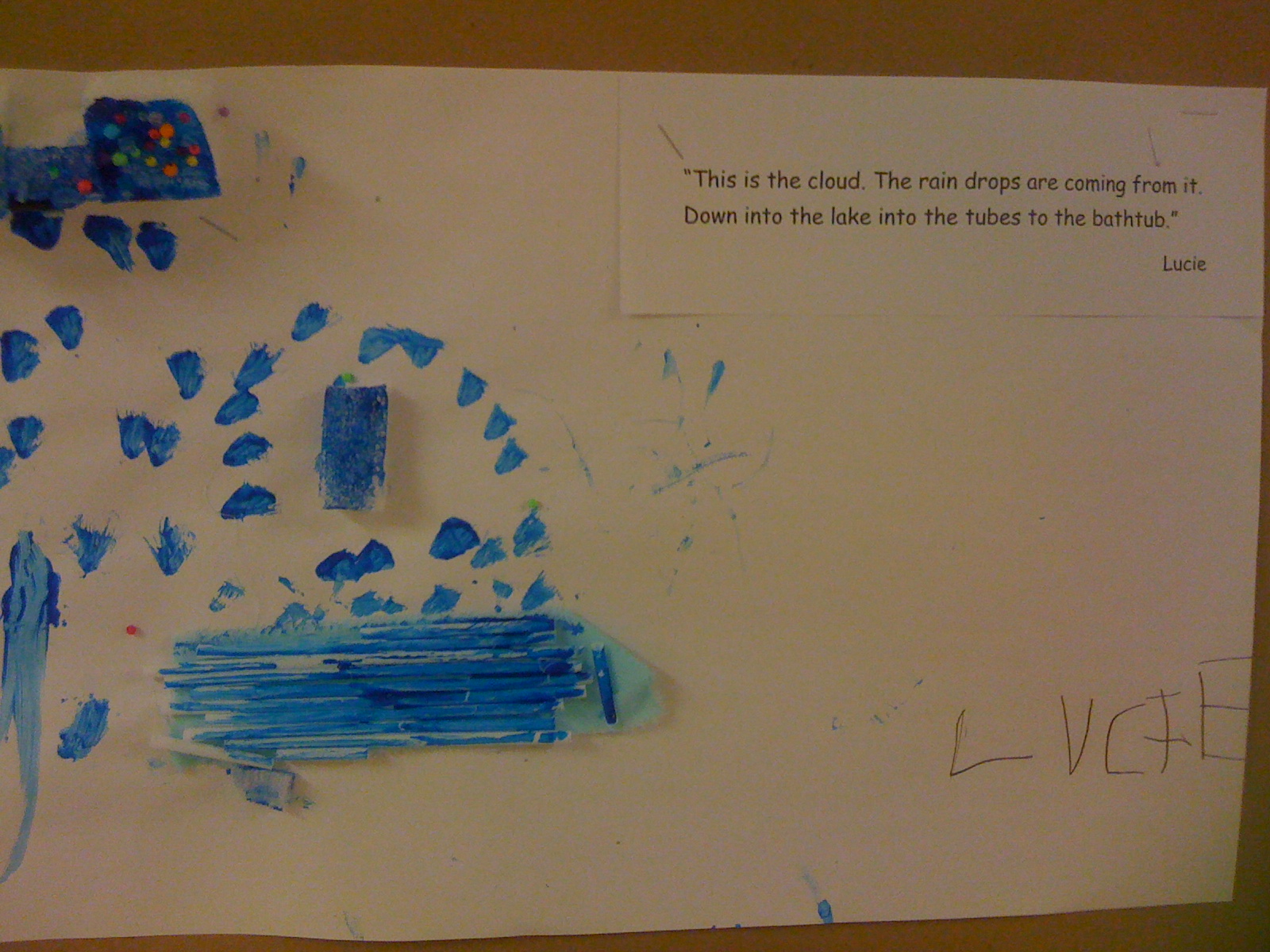
At the end of the week, I selected materials that I thought they could use to demonstrate their understanding. The materials were shades of blue paint, white styrofoam, straws, small beads, and construction paper in blue, brown, and black. The children could select from any of these materials, but by controlling the palette I knew the outcome would resemble their intentions.

I asked the students to show where water comes from or where water goes. Their finished works showed their learning and understanding about the water cycle, it also demonstrated their use of language and how effectively they use materials for visual arts.


Water comes from the clouds into the lake. Then in the pipes, then in the house.”  (JK student)


When we wash our hands it goes from the washroom to the lake through the pipes.” (SK student)


This is the cloud. The rain drops are coming from it. Down into the lake, into the tubes to the bathtub.”  (SK student)

These small projects integrate many subjects and provide the children with authentic learning that they can relate to in the everyday world that surrounds them.

Fairness in Kindergarten

Fairness is a hot topic among children in Kindergarten! It is one of the first judgments that you hear as one child confidently points out that something isn’t fair. After reading Carmen’s informative and thought-provoking post about equity, it encouraged me to consider it in the context of the Kindergarten classroom.

I have found that read-alouds about topics such as fairness are a good starting point. The stories are didactic in that they provide characters and scenarios that the children can relate to and support personal connections for the students. The message is conveyed in a less instructional, more entertaining way.

The book, Big Red Lollipop by Rukhsana Khan, is an example of an engaging story that addresses the idea of fairness not always having to be the same for everyone. It is a story about a girl, Rubina, who is invited to a birthday party. Her mother insists that she brings her little sister, Sana, an embarrassment to Rubina. When it comes time for Sana to get invited to a birthday party, their mother wants to send the youngest sister. Rubina interjects and tells her mother that only Sana was invited and she should go alone, knowing that her sister will have a better experience if their experiences are different. Sana appreciates her sister’s understanding and shows her appreciation with a lollipop.


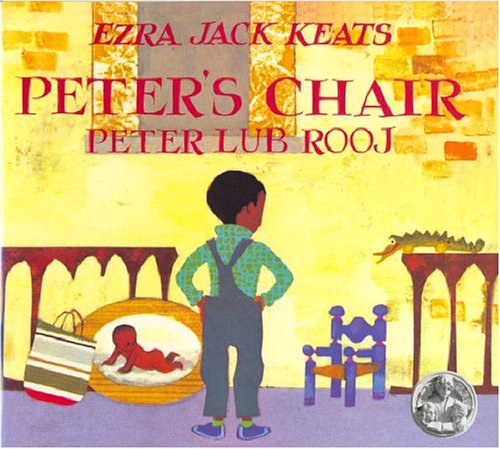
Another book to read aloud for discussion, is Peter’s Chair by Ezra Jack Keats. In this story, Peter is upset when he realizes that many of his things are being painted pink for his little sister to use. The highchair is already painted, but he rescues his little chair before it succumbs to pink paint as well. He wants to run away with his special chair, but realizes it is now too small for him to sit in. He returns with the chair and they paint it for his sister. Although, the bigger idea is about acceptance and change, there is also a connection to the idea of fairness. As we grow, expectations change and what was once appropriate may no longer be the case. Things do not remain the same, situations change, and what was considered fair may not remain so.


There are many opportunities to talk about fairness in Kindergarten. Often, the teacher may need to respond to the statement, “Why does he get to do that? It’s not fair.” And the teacher will respond, “Fairness isn’t the same for both of you. It is what he needs right now.”

Reporting for JKs

The Junior Kindergarten Summary is an important document, as it is the first formal written assessment that parents may receive about their child. In saying that, there also should be no surprises when they read the report. Part of the reporting process in Kindergarten is to provide ongoing assessment in an informal basis when necessary through notes, phone calls, or updates during face-to-face interaction at entry or dismissal times. If you feel that a report you have written may have information that would be of specific concern to the parent, you may want to give a “heads up” phone call before your reports go home in February. If however, you have shared information with parents/guardians regarding a child’s struggles or difficulties in adjusting to the program, then the report will be of no surprise and act as a record of the child’s development at this time, which may be referred to if struggles continue in the next year or two.

The Summary includes three broad areas to provide information for:

1) Interests and Strengths – Try to individualize reports as much as possible. In this section you want to highlight what the child can do (not what they can’t do compared to others). Qualifiers on scripted sentences will not work, as each child will have different interests and different strengths. Suggestions for this section include mentioning the learning centres that the child most enjoys, the ways in which the child contributes to the class, and what attributes the child brings to either group discussions or play.

2) Development and Learning – In this section I would suggest providing assessment on the child’s development according to any of the six areas of development: Personal and Social Development, Language, Mathematics, Science & Technology, Health & Physical Activity, and the Arts (see http://www.edu.gov.on.ca/eng/curriculum/elementary/kindergarten_english_june3.pdf). Remember, you are stating where the student is based on the outcomes/expectations at the end of a two-year program. In this section it is a good idea to draw on specific examples of a child’s learning by quoting what they have said, or referring to something they did or created.

3) Planning for Further Learning – Here you can provide two short paragraphs. One for the planning that the Kindergarten teacher/team will implement to support or extend the child’s learning, and another short paragraph to suggest practical ways that the parents/guardians can help the child at home. Rather than suggest “reading to your child” (which we always want to suggest), you can add specific ideas like counting the floors on an elevator ride to your apartment; counting cheerios at breakfast, learning the sounds of letters on cereal boxes, learning how to write the names of family members. These suggestion may sound obvious to you, but they may be more useful to the parent than suggesting they work on letters and numbers with their child at home.

When you re-read your finished reports, it is important to get a sense of who the child is – including their strengths and needs. It is also a good idea to add an encouraging line at the end of the report, noting the child’s efforts and accomplishments in their adjustment to Junior Kindergarten.

Photo of Carmen Oliveira

What’s On My Professional Learning Bookshelf?

A question that sometimes comes up in my ongoing teaching-learning cycles with colleagues and beginning teachers is, “What books do you recommend I read for my own learning?”  Yikes, this is a tough one!  As teachers, the truth is that if we were to pile up the professional learning books we’ve read and/or used throughout our careers we’d easily surpass the height of the CN Tower (I know you it to be true)!

I tend to prefer sharing some of my favourites and those on my shelf at this moment.  The following books are ones I’m currently going through (and enjoying!) because of insights, lessons, questions, and reflections they’ve sparked in my professional learning.  I’ve added the links to their websites which I find very helpful.

Tuned Out: Engaging the 21st Century Learner- Karen Hume

This book invites readers to both rethink what it means to teach and learn in a digital age and put those ideas into action.  The ideas are practical, closely tied to current learning theories, and important to take into consideration within the current reality of how students learn and become engaged.  Along with the book an educator can use the website which becomes a virtual classroom for teachers to both gather and share ideas.  This resource helps educators realize an energized, student-focused classroom that takes advantage of today’s digital technologies.

http://www.karenhume.ca/resources/publications/tuned-out/


What Do They Really Know? Assessment That Informs Teaching and Learning- Cris Tovani

This book explores the complex issue of monitoring, assessing, and grading students’ thinking and performance with fairness and consistency.  The author admits to struggling to balance her student-centered instruction wit school system mandates.  Her recommendations are realistic and practical and understands that what isn’t manageable isn’t sustainable.  Cris shows teachers how to use assessments to monitor student growth and provide targeted feedback that enables students to master content goals.

Below are a link to a blog and an interview with the author about the book.

http://readingyear.blogspot.ca/2011/07/so-what-do-they-really-know-by-cris.html


http://www.youtube.com/watch?v=c3ir43_qzPU


Photo of Erin G

New Years Equals a New Leaf

     I know there are lots of clichés around the start of the New Year and I have to say that I believe in every one of them. As far as teaching is concerned (in my experience), there are guaranteed to be two magical times of the year where everything goes smoothly and you feel on top of the world. The first is the very first week of school in September where your bright-eyed students sit complacently hanging off your every word. The second couldn’t come at a better time and occurs upon the return from the winter holidays. New Year’s coincides with a shift of cosmic, spiritual or divine proportions and seems to permeate the psyche of even hormonal eighth graders. It is a small window where people stop to take stock of the past and visualize the future.
     As a teacher, this “pause” is a golden opportunity not to be squandered. In this momentary blip (which might last a few days if you’re lucky), it’s as though students have suffered a mild form of amnesia. Apart from being slightly annoying from a pedagogical perspective, it nonetheless allows you to chart a new direction. Changing up the look of your classroom with new displays, layout and seating plan is refreshing and energizing.
     A fresh start has a lot of appeal on many levels not only for you the teacher but for your students as well. Although it’s often said that students thrive on routine, it’s also true that change, spontaneity and an element of surprise go a long way as well. Don’t neglect the fact that your students might also be affected by the psychological hype surrounding New Year’s. I would bet that many of them are thinking about their own ambitions and might have something specific that they would like to achieve. Others might need a blank slate and a chance to start over with you. Any way you look at it, it’s good to capitalize on the energy and momentum surrounding the New Year and move forward with positivity, renewed energy and vigour.

*Some suggested New Year’s Activities:
Have students write down a goal they wish to achieve by the end of the year. At the same time on another sheet of paper, have them envision some of the difficulties they might encounter and write a short encouraging letter to themselves. This teaches them how to set realistic goals, anticipating challenges. At some point, have them read their letters to themselves and compose another to also be opened in the near future. Repeat the process until the final time when they re-read their goal an have them assess their progress.

On a small piece of paper, have students write down something they do not want to carry with them into the New Year. It can be a bad habit, a personal quality or negative situation. In real practice, you would toss your paper into a bonfire symbolizing that you are leaving your burdens behind. This is obviously not an ideal method of disposal for a classroom situation – something equivalent might be the shredding machine…

Photo of Erin G

Social, Popular, Empathetic and Strong Leaders – Today’s Bullies?

Back in October, I read an article in the Globe and Mail by Anthony Volk entitled “Why Bullies Do What They Do.” In brief, it was a very succinct yet comprehensive synopsis of the causes and (proposed) solutions to bullying. At the time, something about it stuck with me and I came back to it when in need of something to blog about during the crazy month of December. Interestingly, there were distinct echoes of Carmen’s grade 6 Bullying Task Force around the ideas of choosing behaviours and belief systems. In identifying the main reasons for bullying, Volk reduces them to just three.
– to get resources (ex. lunch money)
– to get dating partners
– to get social power to be used in getting resources, dates or favours


As indicated by voluminous research, Volk describes the typical bully as someone who has “average or greater social skills, popularity, leadership, cognitive empathy and physical or mental health.” Upon reflecting about this statement, I vacillated between two contradictory trains of thought. On one hand, I found myself thinking that these were pretty basic goals for someone with a wide range of attributes and that given that, they would have been able to achieve social power through less basic means. On the other, I would have assumed (or rather hoped) that above average social skills and cognitive empathy would have prevented bullying in the first place.


Perhaps what struck me most about the article and the most recent publicised cases of bullying was something I took for granted but hadn’t really consciously considered. It would seem that the classic profiles of bully and victim are blurred and that the anonymity of social media has emboldened and perhaps intensified cases of bullying. The root of it would seem to be the need to exercise power (even in the most basic ways) over someone else. Some people would argue that such a need is innate and an undeniable part of human nature and as such, bullying is much more difficult to tackle in a lasting, meaningful way.

Photo of Erin G

A Response to “Talking and Listening Chairs” – Les tête-à-tête sont une nécessité

Having read Sangeeta’s blog about how ongoing conflicts can sometimes hijack your teaching agenda, I was struck with her concept of the “Talking and Listening Chairs”. From my own experience, I know that students seem to run into MANY misunderstandings and oftentimes lack both the forum and the verbal skills necessary to successfully solve their conflicts. Quite frankly, I think her idea is brilliant and the guidelines surrounding their use are thoughtfully considered. She has clearly established boundaries and parameters that would ensure success. With obviously less disruptions for the teacher, the real beneficiaries are the students themselves. Actually having a chance to air their grievances can help diffuse and prevent an emotional conflict from escalating into something more serious and simultaneously allows students to take ownership for solving their own problems. Finally, the end result would be to forge a stronger, deeper rapport between the children and a positive classroom atmosphere. Wow, all that from two chairs! Personally, I’m going to have to think a little more how I could implement this idea as a rotary teacher with older students and a cart (no permanent classroom)…

Photo of Erin G

Keeping It All in Perspective – Teaching Really is a Far-Reaching Profession

As teachers and former students ourselves, we know the impact that we can have on students. One just has to think about “rateyourteacher.com” or think back to our impressions of our own past teachers to realize how distinct and ingrained our memories really are. As we embark on another (or perhaps the first) year in the most “noblest of professions”, it seems like a good time to psych ourselves up with such inspirational thoughts before we are rendered irate and exasperated by that particular student who drives us nuts. I originally planned to address one of the suggested topics of discussion regarding your “most remarkable student” and how you were able to make a difference. In the process of reviewing the legions of young adults I’ve come into contact with in the past 10 years of teaching, I digressed and instead became sidetracked with the notion of time. Nothing brings home the quick passing of years like bumping into a former student who is now teaching your own children. For those of you who have also taught for a while, I’m sure you can relate. Mentally flipping through the faces of all my former students in search of the most remarkable brought to mind many who stand out for their compassion, their funny jokes, their temperamental nature, etc. There are also those who are memorable not only for who they were, but also for what they became – the suicide, the innovative scientist, the high school dropout, the successful entrepreneur, the teenage mother, the infamous actor, the murder victim, the accidental death. What struck me as interesting was that for both of us, we remain frozen in time and are lastingly perceived as a grade 8 teacher and a boy/girl of fourteen. All of which made me appreciate the fact that each year with every new batch of students, relationships, interactions and impressions are formed and will mutually impact us in a way that is more profound and enduring than we realize.