
Why Ontario Teachers Need to be Political

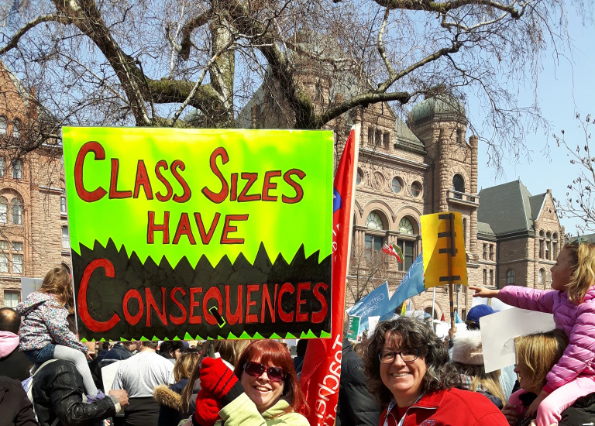
Class sizes have concequences

According to The Washington Post’s Valarie Strauss “Teachers are often expected to remain politically neutral in class, not letting their students know which candidate they support or where they stand on controversial issues” (Strauss, 2016).

Parents may anticipate that teachers could “indoctrinate” students by expressing their own views in classrooms (Strauss, 2016) and as a result, so many teachers are tentative to discuss their political views.

Given that “teachers teach who they are” (Susan Drake, n.d.), it’s hard for teachers to be neutral in their passions for education and especially for the inclusion and equity of students.

I state that the act of teaching is a political act as classrooms hold future citizens and what teachers say and do matters.

Teachers teach children to become creative, collaborative communicators, critical thinkers, problem solvers, and global citizens. Teachers help their students become good citizens or as Dewey stated the “organization of the school, as it affects the mind of both teacher and pupil, [is a] growth and extension of the democratic principle in life beyond school doors” (Dewey, 1903).

The act of advocating for democracy and human rights in schools is a political action – so should teachers be political?  Former state and national U.S. Teachers of the Year wrote in an open letter “there are times when a moral imperative outweighs traditional social norms. There are times when silence is the voice of complicity” (cited in Strauss, 2016).

As teachers, we regularly espouse ideas of supporting human rights, through equity and inclusion. In the act of teaching, we are the political messengers of these ideas. Teachers are role models for students as we set the example through what we say and do. Our students watch our every move in our words and our actions. Teachers’ words and actions matter.

In Ontario politics, teachers’ voices matter and our representation and advocacy through our unions matter. Through the Ontario Teachers’ Federation, teachers represent almost 200,000 voices in Ontario. Teachers’ votes matter!

Results of Ontario political outcomes directly impact education funding for schools, staff, and students. In 1994, the election of Mike Harris cut billions of dollars from education (Martin, 2009). By the time I became a teacher in 2000, classrooms were void of resources – teachers ended up filling this gap directly with money out of their pockets. Teacher salaries are also directly regulated by provincial governments. Politics impacts teachers’ net income.

Teachers have built their advocacy for public education through their boards of education and their agency through their unions.

Should teachers talk about which political party they will vote for on this 2018 Provincial Election Day? Probably not, but teachers can just be who they are … advocates for public education, advocates for human rights, and advocates for the inclusion and equity of all students.

Above all, teachers can be advocates for democracy. The most impactful act a citizen can do to support democracy is to vote.

Teach who you are, be who you are. Vote.

Yours Collaboratively

Deb Weston

References

Dewey, J., (1903). Democracy in education. The elementary school teacher4(4), 193-204.

Drake, S., (n.d.) Professor (PhD), Department of Graduate and Undergraduate Studies in Education,  Brock University, https://brocku.ca/education/faculty-and-staff/dr-susan-drake/

Martin, R., (October 20, 2009). What happened to Canada’s education advantage? The Toronto Star, Downloaded from https://www.thestar.com/opinion/2009/10/20/what_happened_to_canadas_education_advantage.html

Strauss, V., (October 14, 2016). Teachers are expected to remain politically neutral. These Teachers of the Year say they can’t., The Washington Post, Downloaded from https://www.washingtonpost.com/news/answer-sheet/wp/2016/10/14/teachers-are-expected-to-remain-politically-neutral-these-teachers-of-the-year-say-they-cant/?noredirect=on&utm_term=.4ab93d6a23ed

Gender Equity in 2018


women-clipart-at-work-6

The Canadian Charter of Rights and Freedoms outlines what gender equity should look like … but do women really have gender equity in 2018?

In education and workplace participation, gender equity has made some strides.

  • in 2015, women are almost as likely to have a high school (82.5% women vs. 89.3% men) or university degree (83.1% women vs. 89.9% men)
  • in 2015, 77.5% of women were employed compared to 85.3% of men, up from 21.6% in 1950 and 65.2% in 1983
  • in 2015, women are more likely to be away from work (30.0% women vs. 23.9% men) and more likely to be away for a full week of work (38.4% women vs. 24.8% men)
  • in 2015, women are more likely to work part-time (18.9% women vs. 5.5% men)
  • in 2015, women are more likely to do volunteer work (67.2% women vs. 53.0% men)
  • In 1976 – men had higher levels of employment based on the marital status
    • 1976 men – 78.0 % employed single/never married, 92.7% employed married/common-law, and 82.3% employed separated/divorced/widowed
  • In 2015 – women employment rates of women no longer differ based on marital status
    • 1976 women – 79.4% employed single/never married, 44.6% employed married/common-law, and 59.2% employed separated/divorced/widowed

Nevertheless, challenges remain:

Too few women are advancing into leadership roles.

  • Women make up just 21.6% of Financial Post 500* board member (2016)

Women are under-represented in politics in 2015.

  • 26% of those elected to the 42nd Parliament are women
  • women made up 28% of municipal councillors and only 18% of mayors

Women continue to be responsible for the majority of care giving and household unpaid work.

  • women vs. men still spend (25.7 hrs/week) more time caring for their children (in 2010 women 50.1 vs. 24.4 hours/week on unpaid child care)
  • women vs. men are twice as likely to spend more than 10 hours per week unpaid work caring for seniors (49% women vs. 25% men)
  • women vs. men spend 5.5 hours more on housework (13.8 hrs women vs. 8.3 hrs men per week)

Women in the workforce tend to earn less than men.

  • women earn $0.876 for every dollar men earn, largely as a result of inequity between women and men within occupations (2015)

Women continue to experience high rates of gender-based violence.

  • Women have a 20% higher risk of violent victimization than men (2015)
  • Women account for 87% of victims of sexual offences and 76% of victims of criminal harassment (2015)

Some groups are at particular risk for gender-based violence.

  • 10% of aboriginal women were about three times as likely to report being a victim of spousal violence as 3% of non-Aboriginal women (2015)


How does this impact ETFO members?


As 82% of elementary teachers identify as women, women’s issues directly impact elementary teachers.


  • With too few women (21.6%) in leadership roles, women’s voices are not heard.
  • With under-representation of women in politics, women’s needs and equality are not addressed.
  • With more women spending their time, away from work, on unpaid work (caring for children and seniors, housework, volunteer work) , this unpaid work is not valued.
  • With women taking more time off work than men, this means women pay for higher sick leaves and long term leaves (on a personal note, when my children were young, I used 15 days of vacation days, before teaching, to take care of sick children and had no vacation that year). Again, women’s time at work is not valued as much as men’s time at work – if it was, more men would be taking time off to deal with family responsibilities.

Further, our ETFO colleagues are 20% more likely to be victims of violence than men and 87% of victims of  sexual violence. Our aboriginal ETFO colleagues are 3 times more likely to be victims of spousal violence.

Fortunately, female and male ETFO members are paid equitably based on experience and qualifications.

How do we change this?

  • Advocate for women leaders and leadership
  • Advocate for men to take on more caregiving and household responsibilities
  • Advocate for better, more inexpensive and supplemented childcare
  • Start small by changing attitudes and behaviours of women’s paid and unpaid work
  • Challenge gender stereotypes and subtle sexism encountered every day
  • Challenge sexism and discrimination that allow gender inequality to exist
  • Go for leadership roles and run for office

How can you change this on a personal level?

  • Expect men to take as much responsibility as women to care for children and seniors
  • Expect men to take parental leave so women to go back to work
  • Expect men to take as much responsibility as women for household chores
  • Hire house cleaners to clean your house, even if they clean part of the house
  • Advocate for better, more affordable/supplemented childcare, where the childcare workers are fairly paid


In Canada, gender equity is exists but it’s not completely equal. Let’s hope women can make similar strides in improving stats in leadership, unpaid work, and gender violence that have happened in education and employment. Let’s hope in the next 10 years, the stats noted above will look more equal, more equitable, and less biased towards women.

Happy International Womens’ Day 2018

Collaboratively Yours,

Deb Weston

Interesting Resources:

http://interactive.unwomen.org/multimedia/timeline/womenunite/en/index.html#/1840

http://www.unwomen.org/en/digital-library/multimedia/2018/2/infographic-rural-women

http://interactive.unwomen.org/multimedia/infographic/changingworldofwork/en/index.html

http://www.un.org/en/women/endviolence/

https://kids.britannica.com/kids/article/International-Womens-Day/602161

https://www.teachstarter.com/blog/free-international-womens-day-resources-activities/

https://www.internationalwomensday.com/School-Resources

http://www.caaws.ca/gender-equity-101/what-is-gender-equity/

Sources:

*The Financial Post’s ranking of Canada’s largest companies by revenue.

all data from Stats Canada

http://www.swc-cfc.gc.ca/commemoration/iwd-jif/equality-egalite-en.html

http://www.statcan.gc.ca/pub/89-503-x/2015001/article/14694-eng.htm

http://www.statcan.gc.ca/daily-quotidien/170308/dq170308b-eng.htm

Weston, DPA, 2015. Downloaded from http://hdl.handle.net/10464/6191