
Photo of Lisa Taylor

Bulletin Boards – Teaching Tool, Art Gallery, or Wallpaper?

Every classroom has bulletin boards, some have one, some have 10! It all depends on the space you have and how you plan to use it. It is easy to set something up with plans for it to change or evolve, only to find that 4 months later you haven’t touched it, taught to it, or even referenced it!!

In my experience, Bulletin Boards end up falling into 1 of 3 categories: Teaching Tool, Art Gallery, or Wallpaper. Some bulletin boards are a blend of two or even all three of these categories. It is important to make the most of the space you have on your walls, while being cognisant of the fact that many children find too much stuff on the walls to be distracting.

When planning your walls, make sure you check with health and safety regulation, as many school boards have a maximum percentage of walls space that can be covered to stay within the fire regulation. So before you hit pinterest for some great ideas, make sure you are even able to cover the space! In my classroom, I have 5 large boards that cover almost every space that isn’t blackboard, windows or doors. The space that the bulletin boards cover is actually above the maximum percentage I can have covered in paper!! So I can’t paper back my boards as it is a fire hazard.

Many teachers like to paint their boards so they look crisp and clean all year. Again, double check with health and safety, as it is often an issue as it adds weight to the board which might not have been considered when mounting it. Especially if you are the 10th person in the classroom to paint them because the previous colours didn’t suit anyone’s decor!

Once you have established what your health and safety guidelines are, you can start to think about what is going on the walls. Ask yourself a few questions before you put something up there.

1. How will this help the students? While a Word Wall CAN help students, if you slap it all up before school starts and casually refer to it from time to time, it is not a useful tool and it is just wallpaper. Make sure you teach to it. Make it with the class and do it organically!

2. Is this something we need up for more than just today? If you only need it for the immediate future, don’t make a whole board of it. If you want to show off student work, I find the hallway is the best place for this type of thing. It gets more “traffic” from other teachers/students/parents, and it isn’t a distraction to learning. If you do need it for more than just today, you may want to ask a few more questions before you decide where to put it!

3. Do I need to put it all up right away and on my own? As teachers, we hate to look or feel like we aren’t organized, prepared, and ready to go! I recall as a young teacher, putting up bulletin boards before the first day of school. Yes, sometimes I taught to them, but generally they were just wallpaper. Many of us are guilty of putting up the whole word wall kit the day we get it! It just looks so pretty when it is done! Put it up gradually, and with the class! This will make it a more meaningful teaching tool. As teachers, we like everything to look complete and not “in progress” – but having the word wall with just 3-4 words up in September is what your students need!

4. Am I done with this? If you aren’t using it anymore, and the kids aren’t, take a picture of it and take it down! The more “stuff” you have on your walls, the harder it is for students to find what they are looking for. If you don’t need it anymore, take it down!

5. Are the kids using this? Even when you read the research, do the work, cut, past, laminate, and put up a beautiful board, the kids may not respond to it and it may not be useful to them. If you put up a board for math showing single digit addition strategies to start off the year, if they have all mastered it by December, they probably aren’t using it anymore. We have a tendency to keep things up in lieu of blank space to avoid looking like we aren’t accomplishing anything as a class! If they aren’t using it, take it down, or teach to it more, modify it, model how to use it. If after teaching to it more, they still aren’t using it – TAKE IT DOWN!!

There are thousands of blog posts and pinterest boards dedicated to amazing bulletin board ideas. Before you put one up, make sure it is actually something you need, that will get used, and that you install it in such a way that the students know how to access it.

There are great blog posts about what to do with your bulletin boards when you are done. My personal favourite is to snap a picture and create a bulletin board binder. That way, if there is still one of two children in the class that still need that bulletin board, they can go to the binder and look at it all year long! It will also serve as a nice reminder of how they looked if you end up needing to recreate it another year!


Photo of Mike Beetham

Trust and Verify

This is a fantastic new phrase I came upon. I have been experimenting with it in my class over the last two months. As I work with my special needs students I am always looking for new ways to say the same message. A key component that I strive to accomplish in my classroom is the concept of trust. That entails students trusting adults, adults trusting students, and students trusting students. TRUST is a pillar of an effective classroom community.

This phrase puts the trust factor as automatic and you know the verification will follow. That is a paradigm shift for many people. But what I have found from my student conversations is that the fact that I automatically trust them is in itself a breakthrough for their confidence and self esteem.

The way that I am using it is to show them that I believe in them, trust them to do what is right or what they were asked to do. Their role (critical piece) is to show me that my decision was the correct one. I guess a simple way to explain it is to see this as an attribute based approach in that all children are innately good and capable of being trusted. It is proving to have a self-fulfilling affect on my students. As a young boy in my class put it, “You are right Mr. B., I can be trusted”.

Photo of Mike Beetham

Accountable Talk

Students love to talk and some students love to talk more than others. That isn’t a bad thing! Talking is and should be an essential component of every classroom. The key is to help students understand the different types of talk that will take place at school. I teach my students the term ‘on task talk’. That means that if it is math we are working on, then it is math we are talking about or if it is science then scientific conversations are taking place in my room. This creates a win-win situation as humans are social beings and talking is a huge part of both the socialization and learning process. This is part of the routines and expectations that are established at the beginning of your year.

A second type of talk is question and answering or as I phrase it ‘inquiry talk’. This is different in that there is a key person who is explaining or justifying their solution or work to a group of peers. The students asking the questions need to be taught what thinking questions are, how to create them and what respectful dialogue looks and sound like. The person receiving the questions needs to understand that the questions are not meant to be negative but rather to evoke thoughts and express opinions.

The final type of talk in the classroom is social talk. This is just friend-to-friend conversations that take place. I will often interject these sessions as transitions in the room. For example we have just wrapped up our writing and I will tell my students to take a two-minute social break. During that time they can get up and move or talk with a friend or friends.

The key is to help students develop an understanding of what each type of talk is as well as when and how to use it. This is specific to each teacher and their style of teaching. Embrace the power of talk in your classroom

Photo of Mike Beetham

IEP Creation and Implementation

What Is an Individual Education Plan?

An IEP is a written plan describing the special education program and/or services required by a particular student. It identifies learning expectations that are modified from or alternative to the expectations given in the curriculum policy document for the appropriate grade and subject or course, and/or any accommodations and special education services needed to assist the student in achieving his or her learning expectations. For additional information on creating or understanding the IEP, use the following Ontario Ministry of Education link:

http://www.edu.gov.on.ca/eng/general/elemsec/speced/iep/iep.html?view=print

The IEP can have a variety of focuses from academics, accommodations to behaviour and/or social skills. It is essential for students who have been identified as exceptional through the IPRC process. They are also used for students to whom the board feels require special education programs or support to meet curriculum expectations. The IEP is developed within the first 5 weeks of school. It is critical for teachers to seek out as much data about a student as possible (report cards, previous IEP, formal and informal assessments, OSR and any other diagnostic assessments that you are able to complete with a student).

The IEP is drafted by the classroom teacher (usually with support of a school’s Special Education Resource Teacher) and then shared with the parent/guardian for their feedback and finally signed and becomes the legal document by which a student is assessed. It is a detailed document that requires a lot of time to create. It is revisited after each assessment period and adjusted according the progress or lack of progress a student has made toward the target expectations.

This is a critical component to helping each and every child be successful as it epitomizes the need to teach to each child’s needs and not just to a curriculum standard. I highly advise that teachers take the time to familiarize themself with the IEP process.

Photo of Lisa Taylor

Long Range Plans – Are they ever really done?

Some teachers dive right in over the summer and plan their whole year out! I have never been that kind of teacher. Not only do I not have the patience, I am simply not organized enough to get everything laid out in advance. I find it especially difficult to get long range plans together before I have met my students.

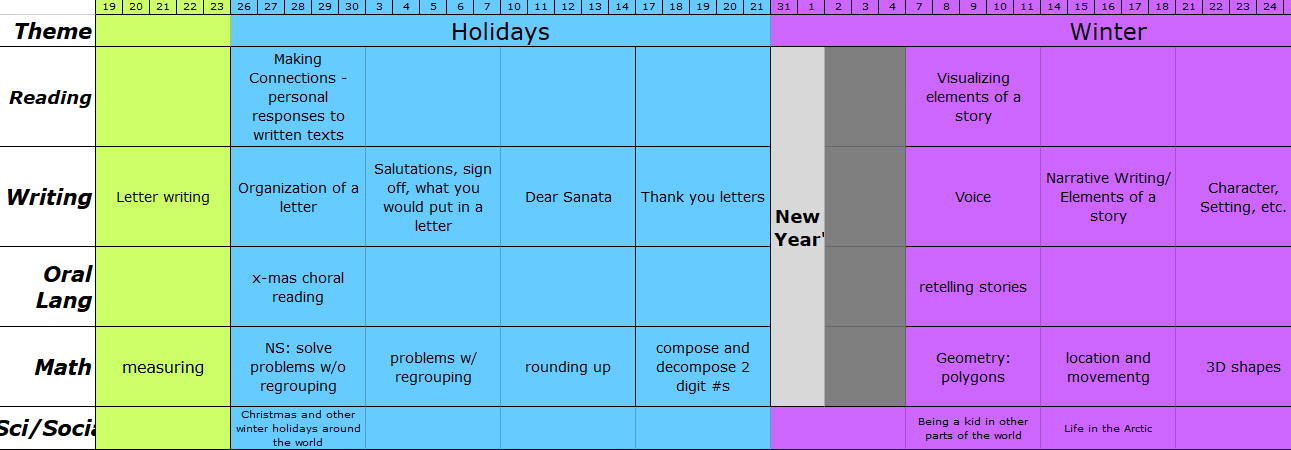
I have tried doing a spreadsheet with a few words in each box to outline what will be happening and have each cell represent a 1 or 2 week block (pictured above), I have tried doing all of the different strands on their own page with the whole year laid out, I have even printed the curriculum document for each strand I teach and cut each expectation out and then paired them with similar expectations (i.e., in Grade 2 Science the students look at the changes of states between solids, liquids and gases, this could be paired with measuring temperature in the Math Measurement Strand, and even volume). Then I tape them all down in groups and go from there.

Last year I went with a template that gives a full 2 page spread with a row of cells for each week. At the beginning of the year, I planned out general ideas for each month/week (i.e., I would focus on data management – graphing for the first 2 weeks, picking a just right book, and writing a retell to be connected to the Social Studies curriculum of Celebrations). Each page started out very general. As the year went on, I could use each page as more of a detailed planning spot where I would go in and “beef up” the plans for that week. Adding in the specifics of what I was going to be doing. I found this was excellent, as it acted as a long range plan and my general daybook. In many cases I would even write in the strands that we had accomplished as we finished them up for my own records.

Handing in my long range plans was difficult, as they were very thin to start. I sat down with my principal and walked him through my plan. I had taught Grade 2 before so I was pretty familiar with where the curriculum would fit together, and I had worked with my grade partner to pair up on some things and make sure we were not overlapping on others (i.e., we didn’t want to both be working on certain strands at the same time as we shared resources, but others we would want to do at the same time to bring our classes together, etc.). My plans were not overly detailed, but they had genera ideas for when I would be working on different strands, etc.. I explained to him that they are not really, “done” yet. He demanded that I finish them and submit them. It took some explaining, but in the end, I was able to create my plans the way I wanted and share them digitally through Google Drive. This way, he could pop in at any time and see where my class was headed and it was always up to date.

Not only did this format work exceptionally well for me, my principal was quite pleased in the end because my plans were the only accurate ones he had by May! We change where we are going with our teaching all the time, it is just what happens in a classroom! You get an email from a local theater company that they are putting on a show in January that would fit perfectly with something you were going to teach in May: you change your plans to accommodate. You find out that they materials you needed for your awesome unit are booked up for the month you were planning to teach it: you change your plans to accommodate. Long Range Plans are as much a living document as any other document we work with! Let it be organic and know that there will be times where you planned to work on something for 2 weeks and at the end of 2 weeks, they still don’t get it! Accommodate and move forward!

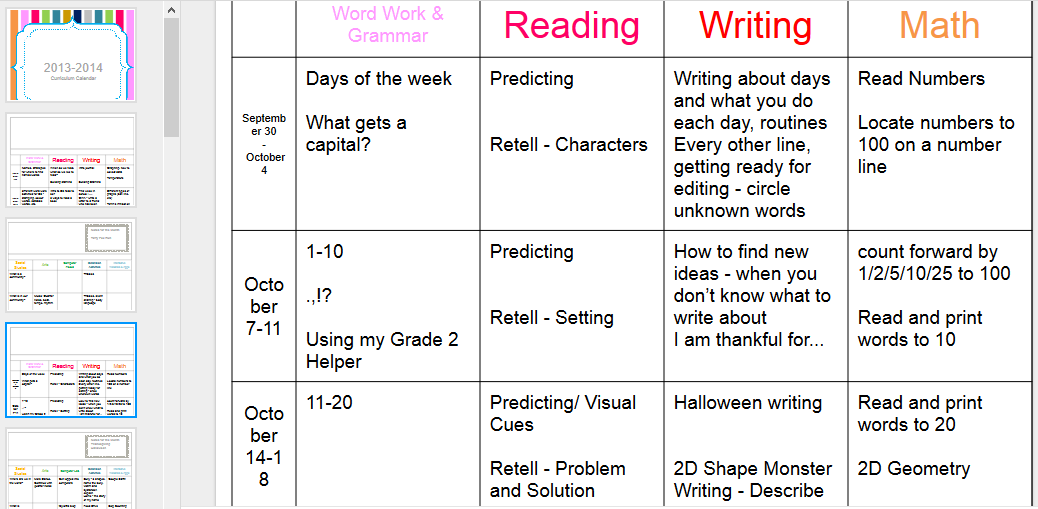
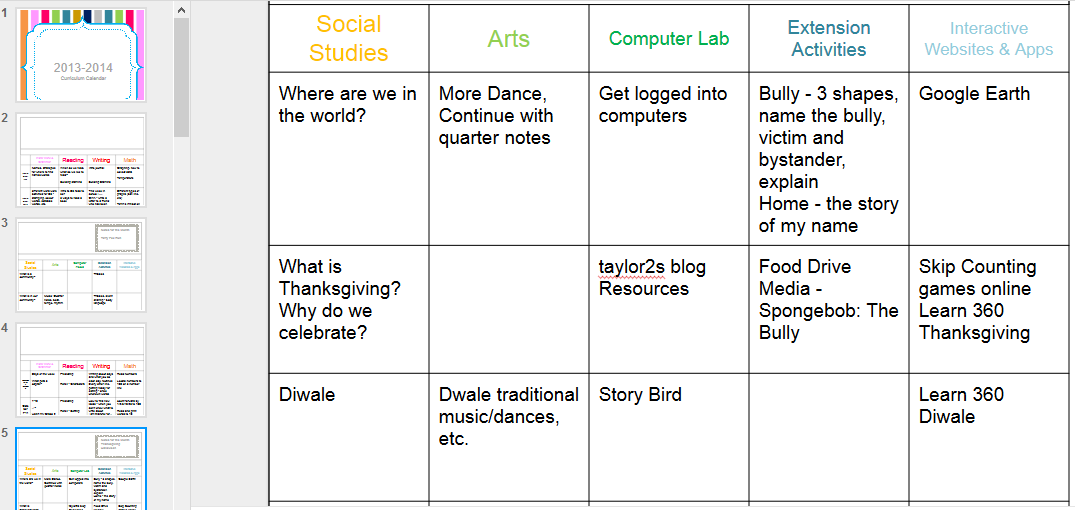
Below are some pictures of the plans I submitted last year to my principal as they looked at the end of the year – they were changed A LOT between September and the end of the year! If a box was left empty, it was because I would be continuing what we had started the week before.

At the beginning of the year, the page for these weeks might have said: Days, punctuation, predicting/retell, writing routines, read numbers and locate on number line, and 2D geometry. When I got to that week, I beefed those weeks up a bit, elaborating on what I was going to do each specific week to build on the concepts, etc.

Photo of Mike Beetham

It’s A Marathon, Not A Sprint

Planning, assessing, progress reports, meetings, parent interviews,supervision duty, long range plans and on and on and on. Within less than four weeks the calm, balanced life that summer provided us with seems nowhere to be found. The demands of the daily responsibilities of being a teacher seem to be like a snowball going downhill as it just seems to be gaining speed and size with no end in mind.

 It is critical that you care for yourself and create that balance between your work and personal life into your routine as early as possible. As is the case with most teachers, we sacrifice our personal wellness for the demands of our role. We eat on the run (if not skip it altogether), come in earlier, stay later, cancel out scheduled fitness time and give up personal needs for the good of our classroom. In the long run, this is not going to benefit anyone and will lead to increased stress in your work and personal life.

You need to set guidelines that you feel will allow you to fulfill your professional responsibilities and maintain a healthy lifestyle away from work.  I use the following guides in helping me keep that balance:

–       I find early mornings are my most productive time so I go to school early but leave 15 minutes after the end of the school day. On staff meetings days, I go in later.

–       I look ahead at my entire week and plan my workouts around the demands of the week.

–       I stay later on Friday afternoon so that I have time to reflect on my week and establish my plan for the upcoming week. That allows me to ensure my weekends are for family and I.

–       Sunday night is my time to ensure my weekly plan is in place for the upcoming days.

Of course my best laid plans don’t always work out (reporting time, parent interviews etc…) and I have to adjust to ensure that I have completed my professional responsibilities. The key is that you have to work at keeping balance in your life and just as you would expect your students to give their best effort and balance school life and home life, so must you. A healthy teacher is more likely to have a healthy classroom.


New Beginnings


My name is Alison Board. I have taught for eight years. This is a second (or third) career for me, as I was previously a librarian and a technical writer.

Over the years I have developed specific interests within education. They include early years literacy, the learning environment, an inquiry approach, and inclusivity. This year I will be teaching a grade 6/7 class and will be in another new classroom (4th room in 4th year!).

September is a time of new beginnings for the students and for me. I look forward to the first few weeks of community building. This requires you to slow everything down, and not feel the pressure of jumping into content on the second day. I also look forward to trying new ways of teaching and learning. This year I will be using Google Docs to share documents with students, confer, and collect work. I will also be introducing a daily poetry cafe. My students will have French every day in the second last period. We will meet for the last 30 minutes (about 20 minutes really) – so I am hoping we can read, share, write, listen and love poetry in a collaborative and reflective way that ends our day on positive note.

I look forward to sharing more of my teaching and learning journey with you.

Photo of Mike Beetham

Backward Planning To A Classroom Community

I would like to take a few lines to introduce myself to new readers or re-acquaint myself to regular bloggers. My name is Mike Beetham and I am entering into my 30th exciting year of teaching and look forward to the learning opportunities that will take place for me as I continually strive to enhance my best practice. I work with an area behaviour class of Junior age students and love to spend time in the outdoors.

 Each September a new group of students arrive in my classroom and our journey begins. Like any other trip, you have to know where you are going so that you can plan your journey accordingly.  In the first week of school we collectively complete the following activity. I create three charts with these titles:

What does a safe and peaceful classroom look like?

What does a safe and peaceful classroom feel like?

What does a safe and peaceful classroom sound like?

It starts with time for self-reflection, than moves to partner and small group discussion. Our final step is to post our ideas on chart paper. These sheets are visited throughout the first week. On Friday we take a final look at what our collective vision is and we complete the task by creating a classroom agreement that will help us create the community of learners we seek. I always accompany this with a good book such as ‘YO! Yes!’, ‘Wings’ or ‘Don’t Laugh At Me’.

As a teacher it is critical to take the time to visualize what your want your classroom to look like, feel like and sound like. From that point you put into action the activities and lessons that will move your group to the desired outcome. It is important to remember that this is a continual process and like any relationship, when the participants stop putting effort and time into the partnership, the bond starts to lessen.

Welcome back everyone and I hope you have a rewarding year!


Photo of Mike Beetham

Personal – Professional Balance

Just a few more hours of marking. I can coach  three teams this fall. Sure, I will gladly help out with the school musical. No, sorry I can’t spend time with you this weekend I have work to do. I will just have to cancel my time at the gym again for that parent meeting. Does this sound familiar? It is a fine balance between teaching, volunteering and personal wellness. Often we will sacrifice our own well being for the benefit of our class and school. It is extremely vital that each and everyone of us know what that balance looks like (teacher, partner, aunt, sister, daughter, Mom) and to ensure that we are buidling in time and/or activities that keep us physically, emotionally and professionally healthy.

What is the value of your ‘yes’, if you never say ‘no’. Over the course of my career this has made more and more sense to me. Sometimes life feels like that runaway snowball that just keeps building and building. It seems that nothing is ever taken away. My change came from a very profound moment I had with my young son many years ago. I was focussed on school work when he approached me and I quickly brushed him off and said, I am busy right now. He looked at me with his bright blue eyes and said, “That is okay Daddy, we can do it in the summer”. Needless to say, I had to re-examne my priorities. Did he really believe that family life only occurred in the summer? I soon found out that even if I did not get every paper marked, every lesson done or gave up a volunteer activity or two that life at school still went on and there was no loss in the quality of the program I delivered nor in the relationship I had with my students.

Today, well into the  years of my career I have learned that I can still put 100 percent of my effort into my class and school during the day, have time for my family and most importantly stay healthy. I hope that this message can be learned by others faster than it was for me. A healthy teacher is more likely to have a healthy classroom. Your career is not a sprint, but rather a marathon. You are the most important asset in your classroom, take care of yourself.

Preparing for the First Day

This year I will be moving classrooms and divisions. Teaching a grade 5/6 class at the other end of school from the Kindergarten section will be a big change for me and also for my students. I am sure they will be looking for glimpses of the “Kindergarten Teacher” that they saw in the halls last year. So I am planning to bring some of what I have learned as a Kindergarten teacher to my new students in grade 5/6. Statistics show that over 90% of children in Kindergarten enjoy school. This number dramatically decreases as children reach the junior and intermediate grades. I want the children in my class to be engaged in their learning and enjoy coming to school.

When starting the new school year I always look through the practical information provided in “The Heart and Art of Teaching and Learning,” to find suggestions on setting up the classroom or planning for building inclusion. On page 22, in a section on Environment, it refers to the Reggio Emilia approach, which considers the children’s development and relationships with their environment. The chapter continues with, “Not only should the classroom represent your beliefs and values about teaching, it should also support them. In order to make the classroom engaging and inviting, consider what you want students to feel when they come in and how you might communicate this in a non-verbal way.”

I always find the environment a good place to start when planning for a new group of students. The layout, the materials, even the lighting can affect how the students interact with the resources and with each other. My goal this year is to have a classroom that is comfortable and aesthetically inviting, yet organized to foster responsibility and independence. I want to encourage collaboration and provide areas for movement within the classroom that focus on particular interests such as reading, art, science & technology, and math.