Next week, our school will be under District Review. We have known this for months, of course, and have been guided by an excited administration on what to expect and how to prepare for something called the “Walk About”. With all of the lead up to the visit, one can definitely detect some anxiety in the air. Making a comparison, I guess it is a bit like having company coming and wanting to be sure that you are ready and that your place looks great.
District Reviews generally take place every five years. In essence, a review is when the administrative members of the school district come to a school to see what is going on. They take notes, ask questions, and try to get a general feel for the school environment. Afterwards, the team makes a report highlighting what the school is doing well with regard to school board mandates and initiatives, and includes suggestions for areas that could use more focus.
The “Walk About”, which is the main part of the Review, seems to generate the most anxiety amongst teachers because superintendents, principals and vice principals from other schools join the school’s administration on a tour of the site, visiting classrooms and chatting with teachers and students. You may be in the middle of a lesson when the team drops by. They will look around your classroom and try to be as discreet as possible as they make their observations. The moment one of the members crouches down to quietly ask one of your students; “What are you learning?” and “Why are you learning that?” can be a little unnerving. Reviewing anchor charts, posters and messages on the classroom walls may make it easier for students to answer questions regarding their learning environment. In addition, you may want to make sure Big Ideas are clearly posted and that the students know to expect someone may ask them questions about their learning goals for the lesson.
While a School District Review is a big responsibility for the school administration and may seem like a distraction from your day-to-day teaching, it can also be viewed as an opportunity for you to take stock of how your classroom presents and how effectively you are communicating on a regular basis with your students regarding their Learning Goals. Take a look around. Do you still have Christmas decorations up in February? Does your class library need some organization? Are your bulletin boards interesting and informative? Would any of your students be able to answer the questions, “What are you learning and why?”? Review what you are already doing. This is not the time for you to change your practice and try to outdo yourself. Rather than being anxious about a District Review it may be more productive to take an objective look at your classroom, do some tidying up and make sure you are ready for visitors.

My Favourite Cross-Curricular Visual Arts Activities
I love Visual Art. It was always one of my favourite subjects in school and I was fortunate to have several teachers who engaged me in unique and exciting art projects. Tragically, I can’t have my students do Visual Arts all day, every day – bummer! Over the last few years, I’ve tried to find ways to integrate a bit of Visual Arts into many other subjects in ways my students don’t expect. Here are a few of my favourite projects from the last four years:
1) Quilts
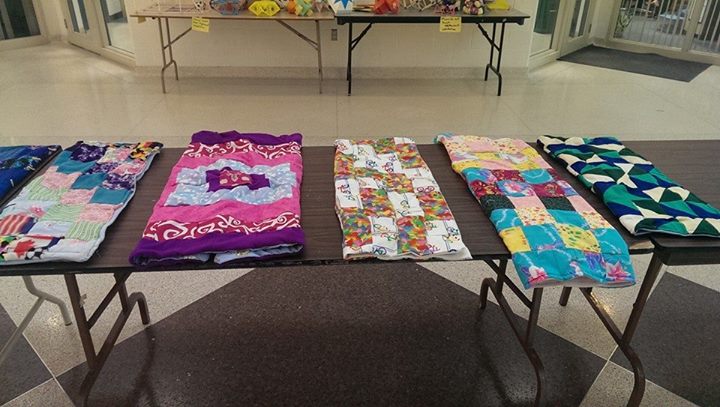
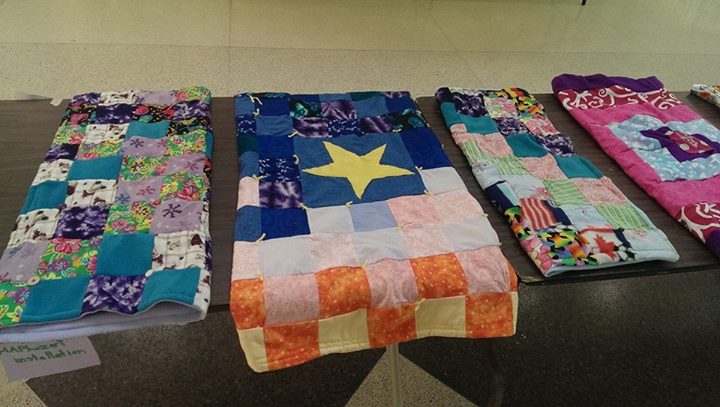
What the project was: Working in groups, my class and another class of Grade 4/5 Middle French Immersion students designed, cut, and assembled baby quilts. At our annual art show, we ran a raffle for parents ($1/ticket). The proceeds from the raffle (over $300!) were donated to a charity. All of the material we used was donated by parents – much of it fabric ends from household projects, but some also salvaged from old pyjamas and blankets that were no longer wanted or needed.
What it taught my students: This project was a joint Visual Art and Mathematics project. From the VA side, it taught the use of tools (including electric sewing machines), complementary colours, patterning, and adapting to/solving design challenges. From the Mathematics side, it taught area and perimeter, measurement, and patterning.
What was challenging: We had 50 students cutting fabric, assembling quilts, and using sewing machines at the same time. The project took months (working one day a week) and the help of a few parent volunteers. I ended up giving up a few of my lunch breaks towards the end so that my students could finish their quilts before our art show.
2) Graphic Novels
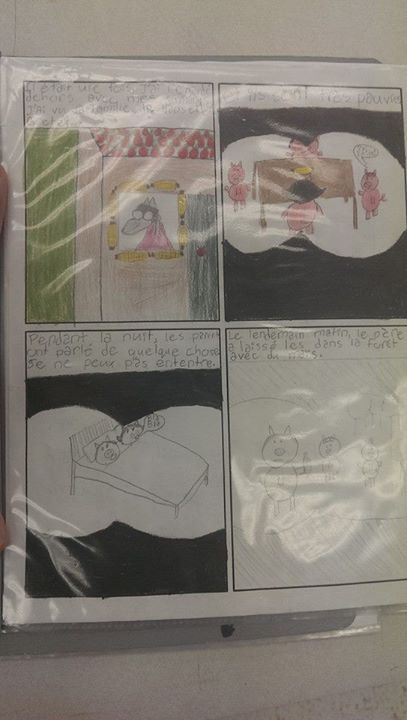
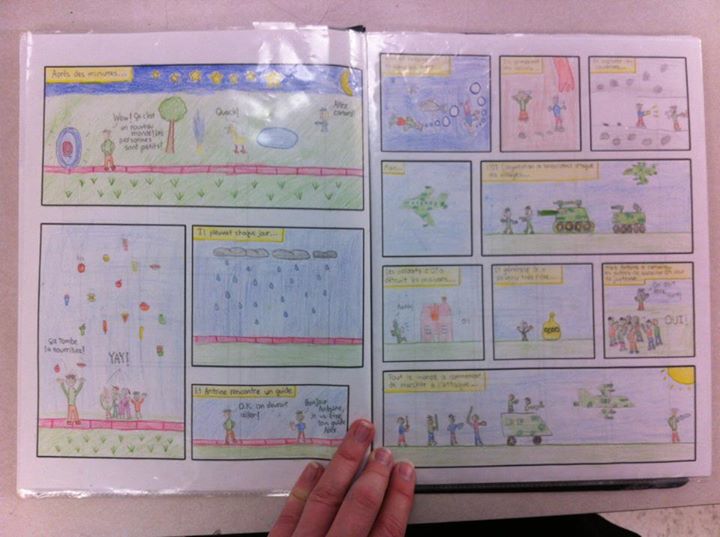
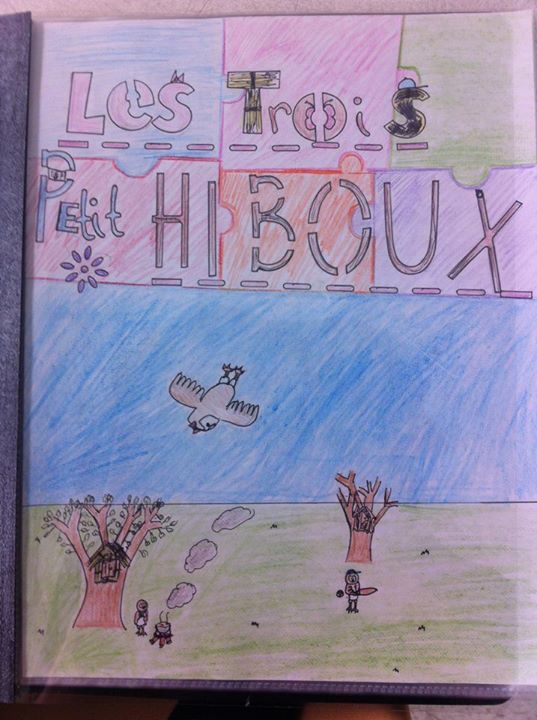
What the project was: Students in my Grade 4/5 class each chose a fairy tale to retell in the form of a graphic novel. Their story had to be different in some way from the original without changing the overall message. They started by brainstorming, then created storyboards, then moved from storyboards to the actual comic panels.
What it taught my students: This was a joint VA/Language Arts project. From the VA side, it taught students composition, shading, line, perspective, and creating a narrative work of art. From the LA side, the expectations are always a little different depending on the grade level and program I’m teaching.
What was challenging: This project takes a long time. There are a lot of steps involved in getting to the final product, and students need a bit of guidance not to get too caught up in their storyboards. Many of them also needed to be encouraged to scale back their story so that it wasn’t 20 pages long – because 20 pages of comic panels is a LOT of drawing and colouring!
3) Carcassonne Variations
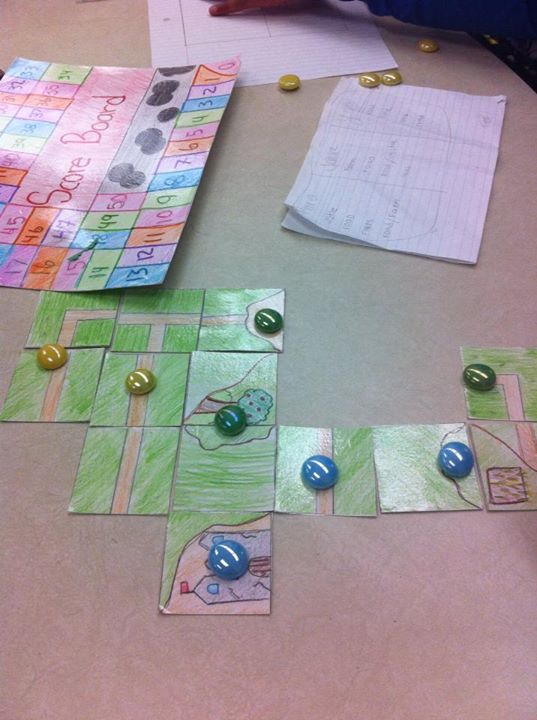
What the project was: Students in my Grade 4/5 Middle French Immersion class worked in groups to create their own versions of the board game Carcassonne. They had to plan/draw/colour their tiles and design a scoreboard. If they added any extra tiles that weren’t in the original game, they had to explain them with written rules.
What it taught my students: This was a joint VA/Mathematics project. I’ve used it to teach a variety of concepts in both areas. It changes a bit each year! For VA, I’ve used it to teach line, shape, colour, and texture. For Mathematics, I’ve mainly used it to teach probability (as the game involves drawing tiles from a bag) and fractions.
What was challenging: The first year that I did this project, I let students choose their own groups. Whoops! I ended up with several imbalanced groups – some with lots of artistic talent but who struggled with the mathematics side, others with lots of mathematical aptitude but who struggled with the artistic side, and everything in between. The next time I did this, I put students into groups, trying to balance artistic ability and mathematical aptitude… but as with any group put together by a teacher, occasionally my students had difficulty working together to plan and design a project like this.
Without going into too much detail, here are a few other Visual Arts activities I’ve done over the past few years:
Oliver Jeffers-inspired Picture Books (Visual Arts/Language Arts): We love Oliver Jeffers. His stories are whimsical, funny, colourful, and poignant. One of my favourite things to do with my students is have them create their own stories in the style of Oliver Jeffers. They get very creative!
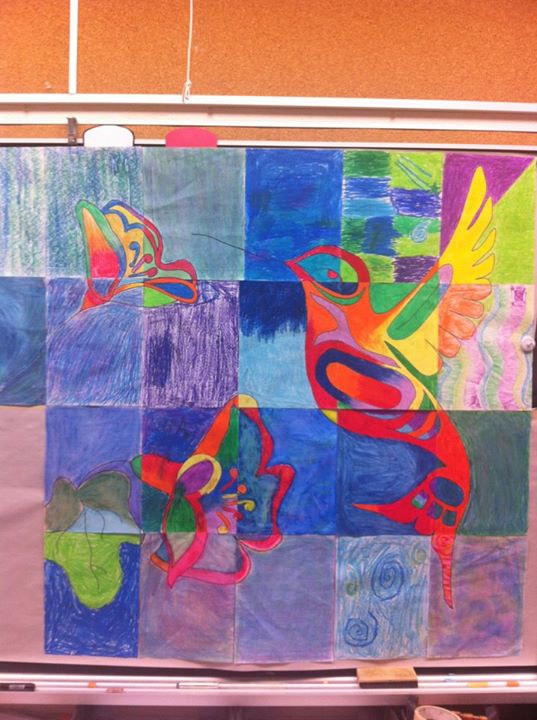
Collaborative Mural (Visual Arts/community building): Each student received a piece of the mural without knowing what the final design would be. Their page had only black linework on it, with some areas coded to be coloured with hot colours and others coded to be coloured with cold. When they finished, we assembled them according to the numbers I had put on the back of each page.
Melted Crayon Art (Visual Arts/Science)
Communicating with 500 parents
I am a music teacher and I have around 500 students that I teach this year. Communicating with the parents of 500 students needs to be approached a little differently than the regular classroom teacher. I don’t send home a beginning of the year letter as I have taught most of my students for a couple of years now. I usually send home communication for other purposes. Below are two letters that I will be sending home in the next couple of months. The first letter is about recorders, and the second letter is about an upcoming concert at my school.
Letter #1:
Dear Parents/Guardians of Student in Grade 3,
As part of the music program, students learn to play the recorder starting in grade 3. Playing the recorder is an excellent way to develop fine motor skills, hand-eye coordination and concentration. At this level, recorders are the best tool for teaching students to learn to read proper notation on the music staff. Studies have shown that taking music lessons increases overall academic achievement, and helps to develop self-confidence and problem-solving skills. For your information, there is an article on the back of this letter on this subject.
At the beginning of May, students will be provided with a clean recorder for use at the school. Each student will have his/her own instrument assigned to him/her that is not used by other students. These recorders are property of Red Willow P.S., and will remain in the music room at all times.
Although it is not mandatory, we strongly suggest that students buy a recorder for practicing at home. This recorder will remain at home. Recorders will be used extensively in grades 4 and 5 as well, and sheet music will be going home for students to practice with. Buying a recorder through the school ensures that your child has a good quality instrument. Recorders purchased at the dollar store are not good quality and they almost always have the wrong fingering system.
Recorders cost $10.00. Please pay in cash. We need to pre-order, so forms with the money are due by May 7, 2015. Please fill out the form below and send it with your child/children.
Sincerely,
Ms. Gallant
Letter #2:
The Music department at Red Willow is extremely excited to invite you to a spring concert starring your amazing children!
What will be happening?
Your child, along with all the other grade 3 and 4 students, will sing songs they have written, share dances that show different cultures, perform a black light show and much, much more. There will be snacks available for purchase, as well as many photo opportunities.
When is this fantastic event?
The Spring Concert will take place on April 23rd, 2015. The show will begin at 6:00pm. We ask that your child be dropped off to the side entrance by 5:30pm. Teachers will be at the door to greet them starting at 5:20. Students are required to stay until the end of the show.
How do you get tickets?
Due to the number of grade 3 and 4 students who will be performing; we must limit tickets to 2 per family. More information regarding tickets will follow.
Showcasing Student Work for Parents
I’m not a huge fan of Parent/Teacher Interviews. It’s not the idea of speaking with parents about their child’s progress, because I am totally on board with that. It’s not the time spent after school, either; I’m usually one of the last teachers to leave my school at night, so I’m pretty used to being around after hours.
My issue with Parent/Teacher Interviews is that the focus is rarely, if ever, on talking about what students are doing daily in the classroom. To me, that’s the important thing: seeing their work and their progress over the course of the ten months that they’re in my class. My students work hard and take pride in their accomplishments. I’ve never liked that interviews are linked to progress reports or report cards because the natural thing to do seems to be to talk about grades.
I hate grades, but that’s another story for another time. 😉
A few years ago, I did something with my class that I felt really offered my students the chance to show their parents just how much they had accomplished that year. It was a really rewarding experience for everyone.
In spring of that year, a few students in my Grade 5 class came to me and asked if we could do a class talent show. This was a congregated gifted French Immersion class with many performers of all kinds. We discussed it as a class and nearly all of them wanted to participate. We decided that we would host the talent show in June as an end of year event and invite everyone’s parents to come. I was not going to force anyone to participate, though, so I had to come up with some reason for the parents of students who were not performing on stage to attend.
My students had been amassing large portfolios of work all year. I’m a bit of a hoarder when it comes to student work and I like them to keep it all at school for as long as possible. Usually this just leaves me drowning in a pile of art projects, scientific models, chart paper, and duo-tangs, but this one year it really paid off. I had my students go through all of their work and choose five things that they were really proud of.
We discussed why they might choose certain pieces over others. Some pieces were chosen because students had worked particularly hard and had done a really great job with them. Others were chosen because they were really fun and exciting. Others still were chosen because students felt that they had made a lot of progress that year. The highlight, for me, was when one of my students chose to showcase her Mathematics notebook. When I asked her why, she said that it was because she started that year hating math, just like every other year, but by the end of the year she felt really confident in math and it had become her favourite subject.
Validation! My teaching is working! But that’s not what this post is about.
We ran the entire event in the school’s gym, which had an attached stage. I pulled out some tables and set them up, then gave each student a space to display their work. They decided how to display it. As parents came in, they were able to wander around the tables and see the work all of the students had put out.
The talent show itself was what I expected: a seemingly endless parade of ten and eleven year olds playing musical instruments, telling jokes, dancing, and doing whatever else they had come up with as a talent. It was really sweet. They did a wonderful job. All I really did was invite the parents; they coordinated who did what and when, rehearsed on their own time, and ran the whole show for parents.
After the talent show, all of the students went and stood by their work. They were expected to explain to their parents why they had chosen to include each piece. I was there and able to answer any questions and chat with the parents, of course, but the students were the stars of the afternoon. I got a lot of positive feedback from parents on the event and they were happy to be able to hear their child talk about his or her work in a positive light.
Healthy Options at Schools PPM150
With PPM150 having had some time to settle into schools, there are blog posts and parent forums popping up all over with discussions about food options being offered to students at schools. While the PPM does outline expectations for what foods can be offered to students at schools, many teachers provide food in class as a reward for good behaviour, sharing candies and snacks as curriculum connections (graphing M&Ms, making Rice Krispie Squares for measurement, blowing a bubble with bubblegum for procedure writing, etc.). Websites like Pinterest are full of ideas that involved engaging students with food and candies.
As a mom of a child with a food allergy and significant digestive struggles that require a very strict diet, I am often overwhelmed when she c
omes home from school to tell me about all of the special snacks she had that day. It is next to impossible for a 6-year-old to say no to a cupcake, so we as the educators need to make those healthy decisions for them by simply not offering them at all. With poor eating habits and obesity on the rise, we need to take advantage of the time we have when children’s diets are completely dependent on the decisions of adults and only provide them with healthy options.
I have had classes that “earned” a positive behaviour reward and we opted to have a balanced breakfast reward where the first period of our day was spent talking about healthy breakfast choices and then we had a balanced breakfast together complete with wholegrain cereal, milk, fruit, and even some veggies! They loved it because it was a snack and it was out of the ordinary!
Think about the value of what you are giving your students both nutritionally and educationally. If you are giving candy or something that is not a healthy choice, ask yourself if there is a healthier option you could give that would get the same result (i.e., if you are teaching procedure with bubblegum, could you teach procedure with making oatmeal, or salad, or something else that is healthy?).
Zipper Club
I truly admire and hold deep appreciation for all of you who teach Kindergarten or Junior Kindergarten. You establish the foundations that will support a child’s academic life and that will allow the rest of us to build upon. I had to share this great concept that I watched evolve from one of my colleagues who teaches Kindergarten. It is called the Zipper Club. The premise is that he is trying to develop and foster independence in his children (which can be transferred to all aspects of school life).
As his children grow from an academic, developmental and gross motor standpoint they are provided with success that fosters a belief of “I can do anything’. So as each child masters the famous jacket or hoodie zipper, he posts their picture in a public display in the hallway. This is then shared with our school so that all can see and celebrate. His students start to feel all grown up and this new found independence fosters many additional side benefits to his class such as less time dressing equates to more on task time.
I have adapted this style of setting targets and working toward those targets with exemplars of what success looks like, sounds like and/or feels like. To this point I have enjoyed many types of both individual and group success. By far the most beneficial has been in my understanding of how important targets and success criteria is.
Spring Concert Preparation
Last year, my school had our very first evening concert. It went so well in December that we did it again in May. It was the first time I had ever organized a large evening event and I learned a lot. As I am getting ready to do another concert this spring, I have been reviewing my notes from the previous year to prepare. Below are some of the questions that came up and how we decided to deal with them. Hopefully, this can be a starting point for preparing a concert at your school!
What kind of budget can we have?
My principal suggested that we should stay around a couple hundred dollars. We did one shop early in the process for things like cotton balls or glitter. Closer to the show, we did one more big shop. It was easier for our secretaries to do big shops and hand in one or two receipts instead of multiple small purchases. We did not ask parents for money.
How will we communicate information to parents?
A letter went home introducing the concert and a follow-up letter went home with tickets. A Synervoice call (robocall) was made to homes the day before the ticket information went home. Another Synervoice call was made two days before the concert.
How will we control the crowds and ensure the safety of the students performing?
Benches were placed across the front of the gym to prevent parents from coming too close to the classes performing. The principal made it part of her opening remarks to remind parents to stay behind the benches.
Can we sell food?
We asked permission from our custodial staff before we went ahead with food sales. Once the custodial staff gave us the okay, we bought popcorn, cookies and water from Costco. I also told the custodial staff that all volunteers would assist with the cleanup after the concert. Obviously, the teachers’ first responsibility was to ensure that the students were safely picked up by their parents, but after the students were all gone, everyone helped with the cleanup.
How can we deal with people who show up without tickets?
The directive from my principal was to just let it go. We had a couple of people show up without tickets so plan for a few extra spaces in the gym. We didn’t want the evening to be about anything except celebrating the students so we didn’t make a big deal about it.
Can we give high school students volunteer hours for helping us?
Yes!
What time is the dress rehearsal?
We ended up having two different dress rehearsals. (I would do more with a kindergarten performance). I tried my best to move classes around so that no one lost their planning time and I invited the classes that were supposed to have phys ed during this time so that the gym teachers didn’t get displaced.
Will there be dinner for volunteers?
Yes, pizza and salad were provided.
Will we have access to walkie talkies?
We used the walkie talkies on the night of the performance to communicate with each other.
How do we photocopy communication about the concert?
Anything photocopying for the show was done using the office code.
Should we prepare a video recording for sale?
We opted not to have anyone videotape the concert to sell to parents. Most people carry video recorders in their phone and had the ability to record the performance.
How will we do the drop off and pick up of students?
The kids were dropped off and went directly to their classroom. The parents picked up their children from their classroom at the end of the concert.
Can we have an extracurricular club to help with the preparation of the concert?
Yes, the club was a fun group of older kids who helped with everything from decorating and costumes, to holding the doors and helping to collect the tickets. They were amazing.
How long will the concert be?
After putting two classes together to perform, there were 10 performances in total. The concert lasted about one hour.
Technology and Social Media for Communication
For years I have maintained a class website. I found as parents became more tech-savvy, they enjoyed seeing the photos of student learning and reading about what was happening in the classroom. This seemed more timely, environmental and cost-effective than a monthly newsletter (as I was in a community that all parents had access to a personal computer). It also allowed parents the option to log on to the site at any our to find information or revisit an earlier post. Websites allow for documentation of the learning and growth of students.
This year I wanted to try Twitter. It was a new learning curve for me, but I could see the benefits of its immediacy. So last fall I started a Twitter account for our grade 6/7 classroom and invited parents and students to follow. Students created a logo contest in the class and selected a piece of student art to represent our account. I have found many benefits to Twitter instead of a classroom website. They include:
- Timeliness – I usually take a photo and send a message once a day from my classroom. It is so quick and simple from my smartphone that my posts are more frequent than logging into a website and writing a post for a class website.
- Focused – I find that my tweets are focused and meaningful. For example, I select a specific moment during math or science and take a photo that makes the learning visible. When I would write posts for my website, I often felt overwhelmed in covering all the subjects and providing enough detail.
- Connections/Information/Networking – Sending tweets and using hashtags from our classroom has created dialogue with other educators, students, and interest groups, that would not be possible through a website. For example, my class was excited to be retweeted by Bird Studies Canada when we shared a photo of one of our students feeding a chickadee from his hand. This introduced us to information about the Great Backyard Bird Count, an accessible activity that interested students could learn more about. It also initiated an environmental leaders project to make and maintain bird feeders at our school.
- Reflection/Assessment – As a daily activity, tweeting from the classroom provides me with a purpose to capture learning and document it. I am then able to review my tweets weekly and reflect on the highlights or areas of need as assessment for learning.
- Social Media Etiquette – Tweeting with my students allows for authentic discussions about how to conduct ourselves with appropriate image use. We also review our messages and discuss what they can convey.
- Accessibility – Although my school is recognized as higher needs due to lower family incomes, some students have access to smartphones that they can use in the classroom with our Bring Your Own Device program. Others can share the iPads and netbooks that are available to our class.
- Engagement – Each month, more students get their own account or encourage their parents and become excited about our classroom tweets that are retweeted by the Principal or the board to an even wider audience. We have participated in tweet chats with other classes, using a visual display of the tweets so the whole class can be involved in the discussion.
I have found Twitter to be an effective tool for increasing engagement and communication. I can use it to feature student voice and reach a community larger than our classroom or school. It also informs my own practice as I follow educational posts to inspire me!
Wellness in the Classroom
Wellness is an important focus for our grade 6/7 classroom and is also a hot topic school and board wide. It encompasses so much of what we do and who we are that it can be difficult to create a specific lesson for “wellness.” In The Heart and Art of Teaching and Learning book, it states, “Getting to know your students is a big part of your success as a teacher” (p 34). This is an important message, as it encourages teachers to be responsive to the specific needs and interests of their current students and not apply generic strategies or lessons.
I recently read a suggestion that a leader should learn and know at least 10 things about a person. This would be a good tool for teachers to use if getting to know the individual needs and interests of their students is challenging for them. A simple notebook with a list under each student name can be filled in as a teacher gets to know new students. I know that for some students I would easily have a list of 20 facts, while there are a few that I would struggle to get 10 for! The Class Database activity (p 39) could be easily modified with questions that involve students’ needs and interests around wellness, to gather some initial data on your students. I have also used a Multiple Intelligence quiz to determine preferences for students and used them (music, nature) throughout the year to guide my plans and make my lessons or activities more inclusive, especially when some students are feeling less confident with content or skill development.
Leading up to Bell Let’s Talk day, we viewed the commercials on YouTube and worked in groups to discuss the effective use of language and its influence on attitude and acceptance. During a language activity with the book, The Man With the Violin, students recognized the sadness of the child and made similar connections from their own experiences of being rushed through their day. We went for a class walk to a nearby park with no activity planned, but to enjoy whatever we noticed. Students were excited to Tweet about their own understanding of wellness using the Bell Let’s Talk #, making suggestions that were accessible and real for them such as “write in a journal” or “talk to an adult”. They are currently making lists of what inspires them and what brightens their day. These activities and discussions continue to be integrated through subjects like language, health, art, music, and science.
The Power of Show and Tell
There is a table in my classroom that is called La table de découvertes (Discovery Table). On it you can find things that I have collected with my family, mostly when my own children were young; there are some seashells, plenty of rocks, 2 bird’s nests, a small log gnawed and shaped by beavers, snake skin molt, a stick covered in tracks made by an insect infestation under the bark, feathers, and pine cones. It is a corner of the classroom where students can visit and touch, marvel and wonder. And it is because of La table de découvertes that Show and Tell (La présentation) has made a comeback in my classroom this year. It wasn’t in my daily plans or my Long Range Plans, but because of its success, I will now be sure to include it every year.
In September, a student asked if she could bring in something for the Discovery Table. She was very excited because she had some shells she wanted to share with the class. The student presented the shells, broken and whole, which she had found on a beach while on holiday. Every student wanted to see and touch the shells as if they had never seen such things before. They asked her which was her favourite, and she told them why they were special to her. This was our first Présentation.
Initially, it was this one student who wanted to share her treasures with the class. Soon she was bringing in something every day until her mother began to be concerned that perhaps it was creating a problem.
After all, among the many items this student brought in, there was a small cupboard filled with origami stars; two small carved statues from a hot country (she wasn’t sure which one), and a zip lock bag of her cat’s orange fur. Everything was presented in detail, accurate or not, and everyone watched and listened and asked appropriate questions afterwards. I was able to tell the mother that everyone was always interested in what her daughter brought to school.
After a few weeks, eventually other students, even the quietest ones, started coming up to me, asking if they could present something to the class. Students would bring in special items from home or simply find cool rocks in the school yard and want to present them because they had a funny shape or a shiny spot on them (Rocks are a big deal in our classroom).
Now our presentations are a regular event at the end of most days, with a few flexible guidelines. This is what works for us:
1) 15 minutes for Show and Tell.
2) 3 students present within that time period. This allows time for each child to speak in as much detail as they like about what they are showing and to pass around their items. The audience also doesn’t have time to lose interest.
3) Some days we present while sitting in a circle on the floor; other days students sit at their desks while the presenter stands in front of a small table where they can display their items.
4) Limit the follow-up question period to 3 questions or comments.
What I love about Show and Tell is that it is a student lead activity that is easy to facilitate. It gives students a true sense of agency as they talk like an expert in front of their peers about something that may or may not be in our Grade 3 curriculum – like sharks or cat fur – and have an audience that is actively listening and genuinely interested in what a presenter is showing and talking about. It is also an opportunity for students to be seen in a leadership role by their peers and to get a boost to their self-esteem.
Since the primary focus in French Immersion education is oral communication, Show and Tell is a clear choice as an activity that allows for a student to “acquire a strong oral foundation in the French language and focus on communicating in French” (Ontario Curriculum, French as a Second Language). The value of developing public speaking skills can also not be overlooked, as it takes great courage at any age, to ‘hold the floor’ and talk in front of one’s peers. As stated in the Language curriculum, students are encouraged to, “communicate – that is, read, listen, view, speak, write, and represent – effectively and with confidence”. Although some students may not have the confidence to volunteer, I haven’t made a schedule indicating the days when everyone is obliged to bring something to talk about. Instead, I have quietly asked a few students if they would like to bring in something to share with the class. It may take a few days or weeks before they are ready, but, following the example of the students who have gone before, everyone who has brought something in does a fine job presenting and fielding questions.
Finally, the benefits of Show and Tell go beyond the presenter to include all students in the audience. These students learn to practice listening actively and respectfully during presentations as well as how to follow up with pertinent questions. Probably the best thing of all, however, is that there is no evaluation of Show and Tell. While I do evaluate Book Talk presentations or projects with outlines and rubrics, I feel that the dynamic, impromptu nature of Show and Tell would be ruined if there were grades placed on the students’ performance, and it would no longer be a wonderful, relaxed way to finish the school day where oral presentation skills are practiced, treasures are shared, and students lead the show.