Blog

Challenging the “Impossible”

“I was shocked when I saw what he had done in class. The psychologist said that’s the kind of thing he wouldn’t be able to do.”

“You’re going to try and teach your class to use sewing machines? Do you think they’ll even be able to?”

“You don’t really think beginner immersion students can memorize an entire play’s worth of lines, do you?”

At least once a year (and usually much more often than that), I have a conversation with someone – parent, colleague, administrator, student – who tells me that something I’m doing in class is “impossible” for one reason or another. Sometimes, like the first comment above, it’s an incredulous parent who is impressed (albeit confused) that their child was able to do something that shouldn’t have been possible. Other times, it’s well-meaning fellow educators who, I think, are trying to keep my lofty newbie expectations in check.

It’s okay, guys. I have this. My students can do it.

I’m not saying that I’ve never tried something that failed horribly (student-created team games in Grade 4 Phys Ed, I’m looking at you) but for the most part, my wackier ideas actually do pan out. Sometimes it takes some creative intervention from me, other times it takes a lot of patience and dedication, other times still I have to admit that we didn’t end up where I had planned but that the activity still taught what I was hoping it would – but we get there!

I credit my dedication to trying new, challenging, ambitious class projects to two people.

The first was my Grade 7 and 8 French Immersion teacher, Mme Crystle Mazurek. I have to admit that I don’t remember a lot about those two years except the really awesome art activities we did, but MAN, did we do some cool things! We made quilts, 3D art out of foam and cardboard, batik designs on fabric using melted wax, linoleum printing… I loved being in her art class (even if her dog literally ate my homework one time). It was in her class (though I can’t recall if it was while I was in Grade 7 or 8, or if it was when she was my teacher again later in high school) that we started a coin collection to help a village in India, where she had spent time in her childhood with her parents, to purchase a buffalo. From those humble origins began an ongoing collection to alleviate some of the effects of poverty in India by buying tools which can be used for trades (such as sewing machines) or by sponsoring students to attend school outside the village. I check in on the fund regularly and have a hard time believing it’s come as far as it has – from old soup cans in classrooms collecting a few coins here and there to a charity raising several thousand dollars a year.

Mme Mazurek, in hindsight, also dedicated a lot of time to helping her students succeed. Some of us were not particularly great students – I may or may not have had a few detentions in my time, despite being an active participant in class – and yet she still managed to get us excited about learning. I never did my homework, but I actually remember one of the novels we read as a class (it was about teenagers in Lebanon), details of Canadian history I know I learned in that class (the Rebellion of Upper Canada comes to mind), and how gracious and funny she was when we played an April Fool’s joke on her by switching her desk with our English teacher’s identical desk across the hall. I think a lot of my interest in becoming a teacher came from her. She probably doesn’t know that. Maybe one day she’ll google her name and find this. None of this paragraph has anything to do with challenging the impossible, she was just a really cool teacher with a bright red pixie cut, leather pants, an awesome attitude, and a wealth of personal anecdotes to keep us interested.

The second was my first Associate Teacher while I was in teacher’s college. I had the extreme privilege of working with a phenomenal teacher, Mr. Bill Morton, in an incredible Grade 3/4 Gifted class. My time in the class was too short, as all practicum placements are, but even in my five weeks there he bestowed upon me a lifetime’s worth of wisdom about education. I’m not sure the word “impossible” is in his vocabulary, unless we’re talking about retiring. His Grade 3/4 students were already engaged in learning and rehearsing A Midsummer Night’s Dream when I started in his class. As I took groups out to work through scenes and break them down, I was amazed by how well they understood the material with very little prompting from me. Nine and ten year olds! Reading Shakespeare! Not just reading it, but actually understanding it. Given what I could remember of reading Shakespeare in high school (and those were plays which I would argue were easier to follow than A Midsummer Night’s Dream, read by teenagers who were given very explicit instruction on what the words meant, who STILL didn’t seem to understand that “wherefore” doesn’t mean “where”), that shouldn’t have been possible.

The point of all of this is that you’re going to hear and read about a lot of things that your students “shouldn’t be able to do”. Students with NVLD “shouldn’t be able to” illustrate a graphic novel with consistency and detail from one page to the next. Second year French Immersion students “shouldn’t be able to” write short stories. Ten year olds “shouldn’t be able to” design and sew quilts. Students with a long history of behavioral problems “shouldn’t be able to” have a year where they fully engage in class and take responsibility for their actions.

You won’t always succeed with the wacky, outlandish ideas you have, and sometimes no matter how hard you and your students try, it won’t work. That’s part of life. But you will almost certainly have more successes than failures, and even the failures teach you something.

Be that teacher who does something “impossible”.

Fair warning, though: it gets pretty addicting to overhear your students bragging about the cool things they did in class as they walk to the bus.


Social Media and the Battle for Public Opinion

I keep hoping I will get the hang of this “parenting and blogging” thing… then suddenly it’s the last day of the month and I realize I haven’t been able to get to a computer for weeks. For a techy like me, this is crazy! I used to spend hours on the computer every day.

I bring this up because a few weeks ago, my local ran a “Twitter Training” session at our AGM. As someone who has been on the internet since before it was commercially available, whose parents ran a BBS (which was a precursor to the internet) which enabled me to chat and play games with other neighbourhood kids when I was in elementary school, I take a lot of things (like social media) for granted. I forget that if you haven’t grown up around it or aren’t terribly inclined towards using the internet, it’s easy not to know about all of the things that are out there.

Social media is really cool. Right now, as we trudge through a complicated and, frankly, disappointing bargaining session, it’s also acting as a powerful tool in communicating our message to the public. People are listening, but you have to know where they are as an audience. Right now, a lot of them are on Twitter. I won’t get into the ins and outs of Twitter on here – it’s not very complicated, but it’s much easier if someone just shows it to you as they explain. What I do want to tell you about is a really cool movement from Ontario teachers to try and enlighten the public on what we’re bargaining for, what our daily reality is, why teacher autonomy is important, and how we work for our students every day.

The first and obvious thing to know about is the official ETFO Twitter account. Worth following, for reasons which probably don’t need to be stated. Lots of worthwhile information. Lots of links to relevant news.

On Twitter, there are things called “hashtags” – words preceded by a # symbol that you put into your messages so that someone could search for a tag and find all public messages with that tag, from all users across Twitter. Over the course of the last few months, a few commonly used hashtags have come up. Click on any of the tags below and you’ll be brought to a Twitter search page showing you the most recent posts with those tags.

#mypreptime and #4MyStudents – Teachers are using these tags to talk about what they used their prep time for and how their personal time goes to support their students. They’re being used to highlight why teacher autonomy is so important and why we don’t want administrators to be able to direct what we do with our time.

#classeswithoutEQAO / #insteadofEQAO / #eqano – This tag is being used to show what’s happening in classrooms which otherwise would be writing EQAO tests right now.

#students4teachers – Students showing support for their teachers as our high school colleagues return to work but continue their job action.

#IamETFO – Daily truths from ETFO members.

@acampbell99 is a great account to follow because he has done a wonderful job of compiling some of the most poignant messages posted by Ontario teachers.

Lastly, if you are on Facebook and are a member of ETFO, you might want to consider joining the ETFO Collective Bargaining group. It’s a closed group (meaning it’s private) and only ETFO members are able to join. It’s a great place to find information and support.

These are by no means the only places to find information on social media right now, but they are a good starting point for delving into social media.

If you know of any others, leave them in the comments and I will update this post!

Photo of Tammy Axt

Top 10 things I learned from Linda Beacham

For the past seven years I was so lucky to work with an amazing colleague and special needs advocate, Linda Beacham. She passed away on Monday and she is going to be greatly missed by myself and all those who had the pleasure of working with her. She was famous for her sense of humour and creating the best top ten lists. Today in honour of my dear friend and colleague who taught me so much about working with children, here is my top ten list of things that I learned from her.

  1. Whether or not you have any singing voice at all, singing out loud is really fun!
  2. Sending an e-mail with the subject line AWESOMENESS to encourage a colleague who had an incredibly rough day working with a student with autism can lift them out of some really dark places.
  3. There are so many things to see in the hallways of your school. Just stop and walk with someone with autism who sees things from a different perspective than you.
  4. ERF, Teacher, TA and ECE are useless titles. Team should be the real title.
  5. Never be nervous about making mistakes. Laugh out loud at them!
  6. Sledge Hockey and Wheelchair Basketball are REALLY cool sports and athletes who play them are hard core!
  7. Country music is a great genre of music for boogying to.
  8. Kids just want to have fun, laugh and smile no matter what their needs are.
  9. When the facilities or resources are not available so that people with physically disabilities can play sports, start them yourself. Check out Cruisers Sports at http://www.cruisers-sports.com/Home.shtml
  10. Giving a colleague a top ten list of the amazing things about working with students with autism is a really fun way to end the year.


Photo of Samantha Perrin

Adaptation and going with the flow

Teaching is a profession that typically attracts people who are caring, nurturing, creative, and curious. Skilled at thinking on their feet, teachers are also an adaptable bunch. And good thing, too, because the changes that pop up in a teacher’s life are numerous and often unpredictable.

Here are a few examples of abrupt and significant situations you may have encountered where your adaptation skills have come into play; you think you know what you will be teaching in September, and then – a new grade level, a new classroom, perhaps even a new assignment are all handed to you; or you get your assignment and begin the school year with 24 students then, three weeks later, due to an enrolment increase or decrease, half of your students are switched up for a different set; or you prepare an outdoor fieldtrip and you have to cancel at the last minute because of inclement weather; or, your plans for a lesson get sidelined because someone in your class throws up, or trips walking around some desks and gets a nose bleed, or refuses to cooperate; or you find that no one is listening to you, or there is a lockdown practice or fire drill, or you forgot to make enough photo copies….

All of these examples come with varying degrees of stress. Regardless of how well-developed one’s adaptation skills may be, the topsy-turvy nature of our day-to-day job makes it exciting and, at the same time, sometimes very difficult. What is critical during any upheaval is to maintain professionalism as this can give you time to calmly reflect on the situation and help you decide how to proceed, thereby avoiding a hasty reaction with potential to say or do something inappropriate. In the heat of the moment, it may sound like an oversimplification, but remember to breathe. Of course, teaching is not the only profession where one has to react to change minute to minute, but it is definitely a valuable skill for teachers. Should you be looking to change schools or assignments, emphasizing traits such as adaptability and being able to work under pressure would be good points to include on a resume. Similarly, before a job interview, it may help to be prepared with an example that highlights your ability to think on your feet, switch gears and carry on.

As we head into June, a time in the school year with plenty of upheaval, it may seem difficult to summon up the energy to keep things in perspective. You’ve been adapting and thinking on your feet all year. But hold on to those amazing adaptation skills to help see you through to the end. There is always something new around the corner and it’s a good idea to be ready for whatever comes your way.

Photo of Samantha Perrin

Fine Weather for an Outdoor Library

Only recently have we been able to take advantage of some lovely warm, sunny days. Spring time has been rather elusive, bringing exceptionally cold weather and very muddy school yard conditions. So it was with great joy this week that we were able to take our class library outdoors, along with sunhats and sunglasses, to sit on the front lawn under the shade of an enormous maple tree. At the beginning of the week, we were in sparse shade, but the students noticed that by the end of the week, the leaves on the tree had filled out and there was plenty of shade for 20 of us to spread out in.

On the way out of the front doors of the school, I let the office know where we were going in case they needed to find us. Once outside and using the shade of the reading tree as our reading space, the students sat wherever they wanted and however they wanted. Some sat cross legged, alone with their books, while others lay on their backs, tummies or their sides to read. One student who tends towards anxiety, however, was really only able to take advantage of the fact that he could lie down in the grass with a book over his face. He was enjoying the relaxing more than the reading, and it was clearly what he needed to do at that moment. After his break, he came back into our discussion circle, relaxed and happy.

Our school is on a quiet street, but even with a few distractions such as vehicles going by or a person walking their dog on the sidewalk, the students were calm and very quiet. Considering I would usually describe my group of students as ‘high energy and talkative’ rather than ‘calm and quiet’, this was a pleasant transformation. I believe being outdoors had everything to do with this. Before reading a story to them , I asked the students if they found that they read less, the same or more when we brought our reading outside. They overwhelmingly claimed that it was not only more, but a LOT more reading that they were able to enjoy when we were outside. As a French Immersion teacher, I couldn’t have been happier to see and hear that my students were able to focus and read in French.

Our outdoor library, such as it is, consists of a few bins of books from our classroom library that we bring out to the front lawn. It is really not any different than when we have our reading time in the classroom – it just feels a whole lot more special because it’s outside. Now the students expect every reading block to take place under the reading tree. It is a delightful time in our day.

Photo of Tammy Axt

Taking Your Students “on Tour” to build community within the school

I grew up in a very musical household. My family is from the Maritimes where the kitchen party originated. I always had visitors stopping by and music blaring in our house. There were guitars, keyboards, banjos or the spoons being played by anyone who could cram into our home. My parents used to listen to old country while they vacuumed early on Saturday morning singing and dancing. As a teenager, I did not find this amusing, but as a music teacher I know the power of music to bring people together as a community.

The sharing of music can take many forms from evening concerts to performances in assemblies. However, this year I decided to add in a few performances that were much less formal with the goal of letting the music be the catalyst for having some fun (very much like the Maritimes).

I started a recorder consort and ukulele club this year. (A recorder consort is a variety of recorders playing together such as an alto, soprano, tenor and bass) Usually, on the first day of a new club the students’ first question is always about when they will be performing. Both of these clubs were no exception. I told the students that we were going to be going “on tour” with our instruments.

Once both clubs had learned a song or two on their new instruments off we went. During our nutrition break time, we took our instruments and found classes that were willing to sing along, tap along or groove along with our music. We went to 2 or 3 classes per break and had a great time.

All this week as I walked down the halls, students from the classes we performed in have been waving their hands and saying hi to me and the students in the club. In our big school, it is not very often that the grade five students do something with the grade two students or the grade fours with the grade ones. The older students may have brought the instruments but just like in a kitchen party everyone was a participating member of the group. Whether you bring your voice, your stomping foot or your clapping hands the music you create together is what brings you together.

ukulele

Photo of Mike Beetham

You Never Know

This blog is based on a real life scenario that I was fortunate enough to be a part of both on a personal and professional basis. It truly reminded me just how important our teacher/student relationships are as you never know when your kind word, out of the ordinary effort or simply just being there will make a difference.

On a late Saturday afternoon there was a knock on our home door and to our surprise, there was our very distraught neighbour who just needed someone to talk to. Over the course of the next hour this young mother poured her heart out to both my wife and I. During that time she asked us to read a series of letters that obviously were very important to her.

As we scanned the pages it became clear to us that these letters were from a past teacher who took the time to write to this young women while she was in her classroom. The key message that surfaced on each and every page was that this young woman was an amazing person who had the potential to be herself and that alone would make her great. It was clear that she had experienced trauma in her adolescence and did not receive the necessary support that she should have had. Through teary eyes, this distraught woman just kept telling us how important this teacher had been in helping her get through some very dark times in her life. In fact, she owed her life to her.

Although these letters were almost 20 years old, we could tell by the wrinkled paper and tear stain marks, that she had went to these words of support many, many times over the past two decades. Once again, she was going to this teacher for support in these times of hardship.

As a teacher, we are merely a step or two on a child’s life journey. Yet that time we spend with each child is one of the most influential events they will ever experience. It is our responsibility to ensure that memory is as positive as can be.

Photo of Mike Beetham

The Power Of The Circle

The circle has many historical references probably none more meaningful as the significance to the traditions of our First Nations’ People. It is a very powerful formation as it represents the importance of each and every person in the group. There is no start or finish to a circle as well as representing the cycle of life for both nature and humans. I use the circle in my classroom for all classroom discussions, meetings and as a morning check in and day end check out.

During circle time the students are facing each other, taught how to demonstrate a good listener position and become more engaged in each and every discussion. The key message the circle sends is that each and every person in that circle is important and valued  for their ideas, who they are and the voice they will share with the rest of the group.

My first month of school is the time when the circle is introduced and the procedures that will be used during circle time. It is like any other beginning of the year activity, it requires a lot of work and consistency in the beginning. I use a variety of adventure based programming activities to further support the concept of how powerful the circle is in our physical education classes.

Over the course of first term there is a gradual release of responsibility to the point (at this time of the year) the circle is lead most often by the students. It becomes a tool for everyone in the room and not just the teacher. Last week a student asked to have circle time so that an issue that had taken place during the fitness break could be addressed and resolved.

Many times I am asked how do you use the circle in a classroom full of students, desks, support material and other classroom materials. My best answer to that important question is that if there is a will, there is always a way to make it work. Through both creative classroom design and the establishment of effective routines, the transition from regular classroom to circle formation can become seamless. I highly encourage you to research more about the traditional circle and how it may become a strategy in your classroom.

Gifts From a Stranger

While we are fortunate in my district to be well outfitted with school supplies at the beginning of the year, there are always things I wish I had on hand that aren’t provided for with limited school budgets. Usually this means I go out and spend my own money on things for the classroom, but last year I discovered something incredible.

Some of you may be familiar with the site Reddit. I won’t go into what the site is here (a quick Google search will turn up lots of info). One of the little offshoots of Reddit is something called RedditGifts, where a variety of exchanges happen between total strangers. There are gift exchanges for a huge variety of things.

One of the gift exchanges is for teachers. As a teacher, you sign up for the program in the summer. You create a profile of your class and your needs. Others sign up as gift givers – people who will be matched up with a teacher and will then go out and buy gifts for that class, for no other reason than that they wanted to. It’s an incredible program, particularly worthwhile for teachers in areas where resources are more scarce and they need all the help they can get.

This isn’t a gift “exchange”; teachers only receive, they don’t send, and people who send things don’t receive anything other than your thanks. The gifts you receive may be completely anonymous, or the person may have included their Reddit username, or they may have included their name and address (in which case perhaps a thank you note or some thank you cards would be in order!).

All you have to do, as a recipient of a gift, is post a photo of it to the RedditGifts website. This is to help the sender know that you received the items and for you to send a message of thanks.

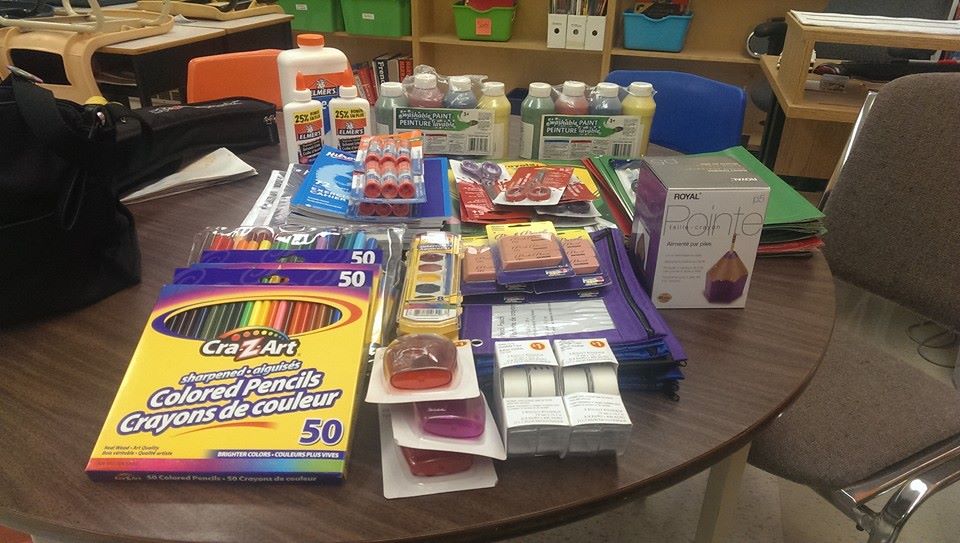
This year, I received all of this from one very kind soul out in British Columbia:

redditgifts

Duotangs, glue, tape, sharpeners, scissors, paint, notebooks, pencil crayons, markers, erasers, pencil cases, construction paper – it was an AWESOME gift and my students were really excited about everything. I had mentioned in my profile that my students often came to school without some of these things (often because they can’t afford everything on the supply list) and that the school doesn’t provide everything (for example, individual sharpeners or pencil cases).

They haven’t opened up sign-ups for the 2015-2016 school year yet, which generally happens in August, but you should definitely keep this site on your radar if this is something that would interest you.

Reddit Gifts for the Teacher

Click here for a gallery of last year’s gifts. You can see the incredible things sent to teachers all over the world. People are remarkably generous and kind!

Everyday Accommodations for All Students

I, like most teachers, have many students each year who have IEPs. I have worked with students with a variety of needs, some requiring more complex accommodations than others. It can be daunting to read IEPs and see the lists of accommodations you’re required to put into place for your students, but I promise it’s not usually as hard as it sounds.

Over the past few years, I’ve found that many of the accommodations I put into place for these students are beneficial to all of my students – so now I plan with these accommodations in mind, whether I am “officially” required to have them or not. Keep in mind as you read through these that I am a Middle French Immersion teacher, meaning that  my students are all in their first or second year of learning all subject matter other than Math or English in their second language (French).

1) Strategic Seating – I doubt this one is a new idea for anyone. I rarely allow my students to choose their own seats in class because for me, strategic seating has always been a priority. I teach a second language program, so I need to make sure that the different levels of linguistic ability are spread around the room and that everyone has someone at their level to converse with when appropriate. I don’t want there to be a table of strong French speakers or a table of weak French speakers. I want every table to have a few speakers at each ability level. The confident French speakers encourage their peers to keep speaking in French. It’s a really important element of an FSL classroom, to me.

At the same time, I also need to keep in mind attention skills, social skills, aptitude in other subject areas, friendships, not-so-friendly rivalries, and a few other kinds of needs as they pop up. Planning seating arrangements takes me a long time… and I change them regularly. My husband can only laugh at this point when he watches me spend an hour planning a seating arrangement only to realize at the end that I have one student left to place, nowhere appropriate for them to go, and I have to scrap the whole thing and start over. I have always found it worth the effort, though, even if that one evening I spend working on it gets a little long!

2) Simplified Formats – Teachers love to dress up handouts and make things look fun and interesting. When you’re teaching a second language to beginners or novices, though, all of those extra things – fancy fonts, illustrations, etc. – can make it really difficult for students to understand the language. I’ve really worked hard at stripping my handouts down to the bare minimum where possible. It doesn’t just help with language comprehension, of course; this is often a suggested accommodation for students with NVLD, ADD, or LD.

3) Breaking Work into Steps – I love projects. I am all about projects. Some of my students love that, some hate it, and it’s almost always something my students use to describe me as a teacher. “She makes you do a lot of projects.” (Exchange the punctuation for more enthusiastic or frustrated symbols as appropriate.) The thing about projects, though, is that they usually require planning and time management.

I don’t know about your students, but I find that my Grade 4 students are not all that skilled with either of those concepts. They need a lot of training. Consequently, any project I assign has been broken down into steps for them to follow, usually with a checklist that I have to sign (for each step!) before they can move on. What I have found is that breaking the work up like this forces students to plan ahead, whether they want to or not.

At each step, I conference with every student (not really all that time consuming) where they show me the completed step. If I’m satisfied that their work in that stage is done, I initial their checklist and send them off to start working on the next one. When they’ve finished their project, they hand the checklist and all of their planning in with the completed task.

It’s not as time consuming as it sounds, I promise. We’re talking about steps like Brainstorming (they show me their spider web organizer), Storyboards (they show me their stick figure storyboards for their graphic novel), Sketches (self explanatory), Revision (they show me their rough copy, which they have gone through and revised on their own or with a peer), etc. It takes a matter of seconds to look over each step and sign off on them.

Overall, this has made my students’ work more cohesive, logical, and detailed.

4) Written and Oral Instructions – This one is really, really easy but has huge benefits for students. I used to have a bad habit of only providing instructions orally. Then, when I had a student with Executive Functioning Disorder, I learned why it was important to provide instructions both ways. Now, when I give students a list of instructions, I also write them on the board (usually with numbers). I provide a lot more detail orally than I do on the chalkboard; the written instructions are just a reminder for students about what to do next.

5) Extended Time Limits – On the rare occasion that I give something like a quiz, I never give my students limits on how long they can take to finish it. I find that giving them a specific amount of time really makes some of them panic, which doesn’t really lead to them doing their best work on the quiz. I try to plan an activity after a quiz/test period that they can easily jump into a little late, or ideally a work period for one of the many projects they’re working on all the time. I do also allow students to stay in at recess to finish something, but I try not to do that too much because I’m often calling parents, attending meetings, or supervising at that time.

6) Visual Schedule – I’m still struggling with getting this into my routine (it usually takes a student mentioning it before I update it for the current day) but it REALLY helps my students prepare for the day when they know what’s going to happen. I think my most loathed question (after “how long until lunch?”) is “What are we doing now?” Put a schedule on the wall. It doesn’t have to be detailed – often just having the subject and time is enough for them.


Those are by no means the only accommodations that would be useful to all students, but they’re definitely my top six that I always put in place no matter the needs in my classroom.