Blog

Adjustments in September


With all the plans we make for those first days and weeks in September, it is worth being open to making adjustments, for your benefit and the benefit of the students. Here are some examples of how I have adjusted the environment and the program in the first few weeks:

  • I have changed the layout twice. We were pleased to get 6 rectangular tables and 1 round table in the second week, but have rearranged them twice to suit the needs of the students. This means that there are two sets of tables put together seating groups of up to 12 students who like to work together, and one table seats only 4 students who require more personal space. I planned for an even distribution of students per table, but am responsive to their different requests regarding space and collaboration.
  • The area carpet was originally placed in one corner of the room for community discussions and knowledge building sessions. The students enjoyed these talks, but found it hard to get close when we are limited with only two accessible sides to the carpet for rows of chairs behind those who are seated on the carpet. So, I moved the carpet to the centre of the room and it connects to the small carpet area of our class library. Now there is less movement of chairs as students turn to the centre of the room for discussions and use the extended space of the class library to sit.
  • We took a Multiple Intelligence survey to get to know our own learning strengths and the strengths of all the students in the class. We continue to consider these and reflect on them by referring to graph compiled in the class to remind us.
  • I finally typed out my schedule last Thursday. It took me that long to juggle our literacy block and periods for Science and Social Studies with withdrawal for ESL and special education support. I have added 15 minutes of literacy to the end of our day when we review our agendas with a poetry cafe allowing dedicated time for the reading, sharing, and writing of poetry.
  • We introduced “Minutes for Mindfulness” each afternoon. After lunch and a transition for French class, some of the students had difficulty settling for a full-class discussion regarding our inquiry topic. I asked if they wanted to try some mindfulness techniques, and a new student shared a website/app called www.calm.com that his teacher used last year. This adjustment not only helps the students, but I benefit from the 2 minute relaxation exercises as well!
I am sure our class will continue to grow and change. Allowing for adjustments to your best made plans is necessary to be responsive in your teaching practice – and everyone will benefit.
Photo of Lisa Taylor

Long Range Plans – Are they ever really done?

Some teachers dive right in over the summer and plan their whole year out! I have never been that kind of teacher. Not only do I not have the patience, I am simply not organized enough to get everything laid out in advance. I find it especially difficult to get long range plans together before I have met my students.

I have tried doing a spreadsheet with a few words in each box to outline what will be happening and have each cell represent a 1 or 2 week block (pictured above), I have tried doing all of the different strands on their own page with the whole year laid out, I have even printed the curriculum document for each strand I teach and cut each expectation out and then paired them with similar expectations (i.e., in Grade 2 Science the students look at the changes of states between solids, liquids and gases, this could be paired with measuring temperature in the Math Measurement Strand, and even volume). Then I tape them all down in groups and go from there.

Last year I went with a template that gives a full 2 page spread with a row of cells for each week. At the beginning of the year, I planned out general ideas for each month/week (i.e., I would focus on data management – graphing for the first 2 weeks, picking a just right book, and writing a retell to be connected to the Social Studies curriculum of Celebrations). Each page started out very general. As the year went on, I could use each page as more of a detailed planning spot where I would go in and “beef up” the plans for that week. Adding in the specifics of what I was going to be doing. I found this was excellent, as it acted as a long range plan and my general daybook. In many cases I would even write in the strands that we had accomplished as we finished them up for my own records.

Handing in my long range plans was difficult, as they were very thin to start. I sat down with my principal and walked him through my plan. I had taught Grade 2 before so I was pretty familiar with where the curriculum would fit together, and I had worked with my grade partner to pair up on some things and make sure we were not overlapping on others (i.e., we didn’t want to both be working on certain strands at the same time as we shared resources, but others we would want to do at the same time to bring our classes together, etc.). My plans were not overly detailed, but they had genera ideas for when I would be working on different strands, etc.. I explained to him that they are not really, “done” yet. He demanded that I finish them and submit them. It took some explaining, but in the end, I was able to create my plans the way I wanted and share them digitally through Google Drive. This way, he could pop in at any time and see where my class was headed and it was always up to date.

Not only did this format work exceptionally well for me, my principal was quite pleased in the end because my plans were the only accurate ones he had by May! We change where we are going with our teaching all the time, it is just what happens in a classroom! You get an email from a local theater company that they are putting on a show in January that would fit perfectly with something you were going to teach in May: you change your plans to accommodate. You find out that they materials you needed for your awesome unit are booked up for the month you were planning to teach it: you change your plans to accommodate. Long Range Plans are as much a living document as any other document we work with! Let it be organic and know that there will be times where you planned to work on something for 2 weeks and at the end of 2 weeks, they still don’t get it! Accommodate and move forward!

Below are some pictures of the plans I submitted last year to my principal as they looked at the end of the year – they were changed A LOT between September and the end of the year! If a box was left empty, it was because I would be continuing what we had started the week before.

At the beginning of the year, the page for these weeks might have said: Days, punctuation, predicting/retell, writing routines, read numbers and locate on number line, and 2D geometry. When I got to that week, I beefed those weeks up a bit, elaborating on what I was going to do each specific week to build on the concepts, etc.

Photo of Mike Beetham

It’s A Marathon, Not A Sprint

Planning, assessing, progress reports, meetings, parent interviews,supervision duty, long range plans and on and on and on. Within less than four weeks the calm, balanced life that summer provided us with seems nowhere to be found. The demands of the daily responsibilities of being a teacher seem to be like a snowball going downhill as it just seems to be gaining speed and size with no end in mind.

 It is critical that you care for yourself and create that balance between your work and personal life into your routine as early as possible. As is the case with most teachers, we sacrifice our personal wellness for the demands of our role. We eat on the run (if not skip it altogether), come in earlier, stay later, cancel out scheduled fitness time and give up personal needs for the good of our classroom. In the long run, this is not going to benefit anyone and will lead to increased stress in your work and personal life.

You need to set guidelines that you feel will allow you to fulfill your professional responsibilities and maintain a healthy lifestyle away from work.  I use the following guides in helping me keep that balance:

–       I find early mornings are my most productive time so I go to school early but leave 15 minutes after the end of the school day. On staff meetings days, I go in later.

–       I look ahead at my entire week and plan my workouts around the demands of the week.

–       I stay later on Friday afternoon so that I have time to reflect on my week and establish my plan for the upcoming week. That allows me to ensure my weekends are for family and I.

–       Sunday night is my time to ensure my weekly plan is in place for the upcoming days.

Of course my best laid plans don’t always work out (reporting time, parent interviews etc…) and I have to adjust to ensure that I have completed my professional responsibilities. The key is that you have to work at keeping balance in your life and just as you would expect your students to give their best effort and balance school life and home life, so must you. A healthy teacher is more likely to have a healthy classroom.


Photo of Lisa Taylor

Themes of Success: Passion for Teaching

When I sat down to think about my very first post for this blog, it was suggested to me that I share some information about myself. So that is where I started. I would share that I have taught for 8 years in the Upper Grand DSB (Guelph and area), that I am currently released from the classroom as Chief Negotiator and Staff Officer at my Local ETFO Office, and that I am a crafter, musician, mother, wife, and animal lover. So many ideas came flooding through!

In reading through the first chapter of Heart and Art, I came across the Themes of Success: themes that emerged after over 2,500 teachers were asked to share their best teaching experience from that year. The heading Passion for Teaching (Page 8 ) really spoke to me.

Passion for Teaching highlights the importance of connecting your own personal experiences and passions with your teaching by drawing on your own personal “resources” for support. I decided this would be the perfect place to start, as I could share some ways that I have done this with my classes with great success, and in the process, you will get to know me a bit better!

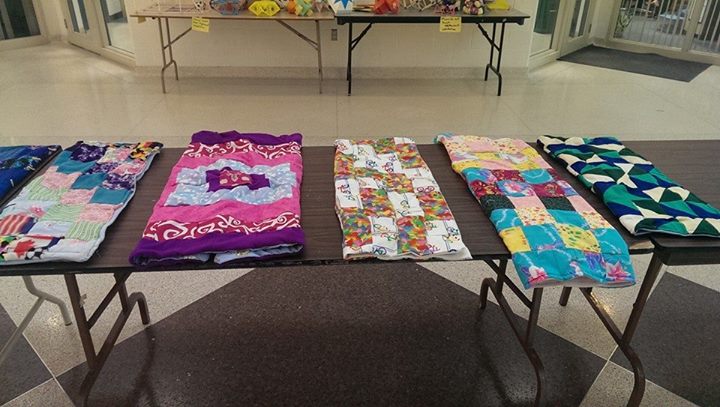
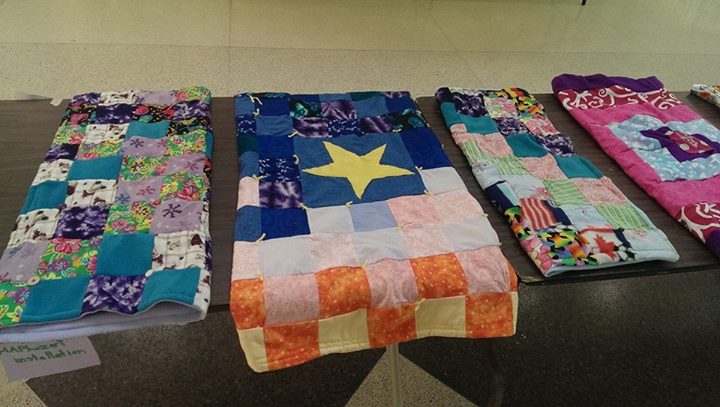
Patterning with Quilts: As an avid quilter, I brought in fabric squares to my Grade 2 class and had students help me plan a quilt. They loved this activity because it was “real” to them. They got to lay out the squares, plan the repeating pattern of colours (in this case light pink, dark pink, yellow, orange) and then see it come together. I would take the squares home and sew a row or two and then come back and have them recall what came next. I would then sew a few vertical columns and see if they could figure out what the next column would look like as the pattern changes in that direction, but there is still a pattern. We did a problem solving based activity with this quilt for weeks!

When I worked with older grades, I brought in fabric measurements (i.e., 100cm x 75cm in blue, 125cm x 50cm in green, etc.) and had them plan out the entire quilt top from start to finish and then the class voted on their favourite quilt and that is the one I cut and made. It is amazing how many ways using quilts in math can be differentiated too! Giving some students a quilt plan and asking them to use colour tiles to plan the pattern, while others are being asked to measure the fabric that would be needed to make that same quilt, allows for extensions galore!


Animal Creative Writing: Living out in the country, we have lots of animals running around our property. One of my favourites is our chickens. We have 8 chickens that wonder the yard and every now and then, one of them disappears for a while. I often give my class an update on what the birds are up to and they write about them. They love using pictures of the chickens, that I take on the classroom iPad, to illustrate their stories using different apps.

I find bringing my own interests into the classroom really helps my students to connect with the activities we are working on and it makes them feel like what they are doing is relevant.


Photo of Tammy Axt

Planning Time Coverage in an Autism Spectrum Disorder Class

Hi everyone! My name is Tammy Gallant and I am a music teacher for students in grade 1, 2 and 5 in the Peel District School Board. This is my fourth year as a music teacher and I hope to be able to assist those new to the planning time role in schools across Ontario. My school is a suburban school about 30 minutes outside of Toronto with a very high ELL population. In addition to music, I also have planning time coverage in the full day kindergarten and contained Autism Spectrum Disorder classes. I hope you enjoy my posts.

As mentioned above, I am very lucky to be doing coverage with the students in the contained Autism Spectrum Disorder class. A colleague of mine was also given the ASD class on a different day. So, the two of us decided to meet before the first day to discuss possible ideas for our 40 minute classes with them. The conversation went something like this:
“Tammy, what do you think we should do with these students during our first period with them?”
“Maybe we could try to do some songs or games, but I really don’t know these students as many of them are new to the school.”
“Which do you think would be better, a game or a song?”
“Well, possibly some songs. In the past, I have had great success with some action songs but I don’t really know this group of students that well. They may not like them.”
“What do you think about some kind of craft or art activity?”
“I haven’t done a lot of art activities in the past with the ASD class as they haven’t really enjoyed it. But, these new students might really like them.”
The conversation went back and forth like this for about five minutes until we both realized that we could plan all day long but it didn’t matter until we actually met and interacted with the students. We decided that our best course of action for the first four or five periods that we had this class was to try a variety of activities including: songs, bean bag games, puppetry, books, short videos, art activities, instrument building, costume play, French language exposure, etc… We also tried different structures within the class such as teacher-directed, small group, circle time, student-led, and exploration time.
We decided that we both would take some observational notes and meet after the first two weeks to discuss some longer term planning for this class. The aim will be to make it as enjoyable as possible for these students while supporting them to meet their own unique goals. I will keep you updated on our evolving program.

Overheard in an Ontario Classroom…
One kindergarten class was asked what kinds of things they could make up songs about. After answers like butterflies and school, one old soul in the front row raised his hand and told us that he would like to make up songs about being brokenhearted. One can only assume that his family are avid country music listeners.

Exciting new opportunity


Hi! My name is Kelly McLaughlin and I am a new occasional teacher for the Hamilton Wentworth Public School Board. I am so excited for this new opportunity and am awaiting each day to let the adventure begin.

Before I was fortunate enough to receive an interview to be on the supply list, I was doing my final placement at a beautiful school in Ancaster. There I was able to start a choir of about 30 girls and 1 boy and we sang at different events for the school. My passion is music and always has been as during my previous placements I have always tried to get a choir started as well. Through this passion, I was able to take the AQ course for instrumental music. So hopefully this year I will be able to share all about my experiences in some of those classes as well. I really do love the fact that music in schools nowadays is not just crossword puzzles and theory but a hands on experience which will allow children to have an appreciation for instrumental music at a young age. This will hopefully foster their love for it and allow them to carry on with playing instruments throughout their lives.

In my spare time I enjoy running, rock climbing and travelling to Portugal and Disney World which I do once a year! I am really excited to apply all I have learnt from university and my nine summers as a camp counsellor in the classroom.

Photo of Beverly Papove

Gentle Reminders

Greetings and welcome!

I don’t know about you, but every September, just like my students, I still feel the excitement and anticipation for the new school year! This year is certainly no exception and I hope you are looking forward to your year, trusting in your professional integrity, your training and experience, and your decision to have chosen a career where you can learn so much from your students in your role as teacher.

I’d like to introduce myself: My name is Beverly Papove and I am a new voice joining the writers on the Heart and Art blog.  I have been a teacher for more than 20 years. My teaching experience has offered me the privilege of working in public and private systems in 4 provinces, in an Inuit community, in a Cree community and in Europe. I have taught kindergarten to university students, and I am currently teaching Grade 3 French Immersion for a fourth year. I look forward to sharing some stories and lessons I have learned that will be useful or, at the very least, entertaining!

Too often, as conscientious as teachers often tend to be, we sometimes find ourselves reinventing the wheel, when there is already a wealth of wisdom out there that is practical, simple, and meaningful. The teaching profession may have changed over many, many years, but we are still humans, whose basic needs have always been to belong, to feel safe and to enjoying the freedom to express ourselves and explore the world around us.

To that end, I started off the year by letting my students know that there are three things I think are really important; Safety, Respect, and Fun. I can get pretty silly and I certainly like to laugh, however, no respect? No fun. And no safety can mean someone gets hurt and that also is definitely not fun. These three goals pretty much go together and when they do, our classroom is a happy place to learn in. Moreover, having only three overall expectations makes it easy for everyone to remember and to achieve. I asked the students what they thought a safe, fun, respectful classroom would look like and they suggested ideas, activities and kind words. After our discussion, the students worked in small groups or individually to create colourful posters illustrating their ideas (for some reason, there is always at least one giant looping slide at the top of a long staircase in drawings of the ideal classroom… I haven’t yet quite figured out why…). The posters now serve as gentle reminders for us all as we work as a team, creating a healthy learning environment for the rest of the year, with or without an indoor super slide.

New Beginnings


My name is Alison Board. I have taught for eight years. This is a second (or third) career for me, as I was previously a librarian and a technical writer.

Over the years I have developed specific interests within education. They include early years literacy, the learning environment, an inquiry approach, and inclusivity. This year I will be teaching a grade 6/7 class and will be in another new classroom (4th room in 4th year!).

September is a time of new beginnings for the students and for me. I look forward to the first few weeks of community building. This requires you to slow everything down, and not feel the pressure of jumping into content on the second day. I also look forward to trying new ways of teaching and learning. This year I will be using Google Docs to share documents with students, confer, and collect work. I will also be introducing a daily poetry cafe. My students will have French every day in the second last period. We will meet for the last 30 minutes (about 20 minutes really) – so I am hoping we can read, share, write, listen and love poetry in a collaborative and reflective way that ends our day on positive note.

I look forward to sharing more of my teaching and learning journey with you.

Photo of Mike Beetham

Backward Planning To A Classroom Community

I would like to take a few lines to introduce myself to new readers or re-acquaint myself to regular bloggers. My name is Mike Beetham and I am entering into my 30th exciting year of teaching and look forward to the learning opportunities that will take place for me as I continually strive to enhance my best practice. I work with an area behaviour class of Junior age students and love to spend time in the outdoors.

 Each September a new group of students arrive in my classroom and our journey begins. Like any other trip, you have to know where you are going so that you can plan your journey accordingly.  In the first week of school we collectively complete the following activity. I create three charts with these titles:

What does a safe and peaceful classroom look like?

What does a safe and peaceful classroom feel like?

What does a safe and peaceful classroom sound like?

It starts with time for self-reflection, than moves to partner and small group discussion. Our final step is to post our ideas on chart paper. These sheets are visited throughout the first week. On Friday we take a final look at what our collective vision is and we complete the task by creating a classroom agreement that will help us create the community of learners we seek. I always accompany this with a good book such as ‘YO! Yes!’, ‘Wings’ or ‘Don’t Laugh At Me’.

As a teacher it is critical to take the time to visualize what your want your classroom to look like, feel like and sound like. From that point you put into action the activities and lessons that will move your group to the desired outcome. It is important to remember that this is a continual process and like any relationship, when the participants stop putting effort and time into the partnership, the bond starts to lessen.

Welcome back everyone and I hope you have a rewarding year!


Photo of Erin G

Technology in the Classroom – an Interesting Perspective

As schools are spending more to have technology more accessible to classrooms, the time students spend on computers is increasing.  In the past, I’d  never really had access to computers. The one I had in my classroom (when I had one) was so slow and dysfunctional it was basically useless. This year, one of the homeroom classrooms where I taught rotary French was also where the mobile computer lab was stored. My biggest management issue with that class revolved around the never ending battle of getting the kids off of the computers who would try to sneak the labtops in their desks at any given opportunity. I’ve never seen a group of students who were so eager to use Wordreference.com. This constant access to computers actually became a real addiction problem for a couple of students who were literally, always in front of a computer screen (and one can assume that it was the same at home). Forget computers, phones are the new device of choice! Despite being banned for use at school, teachers spent more time arguing and confiscating phones than ever before.

It was with great interest that I read the NY Times article “A Silicon Valley School That Doesn’t Compute” that was forwarded to me by a fellow teacher. Although it was written in 2011, I found it really interesting in light of the situation I just described. In a nutshell, the author writes about a school in Silicon Valley where 3/4 of the students have parents who work in the upper echelons of the giant tech companies like Google, Apple, Yahoo and Hewlett-Packard. As a Waldorf school, the emphasis is placed on physical activity and learning through creative hands-on approach. The use of computers is banned at school and are even discouraged at home because it is thought that they discourage “creative thinking, movement, human interaction and attention spans.”

It goes on to elaborate on the debate about the role of computers in education with proponents saying that not equipping students with technology to better compete in the modern world would be irresponsible. The article aslo mentions advocates stating that children who grew up with electronic devices at their fingertips simply won’t be engaged without them. The Waldorf parents argue that teaching is a human experience and that “real engagement comes from great teachers with interesting lesson plans.”

The article frequently references one parent in particular, Alan Eagle, educated with a computer science degree and the director of communications at Google.  His daughter is in Grade 5 and doesn’t know how to use google but according to him, technology has its time and place.  He states, “If I worked at Miramax amade good, artsy R rated movies, I wouldn’t want my kid to see them until they were 17.” Further, the technology is “brain dead easy as possible'” and that he sees no reason why kids cant figure it out when they get older. Interestingly enough, California is home to 40 Waldorf schools (a disproportionate share) and the neighbouring Waldorf schools to the one featured in the article are also heavily populated by students whose are in the high tech industry. It makes you wonder that if these people, the creators of the technology of today, are that opposed to their own children having access to it in their own lives, perhaps we need to consider how much children are exposed to in our own classes…