Blog

Summer Students, Get Ready!

Ahhh Summer… A much anticipated, well-deserved time to rest, relax and recuperate for both educators and students. And a time when many educators can put their teaching hat to the side and take a seat on the other side of the classroom, as a student. 


In my last post I reflected on an ETFO program I participated in this school year and mentioned I would highlight another amazing program that I love, Summer Academy. In Arianna Lambert’s recent post ETFO’s Summer Academy Is Coming Soon, she shares her experiences with Summer Academy and an overview of one of over 40 amazing upcoming in-person and virtual 3-day courses planned this summer. 


From Math and Literacy programs, to Mental Health, Technology, Assessment and Culturally Relevant Pedagogy, there is something from everyone.  Working with locals across the province, ETFO is offering a number of in person sessions as well as virtual. Take a look and find one that suits your needs! 


Check out if there’s one happening locally for you, or maybe one of the many virtual sessions planned is more accessible. Or, try one of my favourite ways to narrow my own search, by finding a cool place to explore. What I mean is,  if you’ve always wanted to check out the capital, head to Ottawa for some learning during the day and city exploring in the evening! Or maybe Stratford is just the place for some Outdoor Exploration with Jacquline Whelan and Joanne Burbridge during the day and an evening play. Or Niagara-on-the-Lake might be for you with evening shopping and wineries after a day of learning how to better integrate and utilize technology in your classroom. Kingston is a beautiful old city with lots to see! Barry’s Bay, London, Brantford, Waterloo, Burlington, Barrie, and Toronto are all on this year’s Summer Academy in person locations! 


And I can’t miss this opportunity to give a shout out to my hometown, Sudbury, where the Rainbow Local is hosting what is expected to be an incredible learning opportunity titled The Art of Teaching Kindergarten. This will be led by ETFO member and Toronto Teacher, Marcia Bumbury. Just another reason why I love Summer Academy: The programs are facilitated by fellow educators and ETFO members. How great is that? To meet, learn and network with our educators from across the province. 


And finally, I would love to meet you in Toronto at Mindfulness in Education scheduled in mid-July!  This is my first year back facilitating since 2020 and am looking forward to offering this in person once again. Designed for educators at all levels who are looking for new or creative ways to bring mindfulness into their classroom and/or personal life, you will leave this three-day workshop with accessible, hands-on activities, read-alouds to introduce mindfulness concepts to students and practices to help you and your students.


While there is much to say about the individual programs, there is more to just giving one a go. For a nominal fee (some locals offer PD reimbursements), lunch and snacks included and incredible professional development from talented educators, I hope you find one that suits your needs this summer! 

Teacher Listening and Student Thinking

Like all teachers, I genuinely find students to be so interesting! They have such a wondrous view of the world and how they formulate new ideas. Listening to them talk to one another and explain their thinking helps to build classroom community and confidence. They learn to discourse and disagree respectfully, but also how to change their thinking as they learn from one another. At the beginning of this year, I blogged about building community and that lists some strategies to start creating a safe classroom environment no matter what time of year. Building community and safe spaces is the first step toward creating an environment where students feel comfortable to share their thinking and learning out loud.

When I want to know more about student thinking, I always consider my intentions. I wonder what I think they might say and how I might respond to them. For example, if I am working in math on visible thinking and I want to elicit specific vocabulary, I might listen for those keywords. As importantly, I also think about what I might do if I don’t hear those words. How can I validate their thinking and also provide the words they need in a way that isn’t intimidating?

When I first started teaching, I always noted what students were saying. I was listening for the right answers. Now in large group discussions, I’m listening to who shares, trying to make space for those who don’t always share, give thinking time, and try to have students respond to each other instead of looking at me to see if they have the right answer. Sometimes that looks like think/pair/share time or I might have them write down two ideas before sharing. We explicitly practise sentence starters that allow for students to participate even if someone shares the same ideas first, such as “I agree with ___, and I also think ___” or “When ___ said that, it changed my thinking”. We also practise how to respond when we have different opinions, for example, “I didn’t think about it that way. My first thought was ….” or “Thank you for sharing. I wondered about….” I spend a lot of time teaching and modelling how to acknowledge each other’s ideas respectfully.

At times, small focus groups really help me to listen for specific ideas. Often, when I am looking for information I use this strategy to coach student learning. In small group literacy instruction, asking the right question gives me some insight into their thinking, such as “I wonder what this word might mean” or “I am not sure why that character might have said that. Do you have an idea?” These kinds of questions can be challenging for students so I find they are best given in a small group or one on one where I can coach students through conversation.

When I started to focus on listening as part of my practice, I learned so much more about students. They became more comfortable talking about their ideas and thinking with me and with their peers. I would often model my thinking process aloud, wondering about ideas, and questioning what I was thinking. I think it gave them the message that they could share imperfectly too – we don’t have to have exactly the right answer before we share some of our beginning ideas with one another. We can share the process and in this way, we can build a safe community together.

I know that I learn better when talking with other teachers.It helps me to develop my thoughts and gives me the opportunity to learn from others. One thing I have learned in all my years of teaching is how important that is for students, too: the space to think through ideas out loud. A space to learn with and from one another as a community.

Reflecting before Retirement

It’s time, and I am excited! I will retire from full time teaching on June 30, 2023. Looking back I see all the adaptations educators have made over the past few decades. From handwritten report cards to sharing floppy disks to shared online documents.  Sometimes it is very challenging to be a teacher but the rewards of the job are immeasurable. I’d like to share 7 reflections during my retirement countdown.

1.Expect Change 

Policies, curriculum, class lists, grade assignments, and technology are just a few things that have changed regularly throughout my career. It was not always easy to take these changes in stride but as my career went on I found I could usually shake off my initial resistance and adapt. 

2. The days are long but the years are short

Some days drag, don’t they? And yet here I am looking back asking, where has the time gone?

3. Take care of yourself

There are times when someone might say to you, are you aware of the Employee Assistance Program? I encourage you to listen to those friends and go ahead and get some help with mental health. We all have internal struggles that can become overwhelming and impact our relationships and our job performance.  Getting advice, counseling and support from a therapist can be life-changing. 

Similarly, I have found it helpful to take charge of my physical health and make it a priority.

4. Lead by example

I discovered some simple tricks from my soft spoken friends. I bring the class energy up and down with my body language and voice. I also set the tone for kindness, manners and joyfulness  in my classes. 

5. Rest

It’s not always easy to make yourself a priority but it’s your #1 job to take care of yourself. So go to bed early or take a nap -after work! (It’s very uncomfortable to nap with your forehead on your desk, right?)

6. Rely on your colleagues for support

I’ve been blessed to work with so many awesome humans. Our union local has also been fantastic for providing support and learning opportunities. We are stronger together.

7. Celebrate!

Chances are you are teaching because you want to make the world a better place. Remind yourself constantly that you are doing just that.

I pass the torch to you. I see the eagerness and energy of new teachers and I hope you can enjoy all the magical moments ahead.  It’s been an incredible 31 years and I’m eager to see what else life has in store for me.  One of my retirement goals is to stay connected to education, so I hope to switch to the role of occasional teacher in September.  Beyond that I will be doing what my retired friends have suggested:  Anything I Want!

I wish you all the best in your year-end countdown!

Honour and Celebrate

June is Indigenous History Month and on June 21, Indigenous Peoples Day. Many Indigenous groups celebrate their culture during this time and it is a wonderful time to honour and celebrate the contributions of Indigenous Peoples. 

If you are looking for ways to learn about and include Indigenous ways of knowing and being with your students, you are in the right place. 


As you may or may not know, ETFO has a plethora of resources that can be found at etfofnmi.ca. With links to ETFO publications including posters, resources and webinars as well as links to great bookstores, relevant and appropriate Truth and Reconciliation and residential school resources, ministry documents, and many other Indigenous organizations, etfofnmi.ca is a great resource to check out when you have some time to devote to exploring this site!

Another great resource I want to share is published by the Indigenous Family Literacy Circle of the Kingston, Frontenac, Lennox and Addington Children and Youth Services planning Committee. The resource titled Come Walk in my Moccasins Newsletter is published once a month. I have absolutely love the consistent format and ease of use of this newsletter. Each issue includes the following categories Books, Our Music, Our Words, Our Stories, Our Traditions, and Recipe. Our Arts, and other categories are sometimes included as well.  

In the Books section there are always at least a few books recommendations, each with a brief description, image of the book cover and the age/grade level the book is geared towards. Our Music highlights a song, often with many Indigenous words or phrases and teachings. For example, this month’s song is “Wichita” ~ the water song. The newsletter provides a link to the a short (under 3 minutes) video from the Ontario Native Women’s Association’s Virtual Drum Book. In the Our Words section, you will learn some Indigenous vocabulary. I have noticed that much of the language lessons are Mohawk, however, some also include other Indigenous languages such as Ojibwe. In the April Newsletter, for example, Animal names are introduced in Mohawk and Ojibwe languages through the use of puppets, and in under 2 minutes. Our Stories, again with links to other sites, will provide you with stories that will help you understand the worldview of many Indigenous People as stories are always connected to the land, animals, plants, and the natural world around us. Want to learn more about traditions and ceremonies? Our Traditions is the section to go to. With teachings including Sunrise Ceremonies, Berry Fasts, Star Blanket Making and Baby’s First Moccasins you’re sure to deepen your understanding of Indigenous ways of being and knowing.  Recipes and Indigenous Infusion offers just that: An Indigenous infused recipe. March’s Issue shared Pork Chops with Pears and Sweet Onions from the Indigenous Diabetes Health Circle Recipe Collection.  Additional information is often found at the bottom of the newsletter, which may include upcoming courses, community events (local to the Kingston area), other relevant resources. 

What I really appreciate about this newsletter is the accessibility of each issue. It is geared toward anyone interested in learning, regardless of entry point. The content is well organized, and with relevant, up to date and short videos, busy educators can quickly find inspiration for a short lesson or additional information for a lesson already planned. If you’re interested, subscribe using the link below and each month you will have access to curated Indigenous content. https://kflachildrenandyouthservices.ca/indigenouslearningcircle/

I hope you find opportunities to recognize, honour and celebrate Indigenous ways of knowing and being with your students as we continue to work towards Reconciliation, throughout the month of June and beyond!

Celebrating Asian Heritage Month in Junior Grades

Asian Heritage Month is an opportunity for us to learn more about the diverse culture and history of Asian communities in Canada, as well as to acknowledge the many achievements and contributions of people of Asian origin who, throughout our history, have done so much to make Canada the country we know and love. (Government of Canada, www.canada.ca/en/canadian-heritage/campaigns/asian-heritage-month.html)

Working with some junior teachers in May, we wanted to make sure we highlighted Asian Heritage Month as a celebration. The theme for 2023 is “Stories of Determination” to celebrate the contributions of Asians while recognizing the challenges that have been faced by the Asian community. We wanted to be aware of any student who identified as Asian in the classroom and to ensure they saw themselves represented in the discussions.

As in primary, we began by asking the students to name Asian countries that they knew. They knew more than the primary students were able to name, such as India, the Philippines, and Thailand. When we showed them a map of the continent of Asia, it helped encourage their thinking and vocabulary of Asia as it’s own continent. Many times, people refer to Western Asia as the Middle East and this language centralizes Europe on a map. Looking at the continent of Asia developed the idea of Western Asia which is a more accurate geographical description that centres Asia as it’s own continent.

Students were surprised to see how close Asian countries were to Europe, Africa, and even Russia. It was interesting to listen to them think through this concept. Comments such as, “I always thought Asia was so far from everything” were evidence of the new learning that was taking place. We also looked at how British Colombia was the closest province to Asia and talked about how that might influence immigration patterns here in Canada. We were fascinated listening to their thinking and to share our own wonderings as co-learners about Asia.

We wanted to maintain our focus on the theme “Stories of Determination” and use this opportunity to celebrate Asian Canadians. We invited the students to think first about any famous Asian Canadians that they knew. It was a fairly small list! We wondered out loud why that was and what we could do to learn more. Using technology, we invited the students to pair up and look through the Government of Canada’s website describing Noteworthy Canadians of Asian Heritage (https://www.canada.ca/en/canadian-heritage/campaigns/asian-heritage-month/noteworthy-figures.html#s8). This site is a curated list by the Canadian Government with short biographies of Asian Canadians. This list celebrates a variety of people, from politicians to writers to athletes and more. It has a diverse representation of Asian heritage, including individuals from the Asian countries that were ‘new’ to students. The biographies are shorter and in language that was manageable for most students to read and explore with their partners.

As we wrapped up our learning, we asked students to share one new Asian Canadian that they learned about from the website. We really wanted to allow space for them to think about Asian identity as diverse in culture and also in contributions. Building the idea that Asians have contributed to Canada in many different ways helps to dispel stereotypes that students may unknowingly hold about Asian identities.

Finding ways to engage students in learning during heritage months is one way students begin learning about identities that may differ from their own. If there are students in the classroom who are Asian, this is a great way to centre and celebrate their identity, too. For some students, this is new learning and for others it gives them a chance to learn even more. Whether it’s a first step or continued learning, I encourage you to think about celebrating heritage months in the classroom together!

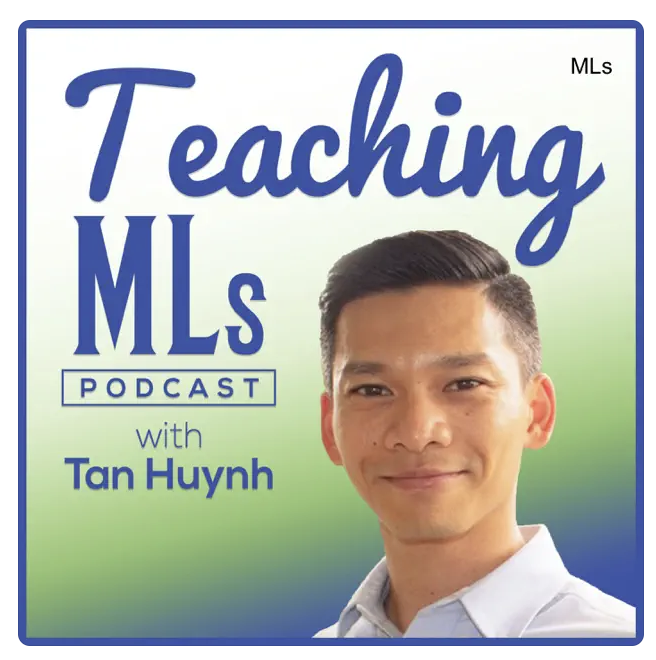
Podcast Recommendation: Teaching MLs with Tan Huynh

Do you want to keep up with the latest culturally responsive pedagogical strategies and thinking, but cannot squeeze yet another book into your shelf? Look no further than Tan Huynh’s “Teaching MLs” podcast, which focuses on sharing the perspectives of the most innovative educators in the field of multilingual learning. Best of all, it’s free, and perfect content for your commute, lunchtime walk, or whenever you find its best to listen to a podcast. Tan’s podcast has over 150 episodes, with new content added weekly.

I have personally found podcasts to be very “hit and miss” in terms of content and quality. Some podcasts seem to barely scratch the surface of their topics, focusing a little too long on conversation and not nearly enough time on the topic that drew me to listen in the first place. Tan does a great job of balancing the banter with substance, making every episode feel like something between a friendly conversation and a keynote address.

This podcast is excellent not only for the topics featured – translanguaging, multilingual assessment, dual language schools, science of reading, and Chat GPT, just to name a handful – but the incredible speakers that most educators will recognize from their professional libraries. John Hattie, Jim Cummins, Ayanna Cooper, Margot Gottlieb, John Seidlitz, and Gholdy Muhammad are just some of the “educelebrities” you will encounter on the podcast.

Tan manages to bring out useful insights and conversations from renowned speakers and experts that will make a lasting imprint on your thinking and pedagogy. Personally, I have found it an excellent resource for summarizing big topics like phonics based instruction, balanced literacy, aritificial intelligence, and and teacher collaboration. Tan connects the research and ideas of his interviewees to his own experiences as a multilingual educator, English learner, and language learner, layering his ideas and perspectives onto the work of renowned researchers and educators in the field. Even when speakers are not completely focused on the topic of multilingual learning, Tan does an excellent job of connecting the topic back to English language pedagogy.

Listening to an author or expert speak about their work also helps me to better understand things I have read, and sometimes even compels me to re-read, deepen and consolidate my learning.

I was fortunate to meet Tan in the fall of 2021 when he accepted an invitation to be a virtual guest speaker at our board’s annual conference for ESL/ELD teachers. He joined our planning meetings and conference from Thailand, where he was likely tuning in at what should have been his bedtime. He turned out not only to be a confident, knowledgeable, and talented presenter, but unbelievably kind, humble and easy to talk to. His presentation on Translanguaging continues to impact my work and the work of my fellow PETL colleagues: we still get comments on how informative and practical his presentation was.

Tan’s dedication to the work of multilingual educators is inspirational and exciting. In a moment where it can seem more challenging than ever to be an Ontario educator, we need professional learning that will affirm and enhance our practices. Check out the Teaching MLs podcast on your favourite streaming platforms. His website also contains great resources and a blog!

Pincushion

I always look forward to May and June — and not just for the blue skies and glorious weather. They are also months of collaboration with secondary educators, when hopeful and nervous grade 8 students can tour the high school they will attend in September. 

One of the secondary schools in our area has an ESL program, among many other specialized courses. And although information nights are held for families throughout the year, in May the small group visits begin.  Parents and guardians of multilingual language learners are invited to join tours, and together we visit classrooms, meet teachers and students, and answer questions. Just a handful of students at a time … a teacher … a family member or two … the ESL department head. These small tours happen fairly often, to accommodate new students and family schedules. 

I accompanied a few grade 8 students on one such tour recently and, as usual, it was a great morning. The learning spaces were alive with creation and vibrant communication. We moved from class to class, watching theatre rehearsals, computer design classes, geography presentations … and all of the spaces incorporated multiple languages, in multiple ways. We chatted with educators and community partners who spoke Turkish, Ukrainian, Arabic, and a host of other languages. We passed signs and posters in Vietnamese, Mandarin, and Spanish. We watched classes full of students speaking, reading, and writing in multiple languages, switching back and forth between them as needed. 

As we moved through the hallways and classrooms, I could see the students from my schools slowly relax, the serious expressions gradually replaced with smiles. Some recognized siblings and friends who already attended the school, some noticed similar activities and learning contexts from their elementary school classes. Witnessing this happy transformation reinforced to me the value of supporting elementary students in transitions, and the central role collaboration among educators plays in this process. 

Towards the end of the tour, we dropped in on the fashion class. The teacher at the front was arranging gold-coloured cloth in front of her sewing machine, and students were looking from her to their devices, hunched over screens filled with translations. The teacher explained to us they were learning about textile quality and cuts, and checking the vocabulary on translation apps and dictionaries, to learn content in both English and home languages. 

As we listened to students talk about what they were making, one student quietly got up and went to the back of the class to retrieve something. As she turned and approached our group, she held out her cupped hands in offering. She said nothing but smiled brightly; in her hands sat a pincushion. Puffed and white and softly rectangular, it looked like a little fairy pillow. She had embroidered two words on its surface, the bold, colourful thread jumping out against the ivory cloth. It was the word “love” — once in English, in deep ruby letters, and once in Arabic, the script obsidian black. She stood silently and smiling and simply holding out the pincushion she had made. I wish I had a photo of that moment.

At times, popular rhetoric can become singularly focused on hard data and measurable results, on whether student learning is up to “standard”. And while reflection on pedagogical approaches and student success is undeniably important, perhaps we should also be asking a different kind of question: Are our schools places of love? In other words, are they places where everyone is welcome and safe and valued? Places where learning happens in ways that centre students’ strengths, experiences, and identities? I have heard educators ask this question in many ways, many times over the years — but the sentiment is always the same. We cannot learn if we are not safe. And we cannot learn optimally unless we are valued for everything we are.

Perhaps that little pincushion, held in the hands of a happy and proud student, can tell us more about teaching and learning than at first glance we might think.

snacks

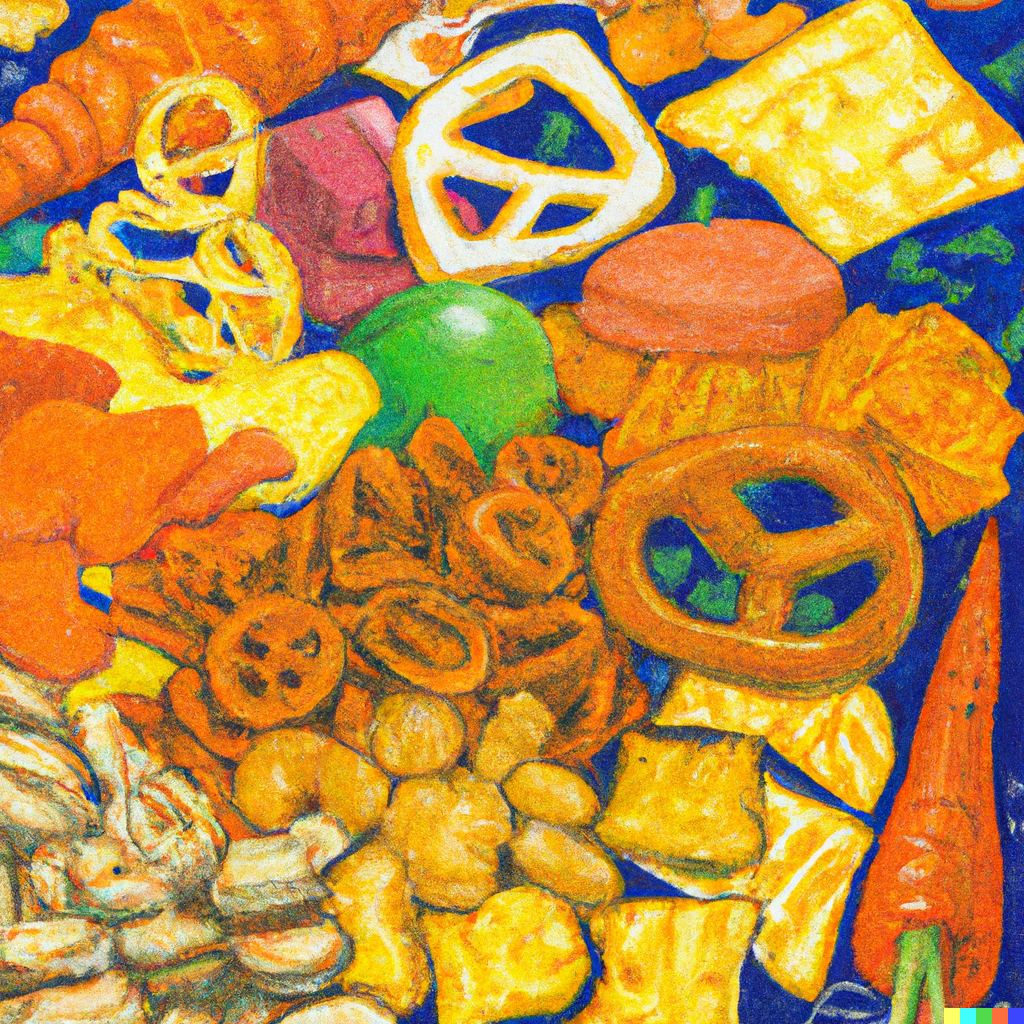
Via DALL-E – create a painting of Chips, Goldfish crackers, Cheetohs, Nachos, Pretzels, Carrots and other snack foods in a Rubenesque style – prompts by author

Crunchy food. I need crunchy food! Chips, goldfish crackers, veggie straws, or even, heaven forbid, real vegetables to stave off my brain triggered hunger now arriving via its ally my stomach.

Our stomachs tell us a lot of things, they are much like having a house weather forecaster by giving off warnings of inclement times ahead. Whether it’s stress, anxiety, nerves, or need for nourishment, stomachs are in the middle of a lot of action(s).

Mine is telling me that some crunchy snacks would be good right about now. So while I type and stare at my own options (granola bars, seaweed, crackers + hummus, pretzels, et al.), the idea to write about snacking and teaching comes to mind. Before I cave into my brain’s demands I thought it would be a good idea to consider why noisy food is a strange necessity during this and other similar moments of my day. 

Furthermore, in the interest of transparency, I will neither be making excuses for my snacking habits nor endorsing them. However, I will mention that there are times during the day which correlate to my need for a snack when the emotional and cognitive demands are increased. I am sure that this is a common occurrence amidst our ranks. 

Crunch crunch crunch when feeling the crunch

Why does eating crunchy food feel so satisfying? Is there a primordial connection to our primitive brains somehow? I can state without hesitation that there is something soothing in the noise. If not soothing then how about distracting? Sometimes our brains need a break from what they are processing. Eagelman repurposed the term “strategic surrender” in his book The Runaway Species.

I love how this phrase sounds, and share it often. Moreover, I share it in my classroom as a strategy for my students. Perhaps my breaks for crunchy foods are providing me with a diversionary pause that allows my brain to continue solving a problem while being distracted by the crunching going on just below it. All things considered, I had not thought about snacks as a restful respite from the compounding moments of the teaching day, but I know if they are good for me, then they are good for others. This includes students and teachers. 

To that last point, I always have a box of granola bars (peanut free – Costco brand) to support the growing minds and bodies in the room. Whenever an OT joins our classroom for the day, I am sure to leave one for them too. I know that it cannot be easy to step into unknown spaces on a daily basis without the need for some strategic surrender from time to time. A snack and a note of gratitude may be a simple act, but can be very meaningful too. 

Crunching gone wrong

I add this thought for consideration only because it is still important to make healthy choices when it comes to what we consume. There are only so many Cheetos binge windows left in my life and I want to savour them over the holidays. So that means carrots, radishes, and other less carby things that can still shake up my brain with some decibels with each bite. Another thing to consider might be how often I am eating my feelings and stress rather than identifying and addressing their root causes. If I am eating to cope with my stresses then I need to get some help. If I am eating to keep my brain and body fueled then I will continue to crunch on. 

Thirst

There might be another factor at play here, and I have often turned to my coffee cup and water bottle to deal with it. Sometimes we forget to drink enough throughout the day. It’s kind of hard when our bladders need to be set to an entirely different schedule than our bodies deem naturally necessary. Unlike our students, we just can’t ask for permission to take the long way around the building to get some water and use the washroom. As a result, many teachers are under-hydrating. This can lead to decreased energy levels and can impair cognitive optimization and may also lead to long term health issues.

As we work to finish off our final month of the year in a good way, it is crucial to keep both body and mind in healthy states with a little crunch and a big sip.

Ideas for Learning in June

June is finally upon us. It might just be me but I sometimes find it hard to compete with the warm weather and the idea that summer is fast approaching. With cut-off dates for report cards set for early June in many boards across Ontario, keeping the learning going all month long can be challenging. In this post, I’m sharing some ideas that might make things a little easier as we work towards keeping learners engaged over the last few weeks of the school year.

Literacy – Podcasts

I’m a huge fan of listening to podcasts and over the years, I’ve seen first-hand how much students also enjoy listening to them. Here’s a list of some podcasts that I have listened to with students that have been a hit:

Six Minutes

The Unexplainable Disappearance of Mars Patel

The Alien Adventures of Finn Caspian

Podcast listening is great but you might be wondering what else you might do beyond listening. 

Here are a few ideas:

  1. Have students draw what they hear as they listen to an episode of a podcast. In some series, the podcast is describing the setting. Have students draw what they imagine the setting would look like. For example, Mars’ room or The Marlowe 280 Interplanetary Exploratory Space Station where Finn and his friends live. 
  2. Have students make predictions and explain why they made their predictions. When finished, ask them to compare what they thought would happen to what really happened.
  3. Have students consider one thing that they might change in an episode and share how that might affect future episodes or change the entire podcast.
  4. Have students compare themselves to a character. How are they similar? How are they different? 
  5. In most of the above podcasts, there’s some form of tech involved. Give students materials and have them build a prototype of the tech. What improvements would they add to solve a particular problem for one of the characters in the podcast?

The ideas are endless! Take a listen and see what you and your students might come up with!

Literacy – What’s Going On in This Picture?

I’ve been a long-time fan of The New York Times’ What’s Going on in This Picture? Simply put, this site is a compilation of interesting New York Times images that have been stripped of their captions, and an invitation to students to discuss them by answering 3 questions:

  1. What is going on in this picture?
  2. What do you see that makes you say that?
  3. What more can you find?

When I have done these with students in the past, I’ve found that in the beginning, students are quick to provide an answer without sharing much of the reasoning behind their answer but as time goes on, I have found that many students take the time to really analyze the picture so as to justify their responses. I found this simple activity a great way to get the day started and get students thinking about inferences. 

Numeracy – Which One Doesn’t Belong?

Anyone who knows me knows that I am a fan of math and love a great math talk. When students are able to share what they know or are able to justify their thinking, I get excited. Which One Doesn’t Belong offers a great opportunity for students to share their thinking around a variety of Math concepts, often leading to some rich conversations as they battle it out to ultimately prove, which one doesn’t belong. In the past, I have printed out images from the site and added them to chart paper or to the whiteboard for students to come up and add their thoughts and ideas. Because the only way to get a wrong answer is to not justify your thinking, I’ve found that some of my most reluctant mathematicians are eager to participate and are often the first to write out their stickie notes and add them to the image that doesn’t belong.   

Numeracy – Coding

There are so many resources out there for coding. From guided activities on Code.org to lessons in Minecraft, there are so many possibilities for helping students to solve problems and create computational representations of mathematical situations by writing and executing code.  Recently, I was working with a group of grade 5 students who were working through the Artemis: Rocket Build. While the Educator Guide was super helpful, it was really my students who were running the show and helping guide me through some of the builds. I currently have a group of grade 4/5 students who are working in Minecraft to build their own town based on the work that they are doing with their classroom teacher for Social Studies. Don’t have access to tech? No worries, Code.org has some great unplugged coding videos and activities that you can try with students. Check them out here

Science – Scavenger Hunts

Create a simple scavenger hunt for your students with items found in the schoolyard or a local park and get students outside, checking out nature. I’ve done this with students from kindergarten to grade 5 and no matter the age, finding something out in nature and taking the time to explore it, is pretty cool. 

Science – Planting

The kindergarten students this year had a blast planting their Grass Heads. In classes around our school, students have been planting seeds and beans and have been recording observations and taking measurements. Some classes have been growing lettuce from existing lettuce heads while others have been doing experiments where plants are put in a variety of conditions to see what happens. Our kindergarten students have also been out planting in our garden with parent volunteers. Consider planting with students. Spring is a great time for planting as things are sprouting all around us. 

Physical Education – Student-Led Workout Circuits

Early in the pandemic, while teaching online, my students and I got really creative in designing our Physical Education classes. We were already used to student facilitators for our activities so when we went online, students were eager to create great lessons to keep the movement going from home. Students were asked to create short 15-minute workouts that they could challenge their peers with. The results were amazing. I haven’t taught Physical Education since we’ve been back in school but this is definitely one thing that I would incorporate if ever I teach Physical Education again.

French – Créez votre monstre

I recently facilitated a workshop for ETFO’s FSL Conference and shared this idea with teachers. Participants were asked to create their own monster using found materials and they had the opportunity to write 4 short sentences about their monster. From there, they used Adobe Express to create short videos about their monster. Half the fun was in building the monster and getting the opportunity to create. We used Adobe Express to create short videos but if you have access to tech, there are so many possibilities of what you might do. Some teachers mentioned using Flip while others considered recording short videos and including them in a Google Slides presentation. Why not create and have fun in the last month of your FSL program? 

I hope that there’s something here that might be of help as you navigate these last few weeks. Wishing you all the best for a wonderful end of the year!
Celebrating Asian Heritage Month in Primary

May was Asian Heritage Month in Canada, a time to reflect on and recognize the many contributions that people of Asian origin have made and continue to make to Canada. Asian Heritage Month has been celebrated since the 1990s. (Government of Canada, www.canada.ca/en/canadian-heritage/campaigns/asian-heritage-month.html)

Celebrating Heritage Months is an important step in helping students to learn about themselves and others. Asia is such a large continent and has so many diverse countries and traditions that I learn something new every year I choose to highlight this month. Even though I am half-Filipina, our culture can be vastly different from other Asian cultures and learning more about others is a great way to honour Asian Heritage Month each year.

Working with primary teachers, we really wanted to highlight the diversity of Asia. We started the lesson brainstorming any Asian countries that the students knew – and they knew quite a few! They were able to identify familiar ones, such as China, Japan, and Korea. Then we pulled up a map of the continent of Asia and looked at so many, many more! The students were able to see countries that they didn’t know yet, such as Yemen and Malaysia. Looking at the map really helped to develop the idea that Asia is a vast continent.

We also showed a variety of photos of different countries and their landscapes, monuments, and architecture. We talked about how different countries in Asia are from one another because we wanted students to understand that being Asian can mean so many things, not just a single story or single experience. With this intention for primary students, we wanted to build this knowledge instead of reinforcing stereotypes of Asian identities.

I shared with the students about my own heritage as half-Filipina and how there were things about myself that reminded me of my family and culture, the foods we eat, my skin, my nose, and my eyes. The students also shared parts of their identities and this helped us to build our thinking before reading Joanna Ho’s book, Eyes That Kiss In the Corners.

In this book, the main character shares how her eyes remind her of her mother’s eyes, her grandmother’s eyes, and her little sister’s eyes. She explains how they help her to feel proud and connected to her family. We looked at the beautiful illustrations by Dung Ho and how they represented Asian identity. The students were enthralled by the stunning colours and the way the illustrations connected to the message of the story.

As we wrapped up, we asked students to tell us one thing they learned. They shared so many things! They learned that there were countries in Western Asia, such as Lebanon. They learned that there were many more countries in Asia than they knew. They learned that there were big cities in Asian countries, but also many beaches along the ocean and seasides. We were so excited to hear that they were also interested in learning more about the countries they had yet to discover!

Celebrating heritage months takes many different forms. I loved hearing primary student voices and helping to develop their curiosity and wonder about the world. I can’t wait to see what they want to learn about next!