Photo of Tammy Axt

My dad’s name is “Bill”

Over the past couple of months, I have been working with a team of teachers and behavior specialists to help one student in my music class who is struggling with disruptive and oppositional behaviour. Through the process I have learned a couple of things. First, that the situation will not be solved overnight; it takes a lot of thought and time to implement a program in order to witness change. I have also learned that five heads are better than one when trying to instill positive behaviour plans. But ultimately, the biggest thing that I learned only happened this week….

When the student first started to have trouble within my class, my first step was to look in the student’s OSR for evidence of a Behavior Support Plan. I read the plan very closely and I decided to implement the suggestions from the plan. The plan indicated that the student should count backwards from 10 when they became upset. I tried this strategy, but I received no response from the student. The plan also suggested that the student go to a quiet spot in the room when they became upset. I asked the student to move, which they did, but they scribbled all over the floor with markers in their quiet spot. Overall, the Behavior Support Plan didn’t seem to help the student be successful.

Next, I met with the classroom teacher. As a planning time teacher, mirroring the language and behavior management system of their regular classroom can be very effective. It requires a lot of flexibility of the planning time teacher but when situations arise that need intervention, this can be a great place to start. Unfortunately, the classroom teacher was dealing with many of the same behaviors that I was and did not have much advice for me.

Then, I met with my colleague to brainstorm some ideas to help the student in my class. My colleague and I came up with a tracking system to try and figure out if there were some triggers that led to some of the student’s behavior. I went up during the lunch break and just observed the student about 10-15 minutes before they came to me every time I taught them and continued to observe them in my class. Observing them in different settings was incredibly helpful. I could see what happened directly before they came to me. The student struggles greatly with recess and comes inside regularly with issues that have happened outside. I also witnessed the ongoing, major conflict that exists between my student and another student called “Bill” in the classroom.

I know what I need to do now in order to help the student. I need to help them transition from the playground to the classroom to help them in music. I have started going up a few minutes early for this period and touching base with the student before they come to see me. I tell them something positive and initiate a conversation about their life. These three minutes twice a week have really made a difference.

Until this week, the one issue I still didn’t fully understand was why this student hated “Bill” so much. The student never wanted to sit near “Bill”, would never work with them and the mere presence of “Bill” annoyed them. Through one of conversations this week things became a little clearer when the student told me that their father’s name was “Bill”.

Taking the time to listen and get to know our students can really make a difference in building a relationship and thus helping us to manage their behaviour.

From Teacher Directed to Student Directed Learning


As a new teacher or a teacher with many years experience, you hear about the importance of planning for student-directed learning in the classroom. Keeping this approach in mind as you plan in all subject areas benefits student learning and also benefits the teacher. Benefits include:

  • Engaged students – most students want the opportunity to talk as they learn, not just listen. When made to only listen, they look for distractions and classroom management issues often arise. If students are provided time to collaborate on a topic that interests them, they are engaged in the process and positive learning outcomes are the result.
  • Student interest – this leads to the content. Provide students with choice and select topics within the curriculum expectations that are of interest to your group of students. Students will demonstrate more initiative and take more responsibility for their own learning if they have choice of relevant topics. For example, in my grade 6/7 class, I modelled writing a monologue from the perspective of a character. Then, the students were all provided with a rubric to create their own dramatic monologue based on a character of their choice from a book from their choice.
  • Differentiated instruction – allowing choice of topic or type of presentation/project differentiates for the range of learners. Again, as an example from the monologue assignment, struggling readers selected books like Diary of a Wimpy Kid, while others selected more challenging texts like Journey to Jo’burg. Similarly, students will select an option for a project on what they are comfortable with (creating a slideshow vs. a video). By allowing students choice, you are more inclusive, not lowering your expectations for those who can surpass them, or challenging your lower level students to frustration. And as a result, the students who select the more accessible choice, often learn from the students who are demonstrating success with a more challenging topic or type of presentation.
  • Assessment – student-directed learning allows time for ongoing assessment. I have spoken to teachers who plan detailed lessons and present to the class in a lecture style format with little time for collaboration or independent research. These teachers lament that student’s aren’t “listening” enough. They also wait until the end of unit to assess students with a paper/pencil task. By facilitating students in a more self-directed approach, teachers can support student where they are at with resources and mini-lessons for those who need it. Why provide the same lesson to the whole class if they do not all need it? When students are working in small groups or pairs, or even independently, the teacher is provided the time to interact with students, find out where they are in their understanding and provide the necessary support (assessment for learning).
Student-directed learning isn’t students learning on their own. It is more like students learning within a framework set up by the teacher, and supported by the teacher. It benefits all those involved!


The Hardest Thing I’ve Done as a Teacher

A month ago, I had to suddenly and somewhat unexpectedly leave my teaching job to go on sick leave. Being pregnant, I knew that at some point this year I would be handing off my class to a stranger, but a big part of me was relying on having lots of notice that it was happening. I imagined a nice, smooth, calm transition where I would be able to give my students ample notice, sit with my replacement and give him or her lots of information on my students and their needs, talk to parents about it…

I definitely did not envision myself standing in front of my class with 20 minutes to the dismissal bell, tearfully telling them that I was sorry, but that I’d be back in the next day to say goodbye but would otherwise not be coming back until after my baby is born.

I had known for a few weeks that being ordered off work was a possibility, but I naively thought that my doctor would give me some kind of nebulous recommendation about going off work and leave the date up to me to decide. Instead, at a routine prenatal appointment on a Monday morning, he wrote me a note that said I would no longer be working as of that day. That day?! I wasn’t ready! My classroom was a disaster, I hadn’t finished marking, I hadn’t even taught things I needed to teach for the Progress Report yet, I hadn’t spoken to my students or their parents, I hadn’t even spoken to my colleagues or, more importantly, my administration!

Stubbornly, I waited until later that day to show the note to my principal and said that I would leave work at the end of the week, on Halloween. She shook her head and pointed to where it said “as of today,” explaining to me that the health of my child was paramount (as was my own) and that my students would be okay. I cried. I argued. I asked if I could please just be at work the next day so that I could get a proper goodbye in. She allowed me to come to work the next day, but not to teach. She had an OT come in for that day, and I spent the day getting things in order for someone to come in suddenly and jump into my class.

I had 20 minutes with my students at the end of the day on that Monday where I could tell them that I would be leaving and that it wasn’t my choice but that it was important for me to be at home and taking care of myself so that my baby and I would be healthy and safe. On the Tuesday, I popped in to see them throughout the day, answered their questions, and managed to get a goodbye in to everyone. They threw together a quick goodbye party for me and made me cry over and over with their kindness and generosity.

I’ve been off work now for four weeks. In that time, I have only been able to visit my class and my students once. This was partially due to time constraints and health, but partially because it’s important to me that they are able to move on and build a rapport with a new teacher.

I’m telling you this story because this experience has taught me several important lessons as a teacher. I’ll try to be concise as I explore them here.

1) Keep your classroom ready. I was fortunate to be of sound mind and healthy enough that I could stay after school those last two days and, with the help of my husband and some very generous colleagues, madly pack up the things I wanted to take home, throw away the things I had been meaning to throw away, and put away everything else in a place that a new teacher could come in and find them. It made me realize that had I gone into preterm labour, or had a major medical emergency of some kind where I could not come in at ALL, my classroom would have been a terrible experience for another teacher. It worked for me, but it didn’t work for anyone else. When I eventually return to work, I’ve learned that I need to keep my classroom in a state of relative readiness at all times so that should anything come up – even if I just need to be away for a day or two – another teacher will feel comfortable walking in and taking over.

2) Your students will be okay. I work hard to build a rapport with my students and I feel like I’m successful in reaching most of them. I am very invested in their success and well-being. It was very hard for me to pass off my class, especially so early in the year, to a teacher I didn’t know. It wasn’t that I didn’t think the new teacher could do a good enough job – it was that I worried about those young souls I left behind and if they would be able to engage with their new teacher. I worried about the ones who needed accommodations and whether they would advocate for themselves in my absence. I don’t deny that the transition was hard for some of my students, just as it is for them to adjust to me as their teacher at the beginning of the school year, and how hard it is for them to adjust to leaving my class at the end of the year. What I learned, however, is that students are flexible. They find things to relate to with their teachers. They find a way to fit a new personality and a new way of doing things into their lives. Will they like every teacher they ever have? No, of course not; to think that would be naive. But they will be okay, their needs will be taken care of, because deep down every teacher (I hope) has their students’ best interests at heart. We all have different styles, but we all want what’s best for our students, and they know that.

3) Crying in front of your students is okay, too. I am fairly certain that my students don’t think less of me because I was an emotional wreck those last two days. They don’t care that you didn’t wear makeup because you knew you were going to cry. They don’t care that you’re flustered and can’t find the right words to say. These things make you human. They make you “normal”. Accessible, in a way.

4) It’s okay to be honest with your students. I didn’t hide anything from them. I told them that my doctor had told me that I had to stop working because it was better for my baby (and me) to be at home resting. I assured them that nothing was wrong, but that this was just to make sure my baby could keep growing as long as possible. They appreciated the honesty. Had I just disappeared or left without giving them any detail, they would have been much more concerned. They were invested in the well being of my child because they cared about me. They were not distressed because I wasn’t distressed, I was just sad to leave.

5) You really, really, really need to disengage when you leave. For the first two weeks after I left work, I thought about it all the time. I cried more. I was upset that things weren’t the way I wanted. I checked my work e-mail constantly and was always texting my colleagues with things I had forgotten. This didn’t really help me “de-stress” the way I was supposed to. I still check my work e-mail once a day, because the official handover hasn’t happened yet and my long-term replacement only starts next week, but once she starts and we’ve had a chance to connect, I plan to reduce my work e-mail perusal to once a week (if that). Trust your colleagues to take care of your students in your absence. It’ll be alright.

I’m finally, four weeks in, embracing my time off. In a way I’m glad that I was sent off work early, because I can only imagine that being as upset as I was about it would have been ever harder if I was going through that while also caring for a newborn. It was very hard to let go and believe that everything would be okay. I still have moments where I think about individual students and how badly I wish I could be there for them, but I’m able to remind myself now that people are looking out for them.

We’ll see how I feel six months from now. 😉

Photo of Lisa Taylor

Behaviour Management – is there one magical system?


How you decide to manage behaviour in your classroom will in the end be up to you. There are many, MANY blogs about the topic, and many are worth reading, if not to get great ideas and resources, but to hear about what not to do! Pinterest is full of links to blog posts, posters, resources, etc., that you can use in your classroom. In the end, it will depend on what you are comfortable with, and the group you have.

When I first started teaching, I tried a marble jar. I made the mistake in my first year of taking marbles out when my kids were misbehaving and this was an awful mistake on my part. I totally lost their trust. If you use a system where you give something, if at all possible, don’t take it back. They have earned that and no future behaviour should impact past positive behaviour.

There is more than just a marble jar out there now! I am going to list a few systems I have used, and some I haven’t. Keep in mind that each of these systems needs to be rejigged to fit your own needs for your teaching style, and the group of kids you are working with.

Class Dojo

Class Dojo is a digital app that is great for tracking behaviours and students and parents can check their progress from home. If you are absent a lot (I was often out on union business, personal illness, and supporting an ill child), it is a great system as you can leave it for

an OT and you can “check in” on your kids and see how they are doing throughout the absence. You get to choose a monster/alien/creature for each student. When I created my class the year I used this app, I chose one colour for my high fliers. I didn’t tell the class this, but it was an easy way for the OT to remember what students needed more positive reminders.

The thing I don’t like about Class Dojo is that it is a token economy where you can give and take points away. Students can actually be in the negative. This is very discouraging for students. It has always been my philosophy that if a child has earned some positive reward of sorts, that they should keep it. If you feel this same way, this app might not be for you, or you would just not use the deduct a point feature.

I have also used this app to track behaviours (secretly – not as a whole class management system). I had a student who was struggling with several severe behaviours – hands on, calling out, personal space, etc. We set him up on Class Dojo and the EA that was in our room would track with positives and negatives as it gave us an excellent print out of his trends. You can change the “behaviours” that it starts with, so you can make them as specific as you need. We even changed one to keep track of ticks in another student.

“Pick Me” Coins

A few years ago I read a blog post about a coins system that I used in my Grade 2 class and absolutely loved! Here is a link to the blog post  – I numbered my students, got some counters (many schools have these in great abundance, but you can get them from most education stores for about $5-10 for enough for the whole class). Each time I saw someone doing something awesome, I would give them a “Pick Me” coin. They would then get to put it into my “Pick Me” bin. I just used a small spaghetti sauce container, or pizza sauce container. Something that will fill up quickly and make a nice sound when you shake it. That way my kids knew I was on the lookout. They put their coin into the draw and then whenever I needed a helper or helpers for anything – attendance, hand things out, collect things, water the plants, run something to the office, etc., etc., etc., the list truly does go on, I just drew a number. This was awesome for two reasons – 1. I never remember to change the “jobs” on the job chart and then the one kid in the class that is on a sucky job like sort the garbage complains relentlessly and you feel awful; and 2. There is never any need to pick anyone for anything and have to think about who has been doing a good job, etc. The system does it for you. My only added rule was that they had to be on task when I drew them. If they weren’t, their number simply went back into the draw for next time. I would empty the “Pick Me” jar at the end of every week.

This is also how I taught my entire probability unit!

I even started letting my kids nominate each other for Pick Mes. I made a form up and they could fill it in and submit it to me. I introduced it during persuasive writing and it was a huge success – and a great way for my kids to start to look for the positive behaviours in others!

This was an amazing system and my class loved it. The second year I did it, my Grade 2s did not buy into it as much and I had to use something else entirely. Every class is different.

Stop Light

My daughter is in Grade 1 right now and she comes home every day saying, “I was on Green all day!” – her class is doing a stop light system. My understanding, from my 5 year old, is that when someone makes a bad choice, they move down to the yellow light, and then down to the red light. “When someone makes to to the red light, Mme calls home!”

Clothes Pin Charts

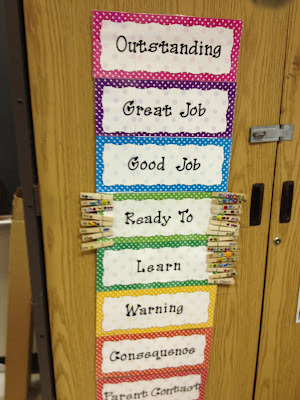
I have seen variations of the clothes pin names moving around. The thing I am not crazy about with clip charts, is that it really singles out the kids who struggle. Those kids who have IEPs and behaviour plans are going to really lose out in this system. It is really easy to get discouraged and give up if you know that every day you are going to end up at the bottom. Set those kids up for success – catch them doing something awesome to move them up as often as you can to start the momentum early. If you can get them moving toward outstanding early in the day, you will be less likely to end up at Parent Contact. If you leave it to them, they will likely end up at the bottom.

NOISE and Decibel Reader

I used this idea for snack time mostly. Put the letters to the word NOISE up on the board. Erase a letter each time the kids need a reminder that it is getting too loud. When it gets to just NO – that means there is NO Talking. It took a few times for them to get to the No Talking part to realize they needed to keep it down. I have paired this with an app that shows the decibels of the room so the lunch helpers don’t have to guess, and have just given them an upper range and when the class goes over that limit, take down a letter. I project the app on the screen so the kids can see where they are as well – add a little science to their snack time!


When it comes down to it, there is no one perfect behaviour management system. Your behaviour management system won’t solve your classroom management problems on its own. It is all in how you use it and manipulate it to serve your purpose. Keep in mind that positive reinforcement is far more effective than negative.

Photo of Mike Beetham

But Why?

This is a term that has become a part of my teaching repertoire since spending the last four summers working with teachers in Sierra Leone, Africa. There are two ways that I make use of this valuable term in my classroom practice.

The first is when I am dealing with classroom management concerns in my classroom. There are always students who are not following the expectations, not fulfilling the work requirements, not complying to the adults etc… The fact is that most teachers are only able to deal with the behaviour piece (tip of the iceberg). The question ‘But Why?’ forces me to look beyond the behaviour, beyond the part that negatively affects the classroom routine and to seek out the roots of the behaviour. If I can make the time to figure out why something is occurring, I have a much better chance to support a change that will be permanent.

For example, student X  in my class last year had a reputation for refusing to do his work. It did not matter whether it was numeracy or literacy he usually behaved in such a way that the teacher had to finally intervene and remove the student for the good of the rest of the class. So, student X had developed a very effective strategy of avoiding areas that he did not want to take part in. The removal from the class was actually a reward for him even though in the eyes of everyone else it was a punishment.

I had to try and figure out the ‘Why?’ for his behaviour. This took time, patience and most importantly a good relationship. The end result was that he had significant gaps in his learning due to his behaviour choices and that future testing revealed that he had a learning disability in writing. As a result, he had learned that compared to everyone else he was dumb when it came to being able to express himself in written form. The removal from a class (adult punishment) was not as negative as the inadequate feeling he had everyday in school when required to write with his peers.

The solution became the need for differentiated instruction and differentiated assessment in order to allow student X the most effective way to demonstrate his learning. He still had to write, but only when writing was being assessed. In numeracy I only assessed his understanding of numerical concepts and not his writing skills. Scribing, models, oral explanations allowed him to both gain confidence in his actual abilities and not have to focus on his area of need.

Stay tuned for Part 2 of “But Why?”.

Photo of Samantha Perrin

Extra-Curricular Involvement – All in Good Time

Your school is a community and a good way to enrich your year as a teacher is to participate in this community. Some good reasons for getting involved include, opportunities to share your expertise or vision for the school, getting to interact and connect with students and parents in a supportive but more informal way, and being part of the spirit of the school. This year, someone may ask you to get involved by organizing extra-curricular sports and clubs for students, or by taking on administrative roles such as a Parent Council, Union, or Safe and Caring Schools Representative.  Here are some things you may want to consider before you make a decision.

Anything you do outside the classroom means you have to be able to take time to do whatever you decide to take on. Make sure that you do not overdo it! I have seen new teachers sign up for as many extra-curricular activities as possible because they think they should, only to have to bow out of many due to a lack of time. Being too stretched time wise can also affect your enthusiasm for the activity and you may begin to look forward to it less and less. Remembering to balance time for your job and your life outside of work is of the utmost importance. Do not feel bad if you have to decline a request to start a club or help coach a team. It is best to become involved only when you have the time and energy! You may lose lunch hours, have to come in extra early some mornings, or stay later after school to make it happen. Some years may be better than others. Do it when you are ready.

And not everyone is able to give more of their time. There may be childcare or family obligations, lack of proximity to the school, or health concerns which may present challenges for someone wishing to coach Girls’ Soccer, for example. Also, taking Additional Qualifications or going back to school to complete a Masters’ degree may not be the best time for you to engage directly in extra-curricular activities at your school. Your studies will ultimately benefit your school community and so while you are studying, your job as a classroom teacher and your life as a student are already big responsibilities and commitments.

If you are looking for ways to become involved, breaking the school community into 3 parts may help organize how you want to participate and budget your time. Firstly, consider your academic obligations towards your own students. Secondly, you may be interested in working with colleagues and parents in the administration of the school. And thirdly, you may be ready to offer your time to run a club or sport involving students in the whole school.

Using this guide, I have always been able to manage time to run a math club or homework help all year long for my students.  And in the last 10 years, I find I have become more interested in taking on administrative roles and enjoy being part of the Safe and Caring Schools initiative – going to workshops and promoting social justice resources and issues at school. And lastly, if I can, I take on a sports or arts club once a week before or after school for part of the year. For example, coaching Track and Field in May and June, or organizing International Dance Day for one day in April. I used to have much more energy and was very happy to run a couple of clubs and teams at the same time. Now, I realize I am able to be useful in more administrative areas of the school community and so I happily leave the running of the teams and clubs I used to enjoy to the younger (more energetic) teachers.

Photo of Samantha Perrin

Getting Sick in September

Three weeks into the school year, and it happens. One day, my throat gets a little sore and then the next day, my voice is completely gone. Laryngitis. Professional hazard. Communication chakra shut down. And what is a teacher to do without a voice?

This cold was a humdinger – in my entire teaching career, I have rarely taken 2 days off in succession because it is usually too much trouble to plan ahead. But with this cold, there was absolutely no way I could teach. Even with 2 days off to rest, I struggled for the rest of the week when I did go back and if it weren’t for the help of fellow teachers, some good preplanning, and the cooperation of my students, I never would have managed.

You may have already received some good council about the importance of seeking a life/work balance. Teachers are so susceptible to germs in our day-to-day jobs because of the age group and the volume of people we come in contact with. So if we can’t avoid coming in to contact with children, how on earth can we find balance so we can protect our health? It is not easy, but it is possible.

Here are some suggestions;

– Try to keep in good health and avoid getting run down. I know it is sometimes hard, but you will be so much happier and effective in the classroom if you are feeling good. To that end, I reckon that the most important factor to maintaining good health as a teacher is getting enough sleep. Second to that is my personal favourite; getting outside for as much time as possible each day – before, during, and after work. Germs spread easily indoors – avoid coming into contact with them if you can. Oh, and drink lots of water (not coffee) to give you energy!

– If you do get sick – and as new teachers and teachers transferring to a new school, it is inevitable as our systems get used to new environments and the stresses of a new assignment –take the time to recuperate. You will not be in top shape to teach and you may be contagious, as well. However, it can be a challenge to make adequately detailed plans for your guest teacher while you are away, so it is a good idea to have some routines set up with your students, lesson plan templates to easily fill in or emergency day plans already drawn up, a sheet with background information on special needs of your students, and the names of a few student helpers who could be called upon to show the guest teacher where the math textbooks are, or explain a class routine. Do this when you are feeling healthy! It will offer you some care-free time to get better.

– When you return to the classroom, be honest about how you are feeling with your students. Your honesty will be appreciated when you say that you are recuperating and may need some helpers throughout the day. As it was a challenge for me to speak and be heard, I relied on the help of students with strong, clear voices to broadcast any messages I had for the class, such as, “Please get your shoes on for gym and quietly line up at the door.” There are always plenty of volunteers for this job!

– Lastly, benefit from the help and support of coworkers.  This cannot be overemphasized, as simple acts of kindness from, taking the time to do some photocopying for you, watching your students while on his or her preparation time to give you a few extra minutes to yourself, inviting your class to participate in a group activity, or sharing a lesson, complete with the necessary resources, that could be easily taught without too much preparation on your part. The best way to make sure that someone will be there for you is to pay it forward and be there for someone when they may need a little support. Good to remember when you are feeling better.

Here’s hoping you have a healthy start to the year. If you have any other tips regarding staying in good form throughout the school year, please feel free to share them!

Photo of Mike Beetham

It’s A Marathon, Not A Sprint

Planning, assessing, progress reports, meetings, parent interviews,supervision duty, long range plans and on and on and on. Within less than four weeks the calm, balanced life that summer provided us with seems nowhere to be found. The demands of the daily responsibilities of being a teacher seem to be like a snowball going downhill as it just seems to be gaining speed and size with no end in mind.

 It is critical that you care for yourself and create that balance between your work and personal life into your routine as early as possible. As is the case with most teachers, we sacrifice our personal wellness for the demands of our role. We eat on the run (if not skip it altogether), come in earlier, stay later, cancel out scheduled fitness time and give up personal needs for the good of our classroom. In the long run, this is not going to benefit anyone and will lead to increased stress in your work and personal life.

You need to set guidelines that you feel will allow you to fulfill your professional responsibilities and maintain a healthy lifestyle away from work.  I use the following guides in helping me keep that balance:

–       I find early mornings are my most productive time so I go to school early but leave 15 minutes after the end of the school day. On staff meetings days, I go in later.

–       I look ahead at my entire week and plan my workouts around the demands of the week.

–       I stay later on Friday afternoon so that I have time to reflect on my week and establish my plan for the upcoming week. That allows me to ensure my weekends are for family and I.

–       Sunday night is my time to ensure my weekly plan is in place for the upcoming days.

Of course my best laid plans don’t always work out (reporting time, parent interviews etc…) and I have to adjust to ensure that I have completed my professional responsibilities. The key is that you have to work at keeping balance in your life and just as you would expect your students to give their best effort and balance school life and home life, so must you. A healthy teacher is more likely to have a healthy classroom.


Photo of Beverly Papove

Gentle Reminders

Greetings and welcome!

I don’t know about you, but every September, just like my students, I still feel the excitement and anticipation for the new school year! This year is certainly no exception and I hope you are looking forward to your year, trusting in your professional integrity, your training and experience, and your decision to have chosen a career where you can learn so much from your students in your role as teacher.

I’d like to introduce myself: My name is Beverly Papove and I am a new voice joining the writers on the Heart and Art blog.  I have been a teacher for more than 20 years. My teaching experience has offered me the privilege of working in public and private systems in 4 provinces, in an Inuit community, in a Cree community and in Europe. I have taught kindergarten to university students, and I am currently teaching Grade 3 French Immersion for a fourth year. I look forward to sharing some stories and lessons I have learned that will be useful or, at the very least, entertaining!

Too often, as conscientious as teachers often tend to be, we sometimes find ourselves reinventing the wheel, when there is already a wealth of wisdom out there that is practical, simple, and meaningful. The teaching profession may have changed over many, many years, but we are still humans, whose basic needs have always been to belong, to feel safe and to enjoying the freedom to express ourselves and explore the world around us.

To that end, I started off the year by letting my students know that there are three things I think are really important; Safety, Respect, and Fun. I can get pretty silly and I certainly like to laugh, however, no respect? No fun. And no safety can mean someone gets hurt and that also is definitely not fun. These three goals pretty much go together and when they do, our classroom is a happy place to learn in. Moreover, having only three overall expectations makes it easy for everyone to remember and to achieve. I asked the students what they thought a safe, fun, respectful classroom would look like and they suggested ideas, activities and kind words. After our discussion, the students worked in small groups or individually to create colourful posters illustrating their ideas (for some reason, there is always at least one giant looping slide at the top of a long staircase in drawings of the ideal classroom… I haven’t yet quite figured out why…). The posters now serve as gentle reminders for us all as we work as a team, creating a healthy learning environment for the rest of the year, with or without an indoor super slide.

Photo of Mike Beetham

Backward Planning To A Classroom Community

I would like to take a few lines to introduce myself to new readers or re-acquaint myself to regular bloggers. My name is Mike Beetham and I am entering into my 30th exciting year of teaching and look forward to the learning opportunities that will take place for me as I continually strive to enhance my best practice. I work with an area behaviour class of Junior age students and love to spend time in the outdoors.

 Each September a new group of students arrive in my classroom and our journey begins. Like any other trip, you have to know where you are going so that you can plan your journey accordingly.  In the first week of school we collectively complete the following activity. I create three charts with these titles:

What does a safe and peaceful classroom look like?

What does a safe and peaceful classroom feel like?

What does a safe and peaceful classroom sound like?

It starts with time for self-reflection, than moves to partner and small group discussion. Our final step is to post our ideas on chart paper. These sheets are visited throughout the first week. On Friday we take a final look at what our collective vision is and we complete the task by creating a classroom agreement that will help us create the community of learners we seek. I always accompany this with a good book such as ‘YO! Yes!’, ‘Wings’ or ‘Don’t Laugh At Me’.

As a teacher it is critical to take the time to visualize what your want your classroom to look like, feel like and sound like. From that point you put into action the activities and lessons that will move your group to the desired outcome. It is important to remember that this is a continual process and like any relationship, when the participants stop putting effort and time into the partnership, the bond starts to lessen.

Welcome back everyone and I hope you have a rewarding year!