Photo of Roz Geridis

Connecting with Parents

As the busy school year develops, parent communication is very important. All parent(s) want to know what his/her child is learning at school. Having a 5/6 all boys class made me find ways to involve the boys and open the communication for the family and to the school. To describe my class a little, it all boys with over half of my class on IEPs; 1 gifted, 2 HSP kids, 1 Aspergers, some identified LD and some still on the wait list for an assessment. Also, many boys have anxiety which some have been medically diagnosed and others are not. Agendas are a routine we are working to develop both for parents to read and for students to use them.

Communication I have used:

– started a bi-weekly newsletter, written by the students;

The writers are a job assignment and hands regularly go up to take on the job. I do give some content to include such as curriculum information, projects and areas of curriculum we are working on. The writers are able to add their content also and I do give a final approval. Once edited and published, I was impressed that the boys all took them home, not one was left in the classroom!

– meetings for IEP;

Most of my parents requested a meeting to develop the IEP so I had to find some time to meet with approximately half of my class. I scheduled all meetings with student entry time as an end time and gave parents 20 minutes to discuss the IEPs. This allowed me to meet with all parents who had requested a meeting, leaving me enough time to input the added information into the student’s IEP. I did keep in mind if parents had other concerns to discuss, another meeting would have to be scheduled.

– use of the agenda;

Many parents have asked for me to communicate through the agenda. At times, it seems like limited communication, I still take the time to develop a routine where students place their agenda on my desk and I initial every morning. I do not sign agendas at the end of the day as I am trying to help the students to build the routine of utilizing the agenda. I do give agenda time at the end of the day and write on the board the evening’s homework and reminders. The students are aware I will look at the agendas the next day therefore the routine is beginning to develop. If there is a need to write a note in the agenda at the end of the day, I do so.

– phone calls home;

Although there are limited phones and phone lines in the large school I am in, I have developed a routine. I take one prep period a week to make phone calls giving parents an update. I try to call every parent once a month.  If there are no concerns from myself or the parents, I start to give strategies to help with homework routine and learning skills. I also inquire about items getting home and inform parents about the class newsletter used as my way to keep parents updated.

– parent meetings;

Many parents have been calling to set up meetings. I am in an involved parent community; this is the norm in my school. Again, due to the early start of the year, I schedule the meetings with an entry time as the end point (i.e. 20  minutes before school or at the end of lunch). Some of my parents are colleagues and I do schedule those meetings for after school. All meetings have gone over 20 minutes but we are also discussing education related issues not just the colleague’s child.

– email;

I do not give out my email unless it is asked for. If parents do email me, my email reply consists of a simple acknowledgement of the concern and asking to set up a phone call meeting or face to face meeting to discuss the concern. Email is very easy to misunderstand and often I am in rush to read all my emails and do not have the time to finely craft an email response to a parent’s concern. If you do decide to use email, please save your email in draft and take another look, either a few hours later or the next day. Often, a discussion with an experienced colleague or time away from the concern gives us a different perspective.


What I have done are just examples of parent communication and have changed for me based on the school I am in or the students in my class. In some schools I have seen parents daily, even in upper junior grades, regular parent communication is quick. You have to do what works for you and your community. Most of all, remember to document your parent communication. Get some labels, print off a sheet with all the students name, record the parent communication and stick it on a paper in your communication binder.

Heart Picture

Slowing Down and Creating Goals

“Go Slow, Go Deep” – Tina’s words have been resonating in my head since I read her last post and over the past couple of weeks. I find myself repeating them to myself daily in response to everything from delivering my lessons in math, teaching the students how to sustain reading effectively during independent reading time, to working through our class agreements and routines.

After reading those words, I found myself reflecting on how intently I work to developing class lessons, routines and climate, and how there are always times when a few students don’t seem to transfer the learning from the class lesson to their individual work or conduct.  It can be frustrating trying to figure out why the students are missing it: Was it because I am moving through the lesson too quickly? Were the expectations clear?  Was it because Jimmy was squirming too much in front of Tommy?   Maybe I’m not engaging them… or is it the material?

Then I remember  the words Go Slow, Go Deep…

After some reflection, I remembered that in order to go deep with my students, what they are doing has to be meaningful to them (even when the subject area isn’t every students interest), and that time needs to be given to hook the students into what they are learning and reflect on what they are supposed to be getting out of a certain activity or lessons  (their learning goal). I usually draw upon student interests to make my lessons fun but not all students are passionate about all areas of the curriculum all of the time, and rather than spend all my time scouring the internet for more fun teaching ideas, I need to find a sustainable way for the students to buy in, and go deep:

Inspired by  Jim’s inclusion activity about developing Goals/Strengths/Beliefs ( Heart And Art of Teaching and Learning, p.36), I adapted the activity to have students communicate their learning goals for several learning tasks and we have begun this for a number of activities and subject areas.

Before and during lessons I  have started to include time for developing goals with my students for what I hope them to learn by the end of the lesson and I have the students share what they  think the final outcome should look like. Sometimes that means that a lesson that was originally intended to take one period will now take two, or even be spread out over the week. These goals are communicated on the whiteboard or chart paper for the students’ reference and so that the students can begin to self-regulate more.  I hope that by putting in the extra teaching time now,  by mid-year the students will be in the habit of viewing  their lessons as a  ‘goal’ with a defined outcome that they want to achieve.

I hope that by taking more time to developing goals with the students, it won’t matter as much that Jimmy was particularly squirmy one day or that Ari was counting the ceiling tiles instead of paying attention to  what a Level 4 Journal entry looks like. It will matter less  because our goals will be visible, available and referred to regularly and eventually (hopefully) it will sink in.  One of my  goals for this year is to continue taking the time to make goals with my students so that they may  develop it as a habit that is internalized, routine and oriented towards success.


Photo of Tina Ginglo

Break Cards

At times last month, it was a challenge to manage some of the behaviours demonstrated in my classroom.  I have some students who have difficulty focusing and completing tasks even when I have supported their learning with modifications and/or accommodations.   Each evening I would drive home trying to think of a new plan for settling these students so they are not disturbing lessons and the other students’ learning.   Through conversations with resource teachers, research and trial and error, I think I have found a keeper!   At least it seems to be working in our classroom community…so far:)

It was recommended that I provide “break cards” to the students in my class who struggle with staying on task.  These students would start the morning with 2-3 break cards and they would be able to hand me a break card whenever they wanted to take a break from their assigned activities.   At first I didn’t like the idea.  What about the other students in the class who work hard and stay focused throughout the day?  Shouldn’t they deserve break cards as well?   Of course they do!  So I decided to provide “break cards” for everyone!

I feel that breaks should be earned.  At my discretion, I give break cards to students throughout the morning and again in the afternoon.  My decision to provide break cards varies from student to student.  I know that 10 minutes of sustained learning for some students is equivalent to 20 or 30 minutes for other students.  Each break card provides students with 10 minutes of “free time” in the classroom.  But, to avoid the possibility of students wandering aimlessly during their break and disturbing others, the breaks must be spent at one of the centers set up throughout our classroom.  I try to have a center for most learning styles.  For example, since we are doing strong and stable structures in science, I have set up a Lego table, for the kinesthetic learner.  I have music and books on tape for the auditory and musical learner, of course there are the two computers in my classroom, and my favourite, a cut and paste centre (which I call the arts and crafts table…after all this is grade 3!).

I am encouraging students to use their break cards wisely.  Some students choose to use their break card immediately. Others choose to save their cards until they have 20 or 30 minutes saved up.  I am thinking that I am going to have to create a new “rule” that students can only use 2 break cards in any given time.  Also, I need to create a planning board with pocket cards for the centers to avoid the arguments that arise when more than 2 people want access to the computers during their break.

We have only been using break cards for a short time.  Perhaps the novelty will wear off in time.  One way or another, I will check in and let you know if this strategy was sustainable in a few weeks from now:)

Photo of Sangeeta McCauley

Choice in the learning environment

Returning to the classroom after working at a central level for 6 years has been an awesome experience so far…I feel like a beginning teacher all over again!

One of the interesting questions that I thought about when planning my first week had to do with choice: how do we know when to involve our students in decision-making and which decisions need to be more teacher-driven?

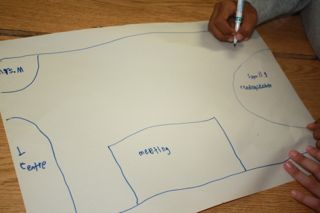
So, I set out to experiment on the first day of school, by letting my Grade 4 students determine which configuration would work best for the classroom desks. I knew this experiment would tell me a lot about my students, such as their problem-solving skills and how they worked together with their classmates.

It was a new feeling for me, always having had student desks already set up for the first day!

To prepare, I came up with some conditions:

-certain areas were to remain as they were (e.g., the reading corner, the conference area, my desk)

-each group had to present their model and the thinking behind it

-the desks were to be arranged in groups, but the number at each group could vary (e.g., there could be some groups of 6 and some groups of 3)

-they would need to include a space where students could go to work quietly on their own, if needed

-when we add to the room (e.g., new students, a SMARTBOARD, etc.), we may need to revisit the plan

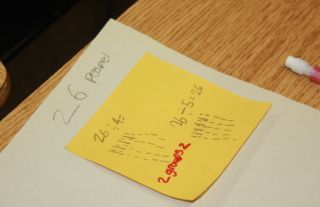
After sharing these conditions on a chart with my class, they organized themselves into groups and set off to plan! It was exciting to see how each group had their own unique style. One group  first calculated how many students we had and thus, how groupings could work. Two other groups drew in the conditions first, then planned from there.


Would I do this again? Absolutely!

I learned that as teachers we cannot underestimate our students’ capabilities. Giving them choice in creating their classroom environment empowered my students and the interest they took in actually moving the desks to reflect the plan we chose was amazing to watch.

The fact that I had written the conditions ahead of time led me to realize my students benefitted from knowing that sometimes when we make choices, there are structures and boundaries we need to work within…

Next up, settting up our reading corner!!!