
Heart Picture

The Power of Partnership

Like Roz and Sangeeta, I too am figuring out ways to strike a balance between work and life amidst the organized chaos of teaching.  Teaching a different grade each year is a challenge.   Every day, the joy of teaching is a juggling act: IEP’s, managing behaviour, integrating lessons, preparing materials and assessments, chasing down assignments, reporting, communicating with parents…     It has been said that it takes a village to raise a child, and I believe  us teachers are doing our students and ourselves a disservice if we try to do it in the  isolation of a single classroom.

Being new to a school can be a little isolating at first because one hasn’t had the time to develop the strong collegial relations that an established staff already has.   Though every school I have  taught at has welcomed me warmly,  I have found that it takes some time to learn who your ‘go to people’ can be which can be complicated further if you’re using your lunch hour for work and others are busy making the most out of their time as well.  Over time, I have learned that to start building collegiality and partnership is to start by asking.  I ask questions.  I  ask if teachers are interested in collaborating.  I ask if they can share.  I ask if we can meet.  And I offer too. I offer what I have and the skills that I bring. After all, partnership is give and take. Through the power of collaboration I am learning that I  able to be more attuned to the things that need to be done,  while feeling less fragmented by all of the balls that are flying  in the air.

This year, I have been collaborating closely with one of my colleagues who has inadvertently become my mentor.  We meet on a common prep time once a week and map out what our week looks like, share materials and resources and brainstorm ideas together. We build on each other’s ideas, pull out books to read, make to do lists, refer each other to helpful information sites,  pull what needs to be photocopied, divide the labour and regroup halfway through the following week to reflect on how the students are doing, what we found challenging and share with each other what we would do differently.  It is a wonderful partnership.

I can’t even begin to share what a relief it is to be able to collaborate so closely with an experienced teacher on such a regular basis.  For one, my thoughts aren’t going into overdrive figuring out ways to organize the multitude of information that I come across daily. Because we approach the teaching of our respective classrooms as a shared responsibility, I can worry a little less that I may not have certain materials in the classroom to do an art lesson, or that I am missing information that needs to be communicated in a newsletter or calendar to parents (which is likely to happen if you’re new to a school or a newly hired LTO).  I have a ‘go-to-person’ that can come to my aid or fill in the blanks, and this has been so good for my peace of mind.  I am sleeping better and have the energy to accomplish all of the things that I set out to do with my students , and I think it is making me a better teacher.


Photo of Erin G

“Targeting” Reflection Through Self-Assessment

As reporting time is fast approaching, I’ve always found it vital that students not only have an idea of where they stand (based on marked assignments) but that they understand how they got there. You would think that with criteria fully explained through various assessment tools and ongoing feedback, students would have a clear idea of their progress. However, I’ve noticed that sometimes they tend to exclusively focus on the mark. Instead of always receiving feedback from the teacher, what is sometimes equally, if not occasionally more productive, is to provide an opportunity to analyze themselves as learners.

I find that using the “Bullseye-Hit or Miss?” questionnaire (see attachment ErinSelf-assment term 1), is effective since the concept of the bullseye in graphic form is engaging on a visual level. I’ve also discovered that for both the students and myself, it communicates a clear perspective without them being subjected to in-depth “reflecting”. Before returning it to  me, I give them a chance to compare and discuss with a friend. Getting input from a partner they feel comfortable with tends to result in a more insightful action plan in the final part of the questionnaire. Once collected, I hang on to these to use in out one-on-one student conferences. More on that in my next blog.

Photo of Carmen Oliveira

Finding Opportunities for Learning Outside the Classroom

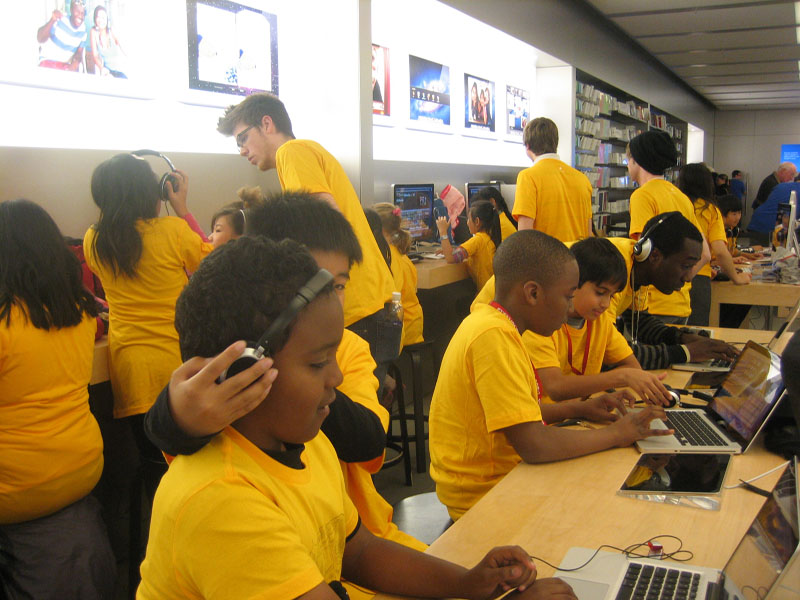
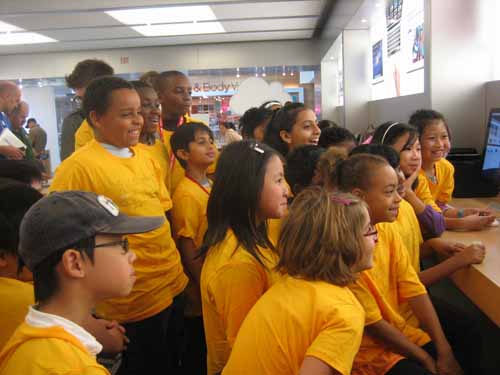
This week we participated in an excellent real world learning experience outside the classroom (and it was almost free!).  My Grade5/6 class has been exploring biographies, memoirs, and looking at the features and format of recounts.  We have also been using our MacBooks to support our learning in various ways.  An opportunity arose to bring the two together by visiting an Apple store to learn how to create an iMovie in the form of a biography about each student.  The entire trip, including transportation, came to $1.50 per student.  It ended up being a meaningful, incredibly fun, and real world learning experience for everyone!

This year, our division is committed to creating as many of these powerful learning opportunities as possible for our students because the enthusiasm, eagerness, and results we see back in the classroom support the belief that applying concepts and new learning to real life experiences is what creates long-term understanding.

When you begin to explore all the possibilities to have students apply classroom learning and experience in a real world setting, with a little creativity and investigation, it’s amazing how many opportunities are out there!  The only expense our students had was the bus trip to the Apple store for $1.50.  In return they received lessons and support from a team at Apple, a free t-shirt, the opportunity to use the latest technology to create their iMovie, and a certificate of participation in the program!  It can’t get better than that!

Students working with the crew at Apple


Students watching their video biographies!


Photo of Alison Board

Staying Connected

Similarly to Tina and Roz, I use different means of communication to stay connected with families throughout the year, mostly our classroom website, face-to-face contact, and agendas. It is difficult to limit yourself to one tool to suit the needs of all families. At the beginning of the year I send a paper newsletter and ask for email addresses to invite families to view our classroom website and receive updates from our weekly blog. This is a big hit in the community where I teach, as many parents like to get reminders on their mobile phones or sync our class calendar to their personal calendar. Most of the emails I receive are simple questions that require a simple and quick response, such as setting up interview times or confirming ad due date. Like Roz, if the request is something more delicate, I often call the parent and discuss the concern over the phone or set up a time to meet in person.

Since I teach a grade one and two class, I walk them each day to the outside door to meet their parents or sitters. The parents that I see daily or weekly can easily approach me with a quick question or I can provide an update without having to make time for the phone or computer. For example, I have a grade one student who has arrived in September with no English language. One or two days a week, her mother may ask me about something we have done in class that her daughter is trying to understand and has told her mother at home. With the mother there as the translator, we achieve quite a lot in a few minutes. These quick discussions are easier, more casual, and provide positive support for the student’s learning on a consistent basis (in addition to the support she receives in the classroom), which connects her learning to her home and family.

At my school, every student from grade one to six purchases an agenda in September. At first, I thought this was taking a step backward on my path to improve parent communication with the use of technology. Now, I realize it is just one more means of communication – not only between me and the parents, but it supports communication between the students and their parents when they refer to it together at home. I decided that if the children are all buying the agendas in my class, then we would make good use of them. So, when the students get settled at entry they first open their agenda and find the day’s date. We do quick math skills, talk about health and wellness while evaluating our feelings and assessing our exercise and eating habits for the week, in addition we use the calendar in the agendas rather than a shared calendar, and the students write reminders to themselves. I do not sign the agendas daily, but I do a quick walk around to either read, respond, or initiate a comment as needed. It has also helped with classroom management during the transition from entry to the time we meet together for our gathering circle. The children have learned to explore their agendas (agenda work), if my attention is focused on addressing a student concern or speaking to a parent at the classroom door.

Although keeping up a few forms of communication sounds like juggling balls in the air (and it sometimes is), it is the best way to meet the needs and include all families. By ensuring that you have communicated with parents about any concerns, your face-to-face communication during scheduled interviews will be easier for you and the parents!

Photo of Sangeeta McCauley

Go-to-People

Thinking about Roz’s commitment to taking care of herself, I realize that one way I have been taking care of myself is by making a mental list of “go-to-people”.

In my classroom, my students have “go-to people” they can approach when they need some help: it may be someone who draws comics well or someone who likes to incorporate humour into their writing. But this concept isn’t limited to just kids…

There are a variety of colleagues I am learning from who I can go to when I need to talk about curriculum planning or when I have a student that I’m trying to reach. That’s the beauty of teaching: we are not alone working in our little cubicles, there are doors open to us and we need to take advantage of that, for our own peace of mind and wellness.

The relationships we nurture with our students is just as important as the relationships we nurture with our colleagues.

So, when you look around, who are your “go-to-people”???

Photo of Roz Geridis

Taking Care of Me

IEPs, religious holidays, released professional learning, extra curricular, occasional teacher plans, parent meetings, and report cards in two weeks. I forgot to mention all the family obligations. Where do I find time for myself? Right about now is where heads are spinning and tension starts building. The school year has barely begun and I have to write report cards.

I have to remember to take care of myself and so do you. In my school, the cold bug has been going around the school the last three weeks. As much as I am fighting one off, I know it is coming and probably will hit me after report cards. I have seen the signs and realize it is time I begin to take care of myself. Since the school year began, I haven’t seen much of my friends. I also haven’t been able to get to the gym more than once  during the school week — if I make it that many times.

In the past, I had a set routine which I need to think about again. My lunches, can be made and frozen on the weekend. Even dinners can be partially made on the weekend. This weekend, I took the time to cut up the vegetables to add to my salads and dinners. Some vegetables are not good to be pre-cut but many are great. I also made a soup which I have jarred to take to school for lunch. Making a little more of your weekend dinners can either be your weekday lunches or dinners.

I am also looking to make more personal commitments to stick to. Picking a time to leave the school and stick to it. At this point, I am going to aim to leave the school 30 minutes earlier. I am also going to commit to doing something for me twice a week; whether it is going to the gym, reading non educational book, meeting friends for dinner, or having a bath.

Teaching is a very demanding job, both physically and mentally. Whatever your goals are find some time for your interests and wants. We all need to take care of ourselves as our students (and families) will only benefit from it.

Photo of Roz Geridis

Connecting with Parents

As the busy school year develops, parent communication is very important. All parent(s) want to know what his/her child is learning at school. Having a 5/6 all boys class made me find ways to involve the boys and open the communication for the family and to the school. To describe my class a little, it all boys with over half of my class on IEPs; 1 gifted, 2 HSP kids, 1 Aspergers, some identified LD and some still on the wait list for an assessment. Also, many boys have anxiety which some have been medically diagnosed and others are not. Agendas are a routine we are working to develop both for parents to read and for students to use them.

Communication I have used:

– started a bi-weekly newsletter, written by the students;

The writers are a job assignment and hands regularly go up to take on the job. I do give some content to include such as curriculum information, projects and areas of curriculum we are working on. The writers are able to add their content also and I do give a final approval. Once edited and published, I was impressed that the boys all took them home, not one was left in the classroom!

– meetings for IEP;

Most of my parents requested a meeting to develop the IEP so I had to find some time to meet with approximately half of my class. I scheduled all meetings with student entry time as an end time and gave parents 20 minutes to discuss the IEPs. This allowed me to meet with all parents who had requested a meeting, leaving me enough time to input the added information into the student’s IEP. I did keep in mind if parents had other concerns to discuss, another meeting would have to be scheduled.

– use of the agenda;

Many parents have asked for me to communicate through the agenda. At times, it seems like limited communication, I still take the time to develop a routine where students place their agenda on my desk and I initial every morning. I do not sign agendas at the end of the day as I am trying to help the students to build the routine of utilizing the agenda. I do give agenda time at the end of the day and write on the board the evening’s homework and reminders. The students are aware I will look at the agendas the next day therefore the routine is beginning to develop. If there is a need to write a note in the agenda at the end of the day, I do so.

– phone calls home;

Although there are limited phones and phone lines in the large school I am in, I have developed a routine. I take one prep period a week to make phone calls giving parents an update. I try to call every parent once a month.  If there are no concerns from myself or the parents, I start to give strategies to help with homework routine and learning skills. I also inquire about items getting home and inform parents about the class newsletter used as my way to keep parents updated.

– parent meetings;

Many parents have been calling to set up meetings. I am in an involved parent community; this is the norm in my school. Again, due to the early start of the year, I schedule the meetings with an entry time as the end point (i.e. 20  minutes before school or at the end of lunch). Some of my parents are colleagues and I do schedule those meetings for after school. All meetings have gone over 20 minutes but we are also discussing education related issues not just the colleague’s child.

– email;

I do not give out my email unless it is asked for. If parents do email me, my email reply consists of a simple acknowledgement of the concern and asking to set up a phone call meeting or face to face meeting to discuss the concern. Email is very easy to misunderstand and often I am in rush to read all my emails and do not have the time to finely craft an email response to a parent’s concern. If you do decide to use email, please save your email in draft and take another look, either a few hours later or the next day. Often, a discussion with an experienced colleague or time away from the concern gives us a different perspective.


What I have done are just examples of parent communication and have changed for me based on the school I am in or the students in my class. In some schools I have seen parents daily, even in upper junior grades, regular parent communication is quick. You have to do what works for you and your community. Most of all, remember to document your parent communication. Get some labels, print off a sheet with all the students name, record the parent communication and stick it on a paper in your communication binder.

Photo of Tina Ginglo

Tweeting To Families

Although I am well aware of the concerns and dangers of participating in web based social media sites with students, social media platforms such as Edmodo.com and Ning.com are quickly becoming powerful classroom tools. I am excited about these web based social media platforms and the potential they have for engaging students with curriculum and providing them with 21st century literacy skills.  Over the summer months, I looked into ways social media has been used safely to build community and collaboration in business and education.

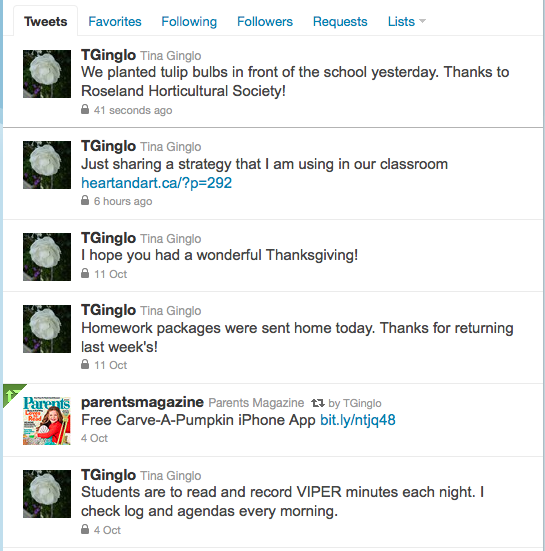
Now that I am a parent myself, more than ever, I appreciate the importance of home and school communication.  I thought that I might try a social media platform to support my connection and foster relationships with families.    With my principal’s permission, I am now Tweeting to my students’ families!

My principal had a few concerns about Internet safety, which I respectfully considered when setting up this Twitter account. First, I have set my Twitter account so I must approve my followers.  Since I have most of my parents’ email addresses, it is easy for me to identify whether or not a request to follow is coming from one of my families.  Secondly, I set it so that followers cannot comment on my Tweets.  Unfortunately, this limits the potential this social media tool has for building community, but hopefully it will help keep parents in the loop and help me to establish trust and rapport with my families.   Finally, I don’t identify my school, my teaching assignment or students’ names in my tweets.

I have 18 students in my class.  To date, I only have two followers, but hey, that’s okay.  I have two parents who I touch base with on an almost daily basis about things such as homework reminders and positive events that took place during the day.  It will be interesting to see if more parents begin to follow as the year progresses.

To learn more about ETFO’s Advice to Members re: Social Media, please click here.

Heart Picture

Slowing Down and Creating Goals

“Go Slow, Go Deep” – Tina’s words have been resonating in my head since I read her last post and over the past couple of weeks. I find myself repeating them to myself daily in response to everything from delivering my lessons in math, teaching the students how to sustain reading effectively during independent reading time, to working through our class agreements and routines.

After reading those words, I found myself reflecting on how intently I work to developing class lessons, routines and climate, and how there are always times when a few students don’t seem to transfer the learning from the class lesson to their individual work or conduct.  It can be frustrating trying to figure out why the students are missing it: Was it because I am moving through the lesson too quickly? Were the expectations clear?  Was it because Jimmy was squirming too much in front of Tommy?   Maybe I’m not engaging them… or is it the material?

Then I remember  the words Go Slow, Go Deep…

After some reflection, I remembered that in order to go deep with my students, what they are doing has to be meaningful to them (even when the subject area isn’t every students interest), and that time needs to be given to hook the students into what they are learning and reflect on what they are supposed to be getting out of a certain activity or lessons  (their learning goal). I usually draw upon student interests to make my lessons fun but not all students are passionate about all areas of the curriculum all of the time, and rather than spend all my time scouring the internet for more fun teaching ideas, I need to find a sustainable way for the students to buy in, and go deep:

Inspired by  Jim’s inclusion activity about developing Goals/Strengths/Beliefs ( Heart And Art of Teaching and Learning, p.36), I adapted the activity to have students communicate their learning goals for several learning tasks and we have begun this for a number of activities and subject areas.

Before and during lessons I  have started to include time for developing goals with my students for what I hope them to learn by the end of the lesson and I have the students share what they  think the final outcome should look like. Sometimes that means that a lesson that was originally intended to take one period will now take two, or even be spread out over the week. These goals are communicated on the whiteboard or chart paper for the students’ reference and so that the students can begin to self-regulate more.  I hope that by putting in the extra teaching time now,  by mid-year the students will be in the habit of viewing  their lessons as a  ‘goal’ with a defined outcome that they want to achieve.

I hope that by taking more time to developing goals with the students, it won’t matter as much that Jimmy was particularly squirmy one day or that Ari was counting the ceiling tiles instead of paying attention to  what a Level 4 Journal entry looks like. It will matter less  because our goals will be visible, available and referred to regularly and eventually (hopefully) it will sink in.  One of my  goals for this year is to continue taking the time to make goals with my students so that they may  develop it as a habit that is internalized, routine and oriented towards success.


Photo of Sangeeta McCauley

Making Connections with Family

Thinking about Carmen’s experiences at her “Meet the Teacher” night reinforces for me how important it is to connect with the families of our students.

Building inclusion goes beyond what we do in our classrooms and if we are going to connect with family members, using less jargon and the words of our students can make a difference.

When our “Meet the Teacher” night came, I asked my students, “What would you like to share with your families about our classroom?” and the answers started pouring in. Not surprisingly, there was very little emphasis on curriculum!!! They wanted to share what they had helped to create: our reading corner, the desk setup, how they can earn class points and so on.

So, I took all their ideas and made a checklist, which they could access when they came in with their families. It was so exciting to observe my students bringing their families into their world at school. It also gave me an opportunity to observe the relationships they have with parents, siblings and grandparents. Once the “tour” was done, then I could chat with family members and answer any questions they had.

Each family left with handouts of the topics we would be covering throughout the year (which still tend to be a bit of an overdose on jargon) so to balance this out, I also send home newsletters with questions that family members can ask my students about what they are learning (see section below). We call it an “Ask-Me” letter and my students helped me develop the questions for their families.

Writing Personal Stories – Ask me…

-what is a seed story and a watermelon story?

-what is the difference between storytelling and telling a story?

-how am I writing the lead to my story?

Problem-solving in Math – Ask me…

-what are some ways you can solve a problem?

-what is one strategies that has worked for me?

-what is “working backwards” or “guess and check”?


Ideally, I hope to have them design the next newsletter, but for now, it’s a start!!!