
Photo of Alison Board

Co-constructing Before Assessing

Back in September, I allotted time to establish the many routines in the classroom. For the grade one’s in the class, most of their learning consisted of new routines. As the children were more comfortable with the expectations in the classroom, we then focused on their work. Then, by the end of October it was already time to gather assessments and start planning for the Progress Reports.

I realized that the students needed to know what they were being assessed on and what the success criteria for achievement would be. We started by co-constucting the criteria for Level 4 on such things as writing a letter, a procedure, or a recount. We added sticky notes to our anchor charts with reminders. The children then assisted in the selection of their best piece using the success criteria as their guide.

We also reviewed the Learning Skills together. Reviewing Responsibility coincided well with our focus on students demonstrating Responsibility with the TDSB Character Education Traits. We created a “My Responsibilities” corner in the classroom to provide a reference area for the students who need support or visual checkpoints to assist with their self-regulation and determine what their responsibilities are. The area includes a schedule for the day, the job chart with names attached on clothespins, our TRIBES agreements, the TDSB Character Traits, a list of tasks that can be done if their work is finished, and an inspiration chart for independent inquiry work.

I have found that this corner of the room is frequented more than I had planned. It assists the children with their self-regulation in the classroom, as there are times throughout the day that some children have completed their work before others. These students are able to refer to the “My Responsibilities” corner independently, and the result is less need for direct classroom management. It also benefits the children’s development of their learning skills and supports their understanding of the assessment of their learning skills.
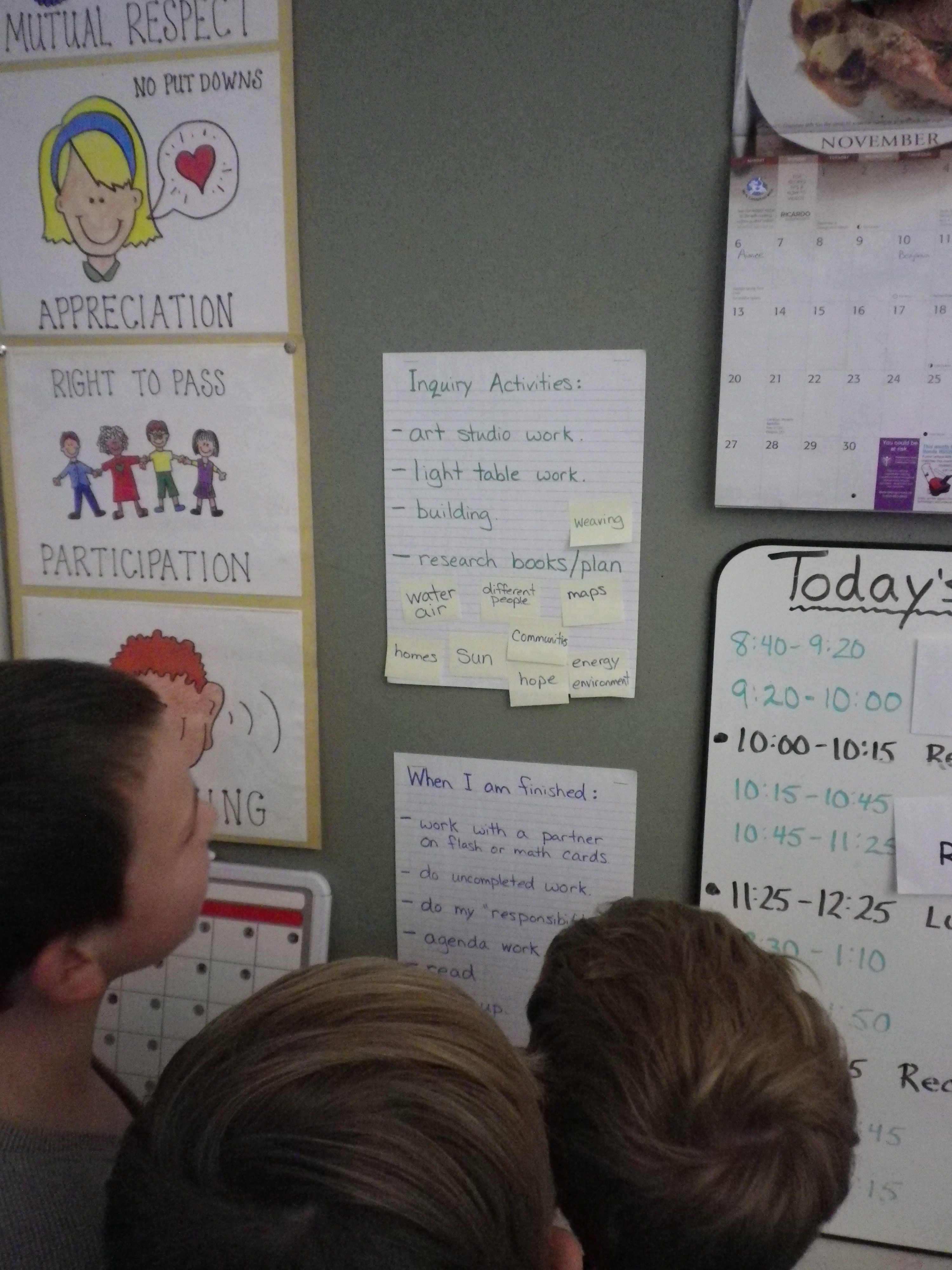
Photo of Erin G

Connecting Through Mini-Conferences

In my last blog, I talked about trying to get students to meaningfully assess how and what they learned. As a crucial follow-up, I make sure to spend some one-on-one time with every student to discuss their progress throughout the term. As a rotary teacher who sees three classes of 30 plus students a day for 42 minutes (a full-time teacher would then see approx 180), I find that it’s challenging to establish a personal relationship with each one of them. Ensuring that I build in the time to sit down and talk to each one of them is a must. I plan around an activity (usually French skits) where students are focused, self-directed and engaged to minimize interruptions with questions. Over the course of the week, I spend between 3 to 5 minutes (not nearly enough I know), where we have each other’s undivided atttention talking about their results for the term, their strong points as students and concrete, realistic steps they could take to  improve. Finally, it is also a great opportunity to just shoot the breeze. It’s been my experience that students respond more positively to this individual attention and it allows them to more fully appreciate and understand their mark on their report card. Most importantly, it allows for each of you to connect on a personal level.

Photo of Sangeeta McCauley

One student at a time…

Sometimes when I look at my students, I wonder: how can I meet the needs of everyone?

Will I be able to support the student who is feeling bullied or the student who struggles to grip a pencil? Will I figure out the best way to explain to a parent that we are focusing on inclusion and gender equality when that may be contrary to how she was educated?

And the answer that comes to mind is definite: not every minute of every day.

But…I can start with one student at a time.

Take “Matthew”. He has been diagnosed with ADHD and takes medication daily to help him manage impulse control and the challenges he has with filtering his thoughts. Matthew’s medication is time-released and so the first few hours of the morning are very difficult for him until things start to ‘kick in’, as he calls it.

So, I tried a few things. I gave him time to do something hands-on when he first came in, but he became frustrated. I used my gym time first thing in the morning to help him work through some of his excess energy, but it seemed to distract him more.

Then last week, I decided to make a morning message for him. I recorded a personal greeting that gave him information about what we would be doing that morning and how he might be successful in those tasks. As he listens, it helps him to access an inner voice he knows he has, but he just can’t hear yet.

Of course, there is no magic answer for Matthew or for any of my kids for that matter. Like us, they will have up and down days and sometimes things won’t work. But maybe if I take on one student at a time, I can start to meet their needs…and mine.


Heart Picture

The Power of Partnership

Like Roz and Sangeeta, I too am figuring out ways to strike a balance between work and life amidst the organized chaos of teaching.  Teaching a different grade each year is a challenge.   Every day, the joy of teaching is a juggling act: IEP’s, managing behaviour, integrating lessons, preparing materials and assessments, chasing down assignments, reporting, communicating with parents…     It has been said that it takes a village to raise a child, and I believe  us teachers are doing our students and ourselves a disservice if we try to do it in the  isolation of a single classroom.

Being new to a school can be a little isolating at first because one hasn’t had the time to develop the strong collegial relations that an established staff already has.   Though every school I have  taught at has welcomed me warmly,  I have found that it takes some time to learn who your ‘go to people’ can be which can be complicated further if you’re using your lunch hour for work and others are busy making the most out of their time as well.  Over time, I have learned that to start building collegiality and partnership is to start by asking.  I ask questions.  I  ask if teachers are interested in collaborating.  I ask if they can share.  I ask if we can meet.  And I offer too. I offer what I have and the skills that I bring. After all, partnership is give and take. Through the power of collaboration I am learning that I  able to be more attuned to the things that need to be done,  while feeling less fragmented by all of the balls that are flying  in the air.

This year, I have been collaborating closely with one of my colleagues who has inadvertently become my mentor.  We meet on a common prep time once a week and map out what our week looks like, share materials and resources and brainstorm ideas together. We build on each other’s ideas, pull out books to read, make to do lists, refer each other to helpful information sites,  pull what needs to be photocopied, divide the labour and regroup halfway through the following week to reflect on how the students are doing, what we found challenging and share with each other what we would do differently.  It is a wonderful partnership.

I can’t even begin to share what a relief it is to be able to collaborate so closely with an experienced teacher on such a regular basis.  For one, my thoughts aren’t going into overdrive figuring out ways to organize the multitude of information that I come across daily. Because we approach the teaching of our respective classrooms as a shared responsibility, I can worry a little less that I may not have certain materials in the classroom to do an art lesson, or that I am missing information that needs to be communicated in a newsletter or calendar to parents (which is likely to happen if you’re new to a school or a newly hired LTO).  I have a ‘go-to-person’ that can come to my aid or fill in the blanks, and this has been so good for my peace of mind.  I am sleeping better and have the energy to accomplish all of the things that I set out to do with my students , and I think it is making me a better teacher.

Photo of Sangeeta McCauley

Go-to-People

Thinking about Roz’s commitment to taking care of herself, I realize that one way I have been taking care of myself is by making a mental list of “go-to-people”.

In my classroom, my students have “go-to people” they can approach when they need some help: it may be someone who draws comics well or someone who likes to incorporate humour into their writing. But this concept isn’t limited to just kids…

There are a variety of colleagues I am learning from who I can go to when I need to talk about curriculum planning or when I have a student that I’m trying to reach. That’s the beauty of teaching: we are not alone working in our little cubicles, there are doors open to us and we need to take advantage of that, for our own peace of mind and wellness.

The relationships we nurture with our students is just as important as the relationships we nurture with our colleagues.

So, when you look around, who are your “go-to-people”???

Heart Picture

Slowing Down and Creating Goals

“Go Slow, Go Deep” – Tina’s words have been resonating in my head since I read her last post and over the past couple of weeks. I find myself repeating them to myself daily in response to everything from delivering my lessons in math, teaching the students how to sustain reading effectively during independent reading time, to working through our class agreements and routines.

After reading those words, I found myself reflecting on how intently I work to developing class lessons, routines and climate, and how there are always times when a few students don’t seem to transfer the learning from the class lesson to their individual work or conduct.  It can be frustrating trying to figure out why the students are missing it: Was it because I am moving through the lesson too quickly? Were the expectations clear?  Was it because Jimmy was squirming too much in front of Tommy?   Maybe I’m not engaging them… or is it the material?

Then I remember  the words Go Slow, Go Deep…

After some reflection, I remembered that in order to go deep with my students, what they are doing has to be meaningful to them (even when the subject area isn’t every students interest), and that time needs to be given to hook the students into what they are learning and reflect on what they are supposed to be getting out of a certain activity or lessons  (their learning goal). I usually draw upon student interests to make my lessons fun but not all students are passionate about all areas of the curriculum all of the time, and rather than spend all my time scouring the internet for more fun teaching ideas, I need to find a sustainable way for the students to buy in, and go deep:

Inspired by  Jim’s inclusion activity about developing Goals/Strengths/Beliefs ( Heart And Art of Teaching and Learning, p.36), I adapted the activity to have students communicate their learning goals for several learning tasks and we have begun this for a number of activities and subject areas.

Before and during lessons I  have started to include time for developing goals with my students for what I hope them to learn by the end of the lesson and I have the students share what they  think the final outcome should look like. Sometimes that means that a lesson that was originally intended to take one period will now take two, or even be spread out over the week. These goals are communicated on the whiteboard or chart paper for the students’ reference and so that the students can begin to self-regulate more.  I hope that by putting in the extra teaching time now,  by mid-year the students will be in the habit of viewing  their lessons as a  ‘goal’ with a defined outcome that they want to achieve.

I hope that by taking more time to developing goals with the students, it won’t matter as much that Jimmy was particularly squirmy one day or that Ari was counting the ceiling tiles instead of paying attention to  what a Level 4 Journal entry looks like. It will matter less  because our goals will be visible, available and referred to regularly and eventually (hopefully) it will sink in.  One of my  goals for this year is to continue taking the time to make goals with my students so that they may  develop it as a habit that is internalized, routine and oriented towards success.


Photo of Sangeeta McCauley

Making Connections with Family

Thinking about Carmen’s experiences at her “Meet the Teacher” night reinforces for me how important it is to connect with the families of our students.

Building inclusion goes beyond what we do in our classrooms and if we are going to connect with family members, using less jargon and the words of our students can make a difference.

When our “Meet the Teacher” night came, I asked my students, “What would you like to share with your families about our classroom?” and the answers started pouring in. Not surprisingly, there was very little emphasis on curriculum!!! They wanted to share what they had helped to create: our reading corner, the desk setup, how they can earn class points and so on.

So, I took all their ideas and made a checklist, which they could access when they came in with their families. It was so exciting to observe my students bringing their families into their world at school. It also gave me an opportunity to observe the relationships they have with parents, siblings and grandparents. Once the “tour” was done, then I could chat with family members and answer any questions they had.

Each family left with handouts of the topics we would be covering throughout the year (which still tend to be a bit of an overdose on jargon) so to balance this out, I also send home newsletters with questions that family members can ask my students about what they are learning (see section below). We call it an “Ask-Me” letter and my students helped me develop the questions for their families.

Writing Personal Stories – Ask me…

-what is a seed story and a watermelon story?

-what is the difference between storytelling and telling a story?

-how am I writing the lead to my story?

Problem-solving in Math – Ask me…

-what are some ways you can solve a problem?

-what is one strategies that has worked for me?

-what is “working backwards” or “guess and check”?


Ideally, I hope to have them design the next newsletter, but for now, it’s a start!!!


Photo of Carmen Oliveira

Getting to Know Your Students Is the Best Time You Will Ever Spend

We just had our school’s “Meet the Teacher” night and the feedback from the parents in my classroom proved that, without a doubt, the best time spent during the first month is in getting to know my students.  I was astounded at the fact that most parents felt like they already knew me.  They commented on how their child went home and told them all about our fantastic conversations during our morning community circle and couldn’t wait to be the “Rockstar of the Week.”  This month I’ve really focused on and enjoyed creating meaningful opportunities to get students to open up and share who they are with our classroom community.

The following are some examples of how we get to know each other:

1. Each student has a Daily Journal.  After they come in, they write a “Reflection Question” in their journal and spend the first 10-15 minutes writing down their thoughts.  This is a powerful self-reflection exercise that I have started in my own life and felt the difference it makes on every level: personal, professional, spiritual, etc.  We then start our morning by sitting in a community circle and volunteering our ideas and opinions.  You can literally feel the good energy permeate in our classroom!  I have attached some examples of Reflection Questions.

2. We have a “Rockstar of the Week” bulletin board.  Each week, a student is chosen to fill us in on who they are!  It involves writing about what’s most important to them in life (we read “The Important Book” as a pre-lesson), sharing their favourite books, music, movies, etc., and putting up pictures that can give us a window into their life.  During the week, students must ask the Rockstar about any fact or picture they’d like to find out more about.  At the end of the week, we have an oral quiz on the Rockstar for points that go to the groups that answer the questions correctly. This is a blast and the Rockstar runs the show!

In a letter to their parents this week, one of my students wrote something that brought tears to my eyes and affirmed why I love teaching.  He wrote, This year, I have an amazing teacher.  She really cares about us and says our classroom is our home for the day.  I like that because that’s how it feels.” And that’s why I love my job!

REFLECTION QUESTIONS

Photo of Erin G

Building Inclusion through Oral Communication Activities

In the Core French classroom, building inclusion is a must. Students will only feel comfortable participating in an environment of tolerance, security and where they are not afraid of risk. In this type of atmosphere, creativity flourishes and learning French becomes interactive and a more authentic experience. I usually start with simple short dialogues involving greetings and exchanging information (ex. telephone numbers and emails). What makes the outcome so positive is that students infuse their skits with current expressions and it is simple enough that everyone can be successful.

Getting all levels of students to participate is also facilitated when you  have visible prompts for those who need more support. Likewise, I also make sure to always to include and model ideas for level 4 extensions using compound sentences with parce que, mais and alors.

Having read through the book, I found several suggestions which would lend themselves perfectly to encouraging inclusiveness through speaking activities. In particular, I thought I would try Carmen’s “Friend Venns” where kids exchange likes and dislikes. Also Shernett’s “Ten Things About Me” incorporated into inside/outside circles would be the perfect and always welcome kinesthetic activity!

Photo of Erin G

Surviving beyond the First Week – the Beauty of a Well-Crafted Seating Plan

As a rotary teacher dealing with up to 180 students, building inclusion is naturally a different process than in a homeroom classroom. Establishing a rapport is definitely fundamental however, I have found that this goes hand in hand with effective classroom management. Eliminating the problem of constant chatting amongst groups of friends can go a long way to establishing order.

Instead of seating kids alphabetically or in random groupings, I have always let my students choose their seats for the first week or two. Taking this time to observe the dynamic of the classroom and work habits of the students ultimately allows me to make informed, strategic decisions about groupings. My decision is also based on the contact information form (see attached) which is filled out during the first week of school. The one side serves as a record of parent contact while the other provides me with invaluable insight into each student’s character. At the end, I have classes where the students are comfortable where and with whom they are seated. Preventatively dealing with the minor issues (that can quickly derail your class) allows me instead to focus on building an inclusive learning environment.

EGStudentInfoSheet

Additional tip: When implementing my seating plan, I put numbers on the seats and have students line up at the back of the room. Having called out their name and number, I have them find their seat. This way there tends to be less drama than in calling out the names which can sometimes lead to some raucous reactions. I also preface my announcement by stating that I had only their best interests at heart and therefore eliminate most forms of protest.