
Photo of Roz Geridis

Engaging students in Visual Arts

Over the last 2 weeks, my class have been working on this wonderful visual art activity which is also connected to grade 6 aboriginal studies. We began by studying the art work of Norval Morrisseau, an Aboriginal Canadian artist (books are available at the public library). Morrisseau’s style is characterized by thick black outlines and bright colors. I shared with the boys the plan for this project was for everyone to complete their own version, then we would do body images of 1/3 of the class which will end up being painted on the Junior Stairway walls.

The boys were very excited about this project and I really tried to encourage their interest and ownership of the art work. As a class, we moved along for the boys to use an overhead and trace their head, hands, or feet to complete their own versions of Morrisseau themed pictures. The boys then had a lesson on drawing the shapes inside their images (guiding them to leave enough room for their black line). Primary colours were used to colour the inside of the shapes and the background was in secondary colours. Using only 2 overheads for the whole class, this stage of project took a little longer than a whole afternoon.

At the end of the first day, we had a discussion as to what the images of the boys would portray. The next day, the boys were asked to bring in items which reflect them in a sport type of way; for example, scooters, hockey equipment, soccer balls, swimming goggles. The boys selected the images to represent themselves as a class. They selected swimming, cart wheel, hockey, soccer, mountain climbing, and baseball. We were planning on adding someone reading and a second image but time was an issue which didn’t allow our plan to fully work out. Using the overhead, in groups of three, the boys then traced their image on life size paper. As others were tracing, the first group would then cut out their image. After lunch, we were able to finish off full body tracing for the rest of the groups and began (the groups completed the cutting)  adding the shapes within their image. This aspect of the project needed to be reviewed with the class a few times. The first lesson was on the personal image, the second mini lesson was to remind them of what to do to begin on the larger image, the third mini lesson was to go through their larger image and fine tune their shapes. This took us a full day.
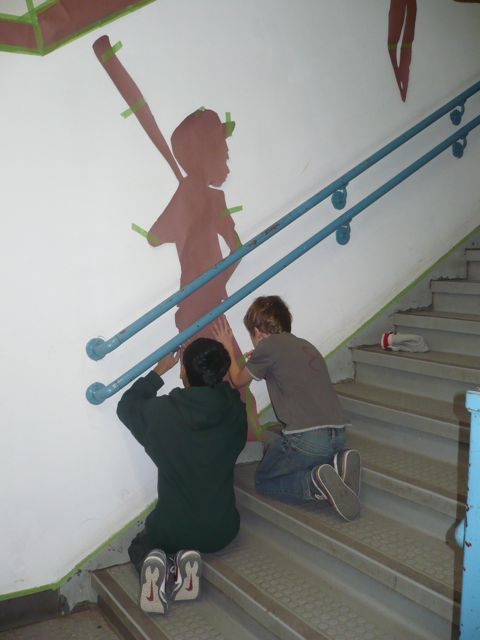
The next day, we taped up all body images on the stairwell walls. Looking to see which image should go where. This was an adult only decision. Once image placement was decided, the boys then traced their image on the wall. After every image was traced on the wall, some boys began painting the background colours while on the opposite side of the wall other boys were tracing their shapes in their image. This process took another full day. Each wall needed two coats and a day to dry between coats.

The fourth and fifth day, the boys were painting the shapes in each image (in groups of three) and then the black line last. We also needed time for touch ups. At the end of it, the boys were able to add their own signature to a wall which will be there for years to come. We are also painting some thank yous on a wall as all the paint used was donated by a local paint store.

The project took a total of five days and I really would recommend to get it completed in a chunk of time. The interest was there and interruption to your regular programming is not much. It was a week of limited program which was a great time to get to know and have some fun with your students. Remember, this is a visual arts project and it is connected to aboriginal studies. I have assessments for both curriculum areas. To adjust it for any grade, if your school walls are already colourful, you can do something very similiar and use the life size paper to paint and hang on the hallway walls. Also, use visual art as your first curriculum area and find a second curriculum area to connect it to, whether it is social studies or math.
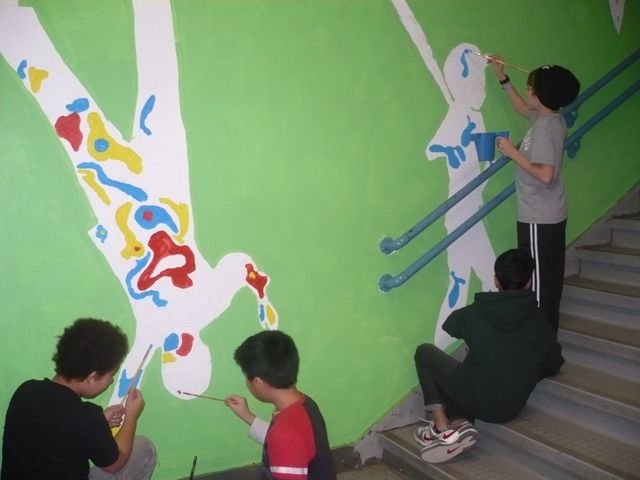
Included are some pictures to help you visualize the project. It was a project completed with a parent (who is also an artist). While she was working in the stairway with the boys, I was in class keeping them on track. The first few days, there was plenty of work to keep the boys busy but by mid day on the fourth day on, the boys had less to do on the art project. That being said, behaviour was amazing!!!! I guess the boys thought if they didn’t manage in class, I couldn’t send them in the hall. Which is a pattern in our class. I definitely had support for this project (administration, artist, and Educational Assistant in the afternoon). I also sent out a letter to the parents informing them of the pending project, the boys working with Latex paint, and dirty clothes coming home (with a tear off signature return). I also asked for volunteers to come in a week later to help paint the final protective coating. I have many teacher and parent volunteers. The boys feel a sense of pride, ownership, and community to their school!
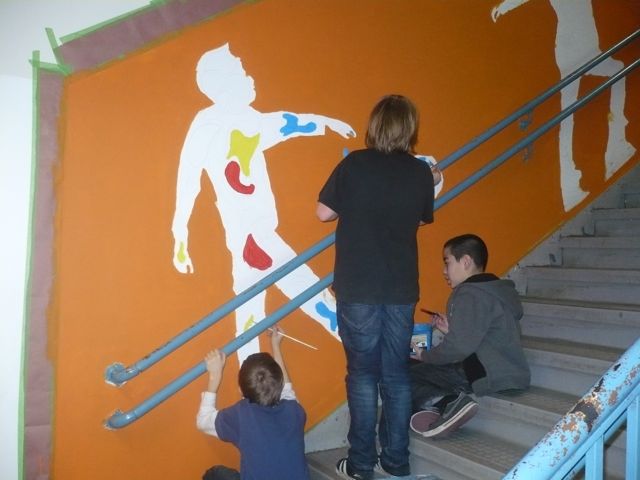
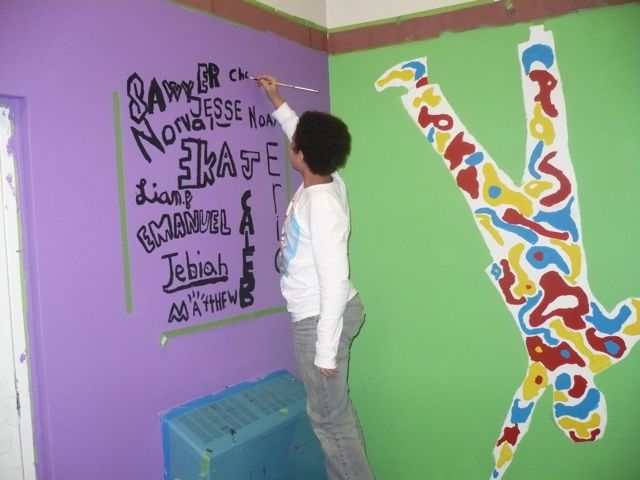
Photo of Sangeeta McCauley

Are We Open?

Reading Samantha’s post about interviews and Tina’s post about co-teaching brings to mind a recurring theme I feel I’m living: teaching is about being open to partnerships.

There are many different ways we can show we are open and they may be as simple as:

-keeping our classroom door open to welcome others

-walking our students outside at the end of the day and talking with parents

-trying a new idea that someone shares with us

-taking time to listen to stories from our students, their family members, or our colleagues

-letting our students take the lead by sharing their ideas and insights

-asking questions when we are unsure

Through these examples and more, we can gain so much information about our students, our school community and most of all, ourselves.

It may be that my perspective is different, given that I haven’t had my own class for the last 6 years, but I like to think that being “new” allows me to see things in another light and I, for one, am glad to be in this position!


Photo of Erin G

Connecting Through Mini-Conferences

In my last blog, I talked about trying to get students to meaningfully assess how and what they learned. As a crucial follow-up, I make sure to spend some one-on-one time with every student to discuss their progress throughout the term. As a rotary teacher who sees three classes of 30 plus students a day for 42 minutes (a full-time teacher would then see approx 180), I find that it’s challenging to establish a personal relationship with each one of them. Ensuring that I build in the time to sit down and talk to each one of them is a must. I plan around an activity (usually French skits) where students are focused, self-directed and engaged to minimize interruptions with questions. Over the course of the week, I spend between 3 to 5 minutes (not nearly enough I know), where we have each other’s undivided atttention talking about their results for the term, their strong points as students and concrete, realistic steps they could take to  improve. Finally, it is also a great opportunity to just shoot the breeze. It’s been my experience that students respond more positively to this individual attention and it allows them to more fully appreciate and understand their mark on their report card. Most importantly, it allows for each of you to connect on a personal level.

Photo of Sangeeta McCauley

One student at a time…

Sometimes when I look at my students, I wonder: how can I meet the needs of everyone?

Will I be able to support the student who is feeling bullied or the student who struggles to grip a pencil? Will I figure out the best way to explain to a parent that we are focusing on inclusion and gender equality when that may be contrary to how she was educated?

And the answer that comes to mind is definite: not every minute of every day.

But…I can start with one student at a time.

Take “Matthew”. He has been diagnosed with ADHD and takes medication daily to help him manage impulse control and the challenges he has with filtering his thoughts. Matthew’s medication is time-released and so the first few hours of the morning are very difficult for him until things start to ‘kick in’, as he calls it.

So, I tried a few things. I gave him time to do something hands-on when he first came in, but he became frustrated. I used my gym time first thing in the morning to help him work through some of his excess energy, but it seemed to distract him more.

Then last week, I decided to make a morning message for him. I recorded a personal greeting that gave him information about what we would be doing that morning and how he might be successful in those tasks. As he listens, it helps him to access an inner voice he knows he has, but he just can’t hear yet.

Of course, there is no magic answer for Matthew or for any of my kids for that matter. Like us, they will have up and down days and sometimes things won’t work. But maybe if I take on one student at a time, I can start to meet their needs…and mine.


Photo of Alison Board

Staying Connected

Similarly to Tina and Roz, I use different means of communication to stay connected with families throughout the year, mostly our classroom website, face-to-face contact, and agendas. It is difficult to limit yourself to one tool to suit the needs of all families. At the beginning of the year I send a paper newsletter and ask for email addresses to invite families to view our classroom website and receive updates from our weekly blog. This is a big hit in the community where I teach, as many parents like to get reminders on their mobile phones or sync our class calendar to their personal calendar. Most of the emails I receive are simple questions that require a simple and quick response, such as setting up interview times or confirming ad due date. Like Roz, if the request is something more delicate, I often call the parent and discuss the concern over the phone or set up a time to meet in person.

Since I teach a grade one and two class, I walk them each day to the outside door to meet their parents or sitters. The parents that I see daily or weekly can easily approach me with a quick question or I can provide an update without having to make time for the phone or computer. For example, I have a grade one student who has arrived in September with no English language. One or two days a week, her mother may ask me about something we have done in class that her daughter is trying to understand and has told her mother at home. With the mother there as the translator, we achieve quite a lot in a few minutes. These quick discussions are easier, more casual, and provide positive support for the student’s learning on a consistent basis (in addition to the support she receives in the classroom), which connects her learning to her home and family.

At my school, every student from grade one to six purchases an agenda in September. At first, I thought this was taking a step backward on my path to improve parent communication with the use of technology. Now, I realize it is just one more means of communication – not only between me and the parents, but it supports communication between the students and their parents when they refer to it together at home. I decided that if the children are all buying the agendas in my class, then we would make good use of them. So, when the students get settled at entry they first open their agenda and find the day’s date. We do quick math skills, talk about health and wellness while evaluating our feelings and assessing our exercise and eating habits for the week, in addition we use the calendar in the agendas rather than a shared calendar, and the students write reminders to themselves. I do not sign the agendas daily, but I do a quick walk around to either read, respond, or initiate a comment as needed. It has also helped with classroom management during the transition from entry to the time we meet together for our gathering circle. The children have learned to explore their agendas (agenda work), if my attention is focused on addressing a student concern or speaking to a parent at the classroom door.

Although keeping up a few forms of communication sounds like juggling balls in the air (and it sometimes is), it is the best way to meet the needs and include all families. By ensuring that you have communicated with parents about any concerns, your face-to-face communication during scheduled interviews will be easier for you and the parents!

Heart Picture

Slowing Down and Creating Goals

“Go Slow, Go Deep” – Tina’s words have been resonating in my head since I read her last post and over the past couple of weeks. I find myself repeating them to myself daily in response to everything from delivering my lessons in math, teaching the students how to sustain reading effectively during independent reading time, to working through our class agreements and routines.

After reading those words, I found myself reflecting on how intently I work to developing class lessons, routines and climate, and how there are always times when a few students don’t seem to transfer the learning from the class lesson to their individual work or conduct.  It can be frustrating trying to figure out why the students are missing it: Was it because I am moving through the lesson too quickly? Were the expectations clear?  Was it because Jimmy was squirming too much in front of Tommy?   Maybe I’m not engaging them… or is it the material?

Then I remember  the words … Go Slow, Go Deep…

After some reflection, I remembered that in order to go deep with my students, what they are doing has to be meaningful to them (even when the subject area isn’t every students interest), and that time needs to be given to hook the students into what they are learning and reflect on what they are supposed to be getting out of a certain activity or lessons  (their learning goal). I usually draw upon student interests to make my lessons fun but not all students are passionate about all areas of the curriculum all of the time, and rather than spend all my time scouring the internet for more fun teaching ideas, I need to find a sustainable way for the students to buy in, and go deep:

Inspired by  Jim’s inclusion activity about developing Goals/Strengths/Beliefs ( Heart And Art of Teaching and Learning, p.36), I adapted the activity to have students communicate their learning goals for several learning tasks and we have begun this for a number of activities and subject areas.

Before and during lessons I  have started to include time for developing goals with my students for what I hope them to learn by the end of the lesson and I have the students share what they  think the final outcome should look like. Sometimes that means that a lesson that was originally intended to take one period will now take two, or even be spread out over the week. These goals are communicated on the whiteboard or chart paper for the students’ reference and so that the students can begin to self-regulate more.  I hope that by putting in the extra teaching time now,  by mid-year the students will be in the habit of viewing  their lessons as a  ‘goal’ with a defined outcome that they want to achieve.

I hope that by taking more time to developing goals with the students, it won’t matter as much that Jimmy was particularly squirmy one day or that Ari was counting the ceiling tiles instead of paying attention to  what a Level 4 Journal entry looks like. It will matter less  because our goals will be visible, available and referred to regularly and eventually (hopefully) it will sink in.  One of my  goals for this year is to continue taking the time to make goals with my students so that they may  develop it as a habit that is internalized, routine and oriented towards success.


Photo of Sangeeta McCauley

Making Connections with Family

Thinking about Carmen’s experiences at her “Meet the Teacher” night reinforces for me how important it is to connect with the families of our students.

Building inclusion goes beyond what we do in our classrooms and if we are going to connect with family members, using less jargon and the words of our students can make a difference.

When our “Meet the Teacher” night came, I asked my students, “What would you like to share with your families about our classroom?” and the answers started pouring in. Not surprisingly, there was very little emphasis on curriculum!!! They wanted to share what they had helped to create: our reading corner, the desk setup, how they can earn class points and so on.

So, I took all their ideas and made a checklist, which they could access when they came in with their families. It was so exciting to observe my students bringing their families into their world at school. It also gave me an opportunity to observe the relationships they have with parents, siblings and grandparents. Once the “tour” was done, then I could chat with family members and answer any questions they had.

Each family left with handouts of the topics we would be covering throughout the year (which still tend to be a bit of an overdose on jargon) so to balance this out, I also send home newsletters with questions that family members can ask my students about what they are learning (see section below). We call it an “Ask-Me” letter and my students helped me develop the questions for their families.

Writing Personal Stories – Ask me…

-what is a seed story and a watermelon story?

-what is the difference between storytelling and telling a story?

-how am I writing the lead to my story?

Problem-solving in Math – Ask me…

-what are some ways you can solve a problem?

-what is one strategies that has worked for me?

-what is “working backwards” or “guess and check”?


Ideally, I hope to have them design the next newsletter, but for now, it’s a start!!!


Photo of Carmen Oliveira

Getting to Know Your Students Is the Best Time You Will Ever Spend

We just had our school’s “Meet the Teacher” night and the feedback from the parents in my classroom proved that, without a doubt, the best time spent during the first month is in getting to know my students.  I was astounded at the fact that most parents felt like they already knew me.  They commented on how their child went home and told them all about our fantastic conversations during our morning community circle and couldn’t wait to be the “Rockstar of the Week.”  This month I’ve really focused on and enjoyed creating meaningful opportunities to get students to open up and share who they are with our classroom community.

The following are some examples of how we get to know each other:

1. Each student has a Daily Journal.  After they come in, they write a “Reflection Question” in their journal and spend the first 10-15 minutes writing down their thoughts.  This is a powerful self-reflection exercise that I have started in my own life and felt the difference it makes on every level: personal, professional, spiritual, etc.  We then start our morning by sitting in a community circle and volunteering our ideas and opinions.  You can literally feel the good energy permeate in our classroom!  I have attached some examples of Reflection Questions.

2. We have a “Rockstar of the Week” bulletin board.  Each week, a student is chosen to fill us in on who they are!  It involves writing about what’s most important to them in life (we read “The Important Book” as a pre-lesson), sharing their favourite books, music, movies, etc., and putting up pictures that can give us a window into their life.  During the week, students must ask the Rockstar about any fact or picture they’d like to find out more about.  At the end of the week, we have an oral quiz on the Rockstar for points that go to the groups that answer the questions correctly. This is a blast and the Rockstar runs the show!

In a letter to their parents this week, one of my students wrote something that brought tears to my eyes and affirmed why I love teaching.  He wrote, This year, I have an amazing teacher.  She really cares about us and says our classroom is our home for the day.  I like that because that’s how it feels.” And that’s why I love my job!

REFLECTION QUESTIONS

Photo of Erin G

Building Inclusion through Oral Communication Activities

In the Core French classroom, building inclusion is a must. Students will only feel comfortable participating in an environment of tolerance, security and where they are not afraid of risk. In this type of atmosphere, creativity flourishes and learning French becomes interactive and a more authentic experience. I usually start with simple short dialogues involving greetings and exchanging information (ex. telephone numbers and emails). What makes the outcome so positive is that students infuse their skits with current expressions and it is simple enough that everyone can be successful.

Getting all levels of students to participate is also facilitated when you  have visible prompts for those who need more support. Likewise, I also make sure to always to include and model ideas for level 4 extensions using compound sentences with parce que, mais and alors.

Having read through the book, I found several suggestions which would lend themselves perfectly to encouraging inclusiveness through speaking activities. In particular, I thought I would try Carmen’s “Friend Venns” where kids exchange likes and dislikes. Also Shernett’s “Ten Things About Me” incorporated into inside/outside circles would be the perfect and always welcome kinesthetic activity!

Photo of Erin G

Surviving beyond the First Week – the Beauty of a Well-Crafted Seating Plan

As a rotary teacher dealing with up to 180 students, building inclusion is naturally a different process than in a homeroom classroom. Establishing a rapport is definitely fundamental however, I have found that this goes hand in hand with effective classroom management. Eliminating the problem of constant chatting amongst groups of friends can go a long way to establishing order.

Instead of seating kids alphabetically or in random groupings, I have always let my students choose their seats for the first week or two. Taking this time to observe the dynamic of the classroom and work habits of the students ultimately allows me to make informed, strategic decisions about groupings. My decision is also based on the contact information form (see attached) which is filled out during the first week of school. The one side serves as a record of parent contact while the other provides me with invaluable insight into each student’s character. At the end, I have classes where the students are comfortable where and with whom they are seated. Preventatively dealing with the minor issues (that can quickly derail your class) allows me instead to focus on building an inclusive learning environment.

EGStudentInfoSheet

Additional tip: When implementing my seating plan, I put numbers on the seats and have students line up at the back of the room. Having called out their name and number, I have them find their seat. This way there tends to be less drama than in calling out the names which can sometimes lead to some raucous reactions. I also preface my announcement by stating that I had only their best interests at heart and therefore eliminate most forms of protest.