
Photo of Lisa Taylor

Homework – how much is too much?

Some teachers don’t give any homework, some give lots! There are lots of schools of thought on homework and if it is necessary, if it is valuable, if it serves a purpose, etc. I have had classes that had weekly homework for the whole year, and I have had classes that didn’t get homework once. It all depends on the group and what they need. I find homework is just as much for the parents as it is for the students, sometimes more for the parents! I follow a few important rules when I send homework home:

1. Never send home a new skill or concept that has not already been taught in class. Quickly explaining it in 2 minutes while you hand it out doesn’t count either – make sure the homework is a review of a skill that has already been taught and worked on in class – otherwise you are sending home an exercise in frustration!

2. Never send home something you want to use as an assessment. You can never truly know if it was done independently, nor can you be sure that it is a true reflection of the child’s ability.

3. Never penalize a child for not getting their homework completed – often it is not their fault. They have things going on after school that keep them busy (sports, clubs, etc.) or they are with a sibling or sitter for a while after school and when they do see their parents, that time is too precious to be used working on skills that they have already mastered.

4. When in doubt, send home reading!! This is universal – you know their ability, you have taught them to read the pictures, so even if the words are a struggle, there are other options.

5. Never send something home for the sake of sending something home. Have a purpose in mind. When you get something ready to send home, before you make copies or hand it out, ask yourself, what am I trying to accomplish with this? If it is not helping you to accomplish your goal, don’t send it home. Homework for the sake of homework is frustrating, especially as the parent at home struggling with your child to get it done!!


When  you establish a homework routine, make sure it is that – a routine. If you are going to have homework coming home regularly, be consistent with it. Don’t send things home randomly and expect parents will just know what to do. I often rely on my child to go through her backpack to find things for me, and if she doesn’t come across her homework (or more likely, ignores it), and we don’t see it until we are packing bags for the next day of school in the morning, as a parent, I feel so blindsided. If I know something is coming home, I can make time for it and be ready for it. If something is coming home randomly, make a big deal of it – make note of it in the newsletter, staple a reminder bracelet around my kid’s arm so I know to look for it, or send an email reminder to parents so they know something is coming.

If you differentiate in class, you need to do the same for homework. If you have a child working on an IEP in class and they need extra help with counting to 100 for example, you could be sending home lots of extra counting to 100 activities. You don’t need to send those home to the rest of the class if they have that skill mastered though. If the rest of the class is working on counting to 1000, don’t bother sending those activities home with your student that is on the IEP if they are not ready for that, as it is not part of their IEP goal, and it will again just be an exercise in frustration for that family.

I would often send home words of the week. No spelling test at the end of that week, just words to work on. We would have a word family to work on that week (primary). We would build our new word family on Friday afternoon for the following week and then each student would pick their words to work on and get their list approved by me from our words we created. So if we were doing -ig words, some of the lower kids might have pig, wig, dig, on their list, but some of the stronger kids might go for ignite, enigma, etc. on their list. At the beginning of the year I sent home a tic-tac-toe board that was laminated. In each of the 9 squares there was a different activity (i.e., make your words out of magazine letters, rainbow spell your words, have a family member make your words into a word search and then solve it, etc.). Each week they had to get 3 in a row. They would mark them with a marker and wipe it clean each Friday. This was great as many of them could be done in the car, while parents were making dinner, etc. They were quick easy tasks that were meaningful, and relevant, and the words the kids were choosing were at a level that was relevant to them. It is impossible to make a spelling list that serves all students in your class. This method helps to give your kids more ownership and responsibility over their words. It was always a successful system!


In the end, you need to make sure you are predictable and consistent, you are serving a purpose, and that you are giving them something meaningful that they need to work on. When in doubt, have a reading challenge!


Photo of Mike Beetham

Zipper Club

I truly admire and hold deep appreciation for all of you who teach Kindergarten or Junior Kindergarten. You establish the foundations that will support a child’s academic life and that will allow the rest of us to build upon.  I had to share this great concept that I watched evolve from one of my colleagues who teaches Kindergarten. It is called the Zipper Club. The premise is that he is trying to develop and foster independence in his children (which can be transferred to all aspects of school life).

As his children grow from an academic, developmental and gross motor standpoint they are provided with success that fosters a belief of “I can do anything’. So as each child masters the famous jacket or hoodie zipper, he posts their picture in a public display in the hallway. This is then shared with our school so that all can see and celebrate. His students start to feel all grown up and this new found independence fosters many additional side benefits to his class such as less time dressing equates to more on task time.

I have adapted this style of setting targets and working toward those targets with exemplars of what success looks like, sounds like and/or feels like. To this point I have enjoyed many types of both individual and group success. By far the most beneficial has been in my understanding of how important targets and success criteria is.

Photo of Lisa Taylor

Updating the IEP

With the end of Term 1, comes the IEP review and update process. While the intention is that the IEP is regularly reviewed and updated, many IEPs lay stagnant all term and are dusted off at reporting time to be updated. Teachers are excellent at setting goals, supporting goals, working with children to achieve goals, and even revising and modifying goals along the way. We often slip up in the record keeping portion of the process. How many times have we called the parent of a student on an IEP to talk about how they are doing, what they can be working on at home to support progress, etc., and not logged it in the IEP contact record? I often forgot to include that until it was IEP review time and then I would grab my communication binder and update. It is so important to keep the IEP up-to-date always. If you set a goal for a student to be able to count up to 50 and notice that they can count to 60, that goal needs to be changed on the IEP immediately! The whole point of the IEP is to have goals that are attainable, but not too easy. The hope is that we will push the student beyond their current ability level to extend their knowledge, hopefully closing the gap between where they are currently working, and the level their class is working at.

When recording communication, goals, assessments, accommodations, etc. on the IEP, I find it helpful to include as much detail as possible. Many IEP engines have drop-down menus, check boxes, etc. This might not always provide you with everything you need to paint an accurate picture of the student. Don’t be afraid to use the “other” box and explain. If you are doing something that is “outside of the box” for a student and it is working, document it!

We like to think that those students will be at our school forever and so will we, but that is not always the case. Unfortunately, families move, teachers move, people get ill, things happen. If you are suddenly not able to be at school, it is important that those records are up-to-date. Last year, I became ill and was quite abruptly sent home from work to await surgery. I was given next to no notice that I was not going to be at work, and the duration was undetermined. In the time that I was gone, two of my students moved. Had I not had their records up-to-date, I would have had to come in off of my sick leave (which might have jeopardized my leave) to collect up my data to update their records. Keeping things thorough and detailed also means your colleagues who have the student in the future know what things have been done for the student, what works, where the strengths are, etc., without having to track down previous teachers. With Lay-Offs, School Surplus, Transfers, etc., the staff in a school can change pretty rapidly. That document might be he only thing left in the school that really knows a student by the end of the staffing process in a given year.

There are lots of sites that will help with writing goals, scaffolding to ensure goals are progressing toward a larger goal, etc. It is often easy to get the IEP completed once you sit down and get to work. It is feeling the urgency and the importance that the document holds that really motivates a teacher to keep the IEP updated on paper, not just in their daily planning.

Starting Over


January can feel like September. It is an opportunity to initiate new routines and expectations or inject something new into your current program. For many teachers, the last weeks of school in December before the break is challenging. Students are excited about the anticipated break; programs are interrupted with practices for concerts and special assemblies; and teachers are hanging on as they maintain or try to maintain a normal environment.

With the much needed break, students and teachers return to school refreshed. Many will not admit it, but look forward to the return of a regular routine. Take this opportunity to get your students quickly involved in new learning that may have been hard to tackle in December. There are at least three weeks of school before the cut-off for term one reporting. Assigning projects the first week back will focus the students directly, and provide you with assessments needed at the end of January.

Over the holidays, I have prepared an outline for the Biodiversity Infographic that I will be assigning my Grade 6 students the first week back. It will provide assessment both in Science and Media Literacy. I have also been considering an autobiography or biography project for my class. I am still working on the outline but I am thinking about a booklet that will include entries in writing and art. To differentiate to all levels for both projects, I will provide graphic organizers, allow choice of topics, and encourage students to create their works in print or with technology.

Take something that has inspired you over the holidays, (travel, nature, art, movies) and find a way to bring that interest to the classroom. It is surprising the connections you will make to the curriculum and the enthusiasm that you will share with your students.

Photo of Mike Beetham

The Second September of Your Year

Have you ever wished for an opportunity to do something over? You know you would make different choices if only you had the chance! Well, as teachers we get that wonderful opportunity at this time of the year (new year).  As all teachers do, self reflection is just part of our DNA and as such gives us wonderful opportunities to create change in our classroom. Every year when my students return after their two-week holiday I start off the year just as if it was our first week in September. The distinct difference being that the activities I choose, the type of engagement I devise is solely based on what has or has not occurred in my room over the first four months of being together.

This year I have found that there are cliques within my room and as such they do not work well unless certain groupings or pairing are created. I will start off the year with a major focus on team building with a specific design that will see a constant mixing of students so that they get to have fun and get to know students they have not made the effort to do so.

A second change that will start off our year is to work from drama to written tasks as often as I can. For example, I am going to be reading a novel that will focus on social justice so I will make use of classroom debates, readers’ theatre and character improvisation prior to my students completing their reading response journals. This change has come about due to the level of engagement that my students demonstrate when drama is a part of our literacy program.

It is important for teachers to take advantage of this unique opportunity that our yearly schedule provides to us. Reflect, re-organize and reap the benefits of your second start to the school year.

Photo of Samantha Perrin

Looking Forward to January

While I am enjoying a holiday from the classroom, from time to time, occasional reminders creep into my thoughts that we will shortly be back at work with only a few weeks before the end of the first term. To quiet these reminders, I think about a few of the activities which I am looking forward to and which I will be able to comment on in my reports.

One activity all my grade 3 students are excited about is producing a puppet show of Robert Munch’s “The Snowsuit”. Before the holidays, students brought in old socks so that they can create sock puppets to be used in the play. The first week back at school in January, my students will be busy at work creating their puppets and props while learning their lines for the puppet show. The holidays can be a stressful time and after 2 weeks of a disruption in routine, many students (and teachers) have a hard time switching back to school mode. With some management and support, a collaborative activity which is student centred, like a puppet show or a play, gives students independence and structure and can be a nice way to begin the New Year. It is also a good alternative to seatwork right after the holidays.

Something else I put in my plans for the first weeks back at school is to be outside everyday with my class. With a little preplanning, I make sure I take my students outside for math – building and measuring snowmen and monitoring temperature changes; social studies – snowshoeing around the school yard imagining we are visiting Wendat, Anishinaabe and settler communities; science – observing plants in winter; language arts – using the 5 senses to describe a winter day; and phys. ed. – playing in the snow after a fresh snowfall. A letter home to inform parents that we will be going outside on a regular basis helps to have students come to school prepared with proper gear or a change of clothing in case they get wet. To guarantee accessibility, however, the school always has a collection of extra gear students can use if they are missing something warm and dry to wear.

It’s not always easy to look forward to heading back to school after the holidays. Drama and outdoor activities are perfect for January because they help with getting back into the groove and break up the daily routine with a little something different.

Photo of Tammy Axt

Visual learners that are visually impaired?

Is there such thing as a visual learner that is visually impaired? If you came to visit my grade four music classroom you would meet her. She would tell you all about her favorite lip gloss, her new music she is learning and her favourite TV shows. Basically, you would be lucky to get a word in edgewise. But one of the greatest things about having this student this year is that she has taught me some very important skills for teaching music to students who are visually impaired.

First off, just because she is visually impaired doesn’t mean that she doesn’t want to see the music or instruments just like everyone else. She has been a committed recorder player this year and I realized quickly that verbally explaining hand position or tonguing to her caused her confusion. Instead, she became very successful when I stood directly in front of her and showed her the technique.

She also tells me if there is not enough natural light in the class. She will ask me to open the blinds or ask me if she can go and stand beside the window. I try to never stand in front of the window myself because the bright light is then behind me, which makes it difficult for her to see.

Technology has also been our friend this year. I was busy preparing music that was enlarged for her to take home when she informed me that she has technology at home to enlarge everything. She also has taken pictures of items on her tablet and increase their size to see them more clearly.

This student also has incredibly strong sense of pitch. She is easily able to play pieces on the recorder that she has heard and can sing along to songs soon after learning them. I thought that the heightened sense of pitch for visually impaired people was a myth, but after reading a few articles on the topic it seems that that is the reality. People who are visually impaired often have perfect pitch or a strong sense of pitch. My student certainly fits in that category.

Teaching this student has taught me a lot as an educator. It has confirmed some previously held beliefs, and has brought to light some new discoveries about teaching someone who is visually impaired. This has made me a better teacher for all of my students.

Photo of Samantha Perrin

Kids Love to Dance

I find dancing with students is usually one of the easiest ways to get them moving during DPA. With a good selection of tunes and a variety of ‘dance’ expectations, everybody can get down, whether preteens in grade 6 or really bouncy grade 1s. Not only is it great for DPA – especially during inclement weather – it is also a lot of fun, a nice break from sitting and thinking, and a chance to be creative without being assessed or evaluated.

The benefits of dance are many; it is a great cardio workout, it is an opportunity to physically express a range of emotions in a creative, socially acceptable way, it stimulates the brain and it releases mental and physical tension.  Although dancing in public can make a few students anxious, I have found that if you make dance a regular part of your routine and set a few ground rules, students who are not sure whether they want to participate tend to eventually warm up and feel more comfortable about joining in. It can also be an accessible activity for students with a limited range of motion.

According to the curriculum, “Dance is expressive movement with purpose and form. All dance communication is transmitted through movement – that is, through the body movements and gestures of the dancer” (p. 14 of The Ontario Curriculum, Grades 1-8/The Arts). While I encourage free form and creative movement, I do not want a mosh pit in the classroom.  I rein in that potential chaos by encouraging students to think of dance as having a structure like a song or a poem, with a chorus or verse that is repeated as it tells a story or a message. For grade 3 students, this is easily understood when we dance like animals. I use a book some students made a few years ago called, “Danser comme…” In it are drawings of their favourite animals. When I use the book for DPA, I put on some music and hold up the book for all to see, turning the pages while I move around the classroom in time with the music. Often students begin by communicating an animal through sound, as in drama, rather than through movement, as in dance. It can get pretty noisy on the monkey page. When I remind students to show me that they are a monkey using a series of repeated movements and gestures, then some wonderful creative dance starts to happen. In a similar activity, OPHEA has dance movement cards as part of their Diabetes Awareness Program that are adaptable for any grade and work in the same manner. All you have to do is play some music and hold up the cards to show the dance moves to the students http://www.opheaprograms.net/EJ/pdf/EJ_PAKit_StationCircuitCards_Final_15NV10.pdf .

For music, I like to choose samples from around the world, rather than something from the pop music stations. The truth is, I can never keep up with what is hot and what is not, and at times, pop songs have lyrics which can be distracting. I want the students to be mindful of how their bodies are moving, so it seems to work better when they aren’t too familiar with the music. Lately, I’ve been playing Bangra from the Bend It like Beckham soundtrack; a collection of drum music from Japan and the Congo; Brazilian folk/techno from DJ Dolores; and First Nations electronic dance music from A Tribe Called Red. The students are really inspired by the terrific sounds and rhythms they hear and move freely to the beat.

For the older grades, line dances are easily brought into the classroom. If you can’t create your own line dance, there is a selection of line dances that can be found on YouTube if you need some inspiration. This way, the music and the moves are already done for you. The Cha Cha Slide was very popular a few years back. It is still handy to use and you don’t need a dance degree to teach it because the DJ calls out the moves, just like in a square dance. Sid the Sloth’s Continental Drift (from the film Ice Age) seems to be making the rounds at our school lately and Michael Jackson’s Thriller is always a challenge but a thrill for anyone who dances it.

Whatever resource you use, I encourage you to bring dance regularly into your classroom because it’s good for the brain and the body. And, it’s a lot of fun.

Photo of Tammy Axt

My dad’s name is “Bill”

Over the past couple of months, I have been working with a team of teachers and behavior specialists to help one student in my music class who is struggling with disruptive and oppositional behaviour. Through the process I have learned a couple of things. First, that the situation will not be solved overnight; it takes a lot of thought and time to implement a program in order to witness change. I have also learned that five heads are better than one when trying to instill positive behaviour plans. But ultimately, the biggest thing that I learned only happened this week….

When the student first started to have trouble within my class, my first step was to look in the student’s OSR for evidence of a Behavior Support Plan. I read the plan very closely and I decided to implement the suggestions from the plan. The plan indicated that the student should count backwards from 10 when they became upset. I tried this strategy, but I received no response from the student. The plan also suggested that the student go to a quiet spot in the room when they became upset. I asked the student to move, which they did, but they scribbled all over the floor with markers in their quiet spot. Overall, the Behavior Support Plan didn’t seem to help the student be successful.

Next, I met with the classroom teacher. As a planning time teacher, mirroring the language and behavior management system of their regular classroom can be very effective. It requires a lot of flexibility of the planning time teacher but when situations arise that need intervention, this can be a great place to start. Unfortunately, the classroom teacher was dealing with many of the same behaviors that I was and did not have much advice for me.

Then, I met with my colleague to brainstorm some ideas to help the student in my class. My colleague and I came up with a tracking system to try and figure out if there were some triggers that led to some of the student’s behavior. I went up during the lunch break and just observed the student about 10-15 minutes before they came to me every time I taught them and continued to observe them in my class. Observing them in different settings was incredibly helpful. I could see what happened directly before they came to me. The student struggles greatly with recess and comes inside regularly with issues that have happened outside. I also witnessed the ongoing, major conflict that exists between my student and another student called “Bill” in the classroom.

I know what I need to do now in order to help the student. I need to help them transition from the playground to the classroom to help them in music. I have started going up a few minutes early for this period and touching base with the student before they come to see me. I tell them something positive and initiate a conversation about their life. These three minutes twice a week have really made a difference.

Until this week, the one issue I still didn’t fully understand was why this student hated “Bill” so much. The student never wanted to sit near “Bill”, would never work with them and the mere presence of “Bill” annoyed them. Through one of conversations this week things became a little clearer when the student told me that their father’s name was “Bill”.

Taking the time to listen and get to know our students can really make a difference in building a relationship and thus helping us to manage their behaviour.

Teaching Math


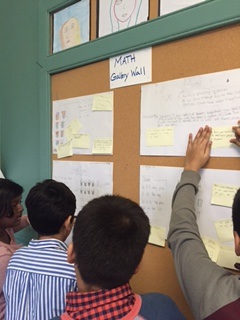
I have always considered myself more of an “English Language” teacher. So, when I moved into the junior and intermediate classroom, I felt less confident in my abilities to teach math. When planning for the year, I surveyed some other junior/intermediate teachers for recommended resources. And when planning for the classroom environment, I made sure to have a corner dedicated to math, which includes a gallery wall, manipulatives, math dictionary and texts as well as tools like calculators.

Although I was given a set of textbooks, I don’t plan or teach from the textbooks. I print the curriculum expectations specific to the grade for each strand, and use them as my guide in planning the units. Then I refer to some other resources for ideas in activities that involve group work or problem solving. Some of favourites to support my math program are:

  • Introduction to Reasoning and Proof, Grades 6-8: The Math Process Standards Series, by Denisse R. Thompson and Karren Shultz-Ferrell
  • Nelson’s Ontario Numeracy Assessment Package
  • Good Questions: Great Ways to Differentiate Mathematics, by Marian Small
By referring to these resources, I am able to understand the concepts that need to be taught and how to differentiate using broader questions for the range of math learners in my classroom. I enjoy providing mini-lessons on strategies to support the students as well as encouraging them to share their strategies with me and the rest of the class. Our math class has become engaging and interactive, not repetitive and boring as I had feared.
We use a gallery wall to display group answers to problems. This has become an invaluable way to quickly assess understanding. Students are given the opportunity to view the gallery, see how others have solved the problem, respond with their own ideas or suggestions and acquire new learning. A week of math classes includes a range of instructional strategies, independent work, paired and group work. One of our common “go to” questions is “Does this make sense?” We are aiming for understanding rather than rote learning of facts and steps (as I learned in elementary school). So, I am enjoying learning with my students as I discover new ways to approach and solve math problems.