Happy Birthday

Celebration

Before we talk about celebrations, let’s break it down into its morphemes.

Base word – celebrate: to honour

suffix -ion  : the act of   (adding -ion turns an action to a noun)

celebration : the act of celebrating

By explicitly teaching morphemes in words, you are giving your students a skills to read multisyllabic words, signals parts of speech and builds vocabulary.

Now back to our topic, celebrations. One way to build relationships and sense of belonging in schools is through having celebrations. There are some such as Halloween and Valentine’s Day, although many schools find that they are not representative of their populations. There are cultural celebrations where we can celebrate diversity and multiculturalism. As we head into winter months, there are many celebrations revolving celebrating with lights. Some Festival of Lights celebrations include Winter Solstice, Diwali,  Hanukkah, Winter Solstice, Christmas and Kwanzaa. Schools sometimes have spirit days to build staff and students morale and school pride. Creating a sense of belonging helps students build self esteem because aspect of their identity is being recognized.

I do recognize some schools or groups of students do not celebrate for reasons I respect. I want to share one way we can create a sense of community by celebrating and acknowledging students.

In my classroom, birthdays are celebrated. I post student’s names and birthdates on a poster and I am intentional in acknowledging birthdays either by writing a card or singing Happy Birthday.

I celebrated my birthday at school a few weeks ago. I wore a birthday hat and walked down the halls and students from all grades shouted, “Happy Birthday!” to me. As I was doing supervision in two classrooms, each class sang Happy Birthday to me. The song brings smiles to faces and especially mine. They ask me how old I am and often I say an outrageous number like 101. I joke with them and realize this small connection is what builds a school community. When you share a bit about yourself as a teacher to your students, you make connections. Fostering relationships is incredibly meaningful although as educators we must be mindful of professional boundaries and not share information that is too personal. That being said, celebrating a student by recognizing their birthday might seem like a small gesture but it can make someone’s day.

And when it comes to making someone’s day, one doesn’t need to have a birthday to do something. There are random acts of kindness you can do as a teacher for your colleagues and students. Say a compliment, acknowledge a student’s efforts, notice what they like or dislike. Take the time to make the connections and it would make your ‘work’ day a more positive one.

“Spread kindness around like confetti”

Go Slow to Go Fast

I swim twice a week in my local public pool. Outside of the positive benefits this has for my physical and mental health, I really enjoy swimming, and for the past few years have been trying to prioritize this throughout the school year.

The other day, I was in the medium lane (I sometimes swim in the slow lane and sometimes in the medium). There were four people in the lane, and in all honesty I thought I was doing great. I felt that I was swimming a little faster, that I was a little bit more fit, and I was doing my best to keep up with the faster swimmers. However, I was being passed by swimmers who were faster than me; after this happened a few times, the lifeguard stopped me and suggested I move to the slow lane as there were only two swimmers there and I wouldn’t be passed as much.

I was shocked and a little hurt, but moved over to the slow lane.

And after I processed and recovered a bit from this feedback, I reflected a bit on the concept of speed, and how in our fast-paced world we are always trying to go faster. I was trying to go faster when swimming, and maybe had not been in the right lane. In my classroom, with the pressure to assess and teach and collect data, we are often moving too quickly with students, and the learning that is critically important at this time of year can get forgotten.

Diagnostic assessment is of course critically important; however, there are also many other aspects of running a classroom at this time of year that are also essential. The foundational work of building classroom routines, establishing how we learn, where materials are and how we use them, how to keep the classroom orderly, and how to move through the school: these are critical skills to build and review in September and October.

The idea of community underpins my approach. I work on building community with my students and colleagues: I value the interdependence of relationships, and this takes time to develop and grow. We recognize that we are a community within the classroom, and also that we go out in the neighbourhood and use the physical community as a place to learn and explore. Because we are regularly moving outside or to different spaces in the school, I request and expect that my class is able to do that quickly and quietly. That doesn’t mean that they are quietly moving through the school, but it does mean that they need to be walking in an orderly way. An important lesson at this time of year is if they are not listening or paying attention, we go back to the classroom and start again. It takes longer, but emphasizing the importance of listening to me and moving safely opens up the world for rich learning opportunities.

We move slow now so we can do more later: we move slow so we can move fast.

The Power of Play in Kindergarten and Beyond

“Play-based learning allows students to learn while at play. The continuum of play-based learning varies based on the learning goals, ranging from student-directed play, to guided play, to educator directed play.”  Ontario Ministry of Education, The Kindergarten Curriculum (2026)

One of the things I love most about teaching Kindergarten is the focus on play-based learning. When I taught Kindergarten, I always told students and their families: play is work. When students are playing, they’re learning in so many areas: problem solving, creative thinking, social skills, emotional awareness. They learn to think for themselves, understand their own feelings, and recognize the feelings of those around them. Through play, they learn to respect differences, build relationships, and grow socially and emotionally.

Play-based learning also helps students think critically and develop a strong foundation in literacy and math. It supports making connections, contributing to their learning community, and exploring the natural world.

Consider checking out Professional Learning in Early Years for bite size videos, podcasts, chats and resources to support your Kindergarten classroom.

Even when I’m not teaching Kindergarten, I find ways to include play. I think all kids need to play — and honestly, adults do too.  This year I am teaching in a Learning Center. This learning space is focused on literacy and math intervention as well as supporting self-regulation.

As I reflect on different types of play in Kindergarten, I think about how I would adapt it into the learning center.

Different types of play

Dramatic play

This is my favourite area to set up. I love how kids interact in a house center, often playing “family.” I include baby dolls with different skin tones and dishes and utensils from different cultures. I’ve also seen dramatic play centers become restaurants, stores, and gardens. In the learning center I can include drama games including role play and puppets to teach lessons.

Sensory play

Some students gravitate to sensory centers like sand, water, and play dough. I’ve added a marble run to water and watched kids explore cause and effect. The next week, the marble run can go in the sand with cars and diggers, and suddenly the play shifts again. In the learning center, I have a basket of sensory items for students to use to help them regulate and focus. As I get to know my students I learn what they gravitate to and ensure they get their sensory break.

Cooperative play

This type of play often includes an educator modeling how to cooperate. Games that involve taking turns or building something together help students learn how to share, take the lead, and listen to different ideas. In the learning center, I can use math and word games to help me continue to teach these important life skills.

Constructive play

In Kindergarten, I have bins of building tools like blocks, Lego, straws, and more. Sometimes students play independently, and sometimes they play side by side in parallel play. There are also moments when students work together to build and create. The art center also promotes creativity with coloring tools, scissors, stickers, and other materials. Currently, I still put out a bin of Lego and see what students would create.

Rule-based play

This type of play is often guided by an educator. Games like Simon Says and What Time Is It, Mr. Wolf? are great for practicing listening skills and following instructions. Musical Chairs is always a class favourite. These games can be played in the classroom, the gym, or outside. I also play classic games like 7-up and Four Corners.

How Play Shifts in Older Grades

As students get older, play doesn’t disappear, it just changes. Consider cross-curricular and integrated learning. Bring STEM into your classroom. STEM integrates science, technology, engineering, and mathematics, and many educators include the arts to make STEAM learning happen.

As students engage in STEM education, they develop transferable skills they need in today’s global economy and society. These include computational thinking, coding, design thinking, innovation, scientific inquiry, and engineering design. These skills are in high demand in our globally connected world.

Teach Oral Language Skills Through Drama and Play

Oral language skills are important across all grades, especially for students with differnet learner profiles and multilingual language learners. Drama games give students a low-risk, safe space to practice speaking and listening. This can happen through role play or dramatic play.

Try This Story Activity

Sit in a circle and begin with a story prompt. Each student adds a detail to continue the story.

Turn this into a writing activity using a fold-over story activity

  • Each student gets a sheet of paper.
  • They follow the prompt and write down their idea(s)
  • They fold the paper, so the next student can’t see what was written and pass it on
  • Pass the paper around the room until all prompts are complete.
    • Who? Where? What? Why? (optional ‘with who?’)
  • Unfold the paper and read the story. Watch and listen for the giggles and laugh along with them because your students are learning and playing.

I hope you find moments to play throughout your day and have fun in your learning space.


The Work We Do Matters

During the second week of school, I had several former students return to visit me at the middle school where I work and where I taught them during the previous year. I was happy to see all of them and hear about their new experiences as grade 9 secondary students. However, a visit with one student resonated with me most because of the comments she shared regarding the way my lessons and instructions positively impacted her learning.

During our visit, we had a pleasant conversation where she shared some of the joys and challenges of being in secondary school that related to making new friends, finding the location of her classes, and managing her course load. Remembering that she was an avid reader and working towards writing her first novel while in grade 8, I asked if she still found time to read material of interest beyond assigned course readings and if she was still working on her novel. She shared that unfortunately she had little time for either, due to the demands of her courses. She then listed her courses and said that she was happy to be taking English during her first term because it gave her an opportunity to read novels and write about them.

She went on to say that she has been receiving positive feedback from her English teacher regarding the structure and quality of her writing. She then told me that part of the reason she chose to visit was to thank me for helping her to become a better writer. She said that before being in my language class she felt that her writing was disorganized and that I really taught her how to organize and communicate her written ideas. Her comments brought me immense joy because they provided clear insight to my lessons and instructions impacted her learning.

While I was thankful to hear that the work I did with this student had a positive impact on her learning, I know that even if she did not share her comments, I would continue striving to facilitate a classroom program that positively impacts student learning. Her comments helped me to understand that even after 16 years of teaching, hearing that I helped a student further develop their literacy skills is immensely rewarding. I share this story because I know that there are numerous other educators across the province doing remarkable work with students and that work is positively impacting their learning. I hope that they too know, whether you hear it from a student or not, the work you do matters.

Edwin is a Great Digital Resource. So Why Do I Still Need so many Photocopies?

Last week a kind student passed me a note. On the outside it read “to my favourite teacher.” My heart warmed. I unfolded the paper – to my surprise, it contained a teaching tip: “please provide us with a social studies book to help us remember.”

I remember a time when textbooks were a core element of learning. As students, we’d all get assigned a well-worn textbook, often with doodles in the margins of the text. Once I became a teacher, textbooks became much less visible in schools – for many good reasons. Digital technologies, the deluge of information brought about through the internet, and shifts in instructional practices greatly changed the way we access, present, create, and engage with information. Our understanding of content-area subjects have also evolved as educators have critically examined long-standing colonial and Eurocentric perspectives. In this context, getting rid of textbooks just made sense.

However, the decline of the textbook learning also has its consequences. Students have less access to resources that they can easily refer to without a device on hand. Many educators have turned to the internet for content that is easy to share through virtual classrooms, print, or display on a projector.

But as my student so keenly pointed out, a handy book resource can do wonders in helping students to do the one thing they should be doing with as few obstacles as possible: studying.

Recently, the Ontario government announced a significant 60 million dollar investment in Nelson  Education’s Edwin platform, which essentially presents their vast collection of curriculum-aligned resources in an easy-to-navigate platform. This would seem to be a huge boon for educators, as Edwin pairs content along with student facing worksheets, lesson plans, assessments, and rubrics all in one location.

There is a lot to appreciate about that. Resources can be accessed from almost anywhere, updated without replacing an entire classroom set, and supplemented with multimedia and accessibility tools.

But when the lesson starts, it becomes clear that having a physical “IRL (in real life)” page or book would make the learning so much better. It’s a powerful practice for students to underline important information and scribble ideas in the margins. They should be solving a problems beside an example, especially in subjects like math. They should be flipping back pages to compare ideas without being distracted online. They should be talking to the student beside them rather than navigating between tabs.

So why not just print what I need? Or use the class set of Chromebooks with some sort of text markup tool? The solution is not so simple in an age where printer ink, paper, and devices are scarce.

A five-page resource for 30 students becomes 150 sheets of paper. Repeat that process over a couple months and I have used up the majority of my photocopy budget within weeks. If I want to use the digital version, multiple students are hovering over a single computer as the Chromebook to student ratio is 9 computers for 30 students in my classroom.

We have not eliminated the physical resource. We have simply transferred responsibility for producing it to the teacher. And teachers know exactly what that means: downloading, printing, photocopying, stapling, sorting, distributing and replacing lost copies. The cycle is endless and time consuming.

From this perspective, a classroom set of books starts to look a remarkably innovative solution.

A book is a resource, not a pedagogy. A skilled teacher with a textbook can still differentiate instruction, facilitate rich discussion, use culturally responsive examples, incorporate videos and simulations, provide choice, use manipulatives, and bring in additional texts and perspectives.

The humble, low-tech textbook simply provides something increasingly valuable in today’s busy classrooms, where more time must be dedicated to providing accommodations to large, intellectually diverse classes: a dependable starting point. Books are also wonderfully uncomplicated. A book doesn’t need wifi, login, a battery charge, or systems update.

These interruptions may seem small, but teachers know how quickly they accumulate. Three minutes here, five minutes there, and suddenly a meaningful portion of instructional time has disappeared. Sometimes good instructional design is simply removing unnecessary obstacles between the student and the learning.

Technology can provide simulations, multimedia, collaboration, immediate feedback, translation, text-to-speech and other accessibility tools that can transform learning. Those possibilities matter, particularly for students who depend on digital tools for equitable access. But reading three pages of ordinary text does not automatically become better learning because those pages appear on a screen.

If we genuinely want students to develop healthier relationships with technology, schools should provide meaningful opportunities to learn with it and without it.

I can seen the impact technology has had on the students I work with on a daily basis. When there is no tech available, students become noticeably restless, looking for something to doodle, squeeze, or toss. Waiting patiently and learning to live without distraction has become a new skill to teach. A physical book gives information a stable location. Students remember that the diagram was on the left-hand page or that the example they need appeared a few pages earlier. They can quickly move between sections without opening and closing windows. There is a physical geography to reading a book that scrolling and clicking does not entirely replicate.

Edwin is a valuable resource, and I am glad Ontario educators have access to it. But perhaps there is value in expanding our definition of a resource-rich classroom. Digital tools can open doors to perspectives, media, and information that were difficult to access in the past, while physical books can provide a sense of continuity, focus, and place. If we are to fully embrace a resource like Edwin, there has to be additional considerations for the amount of printing and photocopying that comes with it. Or, we could just offer the hard copy version, with the understanding that textbooks – like pens and notebooks – are consumable items that need to be replaced at regular intervals.

And yes, there is an environmental cost to purchasing books and photocopying. But if there is any good reason to use paper, surely it is for public education?

Recognizing Multilingual Language Learners (MLLs) in Kindergarten

When conversations arise about MLLs the early years, there are a few curious, skeptical questions that often come up.

Why does it matter if a student is multilingual in Kindergarten?

Aren’t all students the same in Kindergarten when it comes to language and literacy development?

Why bother figuring out who the MLLs are when there won’t be any support?

I don’t believe there is any reason to delay providing program support for MLLs at any age. If a student is learning English for the first time, even in the Kindergarten years, it helps educators to know the learner better, which is essential for understanding their language and literacy development and how we might support their growth. In this post, we will take a closer look at why educators should consider recognizing MLLs in Kindergarten. Next, we will take a look at what tools we can use to support English language acquisition for some of our youngest learners.

1. Students from Multilingual Homes May have a Completely Different Oral Language Foundation from their Peers

I have a friend who shared with me that they were born in Canada, but spent most of their time at home with a grandparent that spoke Chinese. Her parents also spoke Chinese at home. When she arrived in school, it was her first experience with English. “I didn’t know what was going on,” she shared.

It is not uncommon for students to arrive in school without any prior exposure to English whether they are born in Canada or not. And as educators, it is important to encourage and honour home languages because multilingualism is an asset and critical cultural fund of knowledge that serves many important purposes.

When educators know that a student is arriving with a different language foundation from their English-speaking peers, it puts the student’s oral language development into context. Oral language is a key indicator of success in reading, so knowing who the MLLs are in the classroom would signal that a student might need more support in building their comprehension of English words and sounds. The teacher might consider using gestures and pictures to communicate instructions and information in English. They might also teach essential phrases for self-advocacy and play.

2. Understanding a Student’s English Language Proficiency Supports Reading Instruction

Knowing the student’s language background also helps to contextualize data gathered from screeners. Most literacy screeners are developed with the assumption that a student already has knowledge of English vocabulary and sounds (phonemes) from exposure to the language at home. This is not to say we shouldn’t administer screeners to MLLs; rather, we should interpret those screener results from a perspective informed by an understanding of a student’s English language development.

For example, a student may perform poorly on a screener simply because they do not know what is being asked of them. The student might need additional modelling to understand exactly what they should be doing. The educator administering the screener may consider repeating parts of a screener without a timer to see what the student can do with more processing time.

Take note that MLLs are not a monolithic group – the needs of one student may vary from the next depending on their exposure to English at home, in the community, and what their home language is.

3. Creating MLL Portraits in Kindergarten Supports Learning in the Primary Grades

In my board, the typical practice has been to create MLL portraits after they have started grade 1. This has always struck me as an odd practice because becoming an MLL doesn’t suddenly happen overnight; if the student is in the process of developing their comprehension of English in grade 1, then it is quite certain they were learning English in Kindergarten.

Which brings up the question – why wait? Starting conversations with families about ESL programming adaptations sooner is better than later, especially when it happens with educators that have already built that relationship with the family and know a student’s language skills and behaviours well. So many important observations about a student’s language behaviours in English and their home language can be gathered in Kindergarten, and there is no reason to only start collecting that information in grade 1.

4. Recognizing MLLs in Kindergarten is a Curriculum-backed Practice

The latest iteration of Ontario’s Kindergarten Curriculum (2026) states, “many young students starting Kindergarten are entering a new linguistic and cultural environment, while acquiring English-language proficiency.” To provide responsive and inclusive Kindergarten programming, educators need to understand who their MLLs are, including their linguistic strengths, experiences, and learning needs. This understanding helps us to build on children’s full linguistic repertoires, partner meaningfully with families, and provide culturally responsive learning opportunities that support literacy and learning across the Kindergarten program.

Understanding our MLLs is a Culturally Responsive Practice

It’s important that educators frame the process of understanding MLLs in the Kindergarten as a culturally responsive practice that supports teaching and learning. When we acknowledge and honour the cultural funds of linguistic knowledge that our youngest learners bring when they start school, we are not noting an “English deficit”, we are building a more fulsome learner portrait that will help us to leverage teaching strategies and resources with more intention.

The Shoehorn Dilemma

Accommodations, Differentiated Instruction (DI), I think we can all agree DI is hands-down indispensable. Really, what could be better than those rich and varied instructional strategies that we add to our regular teaching, to meet the diverse needs of diverse students?  It could be speech-to-text or other technology to help students with written output challenges; it could be sensory-friendly lighting or sound field systems; it could be providing alternative performance tasks to demonstrate learning, such as visual art, drama presentations, or oral assessments instead of written tests. The possibilities are endless.  But no matter which accommodation is used, it’s safe to say that these pedagogical “extras” can only be a positive thing, and one hundred percent awesome all the time. End of story.

Except for the shoehorn dilemma.

Yes, shoehorns may be great for dealing with stubborn footwear, but metaphorically speaking (when it comes to inserting pedagogical supports into our classrooms) shoehorns may not always serve us well.

The potential problem arises when DI is an afterthought. If it is only used in a reactive way, with differentiated strategies shoe-horned into established learning programs in response to a new student suddenly needing them, it can sometimes – not all the time, but sometimes – have the unintended consequence of highlighting how inequitable the original learning space actually was. There are many instances in which this may occur, but here I will use ESL as an example: if a new multilingual language learner arrives, we may hastily scramble to add dual language books, multilingual classroom labels, and translation tools…while the other students in the class wonder why they are suddenly seeing these resources in their formerly English-only zone. Yes the change is good but, in some circumstances, the very techniques that are meant to create an inclusive environment may also shine a spotlight on who the learning environment was initially and instinctively constructed for, and for whom it was not; which students’ identities were automatically included in the classroom, and whose were not; and by implication, which students may inherently belong, and which may not. You know, those “different” kids who we now have to change everything for.

So the issue becomes not whether to use DI, but how and when. And using the MLL example above, I have some wonderings. What if it were normal to see, use, and discuss the value of other languages in the classroom, regardless of whether there are any MLLs in the class? What if every classroom used multilingual resources from time to time, giving students a chance to explore new languages they are interested in, or strengthen and complement their French program, or make cross-linguistic connections between English and other languages, thus deepening their understanding of English etymology, morphology, and spelling patterns? If it is “normal” to use other languages in learning, would we really be changing the learning environment so drastically if an MLL arrived? And instead of lamenting their lack of English in English-only classrooms, might that new environment encourage us (both students and teachers alike) to view that MLL as skilled and linguistically adept, and a perfect fit for our classroom? Perhaps class introductions might move from “He can’t speak any English, let’s help him” to “She speaks three languages! She can teach us a lot”.

ESL is only one area of consideration in building learning environments for everyone, but it raises an important question for educators: how can we ensure our learning spaces are equitable and inclusive from the outset so that any student might wander in unannounced and access the lessons and learning, and find a space that reflects their identity, already waiting for them?

With woefully lacking supports and funding, it would be quite difficult to anticipate and include all the learning variations we would want in any given classroom. But there are small ways, every day, we can move towards it, such as collaborating with colleagues, sharing ideas, reaching out to Special Education teachers, ESL consultants, and other specialists may broaden our awareness of the types of learning supports that all students need.

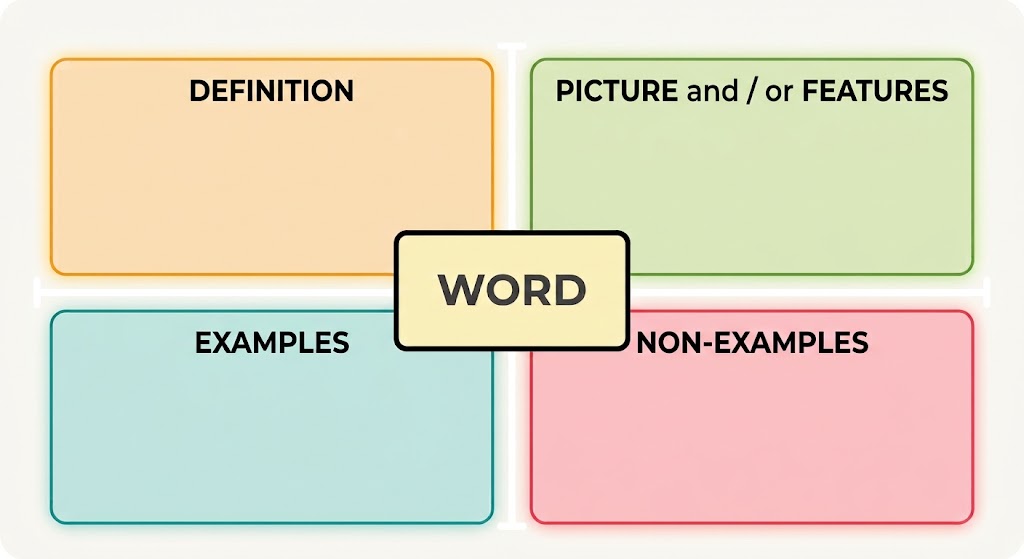
The Frayer Model is one of my favourites. Designed by educator Dorothy Frayer and her colleagues at the University of Wisconsin in 1969, this student organizer is meant to be used in vocabulary study, with the aim of enhancing students’ understanding of words by encouraging a deepened exploration of them. Students record the word right in the middle of the planner and, in the spaces around it, list not only its definition but also its important characteristics or features, as well as examples and non-examples. Here is a basic copy of the Frayer Model planner:

Template created with Gemini AI


And here’s the simple, beautiful addition to the planner that builds multiple languages into your learning program: just add a space for students to write the word in another language as well. Jim Cummins and Margaret Early offer their own variation on the Frayer Model in their book Big Ideas For Expanding Minds, with a spot for “Word in Home Language” as well as slight tweaks to the surrounding quadrants (having MLLs write synonyms and antonyms in the lower left quadrant instead of examples, and simply writing a complete academic sentence using the key word in the lower right quadrant). It is a great variation for MLLs, and you can check out their thoughts on page 60 of this useful book. But classroom teachers can use the traditional model above too, for everyone in the class, by just adding a space for “word in another language” and let the multilingual learning begin! Any student could check with their French teacher, a French dictionary or a translation app to find the French equivalent of their target word. Or if they speak another language at home and already know the translation they could record it right away in home language – or better yet, ask their parent or caregiver and do a little multilingual homework together. Students who speak only English could explore a language they are interested in learning. All rich and meaningful options for everyone in the class, not just MLLs, and a simple way to embed and highlight the value of languages in the classroom.

So as we begin establishing what our learning environments look like this year, I am going to consider the diverse ways I can use DI right now, even if there is no apparent “need” as yet. And honestly, I’m always learning, always uncovering possibilities that did not naturally occur to me, simply because they are not within my lived experience. But that’s the beauty of teaching, of creating better learning environments that include everyone, isn’t it? May new and beautiful discoveries find you this year too.


References

Cummins, J., & Early, M. (2015). Big ideas for expanding minds: Teaching English language learners across the curriculum. Rubicon Press/Pearson.


Sunshine Moments and Organization SKills

Hello Fellow Travellers

Those of you have been in community with me for two years, may know that I have moved from a centrally assigned position as a Consultant (Special Education) to being a Grade 7-8 teacher in a school this September. I am delighted.

My Work and My Job Title

Like you, my work is more than what my job title suggests. There are many small and big things that educators do through our work day that is invisible or invisibilized (made invisible) due to many factors. One of them is that we do not know the realities of people’s home and work lives. We do not know the complexities of the lives of our students even from day to day and period to period.

Reframing and Regulation

When my children were growing up, and now when my students feel overwhelmed by new experiences, I gently remind them that…

It Is Not Weird. It is New.

I also reminded myself that this week when I was in a school full time and for the whole day. You see in my centrally assigned role, I used to be in two to three schools in a day and although I co-taught with colleagues and was always in classrooms with students, I was not governed by bells and timetables the same way. That takes some getting used to.

Grace Is Key

  • In these early days of the school year, everyone, whether colleagues, office staff, caretakers, administrators, families and of course our students, is figuring things out anew given all the variables in our lives.
  • Sometimes timetables get messy, supervision duties need tweaking and pencil cases are forgotten.
  • At such times, it helps to extend some space and grace to the person in front of us in real time, just as we would expect it to be gifted to us.
  • Attending workshops and webinars, sharing updates of sessions presented on social media, following content and putting up glitzy posters on our walls may be important.
  • But really being able to practice grace towards one another is the key to building and strengthening school culture.

The Person and The Paperwork

Since September 8th, in addition to building community and getting to know the students in my class, I have been speaking with students, families and colleagues to understand students’ strengths and areas of support so that I can coordinate IEPs with multiple system partners’ inputs.

I find that at this busy time it helps me to remember this reality:

Under All The Paperwork is Someone’s Child

Sunshine Moment

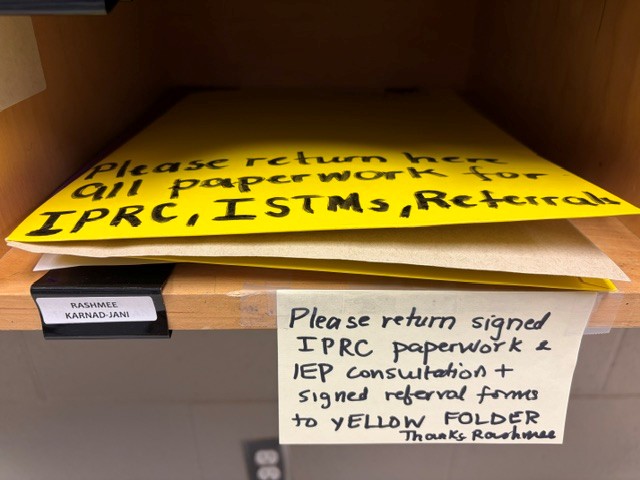
My sunshine moment was therefore related to paperwork because it impacts my everyday work as it does for colleagues who are partnering with me.

As my colleagues and I have busy work lives, and I am trying to keep my teaching space and my school-wide paperwork organized, I began by setting up one process in motion that works well for all of us.

Moreover, we do not have to leave our schedules and walk around to look for one another. This way, papers get filed promptly and we can all move on with our day.

Often the seemingly small considerations are the start of long term collaborative and respectful work practices.

P.S: In addition to the messaging and memos from your school district, do review The Individual Education Plan (IEP): Advice to Members

With You, In Solidarity,

Rashmee Karnad-Jani


Learning Stations or Centres aren’t just for Kindergarten!

Quite often, centres or learning stations are associated with kindergarten, and the reasoning being that its instructional approaches focus on play- and inquiry-based learning. However, the same can be said for any grade. Just like in kindergarten, strategies and approaches are developmentally appropriate; with that in mind, play and inquiry can be developmentally adjusted for older grades. It may look and feel different, but that explorative and curiosity-supporting learning experience is still present. 

THE WHY

Transferable Skills 

In an age where technology is moving so rapidly, we need to provide opportunities for students to develop transferable skills. 

Inquiry-based learning provides learners with the opportunity to critically question and analyze real-life problems, which further engages learners. Imagine there is a concern in the school community, and students are able to discuss and try to problem-solve for that issue all while following curriculum expectations? Inquiry also provides learners multiple means of expression, which makes the learning more accessible. 

The transferable skills and inquiry are also interwoven in the curriculum. Being able to weave through the process of inquiry at centres (indoors or outdoors) helps to chunk the learning process into smaller more manageable stages where students can collaborate, explore ideas, test them out, reiterate, and even consult with an educator. It also provides you the time and space to be responsive to students’ needs. Read this ETFO Voice article to get inspired about an outdoor inquiry-based learning experience.

In a coding class, an educator used learning stations to support learners, specifically small group instruction and problem-solving tasks. While the students worked collaboratively in flexible groups to debug a code at one station or write the code at another, the educator is making observations and having conversations with students. In a French class, an educator is leveraging digital tools, including Artificial Intelligence (AI), at learning stations. (ETFO has published some Members’ Guides to Artificial Intelligence.) Students are sequencing images and then writing the story in French, another centre requires developing a prompt to generate a similar image to infer about, all while the educator is working in a small group to develop and strengthen vocabulary. 

THE HOW

The Environment as a Third Teacher

To encourage learning stations/centres, it is important to consider the learning environment. Flexible seating or being able to move and shift when exploration time is occurring is important in the fluidity of this kind of  learning. There’s a quick read about co-creating a learning environment in ETFO’s Building & Enriching Partnerships in Kindergarten, and most of the self-reflection questions are relevant for any grade. ETFOpley.ca also provides more insight. 

Self-Reflection

Prior to engaging in learning stations/centres, there needs to be detailed thought on the flow and roles to focus the explicit/direct instruction needed to develop the routines. 

For example:

  • What are you doing while the students are at centres?
  • What skills and knowledge are students developing and for what purpose?
  • How do students access the information at each station (e.g., visuals, audio, video, etc.)? 
  • How are the open-ended invitations to learning displayed at each centre (e.g., sign, audio recording, visuals and words, etc.) to support all learners? 
  • Are materials accessible (e.g., magazine folder or tray of all items needed for centre)? 
  • How are students documenting their learning and how is it made visible? 
  • How are you assessing learning (e.g., observations, conversations and products)? 
  • When will learning stations/centres occur (e.g., after lesson, middle/end of a unit)?

Once there is an understanding of these considerations, then there needs to be time to practice for both students and you! 

Success Criteria

Students need to learn how to collaborate with peers, how to engage and then clean up the space for the next group, they need to know how to document or submit learning. Co-creating success criteria on what is expected during learning station/exploration time helps to make it a smoother process.

High Expectations & Check-Ins

Don’t be afraid to stop the learning if the success criteria isn’t being met. Yes, it takes time out of the learning for that moment, but it’s a teachable moment for the learners and reminds them of what they co-created with you. Learning stations take time at first, however, the initial time and energy does pay off as transitions, independence and focus become better. The first step is setting those high-expecations and trying it out together.

A First Week Story

It was the first day of school when I saw them. Two brothers, arriving at school and standing on the perimeter of the groups of reuniting children on the tarmac. They looked uncertain and uncomfortable; just staying with each other and not really making eye contact with anyone. First days can be hard sometimes, but especially when you are new to a school.

I went over to say good morning to them and introduce myself. They were still uncertain on how to answer when I asked them how they were and even more uncertain when I said, “I’d love to help you find your teachers this morning.” But off we went to introduce them to their new teachers. Every time I saw them at break that day, they were sticking close to each other.

As the first week progressed, every time I saw the brothers I said hello and every time I got a few more words from them. Soon they shared their previous schools, teachers they had, what they missed most about their old neighbourhood. Then one day as they were waiting for their bus home, the conversation shifted. They told me what they liked about their new school, their new teachers, and their new friends. Their smiles came easier and they would wave as the bus drove them home.

While I’m no longer at that school every day, I think about their wonderful homeroom teachers who worked hard to build trust and show interest in those new students during that first week. They welcomed them into their classrooms, making sure they had what they needed every day and asking them what their favourite subjects were in school. They created spaces where those new students could feel welcome and that the adults in this building cared about them.

These are often the unspoken parts of teaching that educators do each day and for students, it is one of the most important. Knowing that there is a safe and caring adult at school who is interested in them and who sees them as people makes a difference in a child’s day. Teaching and learning walk hand in hand with welcoming and belonging.

All the small things you do each day let children know you care.

I wonder about those brothers, though it’s been almost a month since the first day of school. I hope they are having a great time at school, that they feel comfortable to participate in class, and that they go home with good news stories each day. I wonder about the teachers, too. I hope they know the impact of those caring moments in the first week and the change that those cumulative moments brought. I hope you know that about your impact, too.