
Movers and shakers

I might catch a little fire for this title.
And thank you in advance for reading.

Every classroom has them- fidgety student(s). You know the ones who cannot get comfortable to sit still, are unable to focus for longer than 8 seconds (there are statistics for that), and are constantly in motion. Some days you see your classroom is more like a garden filled with hummingbirds flitting, buzzing, and appearing to faff about even when totally engrossed in a task.

Are they learning? Can students learn when their distractedness is a distraction? You’re thinking about your students right now(past and present) aren’t you? I am, and yes like yours are incredible capable learners, each of whom possess a curiosity and creativity that we allow to flourish.

So, how do(did) we manage to harness a student’s abundance of energy without blowing a fuse or short circuiting the individual? For me, working with* a ‘busy’ student, whether officially identified with ADHD or not, requires a deft balance of patience, structure, and at the same time flexibility. Inside of this is an expectation of great things that is mapped out and shared with the help of the individual learner. It is not my agenda that gets carried out. Student voice is crucial in this process. Negotiation skills training is included in the deal.

Do you allow students to doodle? This simple artistic expression allows students a place to focus the fidgety moments onto the paper while freeing their attention to concentrate on the lesson. How about a soft foam squeeze toy? In my class we have several available that are specifically dedicated to any students who might feel a bit of stress or the need to keep their hands occupied. Plus they’re fun to throw around the class as a kinaesthetic activity and to practice Math facts or French verb conjugation.IMG_0164
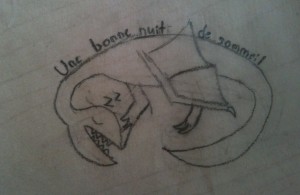
Doodling and fidget toys seem counter-intuitive to many teachers who were educated annually in the art of rote in row after boring row, but can be great ways to support your busy students. Sadly, the education from the good old days doesn’t always honour the progress of humanity in the 21st Century. Especially, when it keeps referring to what worked or is rooted(stuck) in the last one as the only path to knowledge. In my opinion this is antithetical to the needs of modern learners who, as a result of innovation, technology, and pedagogy find themselves barely coping in some classes while thriving in others. 

My teachers had a kid like that, me. My mom shared, that after some tests and upon the school’s urging our family doctor prescribed some meds which were intended to help channel my “energetic” demeanour. My parents refused. Thanks mom and dad!

Although some of my colleagues might volunteer to renew the prescription for me, I am glad my parents decided not to take the pharmaceutical option. Instead they chose to work with my teachers on implementing strategies which would keep me busy, moving, and engaged.

Do you know how many notes I delivered around the school, erasers I cleaned, or how many times I helped the caretaker sweep? And that was during instructional time. Every recess(2 x 15 mins + 60 mins lunch) was spent running, jumping, climbing, and playing. It was the time outside, in motion, that made the time inside learning tolerable. So it makes me wonder how many others went through, or are going through the same thing as I did?

Without apologies I wish to proclaim and thus forever own my ADHD. In fact I wear it like a badge knowing it was a blessing in my life as a learner and is a gift in my life as an educator. The challenge for learners and educators comes in finding that Goldilocks Zone between perpetual motion and learning progress each year that is just right.

As the researchers note, “in the school setting, the challenge becomes how to create an environment in which creativity is emphasized as a pathway to learning as well as an outcome of learning.” from The Creative Gifts of ADHD by Scott Barry Kaufman in Scientific American

And therein lies one of many Catch-22s in our profession. We have some who have blessed their classrooms for  35 years or more, and others who are just being hired. The gap between youth and experience is not going anywhere? How do we re-invigorate mindsets, open ourselves to greater collaboration, and sharing the wisdom gathered from experience. There is much to gain from having both. Now the challenge is preparing, pairing, and finding some playtime between the two sides.

* I had originally considered using the word ‘handle’ instead of ‘work with’ as I wrote this post. Upon reflection it was wiser to be considerate of the fact that handling a student conjures negative thoughts, whereas working with a student evokes a working opportunity.

Quick and Simple Language Activities

Over the past few years, I’ve spent a decent amount of time amassing quick and simple language activities to use with my class. I’ve focused on finding things that easily adapt to a wide range of abilities, can be used in a variety of ways, and are fast to set up. I like to use these activities during my language groups/centres time, but they’re also really handy to have around in case there are any last minute schedule changes or an unexpected absence.

1) Photo of the Day: I load up a photo from a website like National Geographic (their Photo of the Day galleries are great) or a news source. I like to choose photos with a lot of interesting elements to them – things my students can talk about, think about, compare to their own experiences, etc. I provide my students with some sentence starters (I teach a second language program) and then ask them to write about the photo, prepare a short presentation for the class, or discuss it in groups. My sentence starters are things like:

“In this photo, I see…” / “Dans cette photo, je vois…”

“I think ________ becase ________…” / “Je pense que ________ parce que ________…”

“This photo makes me think of…” / “Cette photo me fait penser à…”

My students talk about where they think the photo was taken, what they think is happening in the photo, what details they notice which provide them with insight into where/when the photo was taken and what is going on. These activities have taught them a lot about providing evidence and justifying their responses, which has helped their literacy development considerably.


2) Journal Tic-Tac-Toe: At the beginning of the week, I set up one of my language centres with a tic-tac-toe sheet (really just a 3×3 grid) where each square has a different writing prompt. Over the course of the week, students choose three prompts to write about, with the caveat that their three choices have to make a straight line. The prompts can be as simple or complex as you want them to be. You can tie them into your Social Studies or Science units, or you can focus on specific writing forms, or follow a simple theme. These sheets provide students with choice while focusing on specific skills or subjects.


3) Story Starters: My husband is a professional artist, so sometimes I ask him to make things for me to use in the classroom. It’s pretty awesome when he has the time to make something for me! One thing he made me several years ago was a bunch of sets of “story starters” – collections of images (two characters, an object, and a location) based on fairy tales or themes. I printed them out on cardstock, laminated them, and put them all on their own keyring. In my classroom, I use them for writing and drama. They’re handy to have around for having students come up with simple skits to get them speaking (especially useful in a second language classroom like mine). Sometimes I use them in their original sets, other times I mix and match characters, settings, and objects from different stories/themes. I have about twelve different sets of these, which I keep in jars/tubs that students can draw them out of randomly. Here’s an example of a printsheet with a few different sets:

Story Starter Small Set 1


4) Boggle: I have a standard Boggle template I’ve made and a bunch of laminated square cards that I can write letters on with dry-erase markers. The square cards have magnets on the back so that I can stick them on the blackboard. Students have to make as many words as possible with the letters provided. In French, I don’t worry about adding accents to vowels, telling my students instead that they can add accents to the letters as necessary when forming words. We keep a tally in the class throughout the week of which students have found the most words and/or the longest words, which really motivates them to try and find more as the week progresses. I usually pick the letters for the week by starting with a long word so that my students have a really good one to find. Sometimes I use letters that I know will form a vocabulary word from a unit we’re studying. I don’t do Boggle every week, but they enjoy it every time I do!


Hopefully those are a few ideas others can use in their classroom when they need something fast and simple to prepare. The nice thing about them all is that once you’ve set them up once, they’re really easy to come back to again. I have all my favourite photos bookmarked, for example, and I keep lists of Boggle letter sets my students were really successful with.

If you have any favourite quick/simple set-up language activities you do with your students, let me know! I am always looking to add to my repertoire.

On Work/Life Balance

When I started teaching five years ago, I quickly became known at my school for being at work late. I was usually one of the first teachers to arrive, and I was nearly always the last teacher to leave. I would be in the building for ten to twelve hours a day. I brought work home with me many nights, and every weekend I would spend hours marking, planning, finding ways to keep working long after I should have been finished for the week. I had the sense that if I didn’t spend that much time doing work, I would fall behind, my students would suffer, and my colleagues wouldn’t see me as a dedicated teacher.

(The funny thing about that, as an aside, is that I never thought any less of my colleagues who didn’t spend ten hours a day at work. I could see that they were all good teachers no matter how much time they spent at work. So why did I feel like I was any different?)

Two months ago, I went back to work after being on parental leave for a little over a year. One of the concessions I had to make, now that I have a child at home, was how much time I spend at work. I pick my daughter up from day care at 4 PM, which leaves us just enough time to get home, play a little, have dinner, take a bath, and go to bed. On days when I have to be at work later than usual (such as staff meeting nights or union meetings), I don’t see my daughter at all. She is just getting up as I leave the house in the morning, and she’s in bed by the time I get home on those nights. Because of this, I make it a point to leave as early as possible every day that I don’t have something after work.

Before, my hours were generally 7:30-5:30 or later. Now, I get to work between 7 and 7:30, but I leave by 3:30 every day. I am spending considerably less time at work. And here’s the thing: my students are fine, I’m fine, and my classroom is running pretty much the same way it always has. The only appreciable difference between my last year at work and this year is that I’m spending a lot less time “at work” and a lot more time with my family. I still bring work home sometimes, but I don’t feel guilty when it doesn’t get done. I still spend some time after work prepping for the next day, but more of my prep and marking is done during school hours (such as at lunch and recess). I’ve changed some of my assessment practices to make assessment easier and quicker (more on that in another post).

My professional life has not suffered in any way from me leaving at a reasonable time and leaving work at work. My personal life, however, has benefited tremendously from this new schedule: not only do I have more time to spend with my daughter, but I have more time for my husband and friends as well.

I am still behind on marking, just like I was when I would be at work late every night. There is still more I could do to prepare for lessons or plan ahead of time, just like before. There are many days when I am running around all day to get things done before leaving, and there are days when I bring a stack of work home because I have no choice but to get it done that night. But that’s my point: it was like that before, and it’s exactly the same now, only I’m spending a lot less time at work and a lot more time with family and friends.

And my students are okay.

If you’re a teacher doing what I was doing – spending over ten hours a day at work because you think you need to in order to be a good teacher – try taking a step back for a few weeks. Try leaving earlier, leaving work at home, changing some of your assessment methods so that you’re spending less time marking. You might be surprised at how little it changes your professional life… and how much it changes your personal life.

How important are the arts?

arts

Look very closely at the picture above. This picture was taken at an elementary school in St.Kitts while I was on a tour. I stopped to look at the bulletin board and on the board was a list of classes that the students could choose from for the upcoming term. There choices were Cooking, guitar, drumming, steel pan, dance, drama, sewing, arts and crafts and masquerade. As an arts teacher, with a team of three to support the pursuit of arts at my school, we would not come even close to offering our students all of these subjects as a separate choice.

The reason why I was lucky enough to be taking a school tour in St.Kitts was because two summers ago I was a member of Project Overseas. As a participant on Project Overseas, I spent the month of July giving workshops to teachers in St.Kitts about autism and it was the experience of a lifetime. Although I was there to lead workshops, I definitely learned a lot about my own practice and came back with a lot of questions about our education system. First and foremost, how important are the arts?

Teaching in an elementary school, I see the benefits of the arts every day. For many of my students, it is a chance to be successful in an otherwise challenging day. For other students, it is the outlet that helps them deal with challenges in their home life. I could tell the story of my struggling student who beamed when all of his classmates gave him a standing ovation in class for his beat boxing presentation. During our Black History Month assembly, one of our students did such an amazing dramatic interpretation of a Maya Angelou poem the whole audience broke into thunderous applause at the end and she looked so happy. There are stories of art projects, songs written, original dance moves and hours upon hours of critical thinking and creative expression.

The arts also support learning in all other areas of the curriculum. The scientific inquiry process and the creative process follow a very similar trajectory. They both encourage a lot of curiosity and a chance to try something out and revise as needed. The arts also support learning in math. Music notation and instruction in rhythm is basically a different way of thinking about fractions. Many music posters with division of beats look identical to fraction strips. When I walk around my school, I also often see art projects based in tessellations or symmetry. Social studies is basically embedded in the third overall expectation in the arts curriculum. Analyzing historical contexts and the past and present community perspectives is taught every term in Ontario arts classrooms and that is directly tied with the Social Studies curriculum. Finally, language is often what drives music melody and dramatic presentations.

The arts are also bring us together and make us feel good about ourselves. I have read so many studies about how music and the arts provide stress relief and comfort in times of need. With a very important move towards providing support to our students in the area of mental health, we need to recognize the important role that the arts can play in achieving this goal.

I recognize that I teach in a school with a large staff that requires a lot of planning time so having specialized arts teachers is easier for us than many others. However, when you start looking at the research conducted by People for Education in 2013 versus the same study in 1998 about specialist teachers I start to wonder about the direction we are taking. In 2013, only 44% of elementary schools had specialist teachers dedicated to teaching the music curriculum. In 1998, the number of specialist music teachers was 58%. My question is if planning time went up over the last 15 years why are there fewer music teachers required?

Can classroom teachers do an amazing job at teaching, drama, dance, visual arts and music? Of course they can! I see amazing instruction in the area of visual arts at my school all the time. However, with funding for arts performances and programs down as well as declining commitment to have specialist teachers are we moving in the right direction?

Modifications and Accommodations in the Music Room

Modifications and accommodations happen daily in every classroom in Ontario. Teachers strive hard to make sure that their students have the necessary tools and supports to help them achieve the expectations of the Ontario Curriculum or modified goals. The following are some of the accommodations and/or modifications that I have used this year with a focus on the most common tool used in music…instruments!

When you ask my students what their favorite part of music is, many of them would answer quickly that they like using the instruments. I agree, instruments are AWESOME, but they can also be very challenging for students with impairments in fine motor skills, breath control, impulse control or visual acuity. To help these students, try a few of the following tricks…

  1. Xylophones- Most xylophones have removable bars for students who are overwhelmed with all of the notes laid out before them. I take the bars off that the students don’t need to play a particular song. I also rearrange the bars to make sections of the music more playable for some students. For example, I will move the E and F bars away from the G and A bars so that the student can more easily see the space between the two and identify them as separate. Selecting only part of the melody or accompaniment can also give students with processing difficulties a chance to keep up with the pace of the music. For my students with impulse control challenges, I give them a heads up that while I am giving the instructions I will be holding their mallets and as soon as we start playing I will return them. Furthermore, improvisation can be your student’s best friend on the xylophone as it takes the pressure off of playing specific notes. Finally, metallophones have much better contrast for students with visual impairments than regular xylophones.
  2. Recorders- To help students match their fingers to the right holes on the recorder, I have used small pieces of coloured electrical tape. I put a small piece of blue on the first hole of the recorder and put a small piece of blue on their pointer finger of their left hand. I add one finger at a time and work towards removing the tape when the student is ready. I have also matched a colour coded system to the music that they are reading. For students who have large challenges in fine motor skills, I have also taped the back hole for the first section of the year to let them focus on the front holes.
  3. Drums and Percussion Instruments- When it comes to the percussion family, instrument choice becomes very important. Maracas, bells and guiros are some of the more difficult instruments to use to produce clear rhythms. Rhythm sticks and bucket drums are a much better choice as the sound is more easily produced and controlled. Another helpful tool is to use words to learn rhythms. Using words to help students learn rhythms is great for all students but is especially important for students who need extra support. From the tabla in India to the taiko drum in Japan, there are so many countries that use words to share rhythms. Simple or repetitive words are much more accessible than musical notation for many students.


Recording Process

I recently gained access to the HWDSB app catalogue on our new teacher iPads. I was able to download up to 175 apps and check out the apps I thought would be very helpful for my students. The one app I discovered that I think helps with recording student progress and behaviours in class is the app called idoceo.This app allows for you to walk around with your iPad and keep track of all student work ethics throughout the day. I have started to use the “happy face” symbols that come in four different colours to note the four levels of achievement. This is so helpful because you do not always have to have your mark book out, you now have a portable mark book with easy to use features.

You can also use the “seating plan” section app that helps you chose students at random rather than calling out random students. This keeps all students on their toes and always ready to answer.

You can always show students how they are doing on this app by calling them over to check their process marks in class. I find that I am always so focused on the end product and do not focus enough on the process of my students. With this app in hand, I feel I will be more readily available to record student efforts.

I am very fortunate to be able to have this extra iPad for my class which makes using technology that more accessible.

Reflections on Black History Month

February is Black History Month. It is a month dedicated to paying homage to the diverse contributions and experiences of ordinary and extraordinary Black Canadians, members of the African Diaspora around the world, as well as those who live and whose roots stem from the continent of Africa. There are, in fact, many months that have like-intentions to highlight the narratives of historically marginalized groups in Canada: Women’s History Month in March, Asian Heritage Month in May and National Aboriginal History Month in June. The presence of these months speaks to the result of historical silencing of these narratives from mainstream discourse wherein a call for intentional action in addressing missing voices have been issued in public spaces. But how might we authentically achieve the goals of heritage/history months within our classrooms in ways that go beyond their designated months?

As noble starting points, heritage/history months, and in particular, Black History Month, can be addressed in tokenistic or celebratory ways that miss the intention behind their existence. Songs and dances, foods and celebrating public icons are great starting point in capturing the wealth of often untold histories/her-stories of the Canadian experience. Narratives of pioneers, inventors, politicians, “rebels” and “heroes”, civil right leaders, doctors, nurses, mothers, fathers, caregivers, veterans, children and their experiences in schools, laws, lawsuits, inclusion, exclusion, all make up the rich tapestry of Canadian nation building. With narratives so rich and deep, it important to have these included in the discourse of everyday schooling regardless of the month. As such, heritage/history months should be seen as an impetus to intentionally integrate the diverse narratives of Canadian communities in the everyday-discourse of our classrooms.

What does it actually look like to go beyond a heritage/history month? More than having images of people of racially and ethnically diverse backgrounds posted around the classroom, moving beyond the month might look like intentionally including diverse voices and perspectives in the classroom conversation. It may not solely be reading texts where the protagonist comes from a minoritized community, but rather inviting a discussion around the missing voices in existing texts. It may not be limited to including math questions that include ethnic sounding names, but rather investigating the practice of name changing or prevalence of anglicizing names in general. In grappling with what moving beyond heritage/history months might look like, consider some of the following questions:

  • How might diverse narratives be shared in ways that do not reinforce limiting and sometimes harmful stereotypes?
  • How might teachers engage students in learning opportunities when the student body seemingly is void of students who share the specific heritage that is being acknowledged during the month?
  • What might the conversation sound like or feel like when addressing painful memories as well as uncomfortable truths?
  • How might one invite the telling of stories by those who love them rather than telling their stories for them?

I end this post with more questions than answers. Perhaps this is an invitation to engage our students/colleagues in uncovering that which lie beneath the surface.

Life is for Learning Curves

The view from the halfway mark of my first year teaching senior kindergarten is a lot different than it was just four months ago. Whereas I struggled every day in terms of how to implement the curriculum, now I am so much more comfortable in many, but not all, areas of the program. I hadn’t really taken the time to reflect on how I was feeling about my progress as a teacher and co-learner until, while chatting with my principal the other day, she asked me if I loved kindergarten. I hesitated, because I was thinking back to other grades I have taught, wondering if I had ever said that I loved teaching any of them. I realized, in forming my answer to her, that it is never really the curriculum of any given grade that I love teaching, but rather learning about my learners in order to be able to teach them is what I enjoy the most. I said to her that last term felt like ice-climbing, but now I am on a sort of a plateau – I can take a breath, look back proudly at where I came from, and look forward to how much I still need to learn. I most definitely have not mastered this grade, however, with the loop-de-loop learning curve I have been on this year, I am sure I will be a much better teacher next year.

That is what I was telling myself until recently when our school board confirmed its decision to integrate junior kindergarten with senior kindergarten next year. Even after having lived the senior kindergarten life for six months and feeling they could not be too dissimilar, I could not really tell you what goes on in a junior kindergarten classroom. That is why I am hoping that my principal will give me some coverage time to hang out in one of our JK classrooms to get a feel for the way the program is run and to see how the wee ones go through their day, as a way to help me imagine a blended classroom. Adding French Immersion will be another part of the picture – what will that look like? In-service workshops are to be part of the plan from the school board, and hopefully, so too is having quality time to work it all through with a supportive team of ECEs and teachers. Whereas this year, I was scrambling to make sense of it all as the newbie in the midst of a crew of seasoned kindergarten teachers and ECEs, next year, everyone will be trying to work things through. Life is indeed for learning curves.

Geometry and Race

Can you have a conversation about Black History Month without discussing race?

Important question? Bold question? Irrelevant question?Let me digress here to share an exchange I had with my grade 3/4 students during math class in February.

I’m a math teacher. Although the conversations that take place in my class go deep within and far beyond the math curriculum, I love inviting my students to make connections between real life and the mathematical ideas we explore.

In an integrated unit on Data Management and Geometry, my students were invited to investigate and name the many attributes of 2D figures with a focus on the properties of polygons. They learned the latin prefixes used to name various polygons based on the number of sides. We engaged in an angle scavenger hunt all over the school, classifying the angles we noticed as acute, obtuse and right angles. We also wrote a song that highlighted our learning, adding verses as the learning progressed throughout the unit (https://heartandart.ca/?p=3638).

In a particular conversation about the similarities and differences among quadrilaterals, I questioned my students on the need to classify polygons and then further classify them within the category of quadrilaterals. I then invited them to name the other ways in which things or people are categorized based on different attributes. Almost immediately some students shouted, “skin colour!” Was I shocked? A little bit, but I thought, let’s go there. I had never really engaged in an conversation about race with this group of students and I was curious to hear what was on their minds about the subject. The conversation then delved into discussing the confusion between incongruent language that is often used to describe skin colour when the actual colours in questions were browns, tans and peach-like hues. This conversation invited students to voice questions and make connections between the experiences of fitting in and not fitting in in particular spaces – in a similar way that a trapezoid fits into the category of a quadrilateral, but not in the experience of being a parallelogram. It was an interesting conversation that led to what one student called it as being “shape racism” and another student naming it as “social injustice.” Students have a lot on their minds – I was intrigued with what they shared and the ways in which they articulated their thinking and confusions about the experience of labeling.

Race and geometry were intertwined in that one conversation. Who would have thought? So back to my original question which may, depending on how you look at it, or may not be related to everything I just articulated. Can you have a conversation about Black History Month without discussing race?

Time for a change

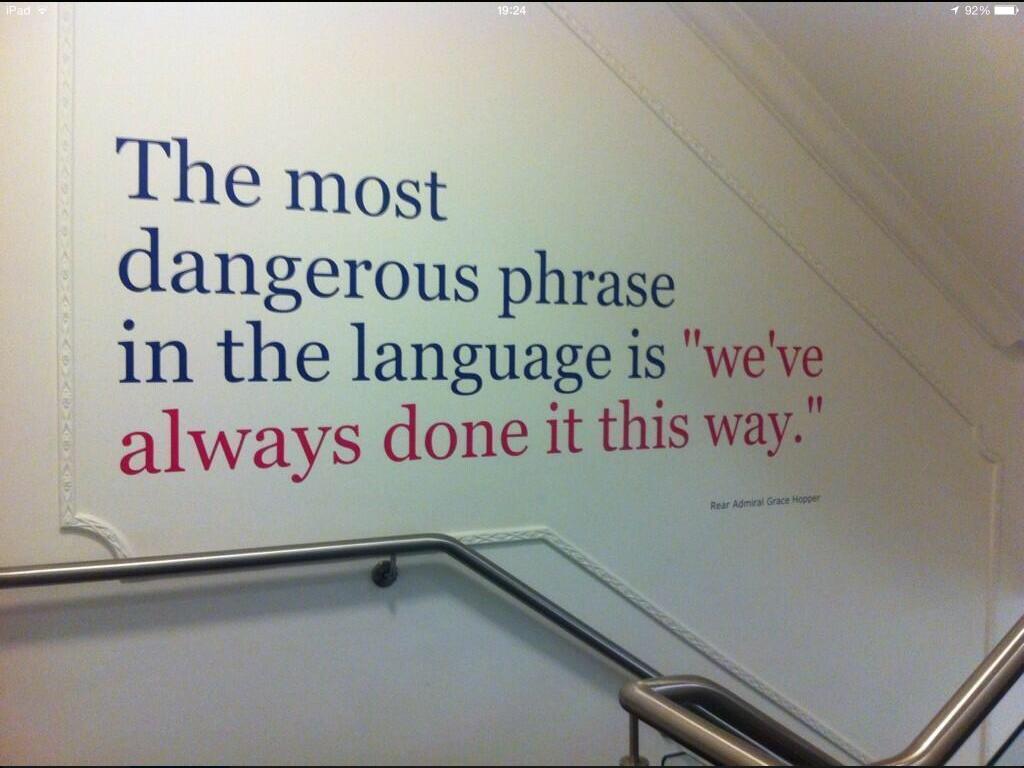
quote by Admiral Grace Hopper

The words above can pervade many work cultures.
It is no different in education. Here’s why.

“We’ve always done it this way,” says…

There is nothing to strive towards. It says, “we’re out of ideas.”
Change is frightening, requires hard work to implement, and may have unpredictable outcomes. It says our corporate culture is too fragile and or afraid to take chances that might result in failure. Run!

“We’ve always done it this way,” says…
Disruption and change are not allowed in the building because they challenge the structures and status quo. It says, “free and fresh thinking are not welcome.” Is there any place where this is a healthy work ethos?

“We’ve always done it this way.” says…
It’s easier to go with the flow than rock the boat. It says that making waves might sink your career. Let me throw you a lifeline.

A friend gave me some great advice when I started out my career as a teacher. He said, “Never stay at a school for too long. Take the opportunity to join new communities of learners to keep your practice growing.” In my career, to date, I have worked at 3 schools and have loved every new adventure.

Was it scary to leave and join a bunch of strangers? Yes! Was it worth? YES!
Do I miss my colleagues? Of course, but that is exactly what coffee shops were made for — reconnecting.

Joining a new staff allowed me to broaden my professional practice and experience new communities of learners while broadening my world-view in education. Think of it from this angle; by making a change you will bring the benefit of your experiences and enthusiasm to a new school. It is in these shifts and new partnerships that strengthens our collective wisdom, and is crucial to innovation of our profession.

It is the time of year where we are asked to submit our teaching assignment requests for next September. For many new teachers this is a great chance to stretch beyond the confines of the comfort zone towards new opportunities.

Frank Zappa said, “Without deviation from the norm, progress is impossible.” This has to start from within. If you work in a place where innovation and growth are discouraged, let me encourage you to take a chance, step out of your comfort zone, and make a change. Seek out communities where ideas are fostered, tested, and curated.

Change is often messy, but it is important to progress. A very very few might still lament not being able to hand write report cards. Although, at the time, there were skeptics of the technology and the disruption it caused while teachers learnt and mastered a newer method of reporting.*

Step out, break free, and affect change in your space. Do anything, but maintain the status quo.
I encourage you to find like minded educators who value the process over perfection and consider where to make a change in your practice whether it is by applying to a new school or in courageously sharing fresh ideas in yours.

*If you’ve seen my handwriting you will be glad the reports are typed and printed.