Nurturing Positive Relationships with Students

In a previous post I shared insights to how I stove to establish and build positive relationships with students at the start of the school. When I wrote that post, I thought it would be a stand-alone piece because I had yet to seriously consider how nurturing positive relationship with and between students involves similar but different approaches than simply building or establishing them. Additionally, as the school year progresses, I’ve been reflecting on the ways that I’m nurturing positive relationships with and between students to continue supporting their learning. Therefore, in this post I’ll share five ways that I’m striving to nurture positive relationships with and between students in the hopes that the ideas I share will provide insight or guidance to other educators. The five approaches below are in no specific order or hierarchy but they do follow a basic structure where I briefly describe the approach, why I use it, and how I have seen that it works to nurture positive relationships in the classroom.

  1. Find time to meet with each student 1 on 1

Each term, I make time to meet with each student 1 on 1 so that I can provide individualized instruction, check-in on their progress related to given tasks, provide feedback, gain insight to their learning strengths and needs, and just generally see how they’re doing. I find that students who may be reluctant to share knowledge and experiences in whole group or small group settings are much more open to sharing in a 1 on 1 setting. I also find the 1 on 1 meeting shows students a certain level of interest and care that they seem to value and appreciate; I say this because I have yet to experience any student who is reluctant to meet with me or engage in some level of conversation during our 1 on 1 meetings. To ensure I can meet with all students within a reasonable timeframe and obtain the information I need, I keep the meetings brief, set clear meeting goals for myself and students, and take notes for future reference.

  1. Start and end each week with check-ins

To begin and end each week, I pose three questions for students as way for me to quickly check-in to see how their doing. The questions are usually what I perceive to be low-risk questions that avoid asking students deeply personal information in a large group setting. For example, in the past I’ve asked students about a highlight of their weekend, how they would spend their day if the weekend was extended or whom is the first person they like to share positive news. I ask students these questions to signal to them that I care and I am interested in their lives beyond the classroom in addition to the questions being a way for me to gain insight to their experiences so that I can find meaningful ways to include them in assignments and activities. Since I started this practice, if for some reason I forget to pose the questions students will remind me that I forgot to do the check-in; their reminders signals to me that they appreciate our weekly check-ins.

  1. Compliment and offer words of encouragement

Whenever I provide any feedback to students whether it be oral or written, I begin by recognizing the things that they are doing well. I do this to remind students and myself that they have valuable knowledge and skills that are working to support their learning and they need to continue using to leverage their strengths to further support their learning. I also actively look for opportunities to genuinely compliment students whether it be for a new haircut, helping a peer, or showing growth and improvement in their learning to ensure that they know that I see and recognize positive things about them. I have found that these words and gestures work to create positive relationships and a positive learning environment fueled by positive energy.

  1. End the week with fun activities

Each Friday, I end the week with a period where students and I engage in large and small group games. Some of the large group games that we play include, BINGO, Silent ball, and Around the World, while some of the small group games we play include, Uno, Chess, and Jenga. I implemented what my students and I call Friday Funday or tech free time, as an intentional pause from content-focused instruction to prioritize skill development that supports student learning, such as collaboration, communication, and relationship building. Since implementing Friday Funday or tech free time, I’ve noticed that students are more open to working with peers whom they may not consider their friends and they engage in more positive peer communication.

  1. Model respectful communication

Whether I am speaking to students in large groups, small groups or 1:1, I practice respectful communication using a calm direct tone. For me this sounds like, when asking students to do something, saying please and thank you. Asking them questions instead of making assumptions or accusations and reminding students that I am here and available to support them in being successful in their learning. I find modeling respectful communication works to create a calm respectful climate conducive to learning that students seem to appreciate. Some of the ways that I have witnessed students appreciating my approaches is that they speak to me respectfully, they avoid wondering the halls during lessons, and I have fewer behavioural issues or concerns.

The Curb Cut Effect

Have you ever been walking along the sidewalk and then come to the place where you’ve got to cross the road?  You may have noticed that the curb is cut, usually meaning a mostly flat ramp has been created to enable an easier crossing. You might have been pushing a stroller, pulling a wagon or suitcase, using a wheelchair or even a bicycle and this small adaptation made your life so much easier. This is called the Curb Cut effect – where the accessibility features designed for people with disabilities ends up benefitting many others as well. 

Like me, I’m sure you can think of a number of other accessibility designs that benefit many people, for example, doors that open automatically in a store and closed captioning.  All of these accessibility features were not designed with me in mind, but they have improved my ability to navigate the world.  I’m thankful they exist when I need them, such as ramps and elevators, but I also acknowledge that they don’t exist everywhere yet. 

Universal Design for Learning, often referred to as UDL, is a framework that meets the needs of learners from different backgrounds, with different abilities, and learning styles. In classrooms, we see how this framework promotes better accessibility for everyone.  For example, a posted visual schedule is helpful for those students who need predictability and routine, but it’s also good for all students to know how their day will go.  Using a timer can help to chunk work for some students; however, everyone (including myself!) can benefit from this strategy in class.  

The UDL framework encourages educators to think about three main principles in their planning: 

Multiple means of representation:  Providing learners with multiple ways to access information and content. This includes presenting information in different formats such as text, audio, and video, and offering different modes of interaction such as visuals, audio, and text.

Multiple means of action and expression: Allowing learners to demonstrate what they know in different ways. This includes providing options for students to express themselves through writing, speech, or other forms of communication.

Multiple means of engagement: Providing learners with multiple ways to engage with content, activities, and assessments. This includes offering choices in how they approach and interact with learning materials, as well as creating opportunities for motivation and self-reflection.

(from: Universal Design for Learning (UDL)- Digital Accessibility Toolkit)

How do we design lessons with these principles at the forefront of our planning?  Admittedly, it takes time, experience, and intentionality. When I first started teaching,  this was a big part of my learning; thinking about how I learn and learning how others might learn differently.  I started observing students, talking with them and their families about what helped them learn best, reading about different accommodations and learning about strategies that were new to me and ever changing with advancing technology.  I asked colleagues for suggestions and feedback; I referred to a lot of documents and research to get ideas and examples. 

Much like The Curb Cut Effect has benefitted so many people by making the world more accessible, Universal Design for Learning has a similar effect on the classroom.  Educators have the power to build “learning curb cuts” into a lesson or unit in a variety of ways, from ensuring slide decks are visually accessible to offering assessment options, such as writing an essay or recording a podcast. These ‘Curb Cuts’ may help students with disabilities, as well as make life easier for the student who is anxious about public speaking, the student learning English, and the student who needs additional processing time.  That seems like a classroom cultivated so that everyone can learn.

Please note: You may also read more about UDL in the Ontario Ministry of Education document entitled, Learning for All.

Tips for Planning a Professional Learning Session at your School

Over the last 5 years, I’ve had the opportunity to work as a centrally assigned educator in my board. And while the job has certainly had its share of ups, downs, stressors, and successes, one thing I know I will walk away with is the ability to plan a professional learning session for staff.

If you are in the position of planning a staff meeting, lunch and learn, or professional learning activity for your school – and are feeling a bit nervous or unsure about it – keep in mind that it is completely normal. After all, you are presenting to your peers, who can sometimes feel like the most challenging audience to “teach” no matter how long you have been teaching in the classroom. These are the same people you probably not only work with, but have lunch with and perhaps even socialize with.

Here are some tips for getting your first professional learning presentation off the ground.

1. Focus on What Matters to Educators

While you may not always get to choose what topic you will present on, you should try to tailor the content you select to what matters to staff. Send out a survey, talk to your colleagues to find out what challenges they have in their classrooms, or connect with your administrator to see what they are noticing. What you want to avoid is presenting information that does not speak to their work, as they will disengage quickly from your session.

2. Avoid Reading off Text-Heavy Slides

This can be tough, but a presentation is always more engaging when you are speaking and connecting more with the audience than reading off a slide deck. A slide deck is there to provide a visual element that supports the information you are sharing, to highlight key ideas, and add a multi-modal dimension. When slides are overly text-heavy, the information becomes to overwhelming.

3. Drive Engagement through Interaction, when Possible

There are presentations where you may have to simply “stand and deliver”. However, building in points of interaction, however brief, can make the learning more engaging and memorable to your audience. Just as with kids, adults also benefit from being able to interact and engage with their learning in pairs or groups. If time does not permit for this level of interaction, do not hesitate to provide points of provocation or reflection that give learners an opportunity to “take in” and absorb what you are sharing.

4. Give “Real Life” Examples

When we are providing professional learning, we are often helping our colleagues to enhance their workflow or improve their teaching. Sharing authentic examples of student work or practical application goes a long way in getting your messaging across, since teachers can start to imagine how whatever you are sharing will look like in their classrooms.

5. Remember that you Don’t Need to Know Everything

It can be easy to feel stressed about not “knowing everything” about what you are presenting. Remember that you don’t need to know it all (in fact you will probably never know it all). If you get questions you can’t answer with certainty, you can always say you don’t have the answer. Someone else in the room may have the answer or a perspective, or you can always find out and share the information later.

6. Do a Run-Through of Your Presentation

If possible, do a practice run of your presentation before it actually happens. You will probably find that there are pieces that you need to practice parsing, or information you want to add on after you go through it. Even just one practice run can do wonders for your confidence prior to presenting, and you will feel less compelled to read off your slides and more ready to add emphasis and expression to your speaking.

PWIM

I was standing at the front of the class, in the middle of my history lesson.  I was a new teacher, and in those early days it didn’t take me long to notice the distinctive energy that characterized a lesson going well. It was marked by easy flow of conversation, focused attention, interaction …  At times such lessons seemed to sail along by themselves, with questions, and answers, and more questions propelling the learning forward. Time would slip away like a stream, completely unnoticed until the bell suddenly announced the end of the period. But on one particular day, things were not going as planned.  Stilted energy. Halting flow. I was distracted by something important, and every sentence I uttered seemed to drop like a stone in front of me.

One student could not understand my lesson, and I knew it.  She had joined our class that morning and was new to English. After introductions, welcoming, and community-building games throughout the morning, we found ourselves in afternoon history class. History can be a challenging subject at the best of times, with abstract concepts and events removed hundreds of years from current experiences. But now this bright student was sitting in front of me, knowledge and skills encoded in a language I was not speaking. She was so eager to learn, wide eyes watching me hopefully …  and my heart sank.

I did not know what to do.

Although I had just returned from teaching ESL abroad and was knowledgeable in ESL instruction, the context here in the Ontario public school system was entirely different. Overseas, the students I taught were studying English as a separate rotary subject, much like students in Ontario study core French. “English” had its own designated period, and the sole goal was linguistic acquisition. Moreover, everyone in the class had the benefit of speaking the same first language, allowing full discussion and explanation of the language material. But here in Ontario, in a class full of English-speaking students, my new student had none of those advantages: she was not learning English for the sake of learning English; she was using it to learn math, science, history, art, health …  How was I supposed to teach her all of these curriculum subjects when she was just beginning to learn the language? When she had no same-language speaking peers with whom to ask questions and clarify material? When she was in a culturally and linguistically unfamiliar place and school community?

I looked back at those hopeful eyes once more.  I am not teaching in a way that she can understand, a loud voice was ringing out in my head. On repeat. Knowing very well what it was like to be in a roomful of people and be the only one not understanding what was being said, I had to switch gears.  I hurriedly finished my lesson, and went over to work with her, re-teaching the topic as best I could and scaffolding language. But there were 25 other needs in that classroom as well, and only one of me. I couldn’t give anyone the time they needed like this. I needed to find other ways to include my new student in whole-class learning.

And that’s where PWIM comes in.

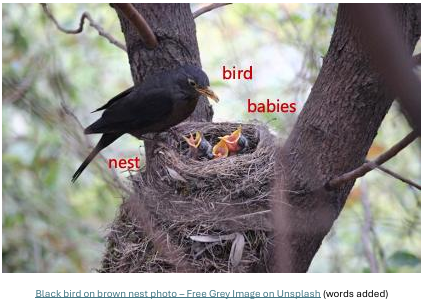
Ah, PWIM. I even like saying it that way. When sounded out it is almost onomatopoeia, a zippy word for a technique that gets your lesson going instantly. The acronym stands for Picture Word Inductive Model, and it is a tried-and-true strategy for teaching vocabulary and curriculum content simultaneously – in a way that is accessible to everyone in the class, including beginner MLLs. And the most amazing bonus? It requires almost zero prep time. The only thing you have to do is find a picture of whatever unit you are teaching … Canada in the 1800s. Desert Ecosystems. Healthy Eating. Or, in this case, the Life cycle of a Bird:

Projected in front of the class, this single image becomes a tool of engagement, with vocabulary learning, activation of prior knowledge, and curriculum teaching all rolled into one. Once the picture is up, the teacher invites students to name anything they see in the picture. In this case, students might say things like bird, nest, babies … The teacher writes the words as the students provide them, labelling the whole-class visual on the spot and even leading the class in chorally repeating the words for emphasis:

During this interaction, teachers also become aware of words students are not volunteering and may not know, and can then introduce them … perhaps words like chicks, down feathers, or talons …  Great for building vocabulary they will need for the subsequent lesson and unit. And of course, let’s not forget translanguaging:

Including students’ languages in learning has immeasurable benefits, in terms of equity and inclusion, language learning, and overall academic performance. Research tells us that students who maintain and develop first language acquire English faster and do better academically than those who do not. In addition, a multilingual classroom creates a new, inclusive space for students, in which their linguistic repertoires and identities are recognized, reflected in the school environment, and integral to learning.

And this is what would have made a difference in my ill-fated history lesson. With vocabulary now pre-taught using the Picture Word Inductive Model (necessary for the MLL but great for everyone), the teacher now has a giant labelled visual to refer to as they teach the main lesson, pointing to items and visuals as they say them, reinforcing vocabulary, and enabling greater access to curriculum content than a purely verbal-linguistic lesson would have allowed.

At some point, we all look back on our beginning years in education and think, I wish I could go back and re-teach this lesson or that …  Well, the history lesson I described earlier is one of mine. But I learned quickly, and have never stopped learning to be honest. There’s always more to consider, more to add to instructional approaches. Hoping this one, or an effective variation that you have discovered, becomes just one more way to include all students in your learning community.


Self-Reflection

This year, I’ve had the privilege to attend and participate in professional learning focused on literacy practices in the classroom. One of the things that has stood out to me in every session was the intentional way facilitators asked us to self-reflect. 

At the beginning of each session, after sharing the learning goals, they would ask the following : Are you a seed, a seedling or a tree?

  • Seed … beginning the learning journey, curious and open to ideas
  • Seedling … someone who has built some roots, experimented, explored new strategies, and looking to learn more
  • Tree … someone who has built strong roots (and will continue to), feels confident in their knowledge and understanding and can share or support others

I appreciate this seed‑to‑tree analogy not only for individual growth but because, in many Indigenous worldviews, plants and seeds are teachers with cultural and relational meaning (embodied in works like Braiding Sweetgrass), which explores how plants teach about reciprocity, relationship, and learning. This approach reminds us that growth is holistic, relational, and generational. The seed, seedling, and tree represent more than stages of personal development; they reflect the continuity of culture and knowledge. 

In relation to professional learning, this subtly highlights that as educators we all are at different points. Growth isn’t linear and there isn’t a single “end” goal. Some days we feel like seeds, absorbing ideas, while others we feel like trees, grounded in our understanding and practice.

This reflection process made me think of my students as well. We often focus on identifying the learning goals, and the success criteria. Giving space for our students to consider where they are in the learning journey can help improve their self-esteem as learners and foster a growth mindset. 

How do you incorporate time for students to self-reflect?

Supporting Special Education Needs: Part 2

Hello Fellow Travellers,

In continuing our conversations around supporting special education needs, I am delighted to foreground the ETFO resource Special Education Needs In The Regular Classroom: Supporting Students with Behaviour Needs.


Firstly, this resource is an important one because it is written by ETFO members for ETFO members.

Also, it aligns with the work that we do in our classrooms and it honours ETFO’s definition of  professional judgement stated as “judgement that is informed by professional knowledge of curriculum expectations, context, evidence of learning, methods of instruction and assessment, and the criteria and standards that indicate success in student learning.”

1st Section

This resource begins with the Equity Statement and outlines ETFO’s Equity Initiative as well as highlights the definition of an Anti-Oppressive Framework. The “Why’ of the contents become visible right at the outset and prepare the reader to engage.

Table of Contents

The table of contents is outlined as follows:

  • Who Receives a Behaviour Exceptionality?
  • Building a Trauma-Informed Practice
  • Special Education in Ontario which highlights two key policies Policy/Program Memorandum 156 and Policy/Program Memorandum 145.
  • Addressing Student Needs
  • De-Escalation Strategies
  • References & Resources

Key Aspects

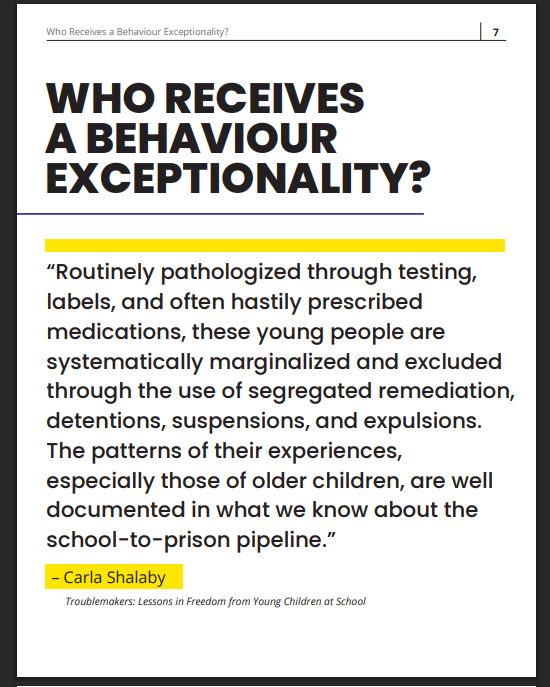
A quote from Carla Shalaby’s book “Troublemakers: Lessons in Freedom from Young Children at School” calls to the change maker in all of us. I especially pay attention to “the patterns of their experiences, especially those of older children, are well documented in what we know about the school-to-prison pipeline.”

The simple question “Who Receives A Behaviour Exceptionality?” invites reader to step outside the everyday busy-ness of our work and think deeply.

What did you think about?

Who came to mind?


Diagnoses and Details

The resource also highlights the different diagnoses that students receive through the Diagnostic and Statistical Manual of Mental Disorders and discusses some with links to websites that invite educators to learn more.

Mental Illnesses  

In this section, the resource discusses the following:

  • Anxiety Disorders
  • Mood Disorders
  • Eating Disorders
  • Personality Disorders
  • Disruptive Behaviour Disorders

Applying an Anti-Oppressive Lens to Behaviour Needs

This section, placed right after  the different categories of mental illness, brings the reader face-to-face with the human aspect of our work. It invites educators to think intentionally and deeply about why it is important to apply an anti-oppressive lens to behaviour needs in this way:

“A behaviour exceptionality and the diagnoses related to it may require ongoing observation and report. However, the language used by society to describe behaviour is value-laden and soaked in judgment. As educators, we must utilize an anti-oppressive framework to guide our observations so that we can be as objective as possible.”

This resource reminds us that anti-oppressive practices are not theoretical terms, book clubs  or hashtags. They are actions that we need to do.

You and I have to do the work of anti-oppression.

These are important reminders.

Reflection Section

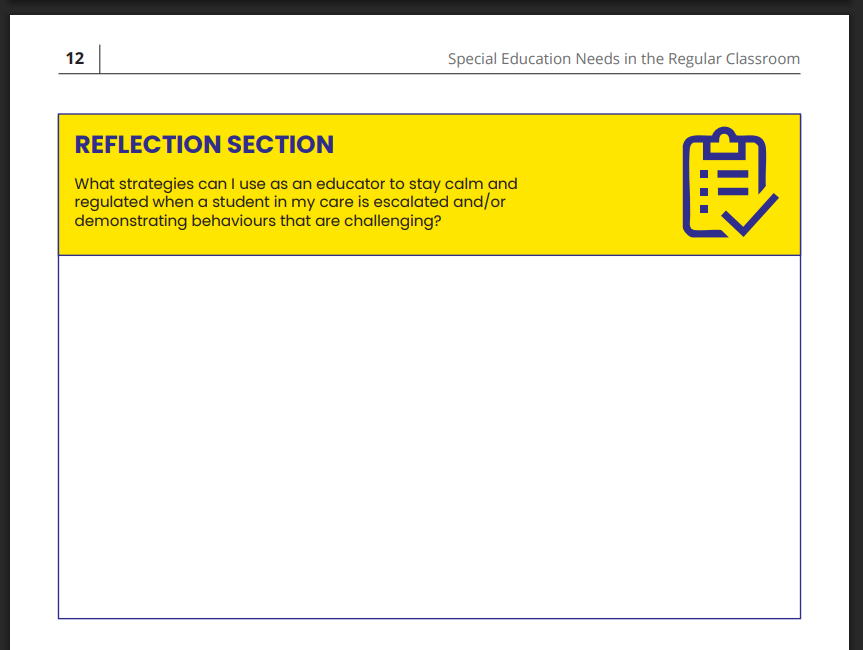
There is space in this resource for each one of us to turn our gaze inwards and to ask questions such as “what strategies can I use as an educator to stay calm and regulated when a student in my care is escalated and or demonstrating behaviours that are challenging?”

I liked this one as it brought me to a moment of calm which I use when working with students in classrooms or when I am in less structured spaces such as outside at recess or in the hallway.


 At The Heart

What resonated for me at the heart of this document are these words:

“Our goal with this resource is to support educators in exploring and redefining discipline protocols from a place of opportunity, with the initial perceptual shift on adult well-being as a cornerstone. Recent research emphasizes that true discipline for our students begins with an adult whose brain feels safe, calm, and still.”

Please read, implement, talk about and share this ETFO resource with colleagues in your professional learning network.

I for one, am delighted that in my school district, on the January 30th PA Day, all of us got to engage with this resource and that it has been showing up in collaborative conversations in many school teams with whom I am partnered.

Much appreciation to the contributions of ETFO members, Lisa Dunbar and Joshua Dickson who have been acknowledged on the page 2.

With You, In Solidarity

Rashmee Karnad-Jani

Read Part 1 of this blog here.

Note: This resource is available at ShopETFO and also digitally on the ETFO member site. Click here.