
Hello Fellow Travellers,
In continuing our conversations around supporting special education needs, I am delighted to foreground the ETFO resource Special Education Needs In The Regular Classroom: Supporting Students with Behaviour Needs.
Firstly, this resource is an important one because it is written by ETFO members for ETFO members.
Also, it aligns with the work that we do in our classrooms and it honours ETFO’s definition of professional judgement stated as “judgement that is informed by professional knowledge of curriculum expectations, context, evidence of learning, methods of instruction and assessment, and the criteria and standards that indicate success in student learning.”
1st Section
This resource begins with the Equity Statement and outlines ETFO’s Equity Initiative as well as highlights the definition of an Anti-Oppressive Framework. The “Why’ of the contents become visible right at the outset and prepare the reader to engage.
Table of Contents
The table of contents is outlined as follows:
- Who Receives a Behaviour Exceptionality?
- Building a Trauma-Informed Practice
- Special Education in Ontario which highlights two key policies Policy/Program Memorandum 156 and Policy/Program Memorandum 145.
- Addressing Student Needs
- De-Escalation Strategies
- References & Resources
Key Aspects
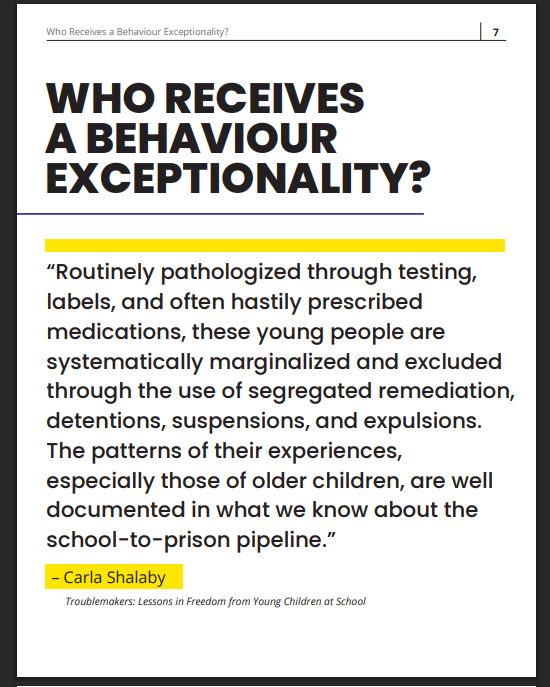
A quote from Carla Shalaby’s book “Troublemakers: Lessons in Freedom from Young Children at School” calls to the change maker in all of us. I especially pay attention to “the patterns of their experiences, especially those of older children, are well documented in what we know about the school-to-prison pipeline.”
The simple question “Who Receives A Behaviour Exceptionality?” invites reader to step outside the everyday busy-ness of our work and think deeply.
What did you think about?
Who came to mind?
Diagnoses and Details
The resource also highlights the different diagnoses that students receive through the Diagnostic and Statistical Manual of Mental Disorders and discusses some with links to websites that invite educators to learn more.
Mental Illnesses
In this section, the resource discusses the following:
- Anxiety Disorders
- Mood Disorders
- Eating Disorders
- Personality Disorders
- Disruptive Behaviour Disorders
Applying an Anti-Oppressive Lens to Behaviour Needs
This section, placed right after the different categories of mental illness, brings the reader face-to-face with the human aspect of our work. It invites educators to think intentionally and deeply about why it is important to apply an anti-oppressive lens to behaviour needs in this way:
“A behaviour exceptionality and the diagnoses related to it may require ongoing observation and report. However, the language used by society to describe behaviour is value-laden and soaked in judgment. As educators, we must utilize an anti-oppressive framework to guide our observations so that we can be as objective as possible.”
This resource reminds us that anti-oppressive practices are not theoretical terms, book clubs or hashtags. They are actions that we need to do.
You and I have to do the work of anti-oppression.
These are important reminders.
Reflection Section
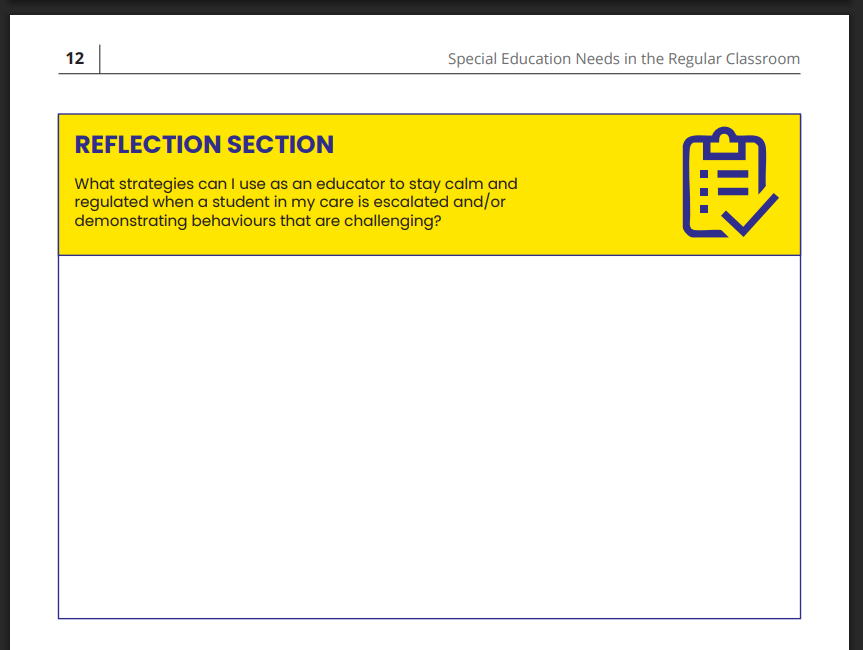
There is space in this resource for each one of us to turn our gaze inwards and to ask questions such as “what strategies can I use as an educator to stay calm and regulated when a student in my care is escalated and or demonstrating behaviours that are challenging?”
I liked this one as it brought me to a moment of calm which I use when working with students in classrooms or when I am in less structured spaces such as outside at recess or in the hallway.
At The Heart
What resonated for me at the heart of this document are these words:
“Our goal with this resource is to support educators in exploring and redefining discipline protocols from a place of opportunity, with the initial perceptual shift on adult well-being as a cornerstone. Recent research emphasizes that true discipline for our students begins with an adult whose brain feels safe, calm, and still.”
Please read, implement, talk about and share this ETFO resource with colleagues in your professional learning network.
I for one, am delighted that in my school district, on the January 30th PA Day, all of us got to engage with this resource and that it has been showing up in collaborative conversations in many school teams with whom I am partnered.
Much appreciation to the contributions of ETFO members, Lisa Dunbar and Joshua Dickson who have been acknowledged on the page 2.
With You, In Solidarity
Rashmee Karnad-Jani
Read Part 1 of this blog here.
Note: This resource is available at ShopETFO and also digitally on the ETFO member site. Click here.