Photo of Roz Geridis

Flexibility

I have part of a new assignment this year. In the morning I am covering prep. Due to re-organization, my schedule is changing again for Monday. I have completed many get to know activities, learned students’ names and just found out some classes I still have and others are new for me. That being said, it will all work out! Everything does. The students get attached very quickly and now I will get to know even more students.

My afternoon, I teach English, Math, Health and Pool to a grade 6 extended French class. The grade 6 curriculum is the same for me but now I teach a smaller portion of it. I will be busy sharing my plans with the other teacher who now has my class for Science.

That is teaching; change and flexibility. My morning will work out and I have worked out my plans to have the next days covered. I just needed to adjust a few items and have been able to use my current plans. As a school, you may have to go through re-organization. It is difficult. Deciding which students will excel in which environment, which students need to be separated from each other, balancing the girls and boys, special education and ELL needs. It is a very difficult task which also needs to be completed after a long day of teaching a class of 52 kids.

As I need to get teaching (with the new classes) in order to have enough assessment for the Progress Report card, I have decided to incorporate my get to know activities with the curriculum. I am planning to find ways to incorporate these activities as much as possible with my new classes. I plan to start with appreciation fans to help build the community within the classroom. The students all know each other and many know who I am but I need to get to know their names (better).

Photo of Roz Geridis

Getting to Know your Students

At the beginning of the year I complete some activities about the classroom environment. I look to build a community environment highlighting the classroom is as much theirs as it is mine. We completed a few activities but I wanted to share this particular one because the student responses really helped me understand and get to know them.

One of the activities we did this year was we talked about keeping the good in and the bad out of us in order to do well at school. We had a conversation about what helps us do well at school and what keeps us from doing well. Some responses about what helps us do well at school were: healthy eating, sleeping, completing homework, asking for help. Some of the responses about what bad things can keep us from doing well at school were: being late, not completing homework, eating bad, not getting enough sleep, bullying, people being mean, depression, anxiety.

The last two responses were comments which really made me pay attention to who said them. I immediately contacted the guidance counselor, informed the administration, and spoke to last year’s teachers. These two comments (from two different students) have helped me with my approach to the students. It made me remember, no matter what community you are in students could have a hard life and have a variety of family/life situations to handle. It reminded me of the need to make that connection as a person with the students.

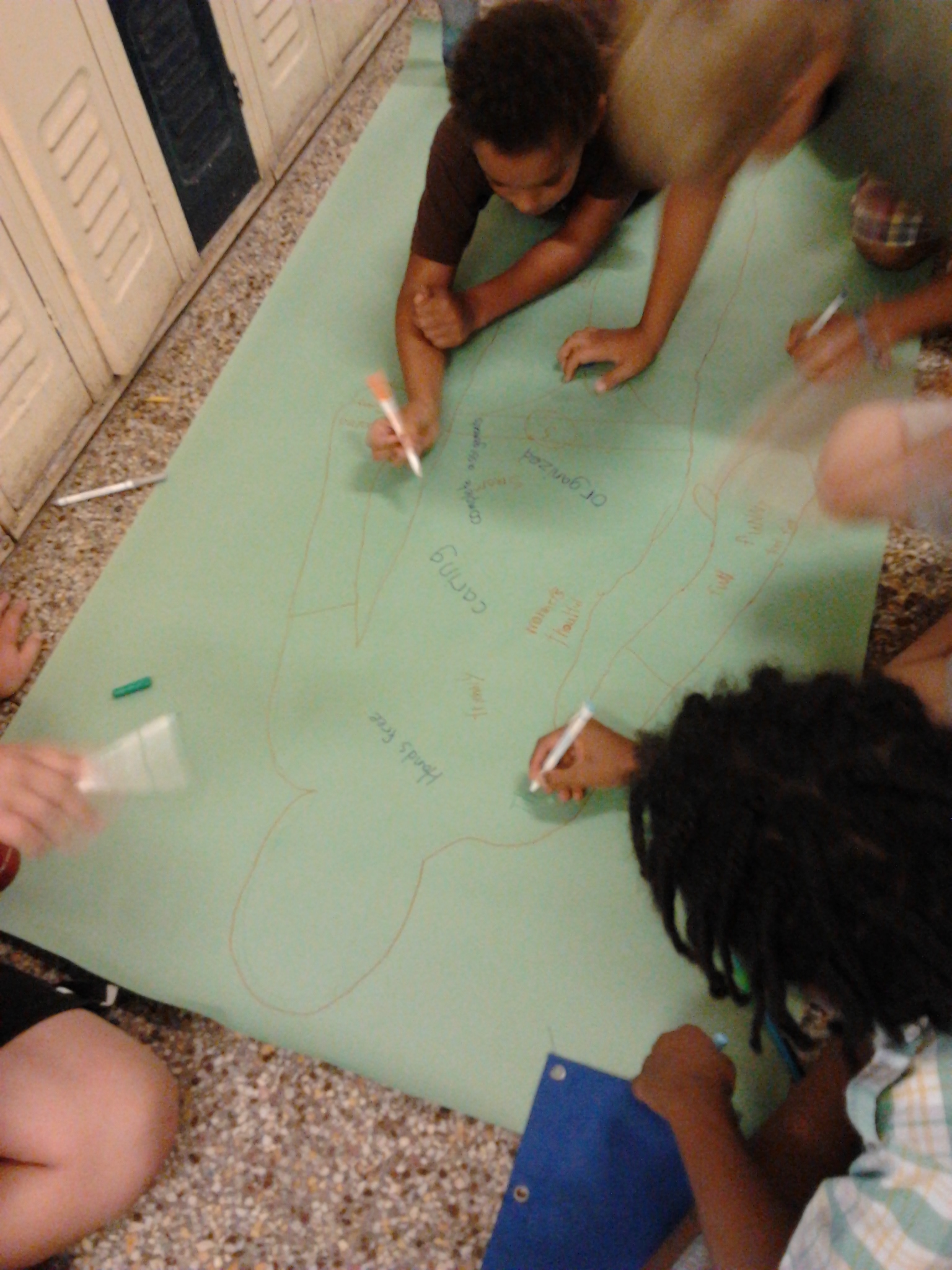
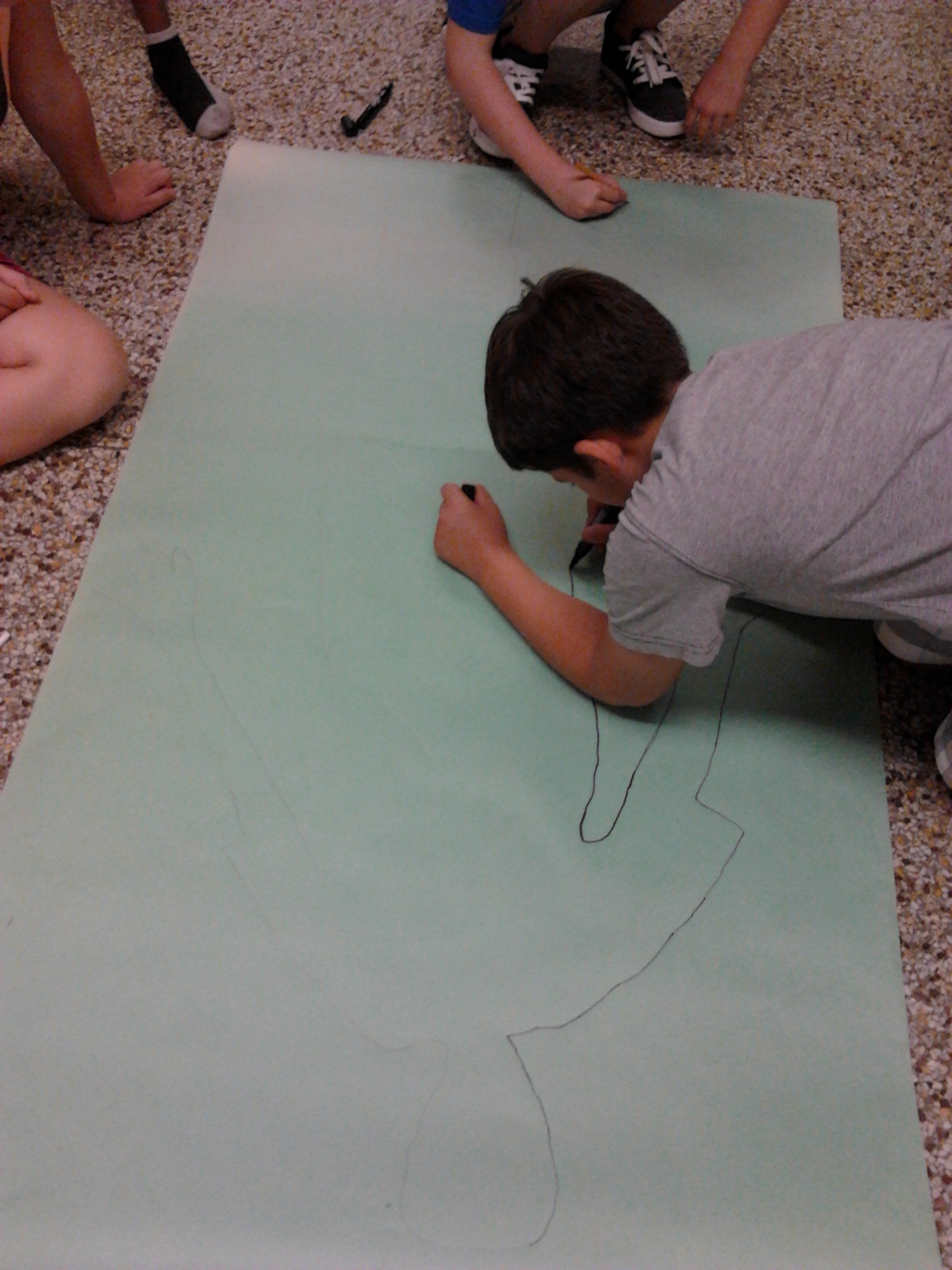
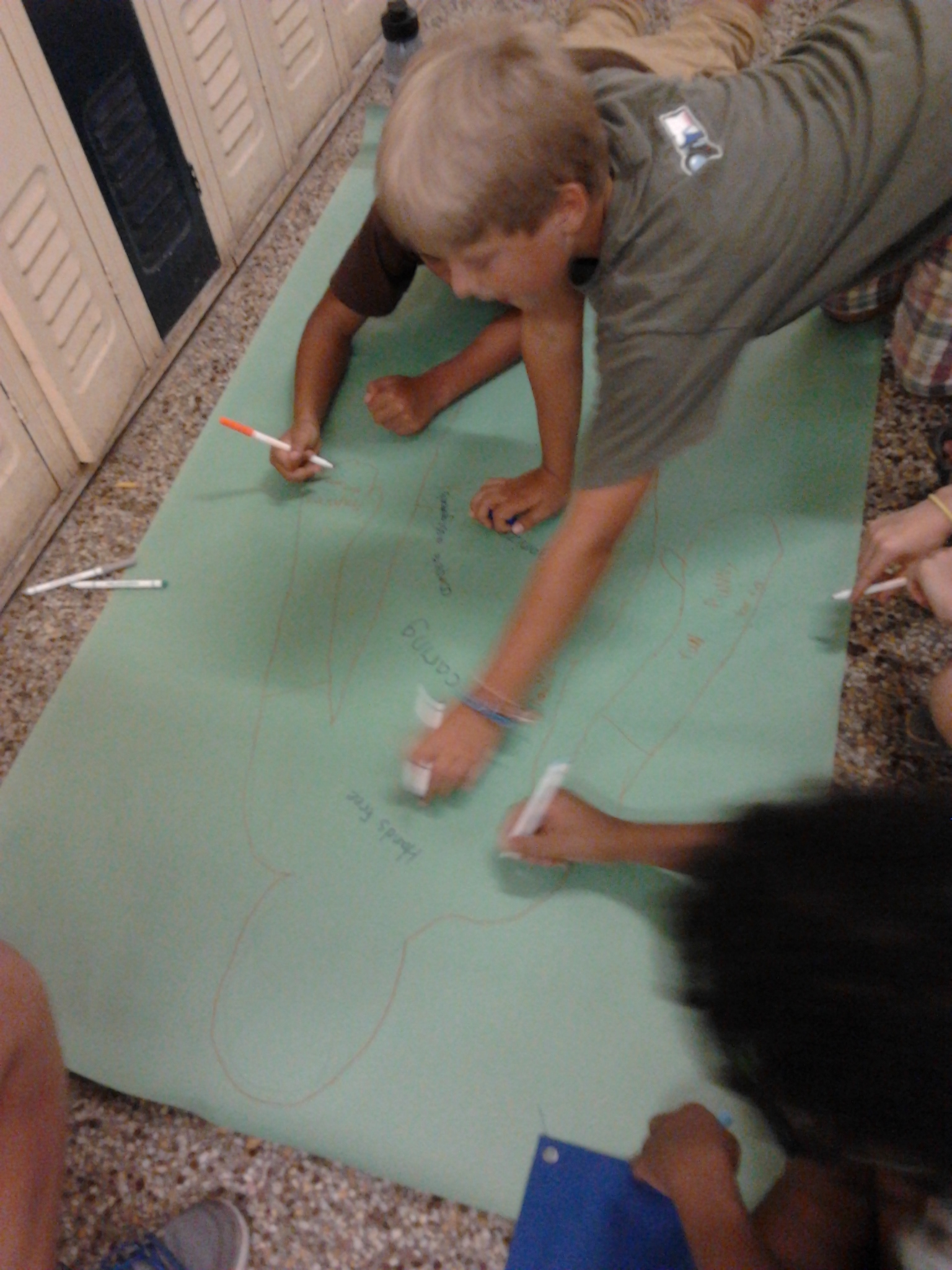
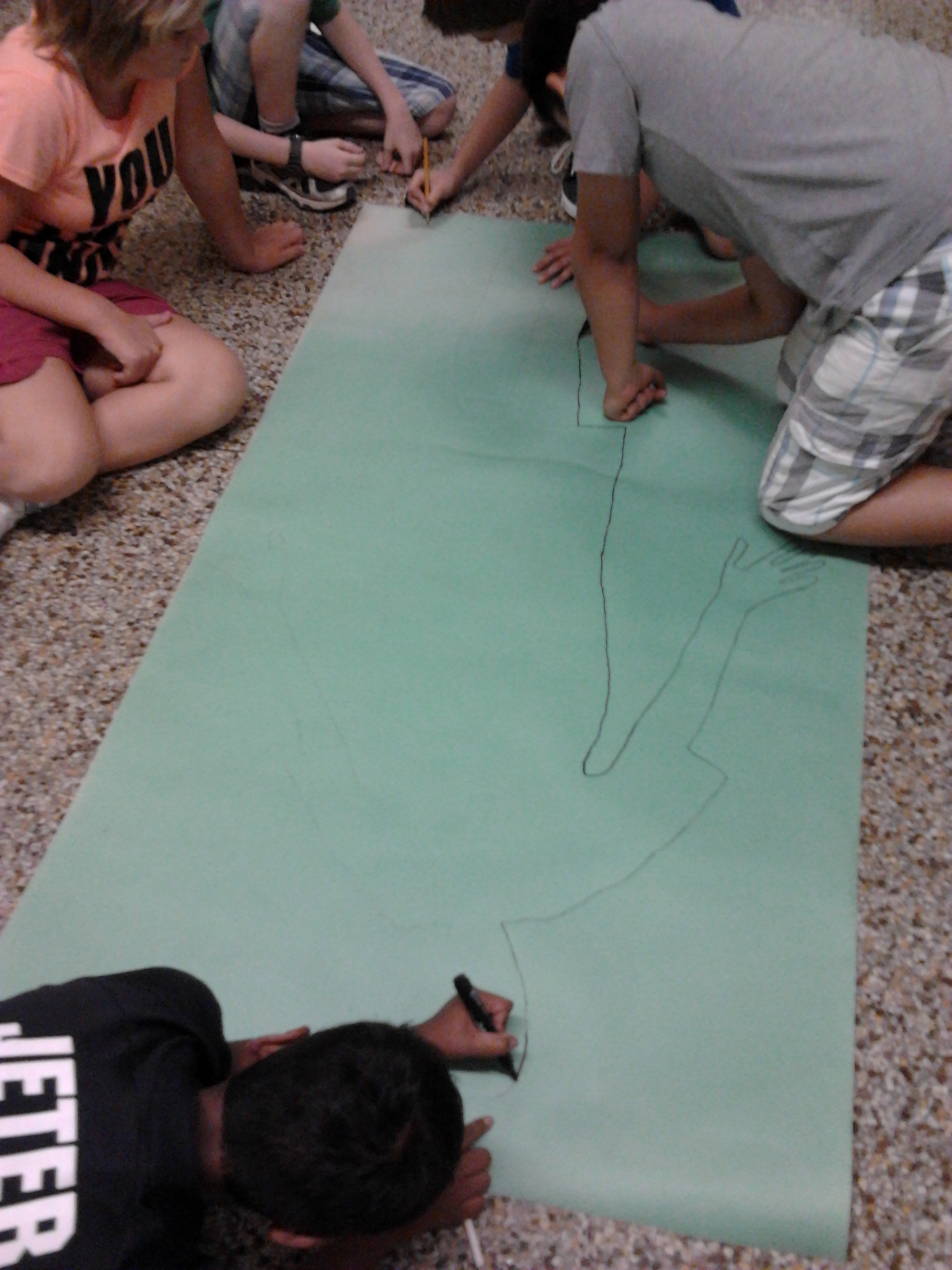
Getting back to the activity; after our lesson, the students got into groups and traced one student in the group. Then as a group, they wrote what helps them to do well at school on the inside of the body and what keeps them from doing well on the outside of the body. The students really enjoyed the activity and every class (from grade 5 to grade 8) has asked to complete the activity. We have the final products hanging in the class as an everyday reminder. This year, I decided to not complete the activity with my prep classes but I will consider it for next year.

Photo of Carmen Oliveira

Lifeclass Begins

“The difference between school and life is that in school you learn the lessons and then get a test, but in life you get a test and then learn the lessons.”

This year I have decided to dedicate a substantial amount of time and effort to learning about and teaching life lessons that can be  integrated into my program.  Having spent the last few weeks really getting to know my students, I feel that they are a group of kids that can benefit from deep and meaningful lessons because they are both ready to explore them and in need of that support in their life.  I looked into integrating each lesson into our Literacy, Social Justice, Financial Literacy, and Healthy Living aspects of the curriculum.  So far, the students have really enjoyed their experience so I thought I’d share what we’ve done.

At the start of each week, I post a quote (linked to a life lesson I believe they need to explore) with questions to guide the students’ thinking.  They glue the prompt into their Journals and then have a week to complete the Journal entry.  The entries have written components and can also be expressed in artwork and various media (cartoons, posters, etc.).  The prompt is also posted on our website so students can share it with their families and hopefully discuss it together.

The responses I have received have been such a pleasure to read and I find that the students are working to try and incorporate the lesson into their way of thinking and acting.  They understand life so much more than we sometimes give them credit for!  At the end of the week, we share our thoughts, how we will use the lesson in our lives, and how some of us have already tried.  This week, the first thing out of their mouths as they walked in on Monday was, “Mrs. Oliveira, what’s the life lesson quote this week?”

If you’d like to take a look at some examples, you can find them in our classroom website.  Click “More” and scroll down to “Lifeclass”- it’s a simple idea that has my students learning about life in a way they’re ready to explore.

www.oliveiraclassroom.webs.com


Learning Goals: Today we are learning...This will help me...Question of the day,.. Reflection Question

Getting Ready for the Art of Teaching and Learning

If you would thoroughly know anything, teach it to others. –Tryon Edwards

As I headed into my classroom today to set up our learning environment for this year, I stood in the middle and looked around at the space which, in a few days, will be filled with curious faces wondering what this year will be like.  A teacher candidate who was helping me mentioned that any advice I could give her would be appreciated because right now, it all seemed a bit overwhelming.  I told her that there are a few things I have come to know for sure about teaching and learning and proceeded to share them with her.  At the end of our conversation she had a big smile on her face and looked so much more at ease!  The truth is, my advice was simple.  Everyone knows it, but it’s sometimes forgotten as we go through our busy teacher lives!  Here are a few things I shared with her:

1. Connect!  Life and learning are about connections, to each other and to the world around us.  If you put in the effort to really connect with your students and create learning opportunities where they explore the connections within the world around them through cross-curricular activities, the learning environment will be charged with an energy that keeps students engaged and willing to take risks as their learning progresses.

2. Start small.  The journey to becoming a great teacher begins with mastering one aspect, topic, or subject at a time.  Choose one (or if you’re very courageous, two) areas to focus on this year to really explore, practice, and begin to master.  Become the best possible teacher in your chosen area of focus.  Celebrate your learning and success!

3. Become resourceful.  No one who has become great at what they do reached their peak without some guidance and support from mentors.  Network and reach out to teachers, administrators, support staff and anyone else who may help you on your path of professional development.  Contact the bloggers on our site!  A useful resource is the “Heart and Art of Teaching and Learning” to get you started this year.

Teaching isn’t always easy.  That’s a fact.  But the journey is well worth it when you realize the potential you have to inspire students, parents, staff, and the community around you.

Below you will find a few items that may be useful for the start of the year (some of which appear in the “Heart and Art of Teaching and Learning” resource.

BT Building effective Classrooms

curriculum night information newsletter

september wanted poster

my t-shirt and summer shorts

In a Million Words or Less…

if math were

grade 6 student intro letter

grade 6 math introductory letter

grade 6 homework newsletter

grade 6 first week newsletter

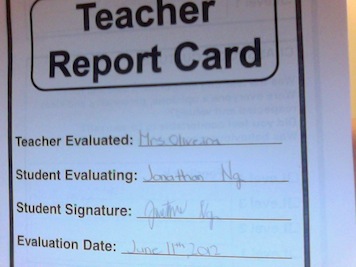
Teacher Report Card

My Report Card

As I mentioned in my last post, I feel that not only is it important for our students to receive feedback on their progress but I too like to get a sense of how my year went in terms of what I feel are the essential foundations to a successful classroom: lesson delivery, classroom culture, assessment and evaluation, and communication.  My students get extremely excited to write my report card and after all the jokes about what my mom and dad will do if I end up receiving less than favourable results, they always share very meaningful feedback about what I did well and what I can improve on.  I read my report cards carefully, reflect on the ideas and suggestions, and just before the end of the year I sit with the class and go over my results as well as my plan to address the areas I need to improve on.

I honestly feel this is a powerful exercise in modelling what I expect from my students.  I like to walk the walk and this is a great way to demonstrate to them that I am a lifelong learner and continuously use feedback to reflect on my practice in order to make the necessary adjustments so I can reach the goal of becoming not only a great teacher but hopefully one of the inspirations in their lives.

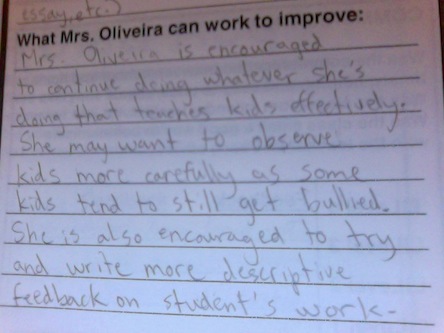
For next year I need to work on providing descriptive feedback that is more specific and provides a clearer focus with respect to how the students can improve.  I also have to be more mindful of bullying behaviour that may be occurring outside my classroom but can impact students’ learning inside the class.  I plan to work on how we co-construct success criteria in order to simplify it while at the same time making it effective.  Just a few things to keep in mind…

I’m quite satisfied with my progress and look forward to continuing on my path to living the art of teaching and learning!

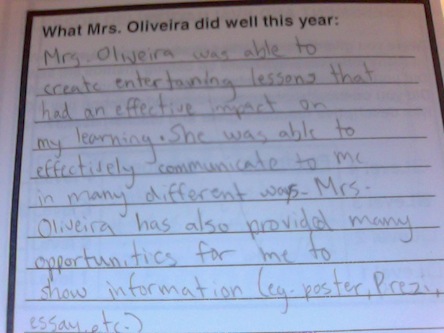
Below I share with you a few report card comments.  I’d like to note that I did receive a few Level 3 marks but they were difficult to read and spoke to the same topics mentioned below.


Mrs. Oliveira was able to create entertaining lessons that had
an effective impact on my learning. She was able to effectively
communicate to me in many different ways. Mrs. Oliveira has
also provided many opportunities for me to show information
(eg. poster, Prezi, essay, etc.)


Mrs. Oliveira is encouraged to continue doing whatever she's doing that teaches kids effectively. She may want to observe kids more carefully as kids tend to still get bullied. She is also encouraged to try and write more descriptive feedback on students' work.


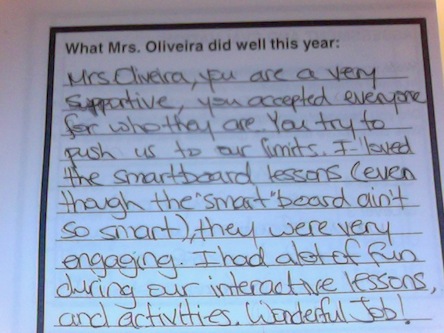
Mrs. Oliveira, you are very supportive, you accepted everyone for who they are. You try to push us to our limits. I loved the Smartboard lessons (even though the "smart" board ain't that smart), they were very engaging. I had a lot of fun during your interactive lessons and activities. Wonderful job!


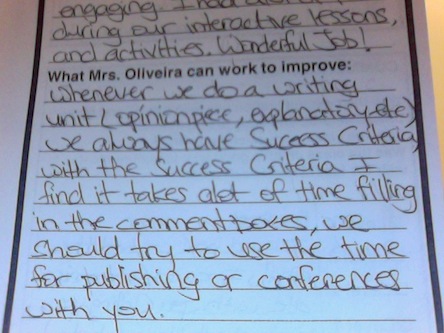
Whenever we do a writing unit (opinion piece, explanatory, etc.) we always have success criteria. I find it takes a lot of time filling in the comment boxes. We should try to use the time for publishing or conferences with you.


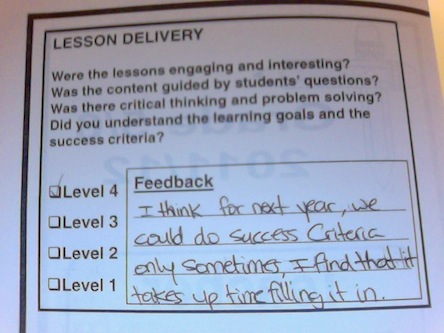
I think for next year we could do success criteria only sometimes. I find that it takes up time filling it in.


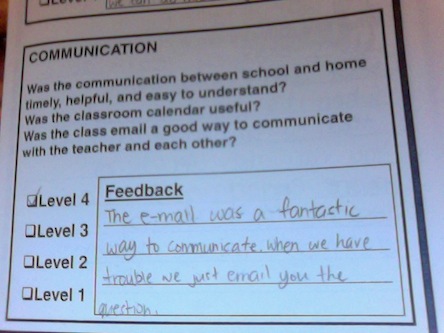
The email was a fantastic way to communicate. When we have trouble we just email you the question.


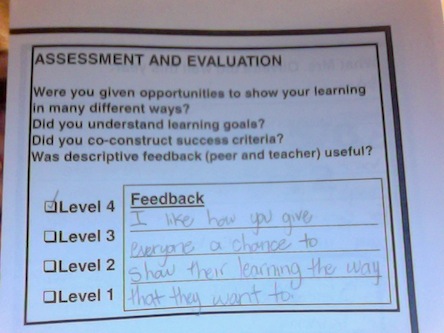
I like how you give everyone a chance to show their learning the way that they want to.


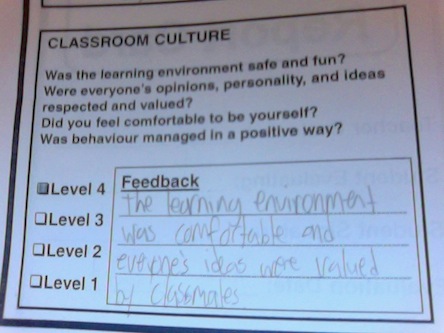
The learning environment was comfortable and everyone's ideas were valued by classmates.


Photo of Roz Geridis

Planning for Next Year


As the school year is coming to an end I use this time to reflect upon my lessons and look forward to next year’s planning. What will I keep, what didn’t work, what needs to be tweaked for next year’s students? Some of this planning will be based on my next year’s students needs and learning styles. Where do I go for new ideas, support for planning and resources?


1)       I sit down with the previous teacher.

Most schools will have sheets or some sort of meeting to share information and build the new classes. Looking to evenly distribute the boys and girls, ESL, Special Education, HSP and which kids should be or not be placed together. The sheets are usually given to next year’s teacher to help understand the student. I find the information on the sheets give limited information and don’t always share who the student is as a learner. I listen to the information being given, take notes on every student and review all this information later. At some point, I go back to the previous teacher and ask for further information.  If the previous teacher is an LTO, I need to connect with the teacher before s/he leaves for a new school. If you are a new teacher to the school in the Fall, ask for the sheets and try to connect with previous teachers as soon as possible.


2)      If you are lucky to get the same grade, I look at my previous year’s planning.

Now I know a little more about my new students. What are they going to be interested in? What do I need to change? Everything should be tweaked for my new class.

If I am teaching a new grade, I still look at my previous year’s planning and build the new year from that starting point. I have learned more about my personal teaching strengths and areas of professional development which I will look into.


3)       Where do I get new ideas?

  • Most boards have teachers who specialize in curriculum areas and provide that support with ideas and resources. Some can even give field trip ideas, support with combined grade planning, will come to your class and teach a model lesson. If you are finding it difficult to locate a name, ask your librarian or administration.
  • Your board website should have some resources available to the teachers. Many board website resources are open to the public and are available for all to find information. There are Science and Social Studies units available for combined grades. I usually don’t use all the information available on the websites but it helps me gather ideas and lessons for my unit.
  • Sitting down with my colleagues to team plan. New people have new ideas. This year, I was the only grade 6 English teacher and my Extended French colleague had already developed his program and found it difficult to devote the time needed to team plan. But we still found smaller opportunities to team plan. I also found support on line, a volunteer who went to different classes throughout the board, student teacher and colleagues who were in the same board but in different areas of the board. Many people have ideas, I find ideas help get me thinking. Whether I take the idea as is or tweak it to suit my student needs, I find all ideas are helpful.


4)       Next year’s class – the students.

As we all know, students achieve more when their interest is in the lesson. At the beginning of the school year, I ask my students what you would like to do, what would you like me to teach you in language. This year, my students wanted to write a graphic novel using bit strips. I took their lead and used graphic novels to teach them about narrative writing and to help develop their plans for writing. I also share the Science and Social Studies units and give them an idea of when we are covering certain units.


At this point of the year, you are looking at finishing things off and planning for your next year. I personally prefer to reflect and think about my next year’s planning now. For some people, they need that down time before they reflect and plan for the following year. It is up to you and what suits your lifestyle best.

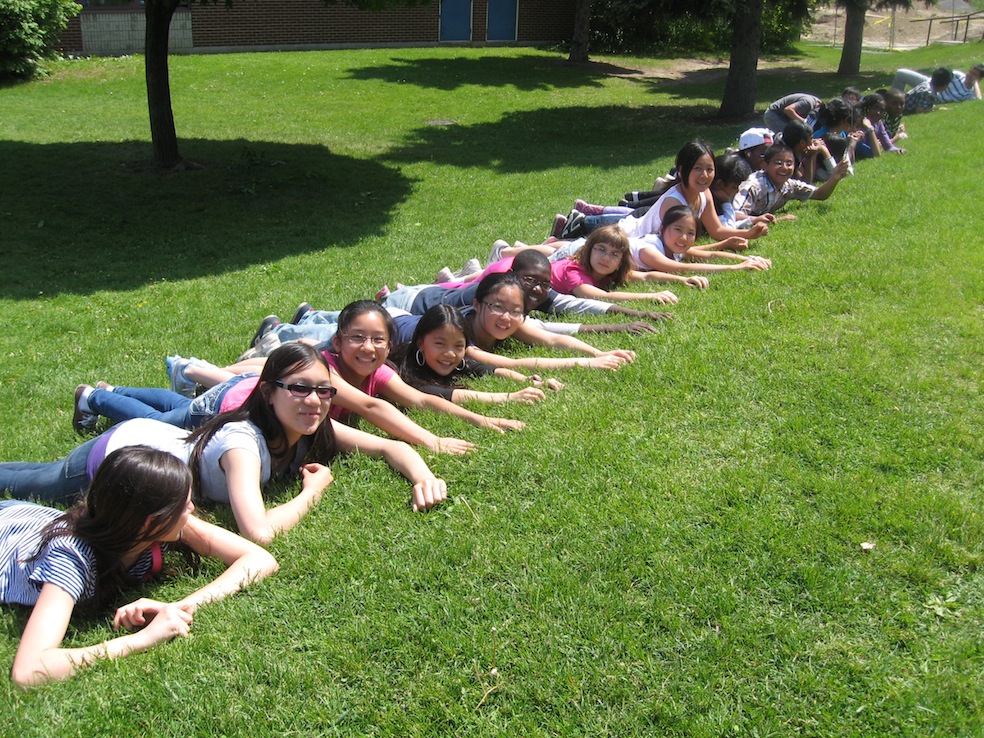
Students lying on the grass for a photo

Looking Back, Reflecting, and Celebrating Our Year!

The students in my class understand the importance of daily reflection in order to take a step back and look at the whole picture before continuing on our journey toward the goals we have set for ourselves.  They also know that celebrating each milestone and learning from our setbacks creates an attitude of gratitude,  a belief in what we can accomplish, and the excitement to take new risks as we adjust our course to take us to the places we imagine in life.

As we near the end of our time together, there are a few activities my students seem to enjoy very much.  It gives them the opportunity to look back on their year, reflect, and celebrate both themselves and their journey.

The activities include:

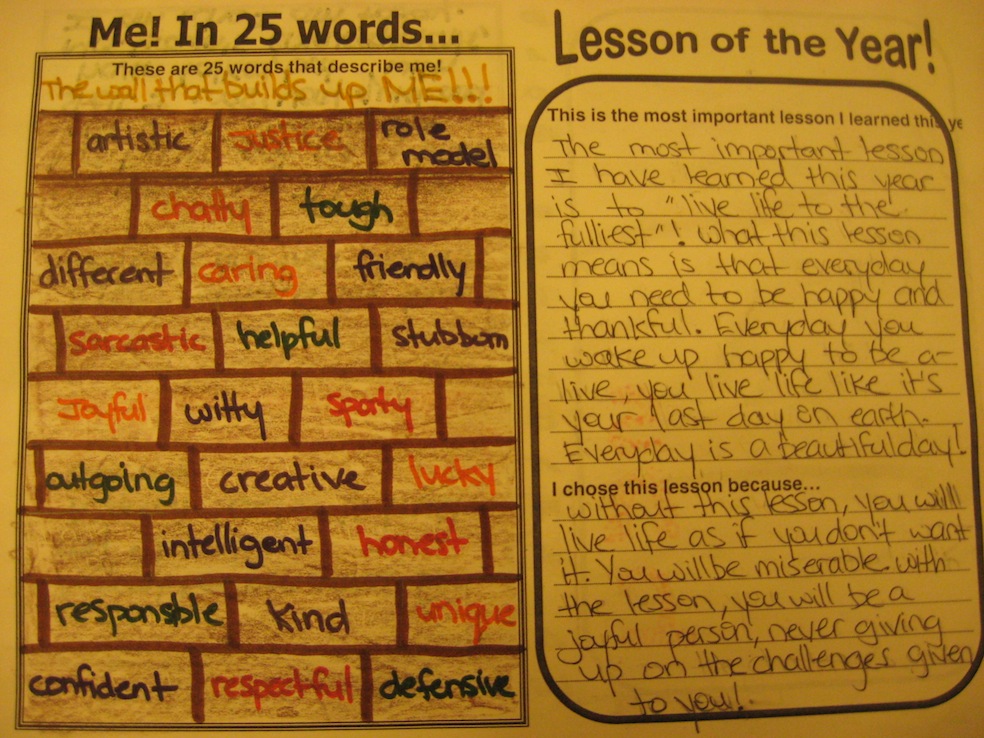
1. Year End Booklet: prompts are used to get students writing and creating art about themselves and their year.

Students take pride in creating their year end booklet
The reflections and art are meaningful and fun!


2. Award: the template is used for students to create an award for themselves and another classmate
On the back of each award students explain why they deserve to receive it
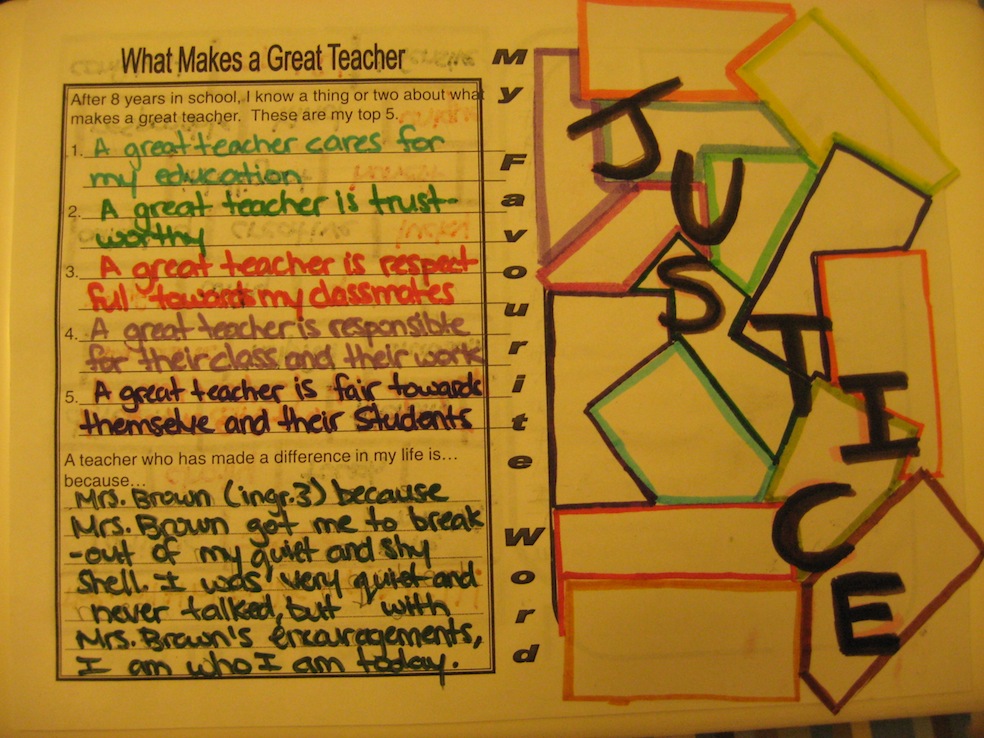
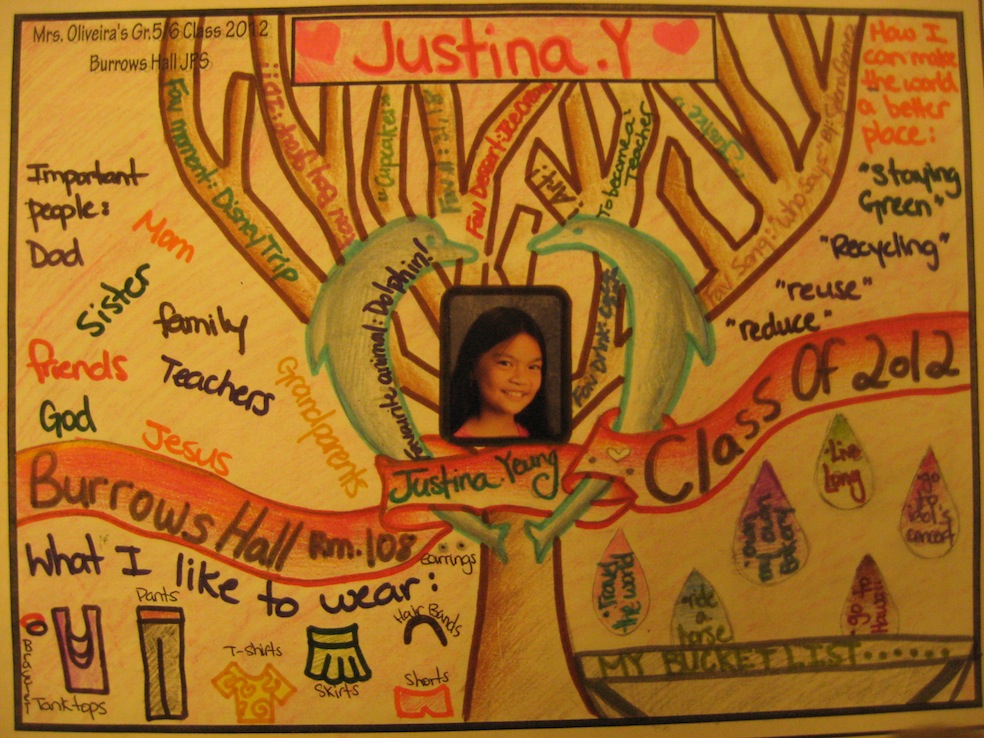
3. Year End Scrapbook Page: students create a scrapbook page using prompts co-created with the class
You can learn so much about Justina!
4. Bucket List: following a story from the Toronto Star on bucket lists, students wanted to create their own (a wall will be put                             up in Toronto this summer so people can write what they want to do in their lifetime)
5. Teacher Report Card: students are not the only ones receiving a report card at the end of the year- I do too! It is co-created
                                              based on what students think is most important for a successful classroom.
Believe it or not, I always get a little nervous when it comes time to receiving my report card!  It too is a way for me to get a sense of how my year went and how my journey as a teacher will look like as I continually grow in the art of teaching and learning!
Photo of Alison Board

Demonstrating Community

Last week my Grade 1/2 classroom was open as a demonstration classroom. In the morning, we went through a condensed version of our regular day, and in the afternoon we debriefed in the staff room. Every time I attend or host a demonstration classroom, I feel energized. And with the end of the year approaching, some re-charing is beneficial.

What interests me, is the feedback from the visiting teachers. There is always the usual talk about curriculum planning, instructional strategies, and classroom environment. But last week, there were comments about how the children shared their thoughts and ideas, and how they listened to one another with respect and patience. The visiting teachers also noticed that while at the carpet for dicussion, some of the children sat on chairs they brought over from their desks, and a few got up to perform a quick task, such as check on a date in their agenda to confirm a fact.

Although I am aware of our daily sharing and community building, it has become so interwoven into the fabric of the day now that it is less obvious. However, I know that back in September we spent most of our time on routines, expectations, and classroom community building. In The Heart and Art of Teaching and Learning, all of Chapter 3 is devoted to Building Inclusion. There are other areas in the book that also provide ways to sustain community, such as the Morning Check In described on page 101. We started doing this exercise when we were studying our Big Idea, “What is Well-Being?” It gave us an opportunity to talk about how much sleep we had, whether family members were home or away, and how we felt in general. We have continued this in the morning – as it has informed us of one another’s feelings and encouraged empathy. Over the year we have also set limits but allowed a certain amount of movement, free choice, and variation to expectations throughout the day. This has resulted in a more engaged learning and responsibility for the children and less classroom management. Discussing with the visiting teachers the intentions in planning and community building that is needed in September, confirms how effective the outcomes are.


Heart Picture

Using Positive Reinforcement for Persistent Misbehaviours

Recently I taught as a daily occasional teacher in a special education, mostly behavioural classroom.   This was my first experience with the kind of group of students where correcting misbehaviours and classroom management was critical to getting through the day safely and working to complete the regular teacher’s goals for the day.   As a daily occasional teacher, I felt some apprehension knowing that an already challenging class could be even more challenging for a new teacher that is out of their familiar routine, but was prepared to face the challenge to the best of my abilities.

One thing that I noticed upon entering the classroom, was that the teacher had laid out a daily behaviour log for each student.  It was broken down into time blocks (corresponding with entry, class periods, recess, lunch and exit) and it included a rubric consisting of levels 1-4 (which corresponded with expected behaviours for each level).    When going over this student information, I recalled reading in Chapter 4 in the Heart and Art of teaching about positive consequences – reinforcing positive behaviour that is consistent with creating a learning focused classroom environment.  I decided that I would begin with this approach to set a positive tone to the day.

When the students entered in a less than orderly fashion, I commended two students for their ‘Level 3 ½’ entry,  and mentioned that their classroom teacher would be pleased to learn of this when I make my notes at the end of the day.  I saw a smile as one student was particularly pleased that I had noticed. The other students overheard, and while some students chose to continue with their off-task behaviour, a few others took their cue and directed their behaviour towards positive praise.   In commending those two students, I also gained two helpers who were inclined to assist me in the classroom routines (i.e., getting out the nametags, advising me who should not be taking washroom trips together etc.).

If you take  look at the Venn Diagram on page 59 of Heart and Art (Students Who Rock, Students Who Are Deciding, Students Presenting Challenges) , I  would say that the class demographic was made up of ‘students who are deciding (on their behaviour), and students who ‘presented challenges’.  With positive reinforcement, I think I was able to encourage a few of the ‘students who were deciding’ to be a little more helpful and focussed, and in this I feel that I averted some additional behavioural challenges that could have existed.

While it was a challenging day, I found that approaching the students initially with kindness and praise sent them a message that I knew what was expected of them, and that I would follow through with the regular classroom culture of behaviour tracking, reward and consequences.  While not all students in the class ‘bought in’, I do feel that using a positive-reinforcement approach increased the potential of the  students wanting  to be successful, and decreased the ‘us Vs. supply teacher’ mentality that some students can develop.    This is an approach that I think many teachers already use in their classrooms, but I hope that it serves as encouragement for occasional teachers to employ in any challenging classroom environment.

A sign that say No Bully Zone

No Bully Zone

Never be bullied into silence. Never allow yourself to be made a victim. Accept no one’s definition of your life, but define yourself. -Harvey S. Firestone

This past week I watched a screening of the upcoming movie/documentary “Bully” directed by Lee Hirsch.  It was a highly emotional experience for every educator in attendance and the conclusion many of us reached was the same: we think we know what’s going on with our students but in reality, that’s not always the case.  In fact, getting to know our students is an ongoing process and I believe that we, as educators, must be responsible for creating the safest environment possible and hold ourselves accountable if we fall short of that expectation.

One of the most powerful and emotional scenes was listening to a mother who lost her son after he committed suicide following years of being bullied. She expressed exactly what I, as a mother, also feel when I leave my son at school.  Our children are our precious babies, our treasures, the most important people in our life.  We entrust them to educators who we believe will teach them, guide them, and protect them from harm.  The responsibility we take on is immense but it’s our job to take it as seriously as a parent would.

I shared my thoughts and feelings with my students and they felt that we should take it a step further by creating a school initiative after looking deeper into the issue of bullying.  I will be sharing our unit and progress in a later blog.

I highly recommend that all educators, parents, and students over the age of 11 watch the movie/documentary.  It captures the raw and cruel reality millions of children face each day at school and opens the floodgates to conversations and issues we need to address in our classrooms and schools.

Here are some helpful links:

A good book to read:

Bullying: the bullies, the victims, the bystanders