Teaching Math


I have always considered myself more of an “English Language” teacher. So, when I moved into the junior and intermediate classroom, I felt less confident in my abilities to teach math. When planning for the year, I surveyed some other junior/intermediate teachers for recommended resources. And when planning for the classroom environment, I made sure to have a corner dedicated to math, which includes a gallery wall, manipulatives, math dictionary and texts as well as tools like calculators.

Although I was given a set of textbooks, I don’t plan or teach from the textbooks. I print the curriculum expectations specific to the grade for each strand, and use them as my guide in planning the units. Then I refer to some other resources for ideas in activities that involve group work or problem solving. Some of favourites to support my math program are:

  • Introduction to Reasoning and Proof, Grades 6-8: The Math Process Standards Series, by Denisse R. Thompson and Karren Shultz-Ferrell
  • Nelson’s Ontario Numeracy Assessment Package
  • Good Questions: Great Ways to Differentiate Mathematics, by Marian Small
By referring to these resources, I am able to understand the concepts that need to be taught and how to differentiate using broader questions for the range of math learners in my classroom. I enjoy providing mini-lessons on strategies to support the students as well as encouraging them to share their strategies with me and the rest of the class. Our math class has become engaging and interactive, not repetitive and boring as I had feared.
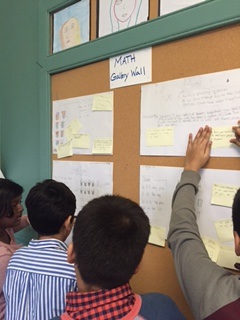
We use a gallery wall to display group answers to problems. This has become an invaluable way to quickly assess understanding. Students are given the opportunity to view the gallery, see how others have solved the problem, respond with their own ideas or suggestions and acquire new learning. A week of math classes includes a range of instructional strategies, independent work, paired and group work. One of our common “go to” questions is “Does this make sense?” We are aiming for understanding rather than rote learning of facts and steps (as I learned in elementary school). So, I am enjoying learning with my students as I discover new ways to approach and solve math problems.

From Teacher Directed to Student Directed Learning


As a new teacher or a teacher with many years experience, you hear about the importance of planning for student-directed learning in the classroom. Keeping this approach in mind as you plan in all subject areas benefits student learning and also benefits the teacher. Benefits include:

  • Engaged students – most students want the opportunity to talk as they learn, not just listen. When made to only listen, they look for distractions and classroom management issues often arise. If students are provided time to collaborate on a topic that interests them, they are engaged in the process and positive learning outcomes are the result.
  • Student interest – this leads to the content. Provide students with choice and select topics within the curriculum expectations that are of interest to your group of students. Students will demonstrate more initiative and take more responsibility for their own learning if they have choice of relevant topics. For example, in my grade 6/7 class, I modelled writing a monologue from the perspective of a character. Then, the students were all provided with a rubric to create their own dramatic monologue based on a character of their choice from a book from their choice.
  • Differentiated instruction – allowing choice of topic or type of presentation/project differentiates for the range of learners. Again, as an example from the monologue assignment, struggling readers selected books like Diary of a Wimpy Kid, while others selected more challenging texts like Journey to Jo’burg. Similarly, students will select an option for a project on what they are comfortable with (creating a slideshow vs. a video). By allowing students choice, you are more inclusive, not lowering your expectations for those who can surpass them, or challenging your lower level students to frustration. And as a result, the students who select the more accessible choice, often learn from the students who are demonstrating success with a more challenging topic or type of presentation.
  • Assessment – student-directed learning allows time for ongoing assessment. I have spoken to teachers who plan detailed lessons and present to the class in a lecture style format with little time for collaboration or independent research. These teachers lament that student’s aren’t “listening” enough. They also wait until the end of unit to assess students with a paper/pencil task. By facilitating students in a more self-directed approach, teachers can support student where they are at with resources and mini-lessons for those who need it. Why provide the same lesson to the whole class if they do not all need it? When students are working in small groups or pairs, or even independently, the teacher is provided the time to interact with students, find out where they are in their understanding and provide the necessary support (assessment for learning).
Student-directed learning isn’t students learning on their own. It is more like students learning within a framework set up by the teacher, and supported by the teacher. It benefits all those involved!


Photo of Mike Beetham

Divide and Succeed

One of the biggest concerns a teacher is faced with is the number of students they have to work with and thus the needs to be met in their classroom. Amongst that class of students will likely be special need students from both an academic and/or behavioural need, students who work very quickly and students who need extra time to consolidate their learning, students working below grade level, at grade level and above grade level. The class profile has a direct impact on the teacher’s plan of action. A successful strategy that has allowed me to ensure that I have direct, 1:1 contact with every student is a divide and succeed.

What I do is to start with a two week cycle (10) school days. I then look at my class number (I will use 30 for a working example) and divide that group into 5 groups. Thus I will end up with 6 students in each group. Each group will be assigned a conference day. Group 1 will get Mondays, Group 2 will get Tuesdays and so on. I then divide those 6 students into 2 groups of 3. Student A, B and C in Monday’s group will meet with me on week 1. Students D, E and F will meet with me on week 2. That means that during each academic day I have to build in time to meet with 3 students. That is a doable strategy. The end result is that I get to meet 1:1 with each student at least once every two weeks. What occurs during that quality time is up to you. I currently use it to conference on reading, writing and personal check-ins.

As I get more efficient in my conferencing and pinpoint exactly what I want to check up on, assess or discuss I am able to move it to a 1 week cycle where I now meet with 6 students a day. At this point I know my students very well and know which students need more conference time and which students need less time. There are many ways to revise this strategy such as when week 1 is used to conference with all students and week 2 is used for necessary follow-ups or teaching students to lead their own conference. There is no interrupting (unless an emergency) during a conference. The class has built in peer supported strategies when the teacher is in a conference. All of the above require routines that need to be taught to the class. This time serves me so effectively when reporting times arrive as I know so much more about my students.

Photo of Mike Beetham

Inclusive Celebrations

Should I celebrate this holiday or that holiday in my classroom? Should I have a holiday free classroom? These are questions that have no simple answers. An inclusive classroom pertains not only to the different learning needs of your classroom but also to the cultural diversity of your group of learners, your school community and the neighborhood in which your school exists.

Over my career I have been very fortunate to have worked with many inspiring, talented colleagues that have always created ways that developed a sense of community within our school by embracing the uniqueness of each and every culture. These were often shared in music, art, drama and other types of public sharing. The end result was that we always left knowing and appreciating more about the global school community. More importantly our students were provided opportunities to build cultural bridges that can be carried with them throughout their life.

I have included a website that provides tips on celebrating cultural diversity. As well, there are many resources available to facilitate awareness such as a multi-cultural calendar.

10 Tips on Celebrating Cultural Diversity in the Classroom this Winter Season


Photo of Mike Beetham

Shifting to Assessment As Learning

How did I do teacher? Did I do it right? Is this what I am supposed to do?  These are the questions that I have heard over and over my entire career. I began to wonder why is it that my students always need to have me tell them how they are doing. As my understanding of good assessment practices evolved, so did my understanding of assessment as learning. This is the ultimate goal of what effective assessment practice strives to create in learners.

Once students not only know what they are doing, but what a successful product looks like (success criteria), they shift from teacher focussed to student directed. At first my practice consisted of the criteria being established by me and then shared with my students. As I continued to enhance my understanding of effective assessment practice (Damian Cooper – Talk About Assessment 2006) I began to experiment with student created criteria. Lo and behold, not only did my students get it, they now owned it and the task became contextually valid to them.

My current pedagogy that I am phasing into my practice is a daily debrief on the day’s learning. I will often use it at our final circle time of the day, journal writing or individual conferencing. The following questions are my guide:

What did you learn today?                 How do you know you learned it?

How well did you learn it?                  What helped you learn it?

What did you find difficult to learn today?                     Why?

What could you do tomorrow to make it easier to learn?

Where can you use what you learned today?

I usually choose two questions and focus on a specific area. What did you learn in mathematics today? I am very happy with the beginning results I am obtaining. I have just recently started to take a few notes from the discussion and remind students the following day so that they can use their own feedback to assist with the new day’s learning.

If you have any other prompts or guiding questions that you use, please post them for other to use.  

Photo of Mike Beetham

But Why? Part 2

Why I have chosen a video? Why I have allowed them to work in groups? Why am I allowing my students to have choice in their learning?  Why have I assigned homework? This is the question I start with for every instructional unit (and in practice, every classroom decision that I make). Why am I doing what I am doing? What is my desired learning outcome? How will it move my student’s learning forward?

My change to using a backward planning model has been one of the most significant improvements to my teaching practice. I now start all of my instructional planning with the following question:

What do I want my students to know, be able to do and value at the end of this instructional unit?

 Of course my answer always starts with the Ontario Curriculum and the overall expectations of that subject area. The next phase on my planning is where I try to visualize what does that learning look like in the life of a 10 year old (or 15 year old or 7 year old etc…). I try to find the context for the learning so that it becomes real for my students. That context increases the level of engagement, which in turn bolsters the intake of learning.

A caution I always have to remind myself of is that I am viewing the learning tasks and content through an adult focussed brain. To be more effective I have to train myself to screen my teaching through the developmental age of my students. When you know why you are teaching something, the actual teaching becomes so much easier.

Photo of Mike Beetham

But Why?

This is a term that has become a part of my teaching repertoire since spending the last four summers working with teachers in Sierra Leone, Africa. There are two ways that I make use of this valuable term in my classroom practice.

The first is when I am dealing with classroom management concerns in my classroom. There are always students who are not following the expectations, not fulfilling the work requirements, not complying to the adults etc… The fact is that most teachers are only able to deal with the behaviour piece (tip of the iceberg). The question ‘But Why?’ forces me to look beyond the behaviour, beyond the part that negatively affects the classroom routine and to seek out the roots of the behaviour. If I can make the time to figure out why something is occurring, I have a much better chance to support a change that will be permanent.

For example, student X  in my class last year had a reputation for refusing to do his work. It did not matter whether it was numeracy or literacy he usually behaved in such a way that the teacher had to finally intervene and remove the student for the good of the rest of the class. So, student X had developed a very effective strategy of avoiding areas that he did not want to take part in. The removal from the class was actually a reward for him even though in the eyes of everyone else it was a punishment.

I had to try and figure out the ‘Why?’ for his behaviour. This took time, patience and most importantly a good relationship. The end result was that he had significant gaps in his learning due to his behaviour choices and that future testing revealed that he had a learning disability in writing. As a result, he had learned that compared to everyone else he was dumb when it came to being able to express himself in written form. The removal from a class (adult punishment) was not as negative as the inadequate feeling he had everyday in school when required to write with his peers.

The solution became the need for differentiated instruction and differentiated assessment in order to allow student X the most effective way to demonstrate his learning. He still had to write, but only when writing was being assessed. In numeracy I only assessed his understanding of numerical concepts and not his writing skills. Scribing, models, oral explanations allowed him to both gain confidence in his actual abilities and not have to focus on his area of need.

Stay tuned for Part 2 of “But Why?”.

Photo of Mike Beetham

IEP Creation and Implementation

What Is an Individual Education Plan?

An IEP is a written plan describing the special education program and/or services required by a particular student. It identifies learning expectations that are modified from or alternative to the expectations given in the curriculum policy document for the appropriate grade and subject or course, and/or any accommodations and special education services needed to assist the student in achieving his or her learning expectations. For additional information on creating or understanding the IEP, use the following Ontario Ministry of Education link:

http://www.edu.gov.on.ca/eng/general/elemsec/speced/iep/iep.html?view=print

The IEP can have a variety of focuses from academics, accommodations to behaviour and/or social skills. It is essential for students who have been identified as exceptional through the IPRC process. They are also used for students to whom the board feels require special education programs or support to meet curriculum expectations. The IEP is developed within the first 5 weeks of school. It is critical for teachers to seek out as much data about a student as possible (report cards, previous IEP, formal and informal assessments, OSR and any other diagnostic assessments that you are able to complete with a student).

The IEP is drafted by the classroom teacher (usually with support of a school’s Special Education Resource Teacher) and then shared with the parent/guardian for their feedback and finally signed and becomes the legal document by which a student is assessed. It is a detailed document that requires a lot of time to create. It is revisited after each assessment period and adjusted according the progress or lack of progress a student has made toward the target expectations.

This is a critical component to helping each and every child be successful as it epitomizes the need to teach to each child’s needs and not just to a curriculum standard. I highly advise that teachers take the time to familiarize themself with the IEP process.

Photo of Alison Board

Our Classroom Voice

At the start of September our classroom looked bare and generic. Although a few motivational posters would have provided some aesthetic visuals to liven the room up, I refrained. Instead, I waited to see how student voice and interest would fill the wall space.

In only one month, our room is taking shape with student work, anchor charts, and art that is unique to the community of students in Room 8. Included in the room is:

  • a row of self-portraits. These are simple line drawings with multi-coloured marker lines, similar to the style of John Lennon’s Imagine album cover. They provide a visual reminder of our diverse group and represent how each individual imagines their own image.
  • an array of clear plastic page covers stapled to the bulletin board. One display of each student’s current published writing. Using the plastic covers allows the work not only to be protected, but stored throughout the year as a tool to show development.
  • a large picture graph on grid chart paper. This graph shows the Multiple Intelligence strengths of each student in the classroom. In the first week of school we used a survey to determine our M.I. strengths. Then after photo day, we used one set of the small photo stickers to make a visual graph of our strengths. We have already referred to the graph on numerous occasions, and other teachers (French, Phys. Ed) have appreciated the graph as well to easily identify student strengths.
  • a math gallery. When students solve problems in small groups, they are all provided with the same size paper. After they complete their work, we hang it on a bulletin board (math gallery) where the other groups can view it, add sticky note responses, and refer to it when working individually.
  • an inquiry corkboard. This dedicated space grows as we add newspaper articles, photocopies of book covers, questions, photographs and data that support our inquiry questions. Our current question is “How are we all connected?” This question has led many discussions about water and our inquiry board is reflecting the questions and knowledge building of the students.
  • logos. The students created their own logo contest for Room 8. There is a display of six logos that were created, then the students voted. Although they selected one winner, all the logos will stay in the classroom on display. We are using the winning logo as our image for our class Twitter account.

There are still many blank spaces to be filled, but I would rather they get filled by student work that is meaningful and authentic, then just decorating the space. As I look around the classroom, I realize that what I see (and more importantly, what they see) is a reflection of their own interests and perspectives. It is their voice.


Adjustments in September


With all the plans we make for those first days and weeks in September, it is worth being open to making adjustments, for your benefit and the benefit of the students. Here are some examples of how I have adjusted the environment and the program in the first few weeks:

  • I have changed the layout twice. We were pleased to get 6 rectangular tables and 1 round table in the second week, but have rearranged them twice to suit the needs of the students. This means that there are two sets of tables put together seating groups of up to 12 students who like to work together, and one table seats only 4 students who require more personal space. I planned for an even distribution of students per table, but am responsive to their different requests regarding space and collaboration.
  • The area carpet was originally placed in one corner of the room for community discussions and knowledge building sessions. The students enjoyed these talks, but found it hard to get close when we are limited with only two accessible sides to the carpet for rows of chairs behind those who are seated on the carpet. So, I moved the carpet to the centre of the room and it connects to the small carpet area of our class library. Now there is less movement of chairs as students turn to the centre of the room for discussions and use the extended space of the class library to sit.
  • We took a Multiple Intelligence survey to get to know our own learning strengths and the strengths of all the students in the class. We continue to consider these and reflect on them by referring to graph compiled in the class to remind us.
  • I finally typed out my schedule last Thursday. It took me that long to juggle our literacy block and periods for Science and Social Studies with withdrawal for ESL and special education support. I have added 15 minutes of literacy to the end of our day when we review our agendas with a poetry cafe allowing dedicated time for the reading, sharing, and writing of poetry.
  • We introduced “Minutes for Mindfulness” each afternoon. After lunch and a transition for French class, some of the students had difficulty settling for a full-class discussion regarding our inquiry topic. I asked if they wanted to try some mindfulness techniques, and a new student shared a website/app called www.calm.com that his teacher used last year. This adjustment not only helps the students, but I benefit from the 2 minute relaxation exercises as well!
I am sure our class will continue to grow and change. Allowing for adjustments to your best made plans is necessary to be responsive in your teaching practice – and everyone will benefit.