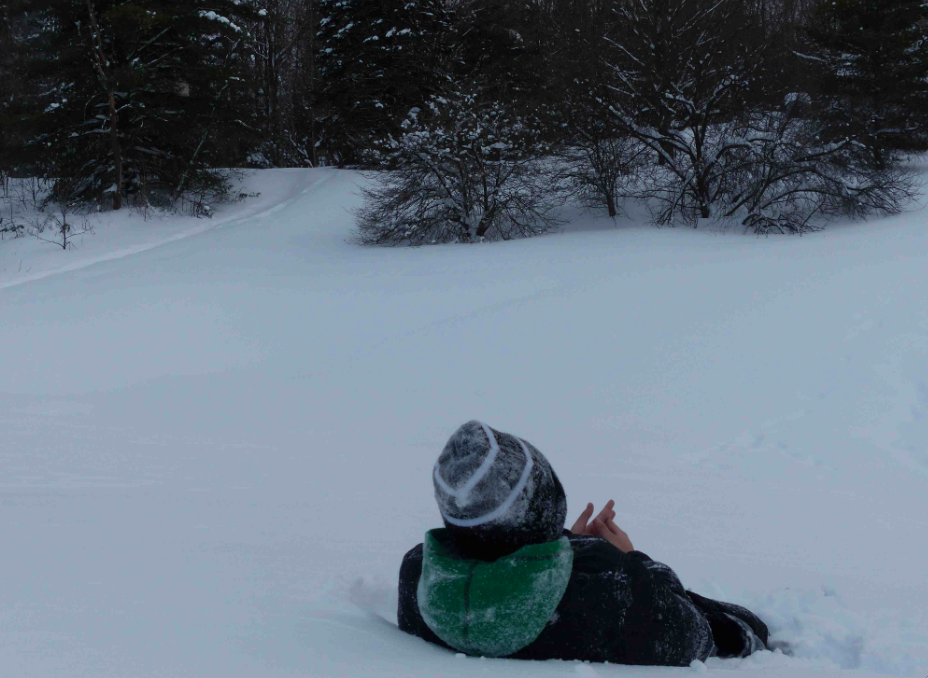

A person lying in the snow

The Power of the Outdoors

A traditional classroom is seen as a room with four fixed walls, desks, books, manipulatives, educational supplies etc… Imagine the enthusiasm running through your students as they scoop, lift and observe the life in that small stream or the piece of art coming to life as they sit and sketch the wonderful scenery that surrounds them from nature’s canvass in the fall.  Nature and the natural wonders of the world opens up options to both the students and the teacher as they ask questions and experience the process of discovering how the world around them works.

Outdoor education is more than just visiting a local conservation area or board run program. Outdoor education is making use of the local parks, school yard playgrounds, school gardens or any natural area that is connected to the lives of your students. Developing an awareness of their environment and just how precious their day-to-day lifestyle habits are must be experienced and not just observed or researched. Over the many years of my career I have learned just how powerful the outdoors can be as witnessed in the level of engagement and the quality of the work produced by my students. You belong outdoors!

Photo of Mike Beetham

What’s For Lunch?

One of the best team building activities and diagnostic tools that I use is eating lunch with my students during the first month of school. During this precious time, I am able to discover so much about the uniqueness of each and every one of my students as people and students. Bonus content comes in the form of what I learn about the  social climate of the classroom (and school).  Over the course of a week I make sure that I move around the room and sit in a variety of groupings to ensure that I have 1:1 contact with every student.

Of course the reciprocal scenario also unfolds as I am able to reveal myself as a real person right before their eyes. I soon am not just their teacher! It is that critical beginning where I am able to send them the message they are important, they are special and that together we will accomplish great things and overcome challenging struggles.

For any teacher new to a school you must always balance this with the need to connect and become a part of the professional team at your site. The critical concept is that this is a planned event with a specific target outcome and can’t just be left to happen haphazardly.

Photo of Mike Beetham

When Does A Classroom Agreement, Become A Classroom Agreement?

I have been using the concept of the group collectively coming up with the behaviour and work standards they would like to live with for their time together as a team for over a decade. But on one fateful day in the winter of 2013 I was able to be a part of an experience that was a profound learning opportunity for me. Students have always enjoyed and valued being asked about the type of classroom they want to create. They have generated ideas, held dialogue on their and other’s ideas, compromised and come to an agreement in which they sign and live by. At that point the class moves forward and the journey begins.

This year we went through the same process I had for many years and came up with a wonderful classroom agreement that everyone was proud of. As always, about a month into the year I purposely broke the classroom agreement and needed to be held accountable for my actions just like everyone else who signed the agreement. That usually means that I have to go through  the problem solving model we use, take ownership for my choices and deal with the appropriate consequences for my actions. Needless to say, there is never a shortage of students who are willing to give up their free time to monitor their teacher as he sits in a detention. Thus the lesson passed on is that this agreement is truly for everyone in the room and not just for students. What made this year different was how my students reacted to it. They were completely silent and unsure of what to say or do when I put myself in the solution zone. A follow-up debrief revealed that teachers have always said that they were part of the agreement, but usually just said sorry when they did something wrong and moved on. They had never been held accountable as the students are. This experience provided me with me a lot to think about!

Photo of Mike Beetham

A Great Classroom Is Created When…

I had to share this with someone, so I felt this blog was the best way. At a recent class meeting we all sat down and started to talk about what makes a classroom great. This topic generated a myriad of ideas, discussion and debate. I am sharing with you the final product that came from this amazing group of students.

– when everyone works as a team

– you celebrate when people do something right

– every student is a success

– tell the teacher how you care for them and they will tell you the same way

– teachers teach us how to share, cooperate and work as a team

– we have fitness in the morning

– we do different kinds of things like planting

– you don’t give too many chances

– you take the time to get to know each other

– don’t be too easy, don’t be too hard

– we set goals

– when students can be taught and entertained at the same time

– teachers discipline

– you take risks with each other

– students and teacher communicate to each other

– we give lots of smiles

– students are allowed to teach teachers

– students are allowed to learn from their mistakes

Needless to say, my students have once again taught me how valuable an asset to our classroom they are. Their collective voice has demonstrated the power of our class motto ‘Together Everyone Achieves More Success’. I hope you can read my happiness and pride!

Photo of Carmen Oliveira

The Freedom of Giving Up Control

When my non-teacher friends describe teachers, words like type A, perfectionist, and control freak tend to be at the top of the list and although they may say it’s all in jest, I know that’s exactly how they see most educators.  Truth be told that in conversation with colleagues and observing many classrooms, I have to admit that to some degree, giving up control presents a challenge that not everyone is willing to take on.  For some teachers, the thought of having students organize the classroom library or put up a bulletin board on their own makes them nervous, to say the least.

I’ve always thought of myself as an educator who shares in the learning with my students and I’ve worked to create an environment in my classroom that I feel is conducive to exploration, inquiry and self-expression.  Of course, this is how I believe things to be without taking into consideration if indeed, my students feel the same way.  I decided to speak with my class about how they felt with respect to the control they had over how things we run.  Interestingly, we came to the conclusion that although they felt they could question anything and could express themselves while feeling valued, they did wish they had more control over day-to-day routines such as organizing supplies, creating the class calendar, writing the homework, putting up bulletin boards, etc.

I realized that I hadn’t given them those opportunities because of my limited belief about how much eight and nine year-olds could handle without creating havoc in our classroom.  I had my doubts about giving up that control over the day-to-day tasks but was curious to find out how they would handle it.  Students began to put up and take down bulletin boards, organize the class schedule and calendar, write up the homework on the information board, organize the forms and notes mailboxes, track completed and unfinished work using class charts, create their own anchor charts, organize the classroom library and supplies cupboards, etc.

What began to happen was wonderful: the students quickly demonstrated how independent and capable they are to run the day-to-day classroom tasks and I had more time to myself that I used to plan, mark and prepare for activities.  Giving up control ended up giving us all the freedom we needed both to do our jobs better!

Photo of Erin G

Reaching All Learners – Flexibility in Core French Class

Out of all the challenges you are confronted with as a teacher, it seems to me that one of the most difficult of all is making sure that you can meet the needs of all of your students (simultaneously!). Everything else seems to hinge on this; if your students can function/are sufficiently challenged, they are engaged. If they are engaged, they are motivated and will not cause problems in class. Seems like once you can identify the root problem, implementing a solution is easy…As we all know, this is seldom the case. Core French being a second/third language makes it that much more challenging. In essence, EVERYONE is needy and that much more dependent on the teacher. It can be exhausting and difficult to be pulled in so many directions. See if this sounds familiar (keep in mind, the key word is once again “simultaneously”).

 Do you have your project with you today?

What project?

 The one we worked on together yesterday? I had given you sentence starters and we spent 20 minutes working on key vocabulary?

 No, I lost it.

 (Great) Well, start it aga…(interrupted) 

I can’t find my sheet!/He stole my pencil and won’t give it back!/How do you say “is” in French?/If I write double the sentences, do I get a level 4?

  So on and so on. No matter how much experience you have (and I have a lot), it is still a difficult task that can leave you feeling overwhelmed. This year, I’m trying out a different approach with my grade seven class with the following scenario: 33 kids in a small space (not my classroom), 4 gifted, 3 on IEPs and 2 HSP students with identified learning disabilities. Already seated in groups of four, I have them now sitting with at least 1 “expert” per group. They are those students who are not only high functioning but are also good communicators. Their job is to make sure that everyone in their group is following along and if they are having difficulties of any kind, they are the “go to” people. I am hoping this will allow me to circulate more and really help those in need (for remediation or enrichment) in a focused way.


“I Know Here”

At one of our first staff meetings this year, we had a discussion about building community in our school. What is our community? How do we see ourselves? Many of the teachers had a difficult time describing our school community. We are in a building with additions that have been attached on various levels, resulting in doors and stairs that physically separate the classrooms into small groupings of three or four to a floor. The community outside of the school is also diverse. There are few apartment buildings as well as a neighbourhood of homes, a park, and a plaza of stores.

To discover our community through student inquiry, all the classes read the book I Know Here by Laurel Croza.


We then asked the students to take a similar approach and define their community with words and representations. The results were outstanding. Every age from Kindergarten to grade 8 was able to identify what made the community unique and they presented their own perspective. To extend that sense of our community defined by student voice, we set up a literacy night at the school to showcase the student work. It included descriptive writing, drawings, 3D representations, photos and videos.

The experience was rewarding for the teachers, students, and parents of our school community. The work was meaningful and the children were engaged. It was a topic that was accessible to all and promoted equity throughout our school. The children were also able to share new insight and point of view with us, the educators.

Venetian Glass

In Praise of Fragility

Teachers spend a lot of time trying to identify students’ strengths.  Through the lens of an attributes-based approach, we can use those identified strengths to intentionally structure tailored learning opportunities.  The Heart of Teaching and Learning reminds us that we can empower our students by simply acknowledging and purposefully using their positive attributes.  Truly, at the heart of teaching is the belief that every child is special, that every child is strong in a way.

Such a heavy focus on student strengths makes me wonder if we adequately acknowledge our students’ weaknesses.  In our quest to identify strengths, what do we do when we discover that some of our students are, in fact, quite fragile?

Admittedly, all of us are fragile a little bit, but we keep it very hidden.  “Most of the the time, we have to be strong, we must not show our fragility.  We’ve known that since the schoolyard,” writes contemporary philosopher Alain de Botton in his new book, Art as Therapy.

It’s unfortunate that we often unassumingly teach the lesson that fragility should be replaced with strength.  “Just ignore him, Sally,” we say to the girl who comes to us in tears for the umpteenth time because of a classroom bully, “and if you don’t give a reaction, he’ll stop bugging you.”  “Walk it off, Scott!” we say to the boy who hurts himself on the pavement.  “No, you don’t need a Band-Aid.  Go.  Play.”  We’ve all dished out the unhelpful advice that really teaches this lesson:  toughen up already.

But fragility has its place.  Alain de Botton gives us this object lesson using Venetian glass goblets:

Venetian glass doesn’t apologise for its weakness.  It admits its delicacy; it is confident enough to demand careful treatment; it makes the world understand it could easily be damaged.

It’s not fragile because of a deficiency, or by mistake.  It’s not as if its maker was trying to make it tough and hardy and then – stupidly – ended up with something a child could snap, or that would be shattered by clumsy mishandling.  It is fragile and easily harmed as the consequence of its search for transparency and refinement and its desire to welcome sunlight and candle light into its depths.  Glass can achieve wonderful effects but the necessary price is fragility.  Some good things things have to be delicate – the dish says:  ‘I am delightful, but if you knock me about I’ll break, and that’s not my fault.’  (Excerpt from Art as Therapy).

Not unlike Venetian glass goblets, some of our students require delicate handling, and we would be remiss to think that the associated character attributes were undesirable.  Light bulbs demand to be treated delicately, and when they are, they can shine beautifully.

As teachers, we need to create spaces where fragile children can thrive.  Where shy children can interact with others at their own pace. Where children who are easily hurt can find refuge.  Where children who are simply unsure of themselves can find acceptance.

Is your school a place where being fragile is okay?


Image of a person going up a ladder

Being a Mentor OT

In my first year of occasional teaching, I was as lost as Bambi in a forest fire.

Yes, I was fully certified, and sure, I had successfully interviewed for the OT list.  Yet there I was, in my first few assignments, marvelling that someone, somewhere, had said, “Hmm.  We have a teacher who’s going to be away for the day.  Let’s put Ryan in there.” The thought that I was actually being trusted with other people’s kids was entirely intimidating.  And let’s face it–most of us have reflected on, and at some point have been terrified about, the enormity of our task as educators.

Thank goodness for Sarah.

Sarah introduced herself, took me under her wing, and showed me around the school.  She connected me with full-time staff members and included me in conversations around the lunch table.  When I didn’t know where to find the photocopier, Sarah showed me.  She even pointed me to where the bathroom was (a gesture, I might add, of no small importance).  Did I mention I was lost?

You can imagine my astonishment when later I discovered that Sarah was a daily OT, just like me.

I don’t know if she realised it at the time–or if she’d even consider herself one–but Sarah was a mentor to me.  Her simple gestures helped make my transition to teaching incredibly smoother.  I bristle to think about how those first few days would have been without her.

In chapter two of The Heart and Art of Teaching and Learning, we’re reminded that beginning teachers are active participants in the mentoring process.  This applies not only to contract teachers, but also to occasional teachers.  Perhaps this means that as a newer OT, you seek out the mentorship of a colleague you trust who can help you navigate through first season of your career.  Alternatively, perhaps you’re a seasoned OT with a kind heart and a wealth of experience who can guide and assist a newer teacher in the schools where you regularly see each other.

The difference informal mentors make in a school is outstanding!  I’ve seen it myself and I’m sure you have, too.  Mentors help to foster a sense of collaboration and community in their schools.  For me, what started off like a forest fire soon began to feel like greener pastures.  Undoubtedly, the mentors I know make my schools fawn-tastic places to work.

Think about your own schools.  Could you be a Sarah in someone else’s life?  I assure you they’d be forever grateful.  I am.

Thanks, Sarah.


A list of Mrs. Mcauley's Thing

What’s Your Thing?

The beginning of the school year always feels so hopeful and the thought of getting to know a whole new group of children is very exciting!

This year, I decided to take on a new angle to my usual “Identity” theme by helping my Grade 4 students to identify what their “thing” could be.

It all began with explaining “Identity” as puzzle pieces that make us who we are…

Each student had a chance to make an image of their identity, broken down into pieces. This led to questions such as, “How does knowing who you are help you?” and “What are the pieces that you are most proud of?”

Before I could introduce the idea that everyone has a “thing”, I decided to read, “Woolbur”, a wonderful story written by Leslie Helakoski. It highlights the unique qualities we all possess and how we can celebrate these qualities.

Afterwards, I asked students to think about Woolbur and what “his thing” might be…whether it was something he liked to do or a talent he possessed.                                               


Then, I asked them to try it out on me: “What is Mrs. McAuley’s Thing?” As they wrote on small white boards, I wrote my own thoughts on a hidden chart and then we compared them. It was pretty eye-opening and led to conversations about assumptions we can make about people.

Next, my students are taking photos of their “things” on iPads and putting together a collage. They are writing about one of their “things” and making an audio recording as they describe how they can use their “thing” to change the world.

If nothing else, this teaching experience has taught me that students are never too young to reflect on what makes them special. And when asked to take on a role in a team setting, they will be equipped, knowing what unique qualities they can share.