Heart Picture

Using Positive Reinforcement for Persistent Misbehaviours

Recently I taught as a daily occasional teacher in a special education, mostly behavioural classroom.   This was my first experience with the kind of group of students where correcting misbehaviours and classroom management was critical to getting through the day safely and working to complete the regular teacher’s goals for the day.   As a daily occasional teacher, I felt some apprehension knowing that an already challenging class could be even more challenging for a new teacher that is out of their familiar routine, but was prepared to face the challenge to the best of my abilities.

One thing that I noticed upon entering the classroom, was that the teacher had laid out a daily behaviour log for each student.  It was broken down into time blocks (corresponding with entry, class periods, recess, lunch and exit) and it included a rubric consisting of levels 1-4 (which corresponded with expected behaviours for each level).    When going over this student information, I recalled reading in Chapter 4 in the Heart and Art of teaching about positive consequences – reinforcing positive behaviour that is consistent with creating a learning focused classroom environment.  I decided that I would begin with this approach to set a positive tone to the day.

When the students entered in a less than orderly fashion, I commended two students for their ‘Level 3 ½’ entry,  and mentioned that their classroom teacher would be pleased to learn of this when I make my notes at the end of the day.  I saw a smile as one student was particularly pleased that I had noticed. The other students overheard, and while some students chose to continue with their off-task behaviour, a few others took their cue and directed their behaviour towards positive praise.   In commending those two students, I also gained two helpers who were inclined to assist me in the classroom routines (i.e., getting out the nametags, advising me who should not be taking washroom trips together etc.).

If you take  look at the Venn Diagram on page 59 of Heart and Art (Students Who Rock, Students Who Are Deciding, Students Presenting Challenges) , I  would say that the class demographic was made up of ‘students who are deciding (on their behaviour), and students who ‘presented challenges’.  With positive reinforcement, I think I was able to encourage a few of the ‘students who were deciding’ to be a little more helpful and focussed, and in this I feel that I averted some additional behavioural challenges that could have existed.

While it was a challenging day, I found that approaching the students initially with kindness and praise sent them a message that I knew what was expected of them, and that I would follow through with the regular classroom culture of behaviour tracking, reward and consequences.  While not all students in the class ‘bought in’, I do feel that using a positive-reinforcement approach increased the potential of the  students wanting  to be successful, and decreased the ‘us Vs. supply teacher’ mentality that some students can develop.    This is an approach that I think many teachers already use in their classrooms, but I hope that it serves as encouragement for occasional teachers to employ in any challenging classroom environment.

Photo of Roz Geridis

Working with or as an Occasional Teacher

When thinking about occasional teacher planning many questions could go through one’s thinking process (what do I leave, how much, what do I bring?). If you are an occasional teacher you need to be able to teach for the time you are in the class with plans or not. If you are a contract teacher, you want the occasional to teach what you would do even if you were there. I just finished having a student teacher in my classroom and as her practicum was coming close to an end, the conversation of occasional teaching came up. She wanted to know how I decided what to leave for an occasional and how much but also what she should expect as an occasional teacher. Below is a summary of what I shared with her:


Planning for an occasional teacher

1) Make sure you leave a current seating plan.

2) Leave tips and notes about your students but remember to be professional as sometimes notes are left in the room for kids to see. Only phrase things in a positive language, leave strategies to help the occasional connect with your students, and 1 or 2 students who the occasional can ask questions about the routine.

3) Leave as much information about your class as possible but remember all information will not always be read. Don’t forget to highlight the allergies in the class and if epi-pens are used (if so, where the epi-pens are stored).

4) Leave lessons which your students will be able to complete. Usually, I still leave my lesson (as if I am there), I make sure I am prepared to complete an assessment for learning when I immediately return. The reason for this is the classroom teacher understands how each student learns, the comfort is there for the student to ask questions and clarify misunderstandings. Also, sometimes occasional teachers don’t have enough background information to connect the lesson for the students, students sometimes behave differently with occasional teachers and lessons are taught differently; the full lesson might not have been taught. I can’t tell you how many times I have returned to my class with a note stating the effort was made but the redirection of behaviour took up too much class time. That being said, I make sure lessons are connected to the curriculum but sometimes I may need to do something different than following my unit plan. It sometimes helps to make the occasional teacher’s day a little more fun.

5) Schedules – leave them in the supply folder. All resource, yard duty, classroom schedules need to be available for an occasional to view.

6) If you need items for a science experiment or art lesson, leave items out or in one location and share the location of items with the occasional teacher.


Working as an Occasional Teacher

1) Arrive as early as possible to give yourself time to review notes and lessons left by the classroom teacher.

2) Be familiar with the grade curriculum (if possible).

3) Try to connect with the neighbour teacher and ask any questions you may have.

4) Have a Language, Math, Science lesson in your bag, as a back up. On very few occasions you may walk into a classroom which has no lessons available for the day. If you have a lesson for each of these subjects, you can fill the day. Based on the grade, have some addition, subtraction, multiplication, division review fun sheets in order for the kids to complete (begin with asking the students to complete any 5, then to pick another 2, and so on). If no photocopier is available, write the questions on the board or display them on the smartboard and have the students record the questions and answers in their math workbooks. For Science or Language, you can have a story book related to the environment. “Where the Forest Meets the Sea”by Jeannie Baker or “The Lorax”by Dr. Suess are two great examples which can begin discussion on environmental issues, based on a situation you give them have the students develop different endings. Another Science activity might be a recycle sort — go through the classroom garbage bin (bring plastic gloves) and sort out what can be recycled or put in a compost. Again, there are many story books you can tie this theme to. For Language, you can use the newspaper and have the students discuss an article you feel is age appropriate. You can also have the kids write down 3 truths and a lie about themselves — then each student presents the 4 statements to the class. The class has to guess which is the lie. The students really enjoy this activity and it does take up an hour and sometimes even more (if the class size is bigger). Please don’t forget about your diversity of learners and adjust your lessons as needed.

5) Don’t forget about yard duty.

6) Try to deal with classroom behaviour in the class. But of course, if safety of yourself or other students is/are at risk, make sure you immediately contact the administration. Having a little reward planned for the end of the day helps students to look forward to something. Making the connection by saying hello/good morning to every student as they enter helps to start off the day well.

7) Say good bye to the administration and thank you to the office assistant(s).

8) Most of all…enjoy the day!

Photo of Erin G

Response to Tina’s Idea of Stations – a Great Teaching Tool

I was really excited to see Tina’s blog on using stations as a teaching tool. I echo that when I’ve used them, the students have been engaged, on-task and really enjoyed the variety of learning experiences offered to them. I also agree that they are a lot of work to set up but the end result is definitely rewarding.

Stations are valuable because they can be used for all levels of assessment – diagnostic, formative and summative and also are ideal for differentiated instruction. Depending on how often you use them, it can definitely be worth the investment of time and money.

In Core French, it would be interesting to have a listening station and related activities especially if you had access to a wireless portable lab. Even reading stations could be a really creative way to focus on different types of texts and useful strategies. In fact, as long as you have gone to the trouble of setting them up, stations don’t have to just be used for one day but could even last for a week-long investigation/activity.

I could also see them being used as a way to keep the rest of the class productively occupied while affording you the chance to work with a small group of students (that in itself could be one of your stations) and a golden opportunity for differentiated instruction/assessment. I think that if you were to use them on a regular basis, it would also be beneficial and efficient to practice each activity with the whole class beforehand so that, on the chosen day(s), they would know exactly what to do and no long-winded explanation would be necessary.

As a final inspired thought, you could also chose selected students who were trained in advance to run and supervise each station as a leadership opportunity which would free you up to kick back and relax – enjoy an extra large cappuccino and the front section of your morning paper while the class virtually runs itself like a well-oiled machine;).

A sign that say No Bully Zone

No Bully Zone

Never be bullied into silence. Never allow yourself to be made a victim. Accept no one’s definition of your life, but define yourself. -Harvey S. Firestone

This past week I watched a screening of the upcoming movie/documentary “Bully” directed by Lee Hirsch.  It was a highly emotional experience for every educator in attendance and the conclusion many of us reached was the same: we think we know what’s going on with our students but in reality, that’s not always the case.  In fact, getting to know our students is an ongoing process and I believe that we, as educators, must be responsible for creating the safest environment possible and hold ourselves accountable if we fall short of that expectation.

One of the most powerful and emotional scenes was listening to a mother who lost her son after he committed suicide following years of being bullied. She expressed exactly what I, as a mother, also feel when I leave my son at school.  Our children are our precious babies, our treasures, the most important people in our life.  We entrust them to educators who we believe will teach them, guide them, and protect them from harm.  The responsibility we take on is immense but it’s our job to take it as seriously as a parent would.

I shared my thoughts and feelings with my students and they felt that we should take it a step further by creating a school initiative after looking deeper into the issue of bullying.  I will be sharing our unit and progress in a later blog.

I highly recommend that all educators, parents, and students over the age of 11 watch the movie/documentary.  It captures the raw and cruel reality millions of children face each day at school and opens the floodgates to conversations and issues we need to address in our classrooms and schools.

Here are some helpful links:

A good book to read:

Bullying: the bullies, the victims, the bystanders


Heart Picture

Classroom Management and Tips for Daily Occasional Teaching

It’s funny to me that when I tell people that I am ‘supply teaching’, I am often met with statements along the lines of “Well that’s pretty easy, you don’t have to plan, and you basically just watch the kids for a day.” At this statement, I usually scoff and reply with “Do YOU remember what you and your classmates were like when your teacher was away?”. This is usually met with a chuckle and a “oh yeah, I see what you’re getting at.”

I think we can all recall a time in our years as students, when the absence of the regular classroom teacher was met with the idea that there was a free pass to try to get away with what you normally couldn’t get away with when the regular classroom teacher was around.  Kids being kids, this scenario still often rings true: students, knowing that an occasional teacher is only in for a day and is not familiar with the rules and routines, will try to push some boundaries.  For me, when teaching as a daily occasional teacher, this is where classroom management and foresight are paramount to having a successful day. I have started my daily occasional teaching assignments, and in preparation, I read Chapter 7- Preparing for or Being an Occasional Teacher (Heart and Art of Teaching and Learning). I found the practical ideas from Connie were helpful in getting my head around teaching in someone else’s classroom for the day, and in being proactive in anticipating the turns the day could take.

In addition to the good ideas already mentioned in the book, I start out my day with my own bag of tricks. My daily bag is equipped with my desk bell, a whistle (in case I am teaching gym), a book of fun drama activities and a few picture books that are appropriate and liked by many age groups. Along with it, I try to think of a follow up activity that can be used if the teacher hasn’t left any plans or when work is completed and we have an extra chunk of time (for example, plotting the beginning, middle, and end of a book, writing in the point of view, creating an alternate cover page for the book).

For the older grades, I make sure to write Ms. Perrin’s Expectations on the board for the students to see right when they enter into the classroom.  My expectations follow along the lines of:

  1. Be respectful of your classmates and teacher
  2. Raise your hand and wait your turn to speak
  3. Ask for permission to use the restrooms or to leave the classroom
  4. Be kind and do your best
  5. Let’s have a great day together!

I find that taking this little step sets the tone for the day.  The students immediately know who I am. They understand that my expectations are probably similar to their regular teacher’s expectations, and that I want to have a positive day with them. Once the students are settled, I take a few minutes to introduce myself and share a little bit about the grades and schools that I have taught in. This way, the students (hopefully) view me as a teacher (and not as some grown-up impostor who has taken over the classroom for the day).  I also take a minute to inform the students of my strategy for getting their attention (ring bell, clap sequence) and what my expectations are for when I use the strategy (stop what you are doing, track the teacher).  With these expectations already established, the students are aware of what being successful and being unsuccessful looks like in terms of their behaviour.

Another thing that I do for most grades that I teach, is if the student’s desks aren’t labelled, I will have the students create a personalized name tag that reflects who they are (and maybe include 3 things that they would like to share with me or the class).  I find that this is a great community building exercise, that lets the students know that I am interested in learning a bit about them, and it helps me to call on the students by name from the beginning of the day. A few minutes spent at the beginning of the day establishing community and guidelines, help me to set a tone that is conducive to us all getting along and  doing what we need to do.

I find it most helpful to envision what I want my day to look like, then think about the things that need to be established in order for that to happen.  If you’re starting out as a daily occasional teacher, or are struggling in getting the students ‘on board’ in your teaching assignments, referring to p. 115-116 of Heart and Art is a good place to start. Hopefully my tips will also help some beginning teachers to have a smooth, well managed day of teaching too. Best of luck!

Learning Goals: Today we are learning...This will help me...Question of the day,.. Reflection Question

Just Let Us Be Kids!

Today, during our Gr.5/6 Writer’s Workshop, we were visited (as we regularly are) by a group of “kindies” who dropped by  to share what they had learned and created while exploring constellations.  The fact that the Kindergarten teacher and I have a similar view on the importance of celebrating children’s learning across the grades could in itself be an interesting topic to blog about but today’s visit lead us to another important topic: teachers should sometimes just let kids be kids, especially as they grow older.

The “kindies” very enthusiastically went on about their exciting day which started with “Show and Tell” and then moved on to exploring space.  Oh, yes, they also took a quick rest after lunch because they were very tired from all the work in the morning.  As they were leaving, I commented on how creative their work was and that my wish was that children never lose their curiosity or the simplicity with which they view the world around them.  I also confessed that I wouldn’t mind a nap myself after getting back into the work routine.  Suddenly, one of the little wonders turned around and said, “Well then, why don’t you guys be kids like us?  Why don’t you take a quick nap too sometimes?  That way, you’ll think better.”

I wasn’t expecting what happened next.  I had a class of junior students agreeing with the “kindie” and asking why we couldn’t sometimes take a 5 minute nap to relax before continuing with our work or having “Show and Tell” once a month to share what’s important and meaningful in their lives.  “It’s true Mrs. Oliveira,” one student said, “parents and teachers want us to grow up and be responsible and then they’re shocked that we grow up so fast.  If you let us just be kids more often then maybe we won’t lose our curiosity.”

Let’s just say we enjoyed our first nap to a 5-minute classical music piece and we have “Show and Tell” scheduled for the end of this month when students will be sharing an object that has special meaning in their life.

I expect to get a few calls from confused parents…


Photo of Erin G

What’s All the Noise About vs. Tomb-Like Silence

Sangeeta’s January posting What’s All the Noise About struck me as something to which all teachers can relate. I found that as a beginning teacher, I was often “aware” of the amount of noise in my classroom however in teaching French, I always felt a certain legitimacy with student interaction. As Sangeeta also mentioned it’s a trait that also characterises different styles of teaching. I know that oftentimes, teachers are judged (even by their peers) as having a lack of classroom management or that their students are too wild to be doing anything productive.

However it seems to me that it all relates to the level of comfort of the teacher and the task at hand. As long as students are on-task, discussion and interaction demonstrate to me a high level of engagement. One also has to take into consideration that students need a release. In teaching exclusively rotary classes, I’ve found that students coming from strict environments where talking/discussion is discouraged in favour of silent work time are often the most challenging when they come to my class as they are frequently the ones who “chatter” incessantly.  Although a definite proponent of student talking, I would say that there are a couple of considerations:

  • students don’t have a licence to talk indiscriminately (ex. during your lesson)
  • the noise level doesn’t interfere with students being able to work productively
  • you are not disrupting another classroom
  • your students are on task and engaged
  • you feel confident and comfortable

I know that I’ve found it personally rewarding to see students engaged in a lively discussion over an assignment.  To me it demonstrates that (mercifully) they are involved and care about what you’re teaching them.

Photo of Roz Geridis

Engaging students in Visual Arts

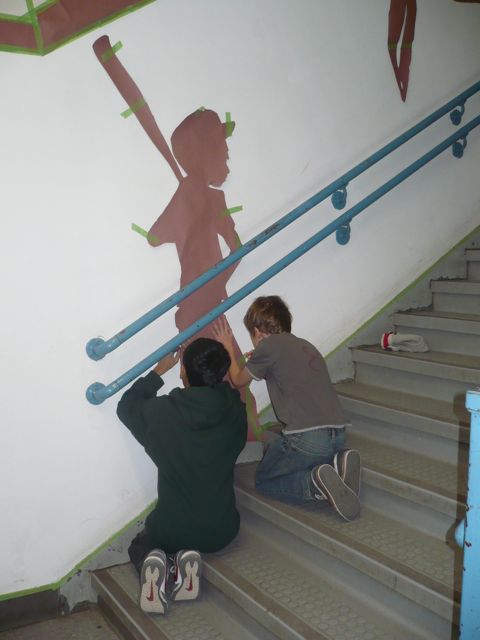
Over the last 2 weeks, my class have been working on this wonderful visual art activity which is also connected to grade 6 aboriginal studies. We began by studying the art work of Norval Morrisseau, an Aboriginal Canadian artist (books are available at the public library). Morrisseau’s style is characterized by thick black outlines and bright colors. I shared with the boys the plan for this project was for everyone to complete their own version, then we would do body images of 1/3 of the class which will end up being painted on the Junior Stairway walls.

The boys were very excited about this project and I really tried to encourage their interest and ownership of the art work. As a class, we moved along for the boys to use an overhead and trace their head, hands, or feet to complete their own versions of Morrisseau themed pictures. The boys then had a lesson on drawing the shapes inside their images (guiding them to leave enough room for their black line). Primary colours were used to colour the inside of the shapes and the background was in secondary colours. Using only 2 overheads for the whole class, this stage of project took a little longer than a whole afternoon.

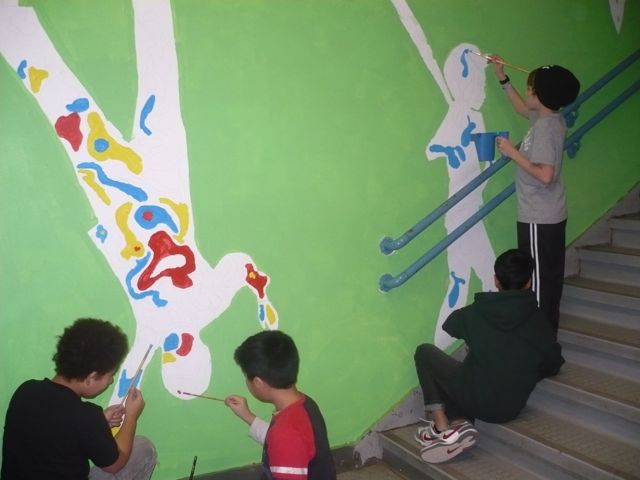
At the end of the first day, we had a discussion as to what the images of the boys would portray. The next day, the boys were asked to bring in items which reflect them in a sport type of way; for example, scooters, hockey equipment, soccer balls, swimming goggles. The boys selected the images to represent themselves as a class. They selected swimming, cart wheel, hockey, soccer, mountain climbing, and baseball. We were planning on adding someone reading and a second image but time was an issue which didn’t allow our plan to fully work out. Using the overhead, in groups of three, the boys then traced their image on life size paper. As others were tracing, the first group would then cut out their image. After lunch, we were able to finish off full body tracing for the rest of the groups and began (the groups completed the cutting)  adding the shapes within their image. This aspect of the project needed to be reviewed with the class a few times. The first lesson was on the personal image, the second mini lesson was to remind them of what to do to begin on the larger image, the third mini lesson was to go through their larger image and fine tune their shapes. This took us a full day.

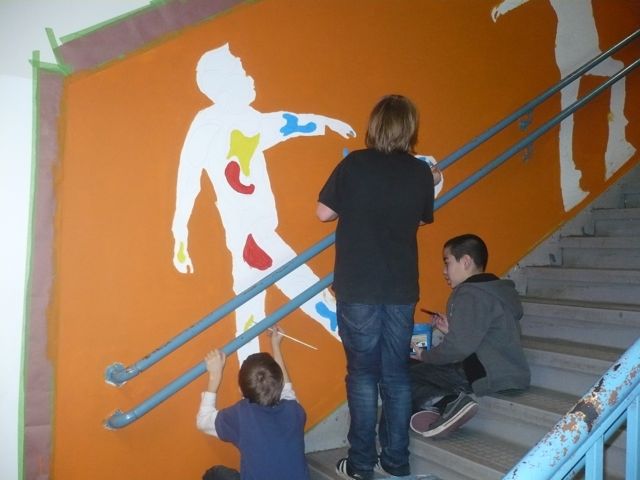
The next day, we taped up all body images on the stairwell walls. Looking to see which image should go where. This was an adult only decision. Once image placement was decided, the boys then traced their image on the wall. After every image was traced on the wall, some boys began painting the background colours while on the opposite side of the wall other boys were tracing their shapes in their image. This process took another full day. Each wall needed two coats and a day to dry between coats.

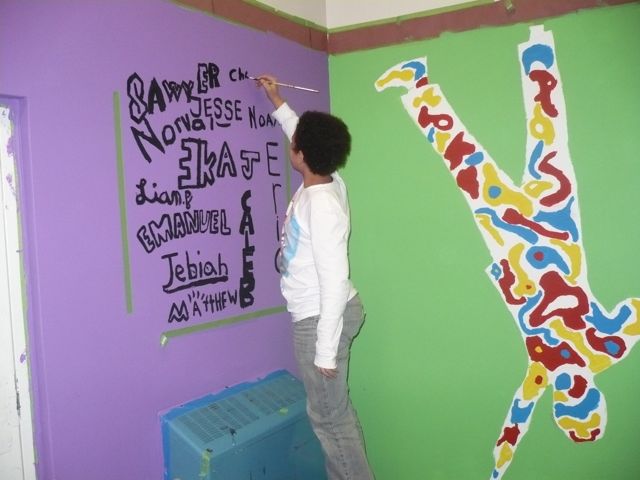
The fourth and fifth day, the boys were painting the shapes in each image (in groups of three) and then the black line last. We also needed time for touch ups. At the end of it, the boys were able to add their own signature to a wall which will be there for years to come. We are also painting some thank yous on a wall as all the paint used was donated by a local paint store.

The project took a total of five days and I really would recommend to get it completed in a chunk of time. The interest was there and interruption to your regular programming is not much. It was a week of limited program which was a great time to get to know and have some fun with your students. Remember, this is a visual arts project and it is connected to aboriginal studies. I have assessments for both curriculum areas. To adjust it for any grade, if your school walls are already colourful, you can do something very similiar and use the life size paper to paint and hang on the hallway walls. Also, use visual art as your first curriculum area and find a second curriculum area to connect it to, whether it is social studies or math.

Included are some pictures to help you visualize the project. It was a project completed with a parent (who is also an artist). While she was working in the stairway with the boys, I was in class keeping them on track. The first few days, there was plenty of work to keep the boys busy but by mid day on the fourth day on, the boys had less to do on the art project. That being said, behaviour was amazing!!!! I guess the boys thought if they didn’t manage in class, I couldn’t send them in the hall. Which is a pattern in our class. I definitely had support for this project (administration, artist, and Educational Assistant in the afternoon). I also sent out a letter to the parents informing them of the pending project, the boys working with Latex paint, and dirty clothes coming home (with a tear off signature return). I also asked for volunteers to come in a week later to help paint the final protective coating. I have many teacher and parent volunteers. The boys feel a sense of pride, ownership, and community to their school!

Photo of Erin G

Refreshed, Rejuvenated and Replenished

The beginning of the year is obviously a great time for fresh starts in all areas. With regards to teaching, I find that a break of two weeks does wonders to clear the mind and soul (not to over exaggerate or anything) from any built up negativity, grouchiness or even lackadaisical behaviour on the part of the teacher once the holiday countdown begins.

Coming back to school rested and refreshed allows me to regain a more centered sense of objectivity and balance. I always take this opportunity to switch up the seating plan, reorganize the classroom layout and generally try to freshen up the environment. In addition, I also use this window of opportunity when students come back with hopefully some of the same mindset to resolve any lingering and ongoing issues around behaviour, attitude or work ethic. I find that approaching them at this point, right at after the break, allows for a frank and productive conversation without the build up of aggravation, tiredness and downright animosity on the part of both parties.

In other words, now is a great time to reinvent or tackle anything that had previously been unsettling you before the onslaught of marking, report cards, form collecting, winter activity days, committee meetings, extra-curricular activities…brace yourselves!

Heart Picture

New Year’s Resolutions

Happy New Year!!!

The New Year is a great time to reflect on the previous year and to set goals and resolutions for the year ahead.  I spoke to my students about New Year’s resolutions and shared some of my personal goals for school and for myself at home. I felt it was important for the students to see that setting goals help to make a person ‘better’ and that it is no different than the practice and work that they put in every day into their learning.  The message was not lost on them, and they were enthusiastic to prove that you’re never too young to start goal setting. In fact, I think that my young students really understood the purpose and value of goal setting because they grow, learn and improve so quickly (for example, in learning how to read).

Together the students came up with their own definitions of resolutions and we discussed the purpose and value of articulating a goal and coming up with a plan for meeting that goal.  Then, we all took turns sharing one resolution that pertains to school and one that pertains to home life.  The students then wrote about their goals for display in the school.  This week I will be sending a copy of the students’ resolutions home with them to serve as a reminder and a discussion point for parents in helping their children achieve their goals.

Click here to see some pictures of this activity from my classroom.

It’s important to strive for improvement, whether it is for the benefit of work or school, but also as busy teachers,  for achieving health and balance, which I will be working on  myself in 2012.