
Photo of Tina Ginglo

Break Cards

At times last month, it was a challenge to manage some of the behaviours demonstrated in my classroom.  I have some students who have difficulty focusing and completing tasks even when I have supported their learning with modifications and/or accommodations.   Each evening I would drive home trying to think of a new plan for settling these students so they are not disturbing lessons and the other students’ learning.   Through conversations with resource teachers, research and trial and error, I think I have found a keeper!   At least it seems to be working in our classroom community…so far:)

It was recommended that I provide “break cards” to the students in my class who struggle with staying on task.  These students would start the morning with 2-3 break cards and they would be able to hand me a break card whenever they wanted to take a break from their assigned activities.   At first I didn’t like the idea.  What about the other students in the class who work hard and stay focused throughout the day?  Shouldn’t they deserve break cards as well?   Of course they do!  So I decided to provide “break cards” for everyone!

I feel that breaks should be earned.  At my discretion, I give break cards to students throughout the morning and again in the afternoon.  My decision to provide break cards varies from student to student.  I know that 10 minutes of sustained learning for some students is equivalent to 20 or 30 minutes for other students.  Each break card provides students with 10 minutes of “free time” in the classroom.  But, to avoid the possibility of students wandering aimlessly during their break and disturbing others, the breaks must be spent at one of the centers set up throughout our classroom.  I try to have a center for most learning styles.  For example, since we are doing strong and stable structures in science, I have set up a Lego table, for the kinesthetic learner.  I have music and books on tape for the auditory and musical learner, of course there are the two computers in my classroom, and my favourite, a cut and paste centre (which I call the arts and crafts table…after all this is grade 3!).

I am encouraging students to use their break cards wisely.  Some students choose to use their break card immediately. Others choose to save their cards until they have 20 or 30 minutes saved up.  I am thinking that I am going to have to create a new “rule” that students can only use 2 break cards in any given time.  Also, I need to create a planning board with pocket cards for the centers to avoid the arguments that arise when more than 2 people want access to the computers during their break.

We have only been using break cards for a short time.  Perhaps the novelty will wear off in time.  One way or another, I will check in and let you know if this strategy was sustainable in a few weeks from now:)

Photo of Erin G

Surviving beyond the First Week – the Beauty of a Well-Crafted Seating Plan

As a rotary teacher dealing with up to 180 students, building inclusion is naturally a different process than in a homeroom classroom. Establishing a rapport is definitely fundamental however, I have found that this goes hand in hand with effective classroom management. Eliminating the problem of constant chatting amongst groups of friends can go a long way to establishing order.

Instead of seating kids alphabetically or in random groupings, I have always let my students choose their seats for the first week or two. Taking this time to observe the dynamic of the classroom and work habits of the students ultimately allows me to make informed, strategic decisions about groupings. My decision is also based on the contact information form (see attached) which is filled out during the first week of school. The one side serves as a record of parent contact while the other provides me with invaluable insight into each student’s character. At the end, I have classes where the students are comfortable where and with whom they are seated. Preventatively dealing with the minor issues (that can quickly derail your class) allows me instead to focus on building an inclusive learning environment.

EGStudentInfoSheet

Additional tip: When implementing my seating plan, I put numbers on the seats and have students line up at the back of the room. Having called out their name and number, I have them find their seat. This way there tends to be less drama than in calling out the names which can sometimes lead to some raucous reactions. I also preface my announcement by stating that I had only their best interests at heart and therefore eliminate most forms of protest.

Photo of Sangeeta McCauley

Choice in the learning environment

Returning to the classroom after working at a central level for 6 years has been an awesome experience so far…I feel like a beginning teacher all over again!

One of the interesting questions that I thought about when planning my first week had to do with choice: how do we know when to involve our students in decision-making and which decisions need to be more teacher-driven?

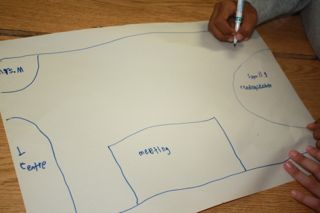
So, I set out to experiment on the first day of school, by letting my Grade 4 students determine which configuration would work best for the classroom desks. I knew this experiment would tell me a lot about my students, such as their problem-solving skills and how they worked together with their classmates.

It was a new feeling for me, always having had student desks already set up for the first day!

To prepare, I came up with some conditions:

-certain areas were to remain as they were (e.g., the reading corner, the conference area, my desk)

-each group had to present their model and the thinking behind it

-the desks were to be arranged in groups, but the number at each group could vary (e.g., there could be some groups of 6 and some groups of 3)

-they would need to include a space where students could go to work quietly on their own, if needed

-when we add to the room (e.g., new students, a SMARTBOARD, etc.), we may need to revisit the plan

After sharing these conditions on a chart with my class, they organized themselves into groups and set off to plan! It was exciting to see how each group had their own unique style. One group  first calculated how many students we had and thus, how groupings could work. Two other groups drew in the conditions first, then planned from there.


Would I do this again? Absolutely!

I learned that as teachers we cannot underestimate our students’ capabilities. Giving them choice in creating their classroom environment empowered my students and the interest they took in actually moving the desks to reflect the plan we chose was amazing to watch.

The fact that I had written the conditions ahead of time led me to realize my students benefitted from knowing that sometimes when we make choices, there are structures and boundaries we need to work within…

Next up, settting up our reading corner!!!


Photo of Roz Geridis

I feel like a beginning teacher again!

I am new to my school and was out of a classroom for a few years.  Finding resources (which I know are in the building), getting to know staff and the school culture, and starting the school year have been an exciting and great experience. I have an all boys grade 5/6 class. Many colleagues wanted to give me information about the boys but I asked for the information to be about the class as a whole with no names to be shared. I really wanted the boys to have a fresh start to the school year. Since I did know the boys did not feel very good about their learning abilities and have all been together since grade one, the first week was very important to me (and to the students). We did a variety of activities to building inclusion, develop a learning environment for the boys to feel safe enough to learn in the classroom, and setting the classroom management routine.


The week before school started, I mailed out a card introducing myself and asking the boys to bring their ideas for our classroom. This is the theme I have used throughout the two weeks, it is not my classroom it is ours. The kids have really taken to that philosophy and enjoy making classroom decisions.  We have a class name “Funky Monkeys”, the boys are researching pets (I gave them a maximum of $100 budget), and we have Ms. G’s bucks where they can purchase new pencils/erasers (to replace lost ones), field trips, fun afternoon off, and I am sure a few more ideas will develop throughout the school year. I have set up the bucks in $3, $4, $6, $7 to help with multiplication for many of the boys. We still have to figure out how much for each of the rewards but the boys have begun to pool their money together for a field trip. It is very interesting to watch a bank concept develop.

An early routine to help with classroom management is classroom rules, which are referred to regularly and utilized. Looking back at my first week reflection, I would like to share a great lesson I completed in relation to classroom rules. I started off the activity by giving the boys post it notes and asking them to write one rule on each post it. The boys were then asked to post the rules on the whiteboard. We then went through each of them (some were really silly, we all just laughed) and grouped the rules in similar piles. Interestingly, the kids had come up with six topics, which will lead us to the six rules. You want to keep the number of rules to five or six. Even less for primary students. We then identified each pile with a title or lead word. I then read a story to them about school rules (a variety of titles are out there and ask your librarian for an age appropriate recommendation) which led us to develop some sample rules. We started with the title or lead word and the boys gave me some sample rules, in positive language. I did have to guide the process of positive language through examples. Once everyone gave their ideas, we looked at all the rules on the board and combined rules where we could. Then we talked about rules being very specific or big enough to include many aspects. For example, respect people when talking, respect other people’s cultures led to respect others. Once we were down to two suggestions, we voted on the rule to keep. This process took three days. It is very important for the students to have ownership of the rules in order to follow them. Once the rules were developed, we started referring to them right away. This week, I overheard students reminding each other of the rules.


Classroom management is not included in the curriculum but is equally important in teaching. You need the students attention in order to teach. Take the time to invest in building an inclusive environment, involve your students and really enjoy the start of the school year. This is the best time to get to know your students; have fun with it.