
Photo of Lisa Taylor

Themes of Success: Passion for Teaching

When I sat down to think about my very first post for this blog, it was suggested to me that I share some information about myself. So that is where I started. I would share that I have taught for 8 years in the Upper Grand DSB (Guelph and area), that I am currently released from the classroom as Chief Negotiator and Staff Officer at my Local ETFO Office, and that I am a crafter, musician, mother, wife, and animal lover. So many ideas came flooding through!

In reading through the first chapter of Heart and Art, I came across the Themes of Success: themes that emerged after over 2,500 teachers were asked to share their best teaching experience from that year. The heading Passion for Teaching (Page 8 ) really spoke to me.

Passion for Teaching highlights the importance of connecting your own personal experiences and passions with your teaching by drawing on your own personal “resources” for support. I decided this would be the perfect place to start, as I could share some ways that I have done this with my classes with great success, and in the process, you will get to know me a bit better!
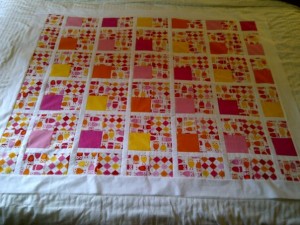
Patterning with Quilts: As an avid quilter, I brought in fabric squares to my Grade 2 class and had students help me plan a quilt. They loved this activity because it was “real” to them. They got to lay out the squares, plan the repeating pattern of colours (in this case light pink, dark pink, yellow, orange) and then see it come together. I would take the squares home and sew a row or two and then come back and have them recall what came next. I would then sew a few vertical columns and see if they could figure out what the next column would look like as the pattern changes in that direction, but there is still a pattern. We did a problem solving based activity with this quilt for weeks!

When I worked with older grades, I brought in fabric measurements (i.e., 100cm x 75cm in blue, 125cm x 50cm in green, etc.) and had them plan out the entire quilt top from start to finish and then the class voted on their favourite quilt and that is the one I cut and made. It is amazing how many ways using quilts in math can be differentiated too! Giving some students a quilt plan and asking them to use colour tiles to plan the pattern, while others are being asked to measure the fabric that would be needed to make that same quilt, allows for extensions galore!

 

Animal Creative Writing: Living out in the country, we have lots of animals running around our property. One of my favourites is our chickens. We have 8 chickens that wonder the yard and every now and then, one of them disappears for a while. I often give my class an update on what the birds are up to and they write about them. They love using pictures of the chickens, that I take on the classroom iPad, to illustrate their stories using different apps.

I find bringing my own interests into the classroom really helps my students to connect with the activities we are working on and it makes them feel like what they are doing is relevant.


 

Photo of Tammy Axt

Planning Time Coverage in an Autism Spectrum Disorder Class

Hi everyone! My name is Tammy Gallant and I am a music teacher for students in grade 1, 2 and 5 in the Peel District School Board. This is my fourth year as a music teacher and I hope to be able to assist those new to the planning time role in schools across Ontario. My school is a suburban school about 30 minutes outside of Toronto with a very high ELL population. In addition to music, I also have planning time coverage in the full day kindergarten and contained Autism Spectrum Disorder classes. I hope you enjoy my posts.

As mentioned above, I am very lucky to be doing coverage with the students in the contained Autism Spectrum Disorder class. A colleague of mine was also given the ASD class on a different day. So, the two of us decided to meet before the first day to discuss possible ideas for our 40 minute classes with them. The conversation went something like this:
“Tammy, what do you think we should do with these students during our first period with them?”
“Maybe we could try to do some songs or games, but I really don’t know these students as many of them are new to the school.”
“Which do you think would be better, a game or a song?”
“Well, possibly some songs. In the past, I have had great success with some action songs but I don’t really know this group of students that well. They may not like them.”
“What do you think about some kind of craft or art activity?”
“I haven’t done a lot of art activities in the past with the ASD class as they haven’t really enjoyed it. But, these new students might really like them.”
The conversation went back and forth like this for about five minutes until we both realized that we could plan all day long but it didn’t matter until we actually met and interacted with the students. We decided that our best course of action for the first four or five periods that we had this class was to try a variety of activities including: songs, bean bag games, puppetry, books, short videos, art activities, instrument building, costume play, French language exposure, etc… We also tried different structures within the class such as teacher-directed, small group, circle time, student-led, and exploration time.
We decided that we both would take some observational notes and meet after the first two weeks to discuss some longer term planning for this class. The aim will be to make it as enjoyable as possible for these students while supporting them to meet their own unique goals. I will keep you updated on our evolving program.

Overheard in an Ontario Classroom…
One kindergarten class was asked what kinds of things they could make up songs about. After answers like butterflies and school, one old soul in the front row raised his hand and told us that he would like to make up songs about being brokenhearted. One can only assume that his family are avid country music listeners.

Photo of Mike Beetham

Keep Them Learning

As June (and all it brings with it) unfolds, minds start to wander, summer day dreaming begins and as a result students start to lose their focus with all the activities that are competing for their attention. This usually results in increased classroom management concerns as well as a significant drop in productivity. My plan at this time of the year is to keep my students as engaged as possible to the very last minute. This is accomplished in two ways. The first is that they become decision makers in what we are going to learn about. This can be done either as a class or as individual learning modules. The students will compose a question to which they will seek to answer. How do words travel from a studio over the radio so that we can hear them is an inquiry chosen by one of my students this year. The questions they create have to be approved and meet the criteria we have pre-established.

The length of this unit is about 3 weeks and will culminate with a classroom open house whereby the other students in the school will be able to visit our work over two days. The student must be at their site in order to share information they have uncovered and answer any questions their audience may have. Needless to say, this unit generates some of the best work of the year. For me as a teacher, it allows me that opportunity to witness (and assess) the transfer of a year’s work of academic focus in  reading, writing and oral language.

The premise remains  the same as I have used drama presentations, storytelling and musical performances to keep my students school focused and engaged until the last minute of school.  I encourage you to share other ideas you have used or witnessed as end of the year units.

Photo of Erin G

Le passé c’est brassé – Bring the Passé Composé to Life (Part 2)

               An important lesson that I’ve learned this year is have the students write in a concise manner. In the following assignment, La journée de …, students must basically incorporate most of the major things we covered in approximately 10 sentences (passé composé with avoir/être, singulier/pluriel, compound sentences and adverbs). Originally in past years, I used to do a similar project entitled “Une semaine dans la vie de …” which involved them describing the week in the life of someone using the same requirements but was more than double in length. With my senior classes, I’ve been focusing more on quality rather than quantity by teaching them how to expand and elaborate on simple ideas. Again, the shorter length requirement is more feasible for reluctant FSL writers but showing all your students how to achieve more complexity allows your more advanced students to still be challenged. I’ve attached the project guidelines and reference sheets for you to view. Hopefully, it might be useful for an end of the year assignment.

la journee de project guidelines

Les activités possibles – au passe


Integrating Learning with Technology


  “Some teachers feel technology is being pushed on them, especially those who struggle with it. They might start using technology just for the sake of using it. This has shown to be an ineffective method for both tech-savvy and tech-challenged teachers. There is a big difference between using technology to teach and the successful integration of technology into lesson plans.“(http://www.edutopia.org/blog/help-teachers-struggling-with-technology-josh-work)


Here are some suggestions to integrate technology in a meaningful way that connects to curriculum:
  • in primary grades, use programs like Kidpix to have students create 2-D representations to demonstrate understanding for Science (Life Systems, Structures and Mechanisms)
  • watch videos of dance performances, (YouTube) and have students respond
  • have students select nature/architecture photo from images or take a photo with iPad and write poem to accompany photo/image
  • using spoken word poetry in the classroom https://www.youtube.com/playlist?list=PLC5PJtWBigV2f4TM4Gx7IlPe1ummqg5jt
Also, don’t feel that you have to be an expert before you “teach” the technology to your students. Think of yourself as a facilitator of a technological opportunity! You can and will learn along with your students.
Photo of Mike Beetham

Shared Learning – Not Competition

In a learning community the focus becomes a shared learning, teamwork and helping each member to reach their potential. This collaborative classroom design creates a community of risk takers, where talents blossom and are shared for the good of all over time. Now, lets shift the scene to a school staff. It is made up of a wide variety of individuals with unique talents and levels of experience. A diverse talent pool that when shared creates a school portfolio that meets the needs of all of its learners.

I share this blog topic based on my many years of teaching in a wide variety of schools and communities. My early years of teaching witnessed classrooms as separate entities within a larger building where the only sharing that took place was at staff meetings. The most rewarding settings were always where classrooms were not a competition between teachers but rather a continuum of grades that were seamless in their beliefs and goals. Teachers seeking help from each other was encouraged and not frowned upon. The sharing of resources should be common practive and not items to be hidden. Mentoring, teaching partners, grade level planning are all significant enhancements to teacher planning pedagogy. Regardless of your level of experience, I highly encourage that you make time for colleague collaboration for it will become a regular part of both your learning and planning. “Even Einstein asked questions!”

Photo of Erin G

Meeting the Challenge – What to Do With Immersion/Francophone Students in your Core French Classroom

     Imagine the following scenario. A former French Immersion student for the past 5 years transfers schools and winds up in a Grade 6 Core French classroom and is subjected to a year of learning basic vocabulary, how to conjugate “er” verbs and doing skits with “AIM” hand gestures. What a nightmare – and our Core French students think that they have it rough!
Over the years, I have had several competent French-speaking students who end up in the Core French stream for a variety of reasons. It can be quite daunting as a teacher to try to effectively accommodate and integrate them into the classroom. It’s almost like having a first year university student suddenly join your Grade 8 History class. I also find, somewhat ironically, that they can be even more challenging to deal with than your neediest students and actually pose the same problem. The difficulty becomes how involve them in the class in a way that they remain interested and motivated to keep challenging themselves as French learners.
     This year, I have a student in one of my classes who is a fully bilingual Francophone who went to all francophone school up until the end of Grade 6. After conferencing with him at the beginning of the year, he felt most comfortable learning alongside the rest of the class. I obviously altered the scope of the work and assessments and in consultation with him, designed some individual project. I still noticed that he wasn’t bursting with motivation (perhaps he never was) but still felt guilty at the thought of his languishing away.
     Finally in a conversation, it came up that he really enjoyed the time I had him working with a group of students on their pronunciation for a presentation. Suddenly, I had an idea. One of my most vivid memories of being in French Immersion in high school was getting to speak in small groups with an older (very good-looking by the way) student from France named Yves. We would go visit with him and just spend the time having a natural, relevant conversation. I thought this could serve two purposes: Charles would feel valued as an expert helping his peers and my students would also benefit by increasing their conversational skills.
Every Friday, I reserve the last 20 minutes of the period for Charles to lead the discussion group. Students must then report back to me and demonstrate the new language they learned so that everyone is accountable on all fronts. So far, it’s been a welcome experience for everyone.

Photo of Mike Beetham

Context – That Makes Sense

Please turn to page 134 in your Mathematics text and complete questions 1 -5. Students comply with smiling faces, complete the work, take up the solutions and then move on. Next day when you revisit a topic, it almost seems like they had forgotten everything that had been done the previous day. This is not a rare occurrence in classrooms of all ages. Research clearly points out how important the role of emotion is in learning. One of the most critical tools for a  teacher is the strategy of context. I always ask myself prior to developing a unit of study what would this concept or skill look like in the everyday life of my students. That helps me frame the context for the learning task.

When I am able to make connections to the everyday lives of my students and the focus of instruction in the classroom I find that the learning is more likely to be consolidated and accessed by the student in future related tasks. Here is an example of how I used context in February. I took my class to camp for 3 days. Prior to going to camp we had to look at what the total costs would be per person as well as for the group. The level of engagement was extremely high as they explored a real life task that required them to access prior mathematical knowledge. While at camp they took photographs and filmed a specific activity they took part in. When we returned to school we did a recount of our experience that was to be shared with their families. It was some of the best writing they had done all year and it allowed me to see a transfer of the skills we had been working on since September. There was no reluctance, no hesitation as the task was real for them.

Photo of Erin G

The ”EXPERT” Solution

A couple of months ago, I wrote a blog about the difficulties of trying to meet the needs of all the students in my grade 7 class.  Just to refresh your memory, this particular group has a unique set of factors at play which undeniably influence the overall dynamic and structure of the class: 33 students in total, almost a 2:1 ratio of boys to girls, 5 gifted students, 3 hsp and another 3 on IEPs. As a solution to managing the endless questions and difficulties of all students, I had set up a system of students who acted as “experts” in their group. I had recruited those students who felt they had a solid grasp of the material and who equally were able to demonstrate patience and good communications skills. Luckily I had more than enough who fit the bill. I had asked the remaining students to submit the names of the top three experts they felt comfortable working with and after spending a couple of months in this arrangement, I decided to move them around to new groups. In the process, I had asked the class to provide me with some written feedback on their thoughts about the “expert” system. On the whole, people thought that it was an effective solution but there were quite a few amusing comments which I had not anticipated. I thought I’d share them with you.

They could all see that having an intermediary was a good form of “blockade” and made life much easier for the teacher. Some were annoyed that their experts couldn’t answer all their questions while others were grateful for the time and effort they had put forth. Funnily enough (I suppose in response to those super demanding students), some had felt rather intimidated and overwhelmed with having to look up all the words in the dictionary for their charges. Others reflected how it was sometimes a thankless job where people were quick to criticize but slow to appreciate.

We had a subsequent discussion as a class where we had to specifically define the duties of the experts who were really only supposed to be the first line of defence. We talked about the need to balance demands with also giving the experts some space to get their own work done. Finally, it was established that the experts were not free labour nor did their duties include literally doing the work of others. With these new parameters in place, the system has been fine-tuned and is now running like a well oiled machine. The experts have achieved a near celebrity type status and seem to enjoy the esteem of their peers. We have now added a new tier as well – the “Experts In Training.”J

Photo of Mike Beetham

Personal – Professional Balance

Just a few more hours of marking. I can coach  three teams this fall. Sure, I will gladly help out with the school musical. No, sorry I can’t spend time with you this weekend I have work to do. I will just have to cancel my time at the gym again for that parent meeting. Does this sound familiar? It is a fine balance between teaching, volunteering and personal wellness. Often we will sacrifice our own well being for the benefit of our class and school. It is extremely vital that each and everyone of us know what that balance looks like (teacher, partner, aunt, sister, daughter, Mom) and to ensure that we are buidling in time and/or activities that keep us physically, emotionally and professionally healthy.

What is the value of your ‘yes’, if you never say ‘no’. Over the course of my career this has made more and more sense to me. Sometimes life feels like that runaway snowball that just keeps building and building. It seems that nothing is ever taken away. My change came from a very profound moment I had with my young son many years ago. I was focussed on school work when he approached me and I quickly brushed him off and said, I am busy right now. He looked at me with his bright blue eyes and said, “That is okay Daddy, we can do it in the summer”. Needless to say, I had to re-examne my priorities. Did he really believe that family life only occurred in the summer? I soon found out that even if I did not get every paper marked, every lesson done or gave up a volunteer activity or two that life at school still went on and there was no loss in the quality of the program I delivered nor in the relationship I had with my students.

Today, well into the  years of my career I have learned that I can still put 100 percent of my effort into my class and school during the day, have time for my family and most importantly stay healthy. I hope that this message can be learned by others faster than it was for me. A healthy teacher is more likely to have a healthy classroom. Your career is not a sprint, but rather a marathon. You are the most important asset in your classroom, take care of yourself.