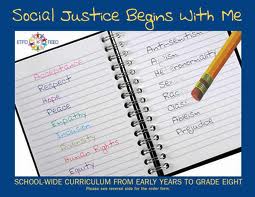
Social Justice Begins With Me Cover

Opening Hearts and Minds Through Social Justice

I recently blogged about an excellent new resource created by ETFO entitled “Social Justice Begins With Me.”  In my post I described how we implemented one of the lessons in the classroom and then extended our learning by taking it out into the community.  It was such a meaningful experience that I decided to share it with the entire staff as well as the  teacher candidate working with me.  As a result, staff members have now begun to try the lessons in their classrooms and the faculty supervisor overseeing my teacher candidate’s progress has also shared it with the faculty students.  The feedback has been phenomenal which is why I have decided to give you all a quick overview of the resource.

Social Justice Begins With Me targets Primary, Junior, and Intermediate grades with literacy focused lessons that are linked to picture books and short novels that target social justice issues.  The lessons guide teachers through various activities that embed both social justice issues and character education.  One of my favourite aspects of this resource are the ideas that support community involvement, thus taking the learning out of the classroom into a real-life context.  The lessons are also supplemented with graphic organizers, assessment tools and strategies, along with well organized lists of texts that include each synopsis.  The reproducibles are very helpful and applicable to a variety of activities.

My students have enjoyed the experience so much that they suggested we find a way to share our learning with the community in some way or another on a monthly basis.  We have just finished our fictional narratives by writing short stories which the class suggested we share with the folks at a nearby nursing home.  “We can take some scones or biscuits and sit with the elderly to share our stories,” they suggested a few weeks ago when we started the process.  “A lot of times old people are not treated very nicely or their families forget them.  This is one way we can tell them about what we’re learning,” one student commented.  Brilliant idea.  And it all started with a lesson on thanking those in our community with unappreciated jobs.

If you want to integrate social justice into your classroom, this is one of the best resources available.  Try it and please share your experiences with us.  I would very much enjoy to know how the lessons came alive in your classrooms!

Below I have included the direct link for those who want to take a closer look at the resource.

http://www.etfo.ca/resources/new/socialjustice/Pages/default.aspx


Photo of Alison Board

Integrating Art in Kindergarten

As mentioned in my previous post, I have been working on an Art Studio for the classroom that will provide enough space and materials to meet the interests of all the children in my class. Even though I have set up a physical space called the “Art Studio” there are other centres in the classroom where representational art is also taking place. At the Messaging Centre, many children are graphically representing their ideas with pictorial images, and in the Building Centre children are using the blocks to create designs and structures. We have a table where play dough is often provided, and this too allows the students to represent their ideas in 3-D form.

By integrating art throughout the classroom, I can access many areas of the curriculum in a way that is engaging and accessible for the children. For example, one of the first overall expectations in Science that I like to plan for is “demonstrate an awareness of the natural and human-made environment through hands-on investigations, observation, questioning, and sharing their findings.” Children need support to develop their observation skills and really notice what is around them, rather than assume an image that they picture in their mind. When you ask a child to draw a tree, they often draw the same straight trunk with a round green top on it! By taking students outside to touch the bark, notice the texture and observe the branches, children will develop an awareness and reflect their observations in more accurate representations.

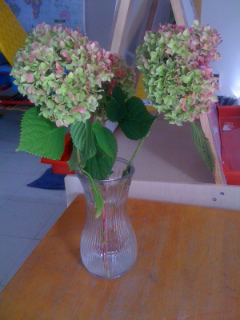
Strengthening visual discrimination in young children can be done at the art centre by providing an object to observe and represent. I often select a natural and aesthetic piece such as the vase of hydrangeas pictured below. A basket of leaves could also be used at this time of year. Then provide a controlled palette of materials. So for the hydrangeas I only set out pencils for drawing and coloured pencils that match the shades of the actual flowers, stems, leaves and vase. The children still have choice, but their selection is from a realistic palette that they will identify as they look at the object with discrimination.


Rather than make art for art’s sake, planned centres can be used to support skill development for visual discrimination, fine motor, and representational as well as integrate many subjects such as Science, Language, and Math.

A sign that say No Bully Zone

My Grade Six Bullying Task Force

In light of the focus on bullying that has come as a result of Amanda Todd’s heart breaking story depicting the path that led her to put an end to the pain and feeling of helplessness she endured for so many years, our class devoted much time and discussion to this urgent topic.  I, like every educator or parent reading this, find myself faced with the issue of bullying on a regular basis which can feel extremely frustrating.  However, this time around, I decided to take the topic further.

As we read picture books, learned about real life stories, analyzed the roles of the bully, victim, and bystander, and thought about what creates the mentality of a bully and the victims, we came to the realization that the knowledge and understanding we need to effectively deal with this issue lies within us.  We looked at ourselves, our care givers, the media, and our lifestyle to find the answers.

Earlier in the week, the government announced that a task force would be created to study this on-going issue on a deeper level in order to come up with strategies and recommendations to support the need for action.  I would like to save the government hundreds of thousands of dollars by sharing what my Grade Six Bullying Task Force created within the span of five days.  Keeping in mind that I am referring to a group of 30 ten and eleven year-olds, the experience was quite simply enlightening.

In a nutshell (and using “big words”), the main ideas discussed included the following:

  • we have all experienced the roles of being the bully, the victim, and the bystander.  Maybe one role has been more dominant so far, but if we take a careful look, we’ve taken on each of these roles at some point in our lives.
  • our upbringing and experiences with our care givers have a significant impact on the roles we choose to take on. No one is born a bully or victim.  Both come to be as a result of the words, emotions, and actions we are exposed to as we begin to make sense of the world.
  • we have a choice about the roles we take on in life.  The power lies within us to choose whether we will be a bully, a victim, a bystander, or none of the above.  Kids need to learn how their thoughts create their reality.
  • education through self-awereness is the most powerful way to unravel our ideas, beliefs, and feelings with respect to how we treat others and would like to be treated.  This will not work if educators and care givers continue to give a “time-out” to those who bully and pat on the back with sympathy to those who are victims.
  • we need to educate the ones who bully (including their care givers!) through self-awareness, empower the ones who are victims by working on their inner belief system, and hold accountable those who decide not to make a positive decision to change by taking legal action that has an impact on their future.
Bullying will not go away by spending millions of dollars on research and resources.  There has to be a fundamental shift in the way we educate and empower people to understand that our ideas and actions originate from a belief system which must be changed at the core if we’re to move forward into a positive way of being.  If a class of ten and eleven year-old get this, then we owe it to them to make it happen.
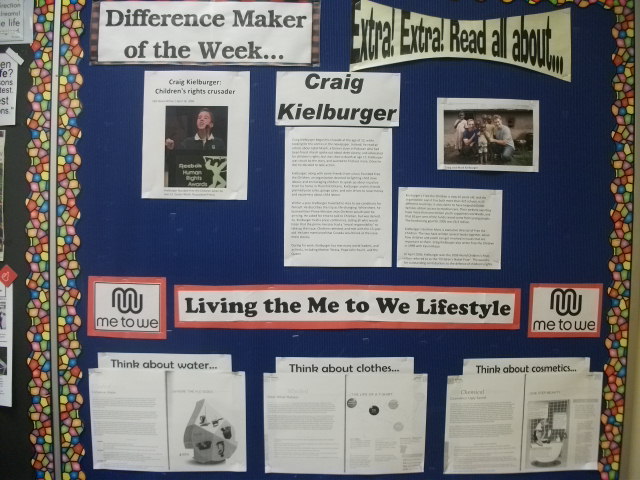
Living the Me to We Lifestyle Bulletin Board

Social Justice Begins With Me!

“A small group of thoughtful people could change the world. Indeed, it’s the only thing that ever has.”
-Margaret Mead

As we ease into another school year our class has begun to live the truth of this quote by Margaret Mead.  We started by becoming involved in learning a dance for a flashmob that we performed to fundraise for the Scarborough Hospital’s campaign to purchase a new MRI machine.  The students felt the opportunity was very meaningful and powerful.  It prompted read-alouds, class discussions, and journal entries on the topics of giving back to our community through simple acts of kindness and the power of believing that we can all make a difference in the world we live in.

This experience was a perfect segway to our Me to We Day.  The group of students who had the privilege of attending the celebration at the Air Canada Centre came back to school in awe and full of motivation to continue learning about how we can create a life where we are aware of how each decision, belief, and act impacts not only those around us but potentially people around the world.

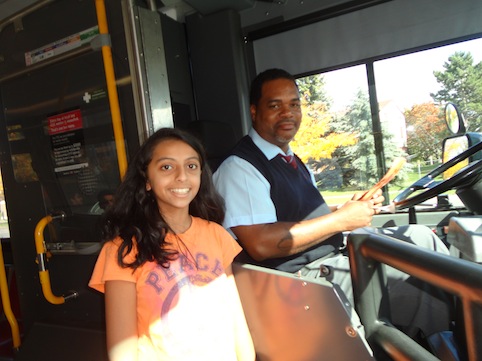
Feeling that the students were ready to embark on a year dedicated to social justice issues, I decided to use the resource “Social Justice Begins With Me! created by ETFO.  Our first activity centred around reading the picture book “Yanni Rubbish” by Shulamith Levey Oppenheim.  The activity proved to be one of the students’ favourites so far.  We discussed how certain jobs and professions are viewed as more prestigious or important than others and why that is.  Amazingly, the students needed absolutely no guidance with respect to understanding that all professions and jobs are important and necessary in their own way.  As a cumulative task, each student created a Thank You card for someone in the community that had an important but unappreciated job.  This Thanksgiving weekend, they gave their cards and took pictures with the recipients.

I cannot begin to express how satisfying it was to see the pictures of my students bringing such positivity to their community!

This email I received from a student says it all:

Hi Mrs. Oliveira!I gave the thank you card to the librarian(s)!!!! They were so thankful and grateful. The librarian that I gave the card to said she will make sure that she shows the other librarians!! When I left, I felt so good and so helpful! I couldnt bring a camera because they were all not available. I feel so happy!
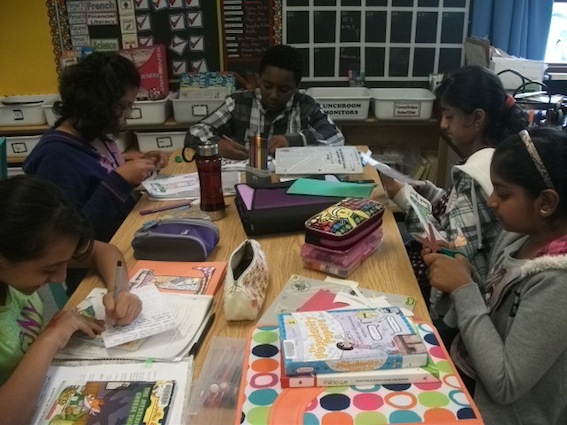
Students create their Thank You cards 
Thank You card cover
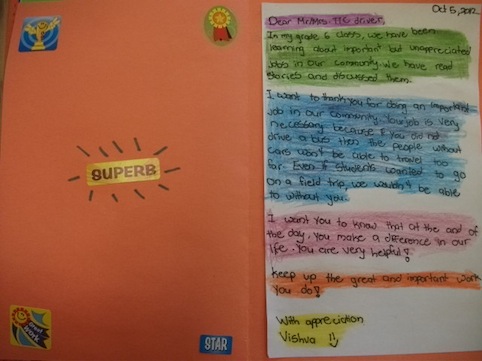
Inside a Thank You card
A student gives her card to a TTC driver


Photo of Sangeeta McCauley

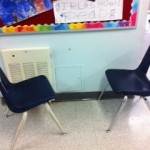
Talking and Listening Chairs

As I look back on this past week, I realize that I spent very little time teaching curriculum and more time working on life skills. I have two choices at this point. I could think, “Oh wow, I’m really far behind!” or “I’ve made a huge investment that I hope will pay off in the future.” I choose the latter.

My students have been coming to with me problems that happen at recess: someone left them out of a game, two friends were whispering something not-so-nice about them or they saw someone being treated badly and didn’t know what to do.

When we talk through these problems, it’s obvious to me that they have the answers on how to solve their issues, but they need a tool to help them do so.

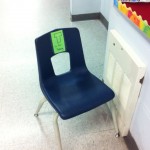
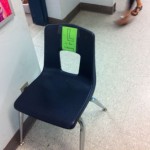
So, I introduce the talking and listening chairs. One chair is marked “T”, the other “L”.

We use one of the problems that happened to illustrate how to use the chairs. For example, “Bill” was upset that “Megan” was not listening to his ideas when they were trying to solve a math problem together. So, Bill sat in the “T” chair and Megan sat in the “L” chair and each had opportunities to talk about what was bothering them and listen to how the other person was feeling. It quickly became evident that they was room for compromise on both ends and they seemed relieved to be able to move on from this problem.

Like most tools, the talking and listening chairs also have boundaries, which I discuss with my students:

* If the person you want to take to the chairs is not ready, you may need to wait.

* If you go out to talk, you will need to attentively listen as well.

* If the problem takes longer than 10 minutes to solve, you may need some help.

* When classmates are using the chairs, we can show respect by giving them some privacy.

* If there are many students involved in the problem, we may need to discuss it as a whole class.

When students ask to use the chairs, I keep track of what time they step out in the hallway and occasionally walk by the door, so the talking and listening remains positive and focused.

As a tool, it can be very successful at helping students who lack confidence to speak up when something is bothering them. I especially enjoy watching, when some of my students who are still learning English approach a classmate to say, “I need to talk to you.”

I have yet to teach a curriculum subject that is more rewarding than that moment.

Photo of Carmen Oliveira

Lifeclass Begins

“The difference between school and life is that in school you learn the lessons and then get a test, but in life you get a test and then learn the lessons.”

This year I have decided to dedicate a substantial amount of time and effort to learning about and teaching life lessons that can be  integrated into my program.  Having spent the last few weeks really getting to know my students, I feel that they are a group of kids that can benefit from deep and meaningful lessons because they are both ready to explore them and in need of that support in their life.  I looked into integrating each lesson into our Literacy, Social Justice, Financial Literacy, and Healthy Living aspects of the curriculum.  So far, the students have really enjoyed their experience so I thought I’d share what we’ve done.

At the start of each week, I post a quote (linked to a life lesson I believe they need to explore) with questions to guide the students’ thinking.  They glue the prompt into their Journals and then have a week to complete the Journal entry.  The entries have written components and can also be expressed in artwork and various media (cartoons, posters, etc.).  The prompt is also posted on our website so students can share it with their families and hopefully discuss it together.

The responses I have received have been such a pleasure to read and I find that the students are working to try and incorporate the lesson into their way of thinking and acting.  They understand life so much more than we sometimes give them credit for!  At the end of the week, we share our thoughts, how we will use the lesson in our lives, and how some of us have already tried.  This week, the first thing out of their mouths as they walked in on Monday was, “Mrs. Oliveira, what’s the life lesson quote this week?”

If you’d like to take a look at some examples, you can find them in our classroom website.  Click “More” and scroll down to “Lifeclass”- it’s a simple idea that has my students learning about life in a way they’re ready to explore.

www.oliveiraclassroom.webs.com


Photo of Erin G

Summer’s Here! Oh yeah, it’s only the beginning of June (Part 2)

Pen Pals – Corresponding with Other Teachers and Students

Pen pals (via actual paper!! or computer) is a great way to link up with other students and teachers. This is something that is wonderful to do throughout the course of the entire school year but it’s also a fun thing to end off with as well. You have a couple options – actual correspondence with francophone students or even writing back and forth to your colleague’s classes at a different school. I’ve found that the yearbook page is a perfect lead in to this activity since students basically have already created their profile in French and can choose to alter it as they wish.

If you’re starting this activity in June, chances are, you’ll only have the time for one exchange but it is still worth it since students will naturally anticipate getting a reply to their letter. Something to consider is also meeting up with the other class and having some kind of event (café/speed meeting, etc) where they can meet and have a personal discussion in French. This exchange can be continued next year when students can continue to build a relationship through correspondence and even future meetings. Not only is this a great opportunity for the students, it also naturally provides a chance for teachers to collaborate with colleagues (much more rare for Core French teachers) on projects and even field trips.


Out of the Mouths of …..Former Students – Serious Words of Advice

Not to give the impression that the entire month of June is a time-filler but between class parties, field excursions, awards assemblies, tournaments, end of the year trips, graduation, etc, there are many days where you need a short/bridge activity. I stumbled across this particular idea entirely by accident when I bumped into four former students in the hallway. With an assembly that unexpectedly ended 40 minutes early and with no energy to entertain the hordes with another French game, I more or less coerced them to come into my class and give a short, impromptu talk about life in high school, and of course, their experience with secondary French.

Tiring of the oft repeated and unheeded “You’re going to need this in Grade 9…,” I figured it would provide my class with real-life renditions of high school experiences and dispel some commonly-held beliefs (or jaded accounts by ill-intentioned older siblings). What resulted was a spontaneous, dynamic discussion that covered a range of topics – challenges, differences with elementary school, preparedness, things they would have done differently, etc.

If you really wanted to play up the French part, it would be a good idea to invite those students who pursued French through high school and to discuss international travel opportunities and future studies/career choices. Somehow, it made a real difference having this frank, open discussion with former peers. They were engaged and because of their familiarity, took their advice seriously. In fact, it was so successful, they willingly agreed to stay and talk to my next class as well. From that year onwards, I always made a point to invite former students back for the same type of discussion. Not only was it beneficial to my grade 8s, it was also an empowering experience for my guest speakers as well.

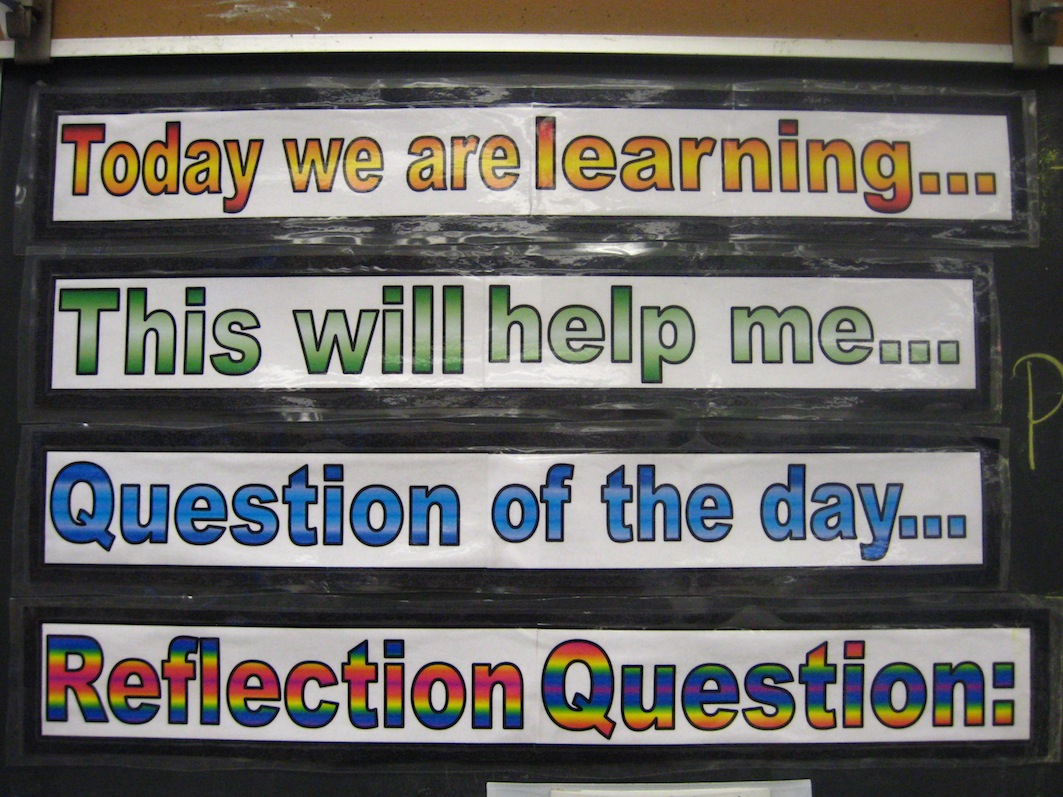
Learning Goals: Today we are learning...This will help me...Question of the day,.. Reflection Question

Students as Teachers: the Power of Modelling

Our school organized the annual “Jump Rope for Heart” play day to raise funds and awareness of the importance of heart health.  Since our Grade 5/6 classes are quite responsible, it was decided that the Grade 6s run the events, the Grade 5s act as team leaders and teachers simply supervise to make sure things ran smoothly.  What I witnessed that afternoon was nothing short of pure pride and astonishment at watching “mini” teachers at their best!

Team leaders would arrive at the stations and immediately count to make sure they had every child (JK-Gr4) accounted for.  They would then make sure that the children were sitting and paying attention to the station supervisors.  I was thoroughly impressed as I listened to the way they spoke with the younger children.  “You’ll get to have fun right after we find out how to play this game.  Remember that listening carefully makes it easier to understand what you need to do.  We’ll be asking you to repeat the instructions so make sure you listen.”  Wow.  I took out a camera to film and photograph these meaningful moments.  The team leaders then proceeded to explain and model each step.  They divided the children into those who felt comfortable with the activity and those that needed extra help.  As each group worked on their skipping skills, a leader continued to support them and modify steps so each child was successful!  “It seems like this may be challenging for you and that’s ok because you’re just starting to learn this.  You’re doing really well.  I’ll modify it for you to make it easier, then we can try going faster.”  Did she just say “modify?”  One of my favourite moments was watching them celebrate each students’ success.  High-fives were shared, cheers were abundant, and positive encouragement such as, “You did it!  You’re amazing!  I knew you could do  it!”  was given to everyone.  I simply sat back with a huge smile across my face as other teachers noticed the same thing.

Afterward, I showed them the video and let them know how amazed I was at what I saw that afternoon.  My students were proud, of course, but they reminded me that in our classroom that’s how we talk and act (most of the time).  “We’re doing what you do Mrs. O!”

The truth is that our actions are much more powerful than our words and if we want to teach children how to behave, learn, think critically, etc. the best way to do so is to model it in our daily classroom experiences.  I cannot stress enough the power of good modelling, self-reflection, and the celebration of success as we try to teach our students to become independent, motivated, self-confident individuals.


Photo of Erin G

Communicative Approach – On y parle!

In my recent blog, I commented on the latest approach ripping through the world of Core French like an F5 tornado. In all honesty, it might not be all that avant-garde since many of you are probably already covering some of the basics. What makes the communicative approach interesting to both students and teachers alike is that it is quite practical and offers kids an opportunity to actually speak French. I say “actually” because having students speak in French can sometimes seems achingly futile when, once dialogue scripts are removed, they seem not to be able to say much of anything. However, based on some suggestions from the workshop I attended and feedback from my students, we came up with a summative task that was quite successful for all.

For the past month, we had been working on a music-related theme and focusing largely on the grammatical concepts of adverbs, making comparisons and opinion-based statements. For our speaking assessment then, I proposed 3 options for having them create a natural, authentic dialogue between two/more people discussing their musical tastes:

  • (A) meeting in a music store
  • (B) calling in to a radio station and debating between two newly released songs
  • (C) scenario of their choice.

After handing them all a sample dialogue, I had them find and highlight the grammatical concepts (e.g., find and underline all the adverbs) to draw their attention to familiar elements. I find that always handing out an exemplar is fundamental in establishing your expectations and getting them to use vocabulary and language structures taught in class instead of ending up with a bad Google translation. What I did a little differently after that was ask the class what could be incorporated to make the dialogue sound more realistic and authentic. At that point, we brainstormed a bunch of expressions and inserted them appropriately and by the end, had come up with a great conversation.

Lastly, here are two suggestions that I have also found to greatly improve the quality of work (to be used also with written assignments). Make sure to continuously reference anchor charts posted around the room which for me, included how to structure a comparison, adverbs that add meaning, phrases related to expressing an opinion and brainstormed vocabulary. Finally, as a daily shared speaking activity, have four to five students answer various questions orally that could relate to the dialogue to get them accustomed to spontaneously speaking in French. Take a sample level 3 answer, write it on the board, and then modeling the use of anchor charts, insert expressions to demonstrate how to construct a level 4 reply. By the time of the dialogue, students will feel more at ease with the vocabulary/pronunciation and they will independently be able to add more complexity to their speaking. Bonne chance!

Photo of Alison Board

Excursions

When I taught Kindergarten last year, it was a half-day program. This was challenging for excursions, since we only had a two and half hour window to go somewhere and get back to the school so the children could meet their day-care providers for pick-up. This year, with my Grade 1/2 class, I have enjoyed many class trips. Most of them I organized or booked back in September to support the learning of our “big ideas.” A couple of trips were more spontaneous, like a trip to hear an orchestra, which was organized by the school.

On one of the trips, a parent volunteer that joined us for the day asked, ” Why do some classes in the school have more trips than others?” She thought that the trips were arranged by the school (administration?) for each particular class. This surprised me, but I explained that it was the discretion of the teacher. Years ago, my mentor suggested taking students on a trip once a month. I remembered this, and tried it out this year.

The places we visited were connected to our big ideas. I found the excursions worthwhile as it engaged the students, affirmed our sense of community as we ventured out of the school together, and provided alternative contexts for the students to create new connections and understanding. We visited a variety of facilities ranging from museums to conservation parks, which offered a range of indoor and outdoor experiences appealing to the many learning styles of the students.

Taking photos on the trip is a great way to document the learning. These photos can be shared with parents on a website as a form of communication or presented back to the students to promote more questions and thoughts. I often asked the students the same question when we returned, “What did you notice?” And it always amazed me how this open-ended question elicited observations that I never expected. We then recorded the observations of the students and used them for further investigation or discussion.

Class trips are like family vacations, you may not recall day to day events, but you often remember the big trips with happy memories.


Our class gets a guided tour at the zoo.