National Ribbon Skirt Day (January 4)

“A bill put forward by Senator Mary Jane McCallum to recognize National Ribbon Skirt Day has received Royal Assent and is now an act of parliament. McCallum was inspired to create the bill after a young Saskatchewan girl named Isabella Kulak was shamed for wearing a ribbon skirt during a formal school event” (Francis, 2022).

Bill S-219 was passed to create awareness and provide an opportunity for Canadians to learn more about the importance of Ribbon Skirts to many Indigenous cultures and heritage. “National Ribbon Skirt Day will provide an opportunity for everyone in Canada to recognize, learn about, and celebrate the importance of Indigenous traditions and expressions of culture. The Ribbon Skirt is one such tradition” (Crown-Indigenous Relations and Northern Affairs Canada, 2022).

In Indigenous communities, “Ribbon skirts are traditionally worn in ceremonies and during special events by First Nations women and represent the person’s identity, unique diversity and strength.  Women, girls and gender diverse people also wear them to express pride and confidence in their Indigenous identity and heritage.” (Crown-Indigenous Relations and Northern Affairs Canada, 2022).

According to the article by CBC News, A young Saskatchewan girl by the name of Isabella Kulak was targeted and shamed at a school function for wearing a ribbon skirt to the school’s formal event.  A teaching assistant told Isabella that her attire did not meet the requirements of ‘formal wear’ and that she should have worn a store-bought (mass-produced brand) to fit with the other students. Unfortunately, in Canada, this oppressive dialogue is not uncommon in the interactions of many racialized and marginalized people groups who choose to honour their culture or religion through their attire. According to Francis, 2022, while speaking at an interview On CBC Radio One, Isabella mentioned that on January 4, she would wear her ribbon skirt. She said, “It makes me really happy because lots of people can now wear their ribbon skirts proudly. I hope they are now proud of who they are” (Francis, 2022). Isabella’s father (Chris) mentioned that “No child should be treated like that regardless of where they come from or who they are” (Francis, 2022).

The passing of this bill is an opportunity for us as educators to gain deeper insight into the importance of traditions and practices in Indigenous culture. It is also a challenge for us to pause and think about what we deem ‘formal’, ‘proper’ or ‘acceptable’ as it has to do with how our students express themselves through their attire or nonconformity to what attires we think they should wear.

Louise Jocko of Birch Island near Manitoulin said, “Each person has their own story behind their skirts. Each person has their own colours that they bring with them when they make the skirt. I think it really does bring about the resiliency, and it shows the strength in our people that we’re reclaiming that culture and identity … wearing these skirts” (Gemmill, 2023).

There is still so much for us to learn, unlearn, and relearn. As we continue to work together to advocate for equitable learning practices and environments for all students, it is imperative that we all understand the importance of Bill S-19 in combating racism, discrimination, and oppression in all spheres, especially as it pertains to raising awareness of and celebrating Indigenous ways of knowing and being.

References

Crown-Indigenous Relations and Northern Affairs Canada. (2022, December 21). Bill S-219, an Act respecting a national ribbon skirt day, receives Royal Assent. Canada.ca. Retrieved January 1, 2023, from https://www.canada.ca/en/crown-indigenous-relations-northern-affairs/news/2022/12/bill-s-219-an-act-respecting-a-national-ribbon-skirt-day-receives-royal-assent.html

Francis, J. (2022, December 23). National Ribbon Skirt Day bill passed, to be celebrated on Jan. 4. CBC News. Retrieved January 1, 2023, from https://www-cbc-ca.cdn.ampproject.org/c/s/www.cbc.ca/amp/1.6694428

Gemmill, A. (2023, January 4). Marking 1st-ever National Ribbon Skirts Day in Northern Ontario | CBC News. CBCnews. Retrieved January 4, 2023, from https://www.cbc.ca/news/canada/sudbury/marking-ribbon-skirt-day-sudbury-1.6702580

Lambert, A. (2020, July 1). Crazy Hair Day. Crazy hair day. Retrieved January 4, 2023, from https://heartandart.ca/crazy-hair-day/
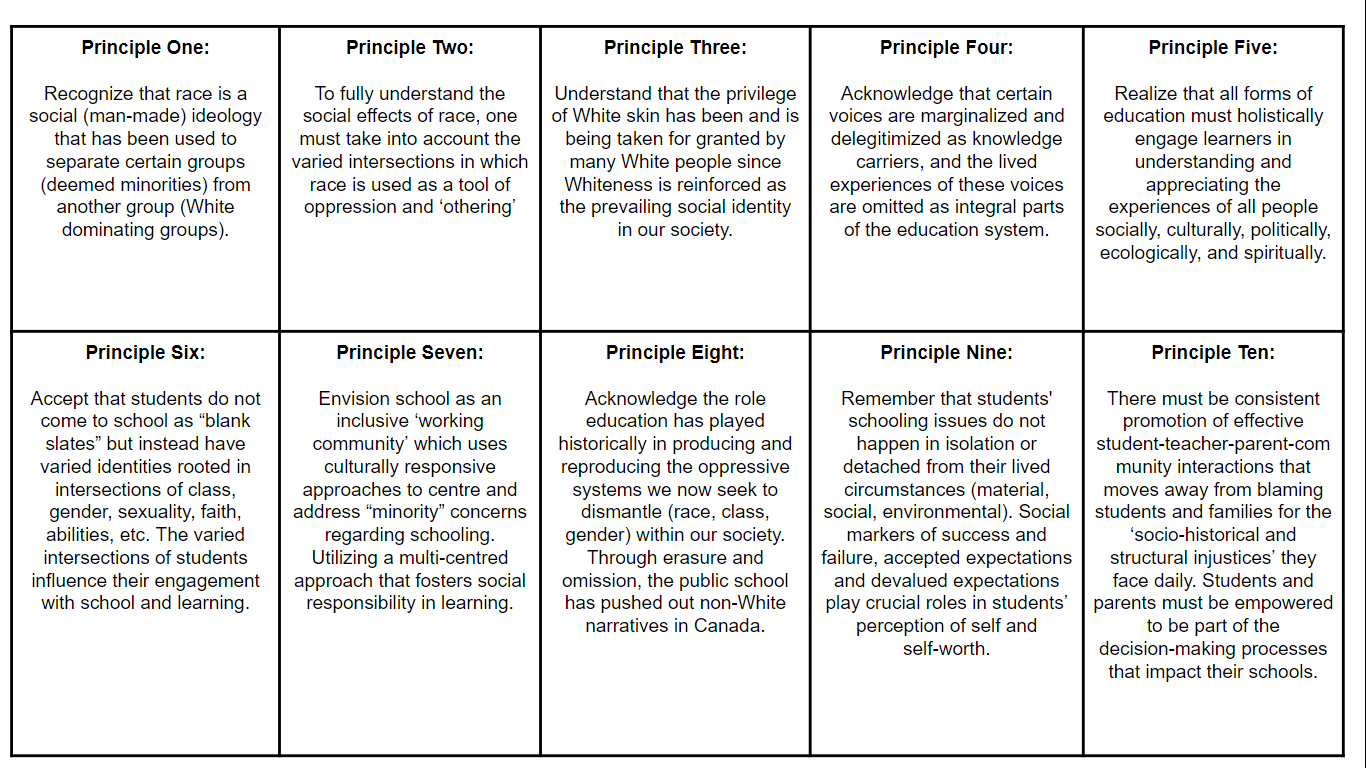
The Ten Principles [Anti-Racism Education: Theory & Practice].

An expression used colloquially in the English language says “______ wrote the book on that subject,” can be applied to George Dei’s research on Anti-Racism Education. Though written in 1996, it outlines so many fundamental principles of antiracism education that educators must grapple with in order to do this work well.

Race has been and is being used as an identifier, a marker that sets one apart from another, which is reinforced by the perceived dominant group through deliberate erasure and omission of narratives regarding who occupies particular spaces.  Action-oriented strategies and explicit identification and naming of race and social issues that strike at the heart of the power imbalance and inequities found in our education systems are what Dei explores in this resource, this call-to-action. The ten basic principles of Anti-racism Education are summarized in the chart below. “Anti-racism education may be defined as an action-oriented strategy for instructional, systemic change to address racism and the interlocking systems of social oppression… Anti-racism education seeks to build what has been termed “communities of differences.” This task can only be undertaken successfully if educators first learn how to deal with difference and the inherent conflictual interests and power imbalances in our societies.” (Dei, 1996).

As educators committed to teaching and learning centered on anti-racism and anti-oppression, it is pertinent to examine and reflect on these basic principles.

Ask yourself:

  • What areas in my teaching & learning styles foster anti-racist teaching?
  • What areas in my teaching & learning styles require change?
  • How can I integrate these ten principles in my learning environment (classroom) to foster equitable learning?

Taking the time to intentionally examine ourselves as educators, to think about our styles and reflect on our practice is essential to consistently cultivating meaningful learning for our students, particularly racialized students who are often not reflected at the forefront.

Examine, Reflect, Refine. This is one of the ways we continue to work towards ‘Building Better Schools.’

References:
Dei. G. J. S. (1996). Anti-racism education: Theory and practice. Basic Principles of Anti-Racism Education. Fernwood Publishing. Halifax & Winnipeg, Canada.

Reflections from 2022

As I reflect on the year we just had, I can’t help but feel proud of myself, all the educators and of course, the children that endured all of the challenges of the year we had. From countless closures to the uncertainties, our feelings of normalcy were starting to become a thing of the past. For someone who is normally so positive, I found it hard sometimes to carry on with a smile and try to spread the feeling of “All will be well.” So how do we learn from this? How do we use what happened in 2022 to guide us in 2023.

Well as I set goals for 2023, I think I would like to bring a couple of mindsets into the new year:

Never underestimate the power of an experience

2022 was made up of many lovely experiences- whether it be viewing a musical at the local high school or playing in a soccer tournament- students remember every single experience and love to look back on it. So try to take the opportunities as they come. Read every email because you never know when a fun opportunity could come your way. Also, never be afraid to make a fun opportunity happen! I know sometimes I wonder if the students will like something I plan or ask them to plan but they always end up reminiscing on how great of a time it was. So experiences are the greatest treasure I would take from 2022, right down to a game of trivia on the playground.

Nothing is forever 

I remember being upset multiple days during 2022 thinking, “I hope this doesn’t last forever” and the truth is, it never did. So positive thinking almost always wins and stressing over things that are beyond our control never works well. I hope in 2023 that when I am faced with a challenge, I will approach it without dreading its end date and that I can find a way out of it. I know that this will ultimately make me less stressed and will help me stay positive.

Breaks are for taking a break

I remember trying to plan any break we would get: Christmas, March, summer, etc. I would carve out a few days to plan as far ahead as I could get and not actually spend any of my break on break. This summer, I tried something different. I enjoyed getting married, my honeymoon and then after, I didn’t plan. I didn’t read any documents, instead I watched videos and read articles about first day activities. I read the exciting first day back opportunities our board had made and from there, I let things happen as they may. I started to really plan the curriculum after I got to know my students. Spending weeks of the summer mapping out a plan was something I thought I needed to feel confident about the next school year- however doing so during the first weeks of September proved to be much more productive. By then, I knew my learners and knew the style of teaching I would want to use for that group. This is a style of preparedness I want to save and continue on with for 2023. I don’t think I ever really tried taking time to take a break- a break from the business and the planning. Now I know I can do it.

There are so many other things I’d like to comment on but I have my activities saved in files, my memories saved in photos and of course, actual items saved in my class. I felt it would be most important to write down these mindsets so that others could try them. Although there are many lessons and units I’d love to try again, it’s more important to reflect on the feeling and mindset I’d like to have. Stress is a feeling almost every teacher shares, I’d love to see that change into something else. This blog helps me relieve some of that and I always hope there’s someone out there that will try it too. Either by reading, replying or trying to write their own version. 

Happy new year everyone! 


The Wind Down

2022 has come to a close. As I reflect on the year, there are 3 things that I will be taking with me into the next: finding moments to create; doing what I can; and resting. They’re simple and yet, if followed, I think they might help to make 2023 a little better for me.

Finding Moments to Create

When anyone asks me what I enjoy most about teaching, I say that it’s working with children. Sitting down and having the chance to interact and watching as students learn is very rewarding. In my role this year as a STEM teacher, I’ve had several opportunities to do just that. This month, students used cardboard and Makedo to create strong and stable homes that could withstand the huffing and puffing of the “Big Bad Wolf”. As group members worked together on their plans and designs, I had a lot of fun sitting with them to see how we could bring their ideas to life. It wasn’t easy at first but it was really neat to see how even our youngest students – the kindergartens – got the hang of it and created incredible homes that were so unique. Overhearing some tell the stories of their homes and what happens in their homes at the end was a great bonus. 

Reflecting on the year, the times that I enjoyed myself most in the classroom have been when I’ve had the chance to either watch students build or have built with them. Seeing the excitement that students have as they create something is truly a joyous experience. Whether or not it’s perfect, many love to describe the elements of their creations and often ask to save them so that others can see their work. Knowing the joy that creating brings, I’ve tried to incorporate more time for myself to be creative outside of the classroom. Whether it’s through making jewelry, painting or building with Lego, I’ve enjoyed creating and as I walk into 2023, I’m choosing to make more time to do so, whether or not I’m “good at it”. 

Doing What I Can

At the beginning of my career, I think I was very hard on myself when I had a lesson that didn’t go as planned or didn’t get as far as I hoped in a unit, usually due to time. At that point, I didn’t quite grasp that we teach the students in front of us and not who we expect them to be. Once I did, I found that teaching became easier. Don’t get me wrong, my expectations remain high for my students, it’s just that if more scaffolding is required, there’s learning needed and we take our time as we learn before moving on.

This year I had a few different design projects that I had imagined and yet we’re still on our first one. We’ve paused and regrouped while learning new skills and I’m proud of what we have been able to learn and accomplish so far. In 2023, we will continue to do what we can without judgment, knowing that learning is happening.

Resting

This year it didn’t take long for me to fully embrace the fact that I was off for 2 weeks. In years past, I would do a little work towards planning for January or start thinking about Term 1 reports but not this year. I need rest and I’m choosing to not feel guilty about having 2 weeks off to rest and get myself ready for school to start again. There will be no work beyond some writing for this blog and I’ve learned to embrace that. As I walk into 2023 I will continue to be intentional when I am at work and when it’s time to recharge, I’ll take the time to do just that. I do hope that you’re taking some time to rest and relax during this break. Teaching can be quite demanding. Remember that we need to take care of ourselves in order to make the most of the learning experiences within our classroom spaces. Refill your cup. You can only give what you have. 

As you wind down from the events of 2022, what might you take into 2023 that will help make it better for you? Wishing you all the very best for this coming year.

brr

Brrrr! Have you noticed that it’s been a bit chilly outside?
It’s so cold out that the bacon fat in my blood coagulated. 
It is so cold out that a polar bear was rummaging through garbage cans on my street.
It could have been a regular bear, but it was hard to see with all the snow and wind. 
It’s so cold out that I ran out of ideas to stretch out this opener. 

Moving on

We are in the midst of a well earned winter break however there is a bit of a struggle happening while gradually letting my guard down in order to relax. It is not easy to turn off my teacher brain. Even though this is not my first winter break, I still find it difficult. Maybe it was two successive Fridays of significant weather events that sapped energy from brain to body while commuting on unploughed roads, pushing cars of folx stuck in uncleared parking lots, or arriving home, at day’s end, to a 3 foot high windrow of ice and snow blocking my driveway that was in need of shoveling too. I know that was the fate of many over the latter part of this month. 

Perhaps it was the harried week we went through prior to the break. Not that the days were explicitly more difficult than others, but rather that they were so fully packed with all of the events, energies, and emotions to accompany the daily unpredictability that is life in the classroom. I am so thankful that we made it even though there might have only been fumes left in the emotional and physical tank. 

I write this from the relative warmth and comfort of my teacher cave away from the icy temps, relentless winds, and countless snowflakes, I do so with a great sense of gratitude. I am thankful for all of the lessons, failures, chances for do overs the next day, and for the changes. I am also appreciative of some time with close friends and family albethey only small frenetic moments shaped in part by the blizzard of 2022 and the outersections of our lives. 

Moving on for real this time

Although our gatherings this year were intentionally set to be small, the weather reduced their size even more. Nevertheless they were meaningful. Maybe less is more this year as I was afforded more time with each visitor rather than having to play host to a larger gathering? We took time to laugh, to remember, to catch-up, and to share a meal or two. It was fun to be pre-occupied with life in the kitchen for a few days. It was a joy to prepare, oops, co-prepare some meals. My contributions for our big dinner were to cook the beets, potatoes, and gravy. It was the last item on this To Do list that had me concerned. Even though I was sure it would all work out, I was still thankful to have a back-up known as mom. 

Listening to her walk me through the ingredients, prep, and execution gave me a lot of confidence that there would be gravy to serve. As we added, stirred and tweaked for consistency, I thought of how we have cooked together over the years and how she patiently explained things over, and over, and possibly over again to me as I learned how to do it. It was here where my thoughts raced back to the classroom, and to the gradual release of responsibility or GRR. 

I’ll admit that the correlation between my years as a kid in the kitchen with mom up to now and my life as an educator never crossed paths, but something about making the gravy helped it come into focus – along with achieving success on an important part of our holiday meal.

From the beginning where I handed her utensils, to measuring out ingredients, to stirring, and finally cooking on my own the GRR was always at the core of our time together, but when you’re used to cooking all the meals it takes a lot to finally step back and watch whether your lessons pay off. It also takes a measure of boldness and belief that everything will work out as planned or at least that the results will still be palatable. 

brr – boldly releasing responsibility

So in honour of time spent around the stove this holiday, and in anticipation of times to come deskside with students my wish for 2023 is for more chances to brr, and in doing so empower my students even more through preparation, opportunities, guidance, trust, and encouragement as they organize the metaphorical ingredients, measure, prepare, and create over the next 6 months and beyond in their learning. If all goes well, I am looking forward to taking the steps backward in order for them to move forward and to cheering for their success and confidence gained in the process. 

As Cristina Milo puts it, “Making myself progressively unnecessary. Therefore, a teacher.” Be bold when you take those steps back even when you think you should not let go. Be bold in the believe that the lessons you have shared are going to make a difference even when if the results are not perfect. Be bold in your own pursuit as a learner too. Cheers for lots of brr in 2023.

Rethinking Celebrations

Winter Solstice is a time of reflection as we appreciate what darkness brings and celebrate the return of the light, through longer days. After years of not being able to gather together and celebrate the changing seasons and other holidays, the opportunity to do so this year sparked a greater appreciation in doing so. It also allowed me to reflect deeply on what is truly important and what I will choose to focus on during 2023. 

In reflecting on celebrations, I thought of June, the end of the school year for us here in Ontario. What a joyous, transitional time for us to celebrate our school year, our students’ success and ready ourselves for a time of rest and relaxation as we anticipate summer break. 

The past three “Junes” were not quite the same as what we’re used to. Although this year, we will not likely endure drive-by graduations, individual photo-ops, social distanced chairs or other modified year end celebrations keeping us more than just physically apart; It is hoped we will finally be able to celebrate the successes of our students, together, in ways we have in the past. 

This opportunity to gather and celebrate student resilience and growth should be a celebration in and of itself. Perhaps though, the pause button during the peaks of the pandemic combined with the COVID-19 restrictions we were following, may also provide us with the opportunity to consider the past celebrations and rethink how we view student success and what we choose to highlight, honour and celebrate.

Last June, as the music teacher, I was asked to select one grade six student to acknowledge for their individual music achievement. To many, it seemed a simple enough task. Selecting the student who obtained the highest achievement or grade, showed the greatest improvement, was determined most valuable, or was the hardest worker were some suggestions to narrow down the recipient. 

But still I struggled. And in the end because I could not choose just one student, a music award was not given. 

Like many good teachers, I had spent the better part of the school year encouraging cooperation, interdependence and group success; I promoted group interaction and dialogue. And by the end of the year, my students, for the most part, became a unit. A group. A community. They were a community of learners: Where everyone tried their best; Where each student improved in some way; Where every single student felt valuable; And many attained high grades. 

Students supported and helped one another. In my eyes that was the success. What else could I want from a heterogeneous group of eleven and twelve year olds from varying backgrounds, strengths, challenges, and capacities? A community of learners. Could our year end celebrations recognize the collective success of students rather than honour only those whose individual achievements stand out? What message do we want to send our learners as they move into the world and become our future leaders? That of individualistic achievement and getting ahead of another or do we want to emphasize the sense of community, collaboration, collective growth, and group wisdom? 

As we move into 2023, and old traditions reemerge, I will continue to reflect on and challenge our traditions, their origins, and the messages they send by asking myself:

Whose philosophies are these practices built upon?  Whose worldview do they highlight? Do my current practices and past traditions align with my teaching philosophy, classroom makeup and community values?  I urge you to pause and ask yourself the same.