Blog

Writer's rainbow bulletin board

Keeping Track of Writer’s Workshop

In my many experiences of LTO teaching in Kindergarten, all my classes have taken part in Writer’s Workshop. We have all used the Writer’s Rainbow as a form of assessment of students’ writing, as well as students using it as a form of self-assessment. I have struggled with keeping track of student writing growth, and how to assess their writing come report card time.

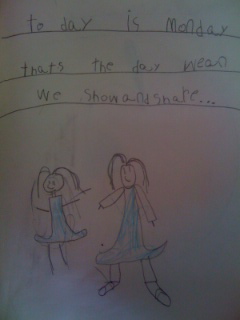
While working my current LTO, the teacher I am replacing has a wonderful way to easily keep track of student writing and growth. After every piece of writing, the teacher writes a little dot of the colour of the Writer’s Rainbow that the student achieved with that writing piece. I have continued to do this, and found it very easy to assess my students’ writing come SK report card writing. It was very easy to look through their writing journal and see whether the student was all over the board, or whether they were quite consistent with the colour of the Writer’s Rainbow. It was also very easy to see when students grew in their writing, by moving up a level (colour) or two. I have attached some pictures of the Writer’s Rainbow, as well as a students’ writing with the colour of the dot that corresponds to the colour they achieved. I highly reccomend doing this for any teachers, Kindergarten teachers or not, to use this as a tracking system of their student writing.


Photo of Erin G

The Unit Plan: The Timeless Form of the Pyramid

This may seem redundant, but I found that unit planning comes up frequently as a topic of interest during workshops for beginning teachers. This is probably due to the overwhelming nature of the job and all of the simultaneous demands coming at you. Consequently, a weekly (let alone a daily) plan is as forward thinking as one can muster at times. It is tempting to use the plans included with some of the resources or someone else’s. However, designing your own is really helpful because you’re forced to really organize your thoughts and direction. The best format of a unit plan that I have ever come across was given to me by a friend at the Halton Board and was the template used by French teachers there. As someone who is very visual and relies heavily on graphic organizers, I immediately put it to use. Without getting bogged down by detailed descriptions, it is very simplistic and allows you to clearly chart a course of action.

 
Shaped in the form of a pyramid, the base is the featured language structures. What follows next are the diagnostic assessments and activities leading to the formative assessment. Finally the peak is your summative assessment. I always begin with the base of curriculum requirements and move on to create the summative assessment related to those. I then plan out the individual activities/lessons that students will need in order to be successful in the final task. What I really like about this format is it allows you to plot out everything and to foresee any possible gaps. In the end you’re left with an efficient, simplified yet cohesive vision that relieves the stress of incoherent and random planning. Both you and your students will benefit. I have included a blank template as well as one of my sample units. Strangely enough, unit planning can be as satisfying as cleaning out one of your messiest closets.

 
pyramid unit plan – sample
pyramid unit plan template

Photo of Erin G

Crepes- Tradition Meets Delicious in French Class

Last year I wrote a blog about making crepes in French class as an opportunity for cultural enrichment. Although students really seem to enjoy making and (especially) eating them, it can be an even more interesting experience knowing the history and tradition behind them. Many years ago, I came across a thorough history of the crepe (who knew they dated back to 7000 BC??) and condensed it into manageable paragraphs. To make it more accessible to students, I added a “lexique” of the harder words along the side with a few graphics as a visual aid (please see attached text). In addition to a formal reading assessment of decoding and comprehension, you could also have students draw a historical timeline. In terms of making connections, we had many interesting discussions as a class about similar variations of crepes and what other dishes in their own cultures were also traditionally significant. As with other subjects, French becomes interesting when you can relate it to something larger and that is personally relevant. In that sense, you can get a lot of mileage out of a bit of sugar, flour, eggs and milk.
P.S. Ideally, the crepe activity should coincide with the Mardi Gras celebrations occurring in mid-February. I was swamped and although I had it written, I didn’t get to post it in time. However, crepes are good at any time of the year and especially in the lead up to vacations of any kind when students tend to be unfocused and not as interested as perhaps they should be in the superlative form of adjectives…

Les crêpes-vue historique texte

Fairness in Kindergarten

Fairness is a hot topic among children in Kindergarten! It is one of the first judgments that you hear as one child confidently points out that something isn’t fair. After reading Carmen’s informative and thought-provoking post about equity, it encouraged me to consider it in the context of the Kindergarten classroom.

I have found that read-alouds about topics such as fairness are a good starting point. The stories are didactic in that they provide characters and scenarios that the children can relate to and support personal connections for the students. The message is conveyed in a less instructional, more entertaining way.

The book, Big Red Lollipop by Rukhsana Khan, is an example of an engaging story that addresses the idea of fairness not always having to be the same for everyone. It is a story about a girl, Rubina, who is invited to a birthday party. Her mother insists that she brings her little sister, Sana, an embarrassment to Rubina. When it comes time for Sana to get invited to a birthday party, their mother wants to send the youngest sister. Rubina interjects and tells her mother that only Sana was invited and she should go alone, knowing that her sister will have a better experience if their experiences are different. Sana appreciates her sister’s understanding and shows her appreciation with a lollipop.


Another book to read aloud for discussion, is Peter’s Chair by Ezra Jack Keats. In this story, Peter is upset when he realizes that many of his things are being painted pink for his little sister to use. The highchair is already painted, but he rescues his little chair before it succumbs to pink paint as well. He wants to run away with his special chair, but realizes it is now too small for him to sit in. He returns with the chair and they paint it for his sister. Although, the bigger idea is about acceptance and change, there is also a connection to the idea of fairness. As we grow, expectations change and what was once appropriate may no longer be the case. Things do not remain the same, situations change, and what was considered fair may not remain so.


There are many opportunities to talk about fairness in Kindergarten. Often, the teacher may need to respond to the statement, “Why does he get to do that? It’s not fair.” And the teacher will respond, “Fairness isn’t the same for both of you. It is what he needs right now.”

Newspaper Poetry

Discovering Our Inner Poet

I love teaching writing.  Let me be more specific.  I loved teaching writing except when it came to poetry.  For some reason, I’ve always managed to bring to life the other writing formats and genres with engaging lessons set upon a backdrop of real world contexts.  The students, for the most part, ate it all up and asked for more.  That is, until  I mentioned we would be exploring poetry.  The good times would come to a screeching halt as their faces reflected what I had also thought of poetry as an elementary student: boring and challenging to understand (how did I know what so-and-so meant by this-and-that?…and who cares?).  So of course, with my determined and stubborn personality, in the past few years I’ve focused on learning how to breathe life into this wonderful writing genre.  It hasn’t always been an ocean of roses but, for the most part, the exploration has led us to a whole new level of appreciation and learning.

We have just completed our poetry unit (which will continue  informally throughout the year) and I can honestly say that the class thoroughly enjoyed it.  I’d like to share with you a few of the activities and resources that made the experience engaging, meaningful, and memorable.

If you haven’t already done so, I strongly encourage you to purchase Classroom Events Through Poetry by Larry Swartz (just purchase any of his books on poetry and drama and you’ll be well on your way to an incredible teaching/learning experience).  It’s a practical and concise book that provides easy and meaningful activities to explore poetry in our classroom and our lives.  We started by looking at poetry in books, researching it on the internet, and sharing it with each other in daily poetry circles.  We created newspaper poems by cutting out words and phrases and ordering them to try and create a themed poem.  We took 2-4 sentences from a favourite poem and created a graffiti wall on our classroom door (the students thought this was very cool!).  We acted out poetry, sang poetry, and shared the lyrics of our favourite songs after listening to them together.  We learned about different structures by having groups of students become “specialists” as they taught the class the structure, gave examples, and had everyone try to create their own.

The culminating task involved creating a poem in the structure of their choice and presenting it at our Poet’s Cocktail Party!  This was no ordinary party!  Invitations were sent out, the poems were displayed all around the classroom, students dressed up, and food was ordered (grapes, cheese, crackers, cupcakes, and grape juice in place of red wine).  As jazz music played, students mingled by reading each others’ poems and discussing their thoughts and opinions.  A few students shared their poems and we snapped our fingers in appreciation of their work (yes, we snapped fingers, not clapped because that’s apparently what poets do).

A few students decided that they wanted to enter the Urban Voices poetry contest and their poems have been sent off.  How special would it be to have a winner come from our class!  Keeping our fingers crossed.

We cut out words and phrases from newspapers and ordered them to create a themed poem.


An example of a newspaper poem.


An example of a newspaper poem.


Students took 2-4 lines from favourite poems and created a graffiti wall on our door.


This poem was presented at our poetry cocktail party.
Photo of Carmen Oliveira

Equity Work: Difficult and Transformative

I am currently taking a Mentoring AQ course that is really impacting my understanding of equity in education and how I can work with my colleagues to explore this topic in our teaching practice.  I truly believe that it is necessary for all of us to take a step back and explore equity as it pertains not only to our classrooms, but to our schools, communities, and personal lives as well.  I have decided to share some of my learning and wonderings as I take a closer look at the “Equity Continuum” from OISE’s Centre for Urban Schooling and the TDSB’s Equitable and Inclusive Schools site.

OISE Centre for Urban Schooling: http://cus.oise.utoronto.ca/

TDSB Equitable and Inclusive Schools: http://www.tdsb.on.ca/_site/ViewItem.asp?siteid=15&menuid=570&pageid=452

Just some food for thought…

Fairness does not mean everyone gets the same. Fairness means everyone gets what they   need.”-Rick Riordan, The Red Pyramid

This very simple and yet profound quote set off a critical unit of inquiry around equity in my Grade 6 classroom last year.  Over the span of a few weeks (and subsequently the school year), we explored, discussed, questioned, challenged, and brought to light this important understanding that, in order for everyone to experience success and a strong sense of self, they would not necessarily need to be treated exactly the same.  The best part of this experience was my own journey as I grappled with my previously constructed schema around equity and fairness in all aspects of my life.

I vividly remember coming back after a supply teacher had been in the classroom during this period of inquiry and having my students astonished and fuming at her reaction when a student asked for extra time and a quiet space to complete a task.  She said she had to be fair and that everyone would need to hand it in at the same time.  When the students let her know that fairness is when they have the right to learn the way that is best for them to be successful and in our classroom that means people may need different treatment, she completely disagreed in a manner that undermined what they had come to understand as being “fair.”  Our conversation was lively, to say the least, and their questions were ones I have come to ask many times since then: “How can we get people, especially in education, to think about fairness as a way of everyone getting what they need?” and, “How can we create a positive space where teachers, students, and parents question, challenge, voice their own opinions, and feel that they have the right to self-advocate?”  (Theirs were in kid-friendly language, of course).

After looking at the “Importance of Equity in Education” from the TDSB’s Equitable and Inclusive Schools page as well as the “Equity Continuum” from OISE’s Centre for Urban Schooling, I came to realize that, for me, the reasons that make equity work personally and professionally difficult are the same as those that make it transformative and fundamental if we are to move forward in education.

Whether it be with friends, colleagues, mentees, students, or parents, I find that when a conversation begins to challenge the status quo, challenge stereotypes, or involves having to critically look at ourselves, our beliefs, our expectations, or our practice, discomfort can quickly build up and the outcome takes the form of people shutting down, becoming outwardly upset, and unfortunately not evolving or learning from the experience.  I feel that at the core of this difficulty in equity work is the reality that all of us are complex beings having been influenced on so many levels in so many ways by so many people throughout our lives therefore often making us oblivious to how our own story is projected in what we think, say, and do both personally and professionally.  We seem to jump at the opportunity to try and convince others to take our viewpoint and find it easier to criticize those who do not share our beliefs.  However, looking at and inside ourselves is a whole other story.  Thus, the difficulty lies in welcoming discomfort as we tread the path of looking at equity not only by having others explore it but in also working through it ourselves.

The beauty and transformation in equity work comes about when we all courageously welcome the discomfort that arises in questioning our belief system as it pertains to our own culture and that of our school, classroom, and global community.  When we are willing to question the status quo, challenge stereotypes, critically think about how our experiences and schemas influence our pedagogical practice, hold all students (and anyone connected to education, for that matter) to the highest standards and expectations regardless of race, ethnicity, religion, gender, linguistic competence, etc., we begin to pave a path toward open-mindedness, acceptance, respect, and transformation not only within our personal lives but in our professional practice as well.  When I began to take a deeper look at the Equity Continuum, I came to the realization that, even though I honestly believed I understood equity and had infused it in my teaching, there were so many other layers to it that I had not yet begun to peel back.  In the world we live in today, this may be one of the most important questions we can ask ourselves as educators, parents, leaders and global citizens, “How will we work to ensure that everyone gets what they need to live a dignified life?”

I now know where my focus on equity will take me: unlearning what I have over time come to believe as the truth when it does not support the idea that everyone can be held to the highest standards and expectations regardless of their cultural background, race, gender, socio-economic status, etc.  I’m willing to get my hands dirty as I explore the topics, ideas, beliefs, experiences, and realities that continue to shape my understanding and practice of equity within our education system.

As Will Durant commented, “Education is a progressive discovery of our own ignorance.” I chose this quote because it can provoke discomfort by having us admit that we may be ignorant while also noting that the path to discovery is progressive which to me signifies that learning happens when we entertain that which may make us uncomfortable.  Learning is messy business.  That’s what makes it transformative.


Reporting for JKs

The Junior Kindergarten Summary is an important document, as it is the first formal written assessment that parents may receive about their child. In saying that, there also should be no surprises when they read the report. Part of the reporting process in Kindergarten is to provide ongoing assessment in an informal basis when necessary through notes, phone calls, or updates during face-to-face interaction at entry or dismissal times. If you feel that a report you have written may have information that would be of specific concern to the parent, you may want to give a “heads up” phone call before your reports go home in February. If however, you have shared information with parents/guardians regarding a child’s struggles or difficulties in adjusting to the program, then the report will be of no surprise and act as a record of the child’s development at this time, which may be referred to if struggles continue in the next year or two.

The Summary includes three broad areas to provide information for:

1) Interests and Strengths – Try to individualize reports as much as possible. In this section you want to highlight what the child can do (not what they can’t do compared to others). Qualifiers on scripted sentences will not work, as each child will have different interests and different strengths. Suggestions for this section include mentioning the learning centres that the child most enjoys, the ways in which the child contributes to the class, and what attributes the child brings to either group discussions or play.

2) Development and Learning – In this section I would suggest providing assessment on the child’s development according to any of the six areas of development: Personal and Social Development, Language, Mathematics, Science & Technology, Health & Physical Activity, and the Arts (see http://www.edu.gov.on.ca/eng/curriculum/elementary/kindergarten_english_june3.pdf). Remember, you are stating where the student is based on the outcomes/expectations at the end of a two-year program. In this section it is a good idea to draw on specific examples of a child’s learning by quoting what they have said, or referring to something they did or created.

3) Planning for Further Learning – Here you can provide two short paragraphs. One for the planning that the Kindergarten teacher/team will implement to support or extend the child’s learning, and another short paragraph to suggest practical ways that the parents/guardians can help the child at home. Rather than suggest “reading to your child” (which we always want to suggest), you can add specific ideas like counting the floors on an elevator ride to your apartment; counting cheerios at breakfast, learning the sounds of letters on cereal boxes, learning how to write the names of family members. These suggestion may sound obvious to you, but they may be more useful to the parent than suggesting they work on letters and numbers with their child at home.

When you re-read your finished reports, it is important to get a sense of who the child is – including their strengths and needs. It is also a good idea to add an encouraging line at the end of the report, noting the child’s efforts and accomplishments in their adjustment to Junior Kindergarten.

Photo of Tina Ginglo

Using Audio for Self-Assessment

I have added a new layer to the writing process in my third-grade writing workshop.  As I wrote in a past post, our writing workshop process begins with students writing in their Writer’s Notebooks.  When a writer completes a piece of writing, they then meet with their assigned writing partner and/or me for a writing conference.  At this conference, writers review the success criteria for their writing assignment and then identify two ways in which they have successfully met the criteria.  Writers then identify one criterion that needs to be developed further. They then transfer their writing to their laptop keeping in mind the feedback they received and making their revisions as they type their second draft.  Ultimately, writers post their narratives in their writing group on Edmodo.com where they receive more feedback from their group members.

Using Audacity software and a set of headphones with microphone, my third graders have learned how to read and record their personal narratives.  Once recorded, students listen back.  They then ask themselves two questions:  “In what ways does my story sound like a real story?”  And “In what ways can I make my story sound more like a real story?”  Students enthusiastically record their stories.  This component of the writing process engages those auditory learners who could benefit from this new component of the writing process.

I have changed the way I phrase these reflection questions.  At first I instructed students to ask themselves, “Does my story sound like a real story? Yes or no?”  If yes, why does it sound like a real story? If no, why not?”  I found that this self-assessment exercise wasn’t making a significant difference in their writing.   I concluded that it wasn’t the process that was ineffective, but the questions I was asking writers to consider.   These yes/no questions left writers basically rating their narratives as “good” or “bad.”  Their narratives either sounded “real” or didn’t.  These questions didn’t allow students to identify the strengths in their narratives and where it could sound better.  Realistically, all of my writers’ stories sounded a tad real, some more so than others. The goal here is to make everyone’s writing sound better. Using these new questions should ultimately improve the writers’ craft.

I am also thinking of adding audio to the writing conferences with writing partners and teacher.  Some students struggle to give feedback on other students’ writing for a number of reasons.  Perhaps a student’s penmanship is difficult to read or spelling or punctuation is interfering with comprehension.  Listening to a story as it is intended to sound eliminates those barriers to comprehension.

I am proud of my third graders.  Each day they are becoming more independent writers.  I believe the secret to their success is that the students understand the flow of our writing workshop and, thanks to clear success criteria, they can identify their strengths as writers.   They see themselves as writers!   I am fortunate to have access to audio technology.  In reality, you don’t need computers or even headphones to make this happen in your classroom.   You can go “old school” with a mini cassette recorder.   Some old cell phones have recording devices.  One of our goals is to teach our writers to write like readers and read like writers.  Using audio is one way to get there!

Writer's wall bulletin board

Writer’s Wall

Do you ever wonder what to do with all the wonderful pictures and cards that students create for us teachers? Do you ever guilty putting pictures in the recycling? I know I have! And I have found a solution for you…

Create a We Are All Writer’s board. On one of the bulletin boards in the classroom, I have posted student work on this wall. This is such a wonderful idea because students get to show their work off to the world, it is all in once place, and students are recognized for being writer’s no matter what they are writing/drawing. My students love to create pictures and cards for me, or for others in the classroom, and having this wall is a great idea!

Here is a picture:

List of 2013 Goals

Goal Setting…Even in Kindergarten

Upon the return to school after the Holiday Break, I thought it would be interesting to see how goal setting might look in Kindergarten. We had a little discussion as a whole class about goals, and how at this time of year many people create goals for themselves. We brainstormed some common goals some people may want to make for themselves. Then, I made it specific to school, and my students brainstormed some ideas of Classroom Goals we should have for the 2013 school year.  I have attached our goals for each Track that I teach. Some were very similar, but some were very creative and inclusive to that Track only. I was very proud of my students for coming up with such amazing goals.


I also got each student to write about what they would like to learn about for this upcoming year. Again, I was shocked and and so proud of the goals many of my students came up with!

See these goals at: https://mobile.twitter.com/class_pryde/status/289774661540147200/photo/1

https://mobile.twitter.com/class_pryde/status/289774263022534656/photo/1

Goal-setting can happen…. even in Kindergarten!