Photo of Lisa Taylor

Themes of Success: Passion for Teaching

When I sat down to think about my very first post for this blog, it was suggested to me that I share some information about myself. So that is where I started. I would share that I have taught for 8 years in the Upper Grand DSB (Guelph and area), that I am currently released from the classroom as Chief Negotiator and Staff Officer at my Local ETFO Office, and that I am a crafter, musician, mother, wife, and animal lover. So many ideas came flooding through!

In reading through the first chapter of Heart and Art, I came across the Themes of Success: themes that emerged after over 2,500 teachers were asked to share their best teaching experience from that year. The heading Passion for Teaching (Page 8 ) really spoke to me.

Passion for Teaching highlights the importance of connecting your own personal experiences and passions with your teaching by drawing on your own personal “resources” for support. I decided this would be the perfect place to start, as I could share some ways that I have done this with my classes with great success, and in the process, you will get to know me a bit better!

Patterning with Quilts: As an avid quilter, I brought in fabric squares to my Grade 2 class and had students help me plan a quilt. They loved this activity because it was “real” to them. They got to lay out the squares, plan the repeating pattern of colours (in this case light pink, dark pink, yellow, orange) and then see it come together. I would take the squares home and sew a row or two and then come back and have them recall what came next. I would then sew a few vertical columns and see if they could figure out what the next column would look like as the pattern changes in that direction, but there is still a pattern. We did a problem solving based activity with this quilt for weeks!

When I worked with older grades, I brought in fabric measurements (i.e., 100cm x 75cm in blue, 125cm x 50cm in green, etc.) and had them plan out the entire quilt top from start to finish and then the class voted on their favourite quilt and that is the one I cut and made. It is amazing how many ways using quilts in math can be differentiated too! Giving some students a quilt plan and asking them to use colour tiles to plan the pattern, while others are being asked to measure the fabric that would be needed to make that same quilt, allows for extensions galore!


Animal Creative Writing: Living out in the country, we have lots of animals running around our property. One of my favourites is our chickens. We have 8 chickens that wonder the yard and every now and then, one of them disappears for a while. I often give my class an update on what the birds are up to and they write about them. They love using pictures of the chickens, that I take on the classroom iPad, to illustrate their stories using different apps.

I find bringing my own interests into the classroom really helps my students to connect with the activities we are working on and it makes them feel like what they are doing is relevant.


Photo of Tammy Axt

Planning Time Coverage in an Autism Spectrum Disorder Class

Hi everyone! My name is Tammy Gallant and I am a music teacher for students in grade 1, 2 and 5 in the Peel District School Board. This is my fourth year as a music teacher and I hope to be able to assist those new to the planning time role in schools across Ontario. My school is a suburban school about 30 minutes outside of Toronto with a very high ELL population. In addition to music, I also have planning time coverage in the full day kindergarten and contained Autism Spectrum Disorder classes. I hope you enjoy my posts.

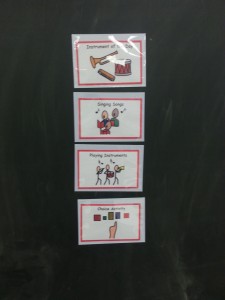
As mentioned above, I am very lucky to be doing coverage with the students in the contained Autism Spectrum Disorder class. A colleague of mine was also given the ASD class on a different day. So, the two of us decided to meet before the first day to discuss possible ideas for our 40 minute classes with them. The conversation went something like this:
“Tammy, what do you think we should do with these students during our first period with them?”
“Maybe we could try to do some songs or games, but I really don’t know these students as many of them are new to the school.”
“Which do you think would be better, a game or a song?”
“Well, possibly some songs. In the past, I have had great success with some action songs but I don’t really know this group of students that well. They may not like them.”
“What do you think about some kind of craft or art activity?”
“I haven’t done a lot of art activities in the past with the ASD class as they haven’t really enjoyed it. But, these new students might really like them.”
The conversation went back and forth like this for about five minutes until we both realized that we could plan all day long but it didn’t matter until we actually met and interacted with the students. We decided that our best course of action for the first four or five periods that we had this class was to try a variety of activities including: songs, bean bag games, puppetry, books, short videos, art activities, instrument building, costume play, French language exposure, etc… We also tried different structures within the class such as teacher-directed, small group, circle time, student-led, and exploration time.
We decided that we both would take some observational notes and meet after the first two weeks to discuss some longer term planning for this class. The aim will be to make it as enjoyable as possible for these students while supporting them to meet their own unique goals. I will keep you updated on our evolving program.

Overheard in an Ontario Classroom…
One kindergarten class was asked what kinds of things they could make up songs about. After answers like butterflies and school, one old soul in the front row raised his hand and told us that he would like to make up songs about being brokenhearted. One can only assume that his family are avid country music listeners.

Exciting new opportunity


Hi! My name is Kelly McLaughlin and I am a new occasional teacher for the Hamilton Wentworth Public School Board. I am so excited for this new opportunity and am awaiting each day to let the adventure begin.

Before I was fortunate enough to receive an interview to be on the supply list, I was doing my final placement at a beautiful school in Ancaster. There I was able to start a choir of about 30 girls and 1 boy and we sang at different events for the school. My passion is music and always has been as during my previous placements I have always tried to get a choir started as well. Through this passion, I was able to take the AQ course for instrumental music. So hopefully this year I will be able to share all about my experiences in some of those classes as well. I really do love the fact that music in schools nowadays is not just crossword puzzles and theory but a hands on experience which will allow children to have an appreciation for instrumental music at a young age. This will hopefully foster their love for it and allow them to carry on with playing instruments throughout their lives.

In my spare time I enjoy running, rock climbing and travelling to Portugal and Disney World which I do once a year! I am really excited to apply all I have learnt from university and my nine summers as a camp counsellor in the classroom.

New Beginnings


My name is Alison Board. I have taught for eight years. This is a second (or third) career for me, as I was previously a librarian and a technical writer.

Over the years I have developed specific interests within education. They include early years literacy, the learning environment, an inquiry approach, and inclusivity. This year I will be teaching a grade 6/7 class and will be in another new classroom (4th room in 4th year!).

September is a time of new beginnings for the students and for me. I look forward to the first few weeks of community building. This requires you to slow everything down, and not feel the pressure of jumping into content on the second day. I also look forward to trying new ways of teaching and learning. This year I will be using Google Docs to share documents with students, confer, and collect work. I will also be introducing a daily poetry cafe. My students will have French every day in the second last period. We will meet for the last 30 minutes (about 20 minutes really) – so I am hoping we can read, share, write, listen and love poetry in a collaborative and reflective way that ends our day on positive note.

I look forward to sharing more of my teaching and learning journey with you.

Photo of Erin G

Technology in the Classroom – an Interesting Perspective

As schools are spending more to have technology more accessible to classrooms, the time students spend on computers is increasing.  In the past, I’d  never really had access to computers. The one I had in my classroom (when I had one) was so slow and dysfunctional it was basically useless. This year, one of the homeroom classrooms where I taught rotary French was also where the mobile computer lab was stored. My biggest management issue with that class revolved around the never ending battle of getting the kids off of the computers who would try to sneak the labtops in their desks at any given opportunity. I’ve never seen a group of students who were so eager to use Wordreference.com. This constant access to computers actually became a real addiction problem for a couple of students who were literally, always in front of a computer screen (and one can assume that it was the same at home). Forget computers, phones are the new device of choice! Despite being banned for use at school, teachers spent more time arguing and confiscating phones than ever before.

It was with great interest that I read the NY Times article “A Silicon Valley School That Doesn’t Compute” that was forwarded to me by a fellow teacher. Although it was written in 2011, I found it really interesting in light of the situation I just described. In a nutshell, the author writes about a school in Silicon Valley where 3/4 of the students have parents who work in the upper echelons of the giant tech companies like Google, Apple, Yahoo and Hewlett-Packard. As a Waldorf school, the emphasis is placed on physical activity and learning through creative hands-on approach. The use of computers is banned at school and are even discouraged at home because it is thought that they discourage “creative thinking, movement, human interaction and attention spans.”

It goes on to elaborate on the debate about the role of computers in education with proponents saying that not equipping students with technology to better compete in the modern world would be irresponsible. The article aslo mentions advocates stating that children who grew up with electronic devices at their fingertips simply won’t be engaged without them. The Waldorf parents argue that teaching is a human experience and that “real engagement comes from great teachers with interesting lesson plans.”

The article frequently references one parent in particular, Alan Eagle, educated with a computer science degree and the director of communications at Google.  His daughter is in Grade 5 and doesn’t know how to use google but according to him, technology has its time and place.  He states, “If I worked at Miramax amade good, artsy R rated movies, I wouldn’t want my kid to see them until they were 17.” Further, the technology is “brain dead easy as possible'” and that he sees no reason why kids cant figure it out when they get older. Interestingly enough, California is home to 40 Waldorf schools (a disproportionate share) and the neighbouring Waldorf schools to the one featured in the article are also heavily populated by students whose are in the high tech industry. It makes you wonder that if these people, the creators of the technology of today, are that opposed to their own children having access to it in their own lives, perhaps we need to consider how much children are exposed to in our own classes…

Photo of Erin G

Keeping the Wheels Turning As the Year Winds Down – Detective Stories

Yes, it’s that time of year again – summer vacation on the horizon but before getting there, you must survive the last few weeks of French with the Grade 8s.  In case you’re not familiar with that scenario, getting them to do any work can be “a most frustratingly futile experience which sees your heart rate and blood pressure soar.” And that’s putting it politely. Although I agree with Mike about the need to have the students working on something that motivates and engages them, the challenge with seeing your students for one period a day is that there is little continuity at this time of year with it being a time of constant disruptions. What I’ve more or less resorted to by the last two weeks of school is mini activities that span a range of 1 to 3 classes. One that I’ve found they’ve enjoyed is the Murder Mystery activities. There is nothing more enjoyable than seeing your students thinking, debating and collaborating during this time when the most energy they seem to be able to muster is devoted to them repeatedly asking you why you’re still making them do work. Although I started off this post talking about Grade 8s, this is actually an activity that could work with a rannge of grade levels. I found  a couple of online sites suited for students which had a variety of mysteries (and even magic tricks as a bonus). Two that were particularly are listed below. I also found the Schoastic website helpful for ideas to develop a whole unit (ideas for next year…)  As for finding material in French, I was not overly successful. There was one site Polar FLE that seemed to be fairly good but again as a Core French teacher, you’ll probably find that you will need to translate and adapt the material so that your students can easily follow along. Happy sleuthing!

www.kidsmysterynet.com

www.42explore.com


Photo of Erin G

“Frozen” in June

I know that at this stage, the last thing anyone wants to think about is winter (unless of course we’re in the middle of a heat wave). My one grade 7 class has been Frozen (as in the Dinsney movie) obsessed! They’ve seen the movie together as a class, know all the songs, can quote any line (Swedish accents included) and even shed a few tears when Anna is temporarily turned int beo ice. We had been working on a unit loosely based on On y va Destinations d’hiver way back before March Break. For a multitude of reasons (namely soccer, track and field, baseball tournaments and the school play) it has taken us forever to wrap it up – hence the title. Once May hit,  we opened it up to just about anywhere for the final task where students had to write a postcard from a destination of their choice. Based on their research, they had to comment on the food, attitutude of the people, possible activites with a focus on using the futur proche (je vais visiter) and the verbs vouloir and pouvoir (je veux faire, je peux voir). For the project,  several students approached me and wanted to write a postcard using the premise of the Frozen movie. The submissions were fantastic and were highly creative (and down right hilarious). I thought it was worth blogging about because it was met with such enthusiasm that students did not even mind doing the assignment. It seemed like a good example of tailoring things to suit the interests of the students. Below is an example of one of the submissions.

Bonjour Rachel,

Je suis à Arendelle avec la fameuse Elsa. Ici, c’est vraiment fantastique! La nourriture est tellement délicieuse, surtout le magnifique gâteau au chocolat. Le paysage est accidenté et à couper le souffle. J’aime beaucoup le Montagne du Nord parce que le Palais de Glace exquise est au sommet.  Demain je vais faire une tournée dans le traîneau de Kristoff avec Sven et je vais faire une famille de bonhommes de neige pour Olaf. Avant de partir, je veux surtout visiter la Vallée des roches vivantes et donner un coup de visage à Hans. Je veux jamais quitter!

Ton amie,

Sophia


Photo of Mike Beetham

Classroom Advisors

Wow, things have certainly changed since I was in school. When I went to school we __________ (fill in the blank with a change you have observed). When I look at the behaviours of my students, the choices they make and day-to-day social interactions in my classroom I filter it through the 54 year old brain of mine. It usually doesn’t make sense or seems silly and a waste of time. There are many times when I can’t make heads or tails of some of the things that my students do. So, what I tried (and found very useful) is to try and understand it through the brain of the age group I am working with. I sit and talk with individual students, small groups or even at times the entire class and have them explain to me the why of what took place. I tell them that through my adult brain it does not make sense and why would anybody do that. This opens up a wealth of opportunities to delve into the world of my students.

It has evolved to the point where my class votes in key students who will represent their needs and interests and those students become the classroom advisers. When ever a decision that requires our entire group’s input is needed, I go to the classroom advisers who then go to their classmates and get their feedback. The advisers then must prepare a summary of the input they received and meet with me as we collectively make the best decision for our group. In other scenarios, they serve as a resource who can explain to me what a student was thinking or why this makes sense to them. The final role these students play is being a peer mediator/mentor as students work their way out of poor decisions they have made. Needless to say, this is a very empowering strategy for both my students and me.

Photo of Erin G

Le passé c’est brassé – Bringing the Passé Composé to Life (Part 1)

     With the arrival of the nice weather, it can be increasingly difficult to keep students on track and focused. As Mike suggested, coaching them to the finish line is a must. However, what helps immensely is when they are interested and engaged enough to put out the effort, which for Grade 8’s at this time of year is a challenge. I thought I’d share something that my grade 8 students seemed to respond well to. We have been studying the passé composé for some time now (in a more isolated grammatical fashion) and it was time to start using it in a more concrete fashion. Seeing the success my colleague had with the Six Word Memoirs (see previous blog), I decided to kind of mirror that and have them write out their 5 most memorable moments. I wrote out an exemplar based on my own personal memories (excluding marriage and birth of children – didn’t think they could quite relate to that) and then we brainstormed most frequently used verbs and them listed on different charts according to verb endings. Just to make it a little more interesting, I came across some really nice watercolour paper and had the students paint a background. The project was short enough that it seemed feasible even for the most reluctant students and was a bit of a creative outlet for the artistic types. However, even with 5 sentences (more or less), I was able to see if they had in fact grasped the concept. The photos convey what they were able to come up with.

Photo of Erin G

Six Word Memoirs – How Much Can Be Said With So Little

     There’s not a whole lot of positive things to be said about French à la carte, but something I have learned to appreciate this year is going into the different classrooms and seeing what other teachers are doing. My colleague, who is the Homeroom teacher of one of my French classes, is phenomenal on many fronts. Most of all, her depth of analysis and critical thinking means that her assignments are always creative and engaging, so much so that I find I’m almost wanting to do them myself.

     The other week, she showed me the latest. As part of her memoir unit, she had her students communicate the essence of their lives and characters into six word memoirs. Some of the examples she provided them with were the following:

“Author of so many unwritten books.”

“Yes, I still have Superman sheets…”

“Was a painting, now a mural.”

“My rise to fame went unnoticed.”

“Smart girl wants love, gets dog.”

     It was fascinating to see what the students were able to come up with themselves. Submitting a draft of their top six, it was amazing actually to see how they were able to incorporate wit, perspective and feeling into their descriptions. Most intriguing was matching up the words with the student and the insight it provided into their character. Finally, it was really interesting to see how effective they were as writers. They were much better at it than me. The right six words are not easy to come by – try it yourself…