The KWC

Sadly, I can’t remember who introduced me to the KWC but it’s a strategy that I have used in Math with students for a number of years now and I should really find the person and thank them. If it was you, please reach out and let me know! Particularly when solving word problems, a KWC helps students to consider the question, what they know, what they want to know, and possible steps to take in getting started and solving the problem. 

Prior to the break, we were working towards demonstrating the knowledge and skills needed to make informed financial decisions. Using problems that we would encounter in the real world, students were tasked with trying to solve them and to justify their choices. In this post, I break down the KWC using one of the guided examples in our classroom.

K – What do you know?

After reading the problem, students are asked to list everything that they know about the problem. These are things that they know for sure based on the information given and sometimes, their prior knowledge. 

Here’s the question that we worked on as a class as we started learning about how to calculate the sales tax:
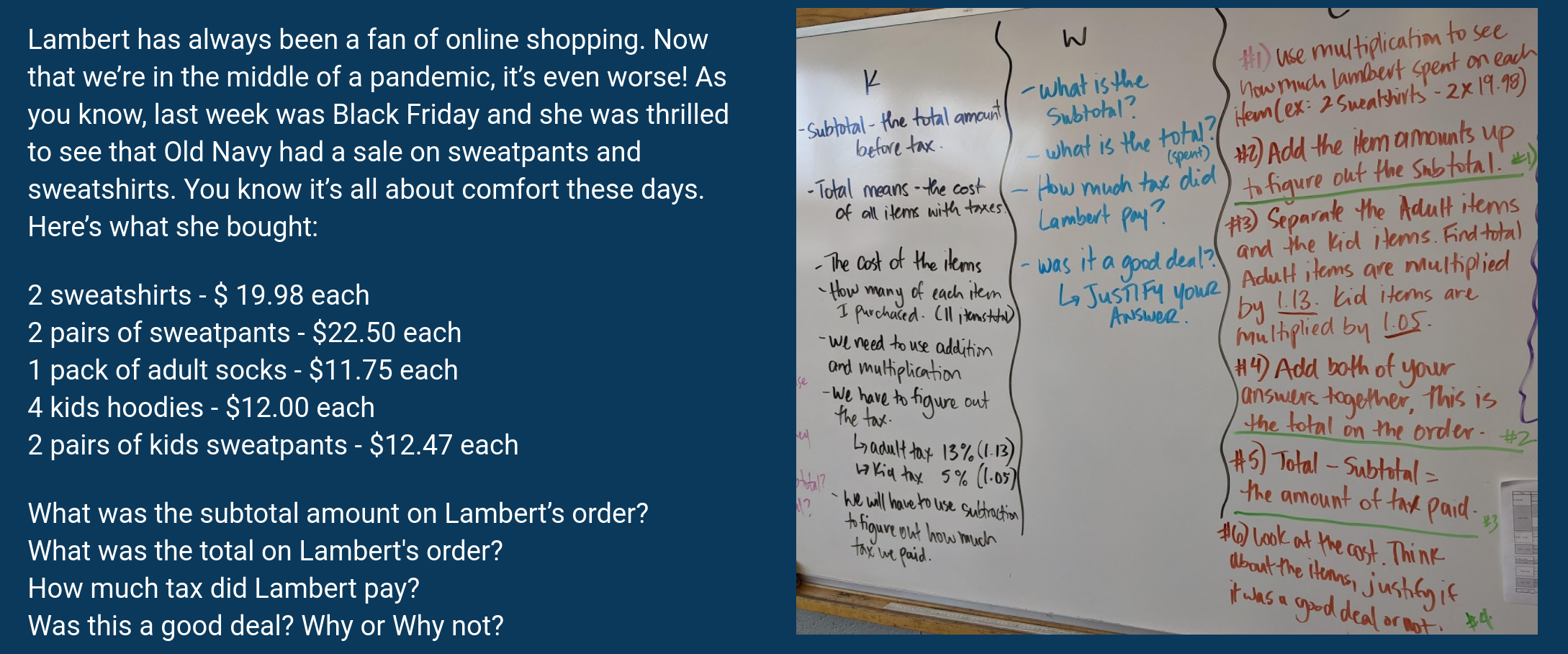
As a class, we learned a new term – subtotal – and understood that total now meant the cost, including tax. We also determined that the operations we would use would be addition, multiplication, and subtraction. We learned that there were different rates for tax based on the type of item. In this case, adult clothing and children’s clothing. 

W – What do you want to know?

This is the place where students can clearly state what they want to figure out, find out, or do. Restating the question in your own words helps to make sure that you really understand what is being asked in the question. In our case, this was a multi-step problem, so there were several things that we wanted to know:

  • What is the subtotal?
  • What is the total?
  • How much tax was paid?
  • Was it a good deal?

C – Conditions

This part is always one that is a little tricky for me. I often think of this section as the things that students need to watch out for but as in our case, I have used this section as the steps that we need to take in order to solve the problem. In other words, what are the things that we need to do to answer the question successfully? Through discussion, we broke down the problem and determined the steps involved in solving the problem so that when working in their groups, students could refer back to it. Even with the steps in place, there were groups of students who solved the problem differently. For example, for the third question, rather than taking the total and subtracting the subtotal to find the tax, some groups wanted to multiply the subtotal by the appropriate tax rate (0.13 or 0.05) and also state the amounts paid for the different rates. When it came to justifying their thinking for question 4, it was great to see that some groups asked questions about the discount for the sale. Many were eager to jump online to investigate the non-sale price and did calculations to determine how much of a deal it really was. Others thought about taking the total and dividing that by the number of items and thought about whether or not that was a deal based on the price per item. Different groups thought of different ways to use Math to justify their answer. 

This question took us a couple of Math periods to work through but it continued to help solidify the effectiveness of the use of this strategy. With gradual release – beginning with the teacher as a guide; moving into students using it in small groups, then partners, and then on their own – once students understand the problems they come across, they are better able to solve them with greater confidence. While students aren’t always going to stop and work through creating their own KWC, it’s one tool that they can use and when given problems to solve. I’ve seen students use it independently and confidently to answer all parts of multi-step problems.
Occasional Teaching Online (part 2 of 3): My Challenges

I will never forget my first supply day for virtual learning. Even though I am early into my teaching career, I believe this experience has changed the way I will reflect on my teaching practice for years to come – dare I say forever?

As I logged onto my first Google Meet with no idea who was greeting me on the other side, so many things raced through my mind and my heart felt like it was going to beat out of my chest. Nerves. Excitement. Fear. 

In my last post I reflected on my realization of the power of connection and children’s drive for relationships. As I continue to venture on with positivity and optimism, I cannot ignore the raw emotions I have felt, the challenges I have faced and the questions I have unanswered. 


“I don’t know”. 


In my personal and professional life this year, “I don’t know” has been part of my daily conversations with colleagues, friends and family. Last year, saying this out loud would have felt like admitting defeat, accepting failure even. As the uncertainty and the unknown continues, we are being forced to live in a world of “I don’t know”. The challenge is constantly turning the “don’t know” into “let’s try” with a smile on our faces. Of course we want to support our students, their families, and our communities. Of course we want to embrace change, challenge, and even failure. But, the reality is, we are navigating this new path in which there are no correct answers, there is no manual, and there are no instructions.  

Openly admitting what I don’t know feels uncomfortable and scary. But discomfort is required for growth and change. I share my challenges with you as a means of connection. Maybe you don’t know either – and that is okay. Additionally, admitting the unknown provides opportunities to gain insight from those who may know, those who have ideas and those who can say “I have been there, and I know how hard it can be”. 

As an OT I have felt it challenging at times to engage with students who are not turning on their microphone or camera, for whatever reason. I want to get to know them but am also mindful how vulnerable they may feel turning on their video to chat with a complete stranger. How are you supporting student engagement and providing a safe space for all? 

How are you supporting students with special needs, learning challenges and students who are working with limited resources? I once taught in a class where one of the students did not have paper or pencils. 

How are you supporting students through technical difficulties or navigating new online platforms? I have been doing a lot of screen sharing. I often share my own screen and/or ask students to share their screen if they are comfortable. I am finding this method to be extremely time consuming. Although sometimes necessary, it can also be very distracting. When students share their screen, it puts the issue they are having on display for the whole group to see. This can be helpful if someone knows how to solve the problem, or harmful under certain circumstances and can intensify feelings of helplessness for some students. 


*Holds breath* 

No correct answers.

No manual. 

No instructions. 

*Exhales*


There is beauty in this.

It may be hidden or the view may be obstructed right now. But it is there. Together with our students and our colleagues, we are the creators, we are the inventors, we are the pioneers.

Teaching in Small Groups

Every day when teaching remotely, I worry when I do not hear from a student for the entire day. Either they did not post in the chat that day or they did not turn on their microphone. I often wonder if they are even there. I had to think of something to reach every child and to have at least one small contact with these “non-participants” once a week.


Thankfully, my board had a guest speaker at our last staff meeting and I was able to hear about a great idea to start small groups. You create small meetings for six students per day. I meet with these students at the beginning of our language meeting and we meet for thirty minutes. I had to think of fun animal names and it is the new norm that they join that call rather than joining our larger meeting. The first week was an introduction to our media literacy unit, last week was reading a newsela article about Sarah Fuller being the first female in a Power Five football game and this week, we will do fun holiday activities. 


During these group meetings, I encourage students to use their microphone rather than their chat. It is an intimate setting where I leave my camera on and it feels like small groups in the physical classroom. Students that are nervous to participate in the larger setting get a chance to shine now. They are doing much better in this setting and I am looking forward to hearing from them during this time. Even some of our students who have been anxious to turn on their microphone have made it their goal to speak in the small group meetings. I made sure to group the students that participate the most in a group together so that the students who haven’t been participating as much have time to share their ideas in their group.


I look forward to extending this idea during math periods and continuing to set up these meetings for students who are involved in group meetings for science or other subjects.


 I am really excited to continue trying things that have been working for other remote teachers and keep posting the ideas that have been working for me. I am getting really used to the online platform and although I do miss the face to face connections, I am loving this new and innovative way of teaching! 


Happy Holidays and Merry Christmas to all. I hope the well deserved break will recharge us for an exciting (and hopefully less dramatic) New Year!

“The answer, my friend, is blowin’ in the wind….”

This term, I had the honour of working with a Master of Arts student in Child Studies and Education, in his first teaching placement. Working in collaboration as a co-learner and co-teacher is a humbling experience. It is always a lot of work, but I appreciate the opportunity to reflect on my own practice, and remember what it feels like to be a new educator.

Ishai Buchbinder and I had a lot of fun creating an integrated unit about Wind for the Grade 2 students. This inquiry connects to “Air and Water in the Environment” as students “investigate, through experimentation, the characteristics of air and its uses.” (The Ontario curriculum, Grades 1-8. Toronto: Ontario, Ministry of Education, 2005.) This blog post is a documentation of our learning together.

Where Do I Begin?
Ishai asked me to describe the planning process for developing a series of lesson plans and activities that culminate in a summative assessment task. This year, I am trying to integrate Indigenous perspectives through land education and environmental inquiry. I am also trying to center stories of Black excellence and innovation throughout my pedagogy.

First, I look at the expectations in the Ontario curriculum, think about the “big ideas”, and generate a few guiding questions to support our inquiry. Then, I brainstorm several activities that might help us to explore and investigate our learning goals. Next, I gather resources, including: picture books, songs, videos, real-world examples of innovation and creativity. Then, I think about a summative task that would allow students to have choice and demonstrate their understanding in different ways. Finally, I sequence the learning activities in a way that builds on prior knowledge and connects to new learning, while also being responsive and open to following the interests, needs and questions of the students.

Who Has Seen The Wind?
We started our inquiry with an active game called “When The Big Wind Blows…” and a poem by Christina Rosetti called, “Who Has Seen the Wind?” This poem has been re-imagined as a song, which I learned from an Orff Music workshop. There is a simple ostinato that is layered underneath, and patsched on the lap: “Wind, Wind, Passing By.” We chanted and sang this song outside during our Welcoming Circle, and acknowledged the wind with gratitude.

Knowledge Building:
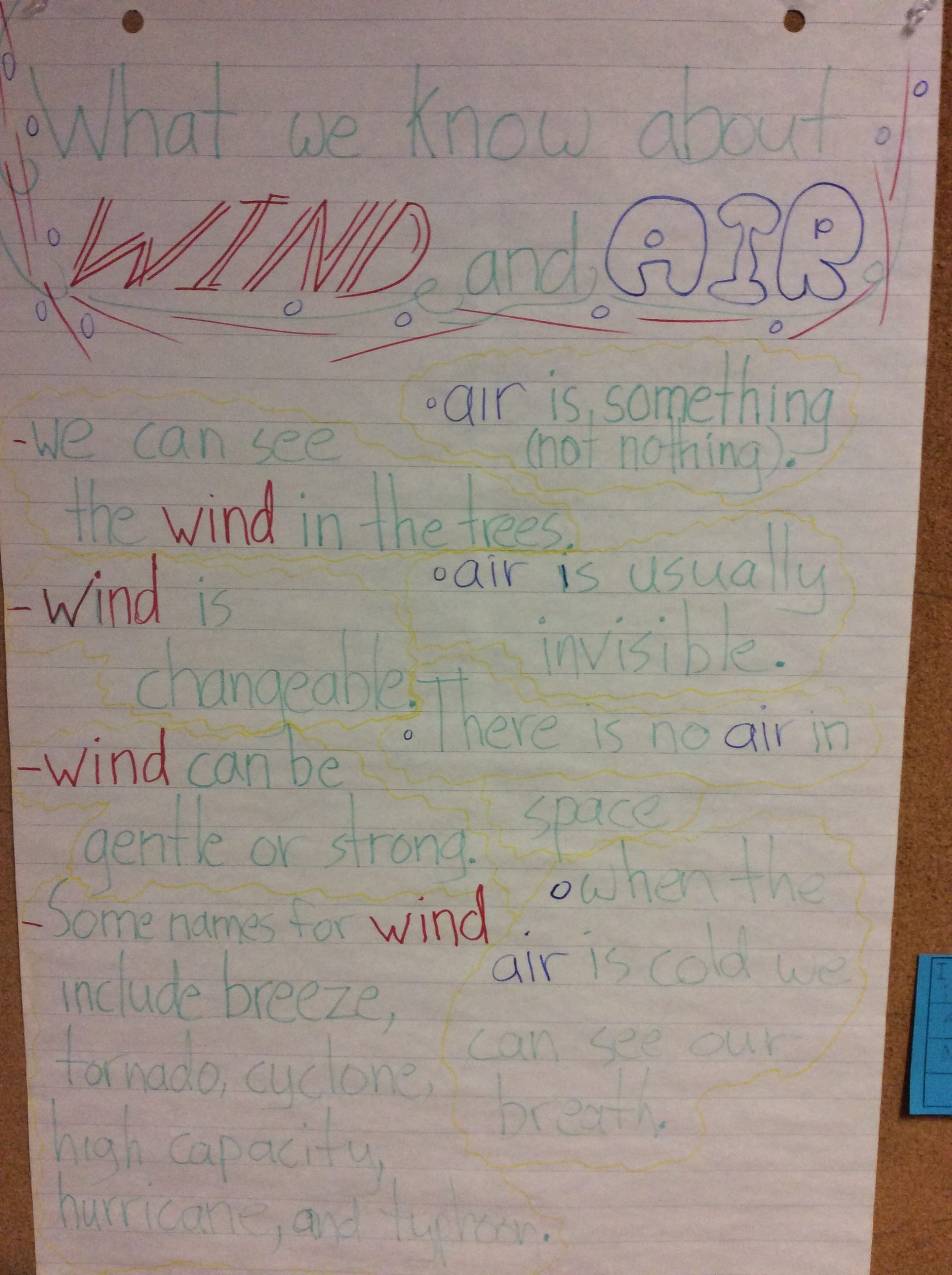
Ishai shared a riddle with the students: “What takes up the most space but is something that you cannot see?” After solving the riddle, the students shared what they already know about air and wind. Then, we asked the students to generate questions about what they wanted to know, using “I wonder…” inquiry cards.  These activities help to honour student voice and position all of us as co-learners,


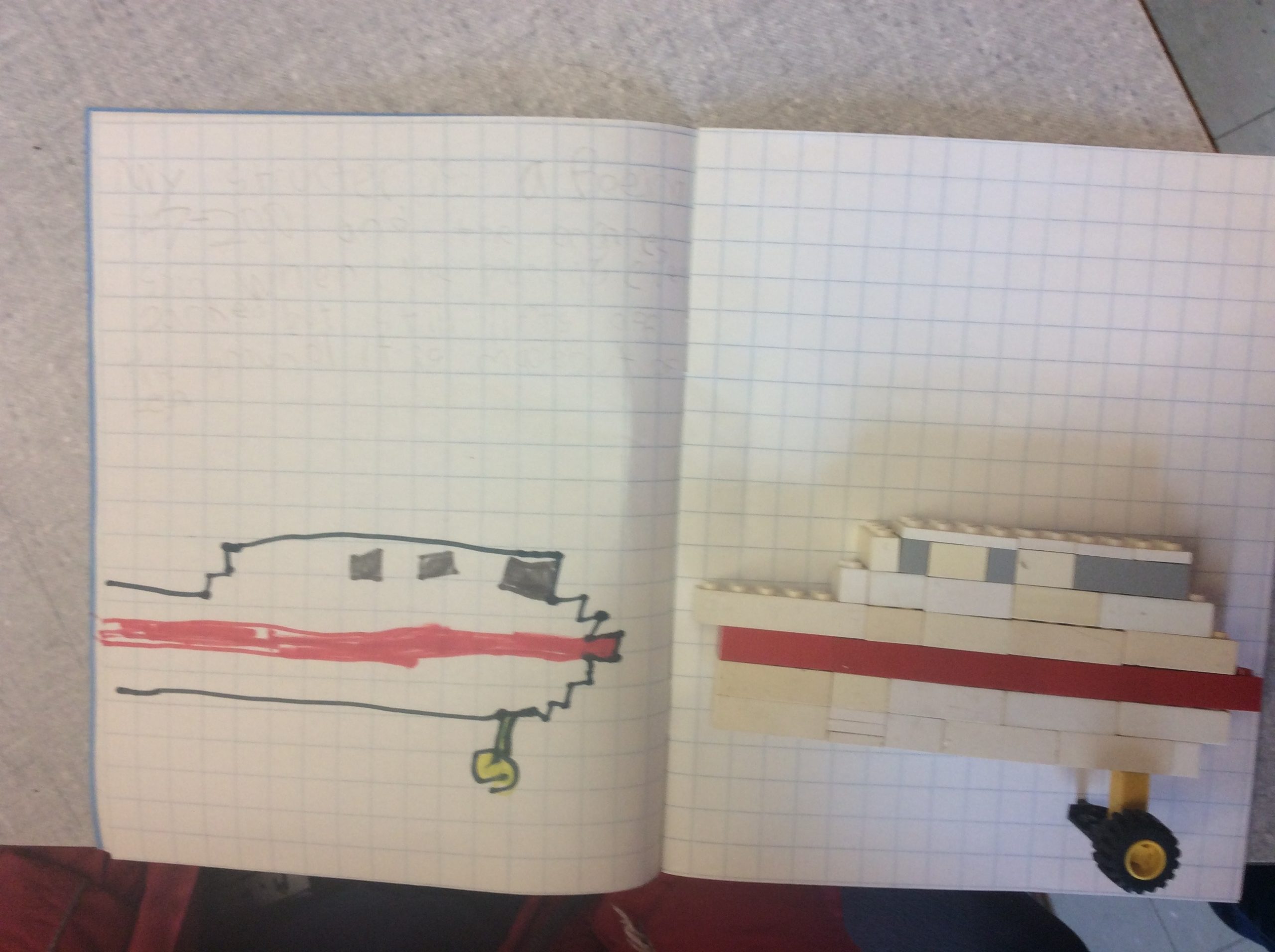
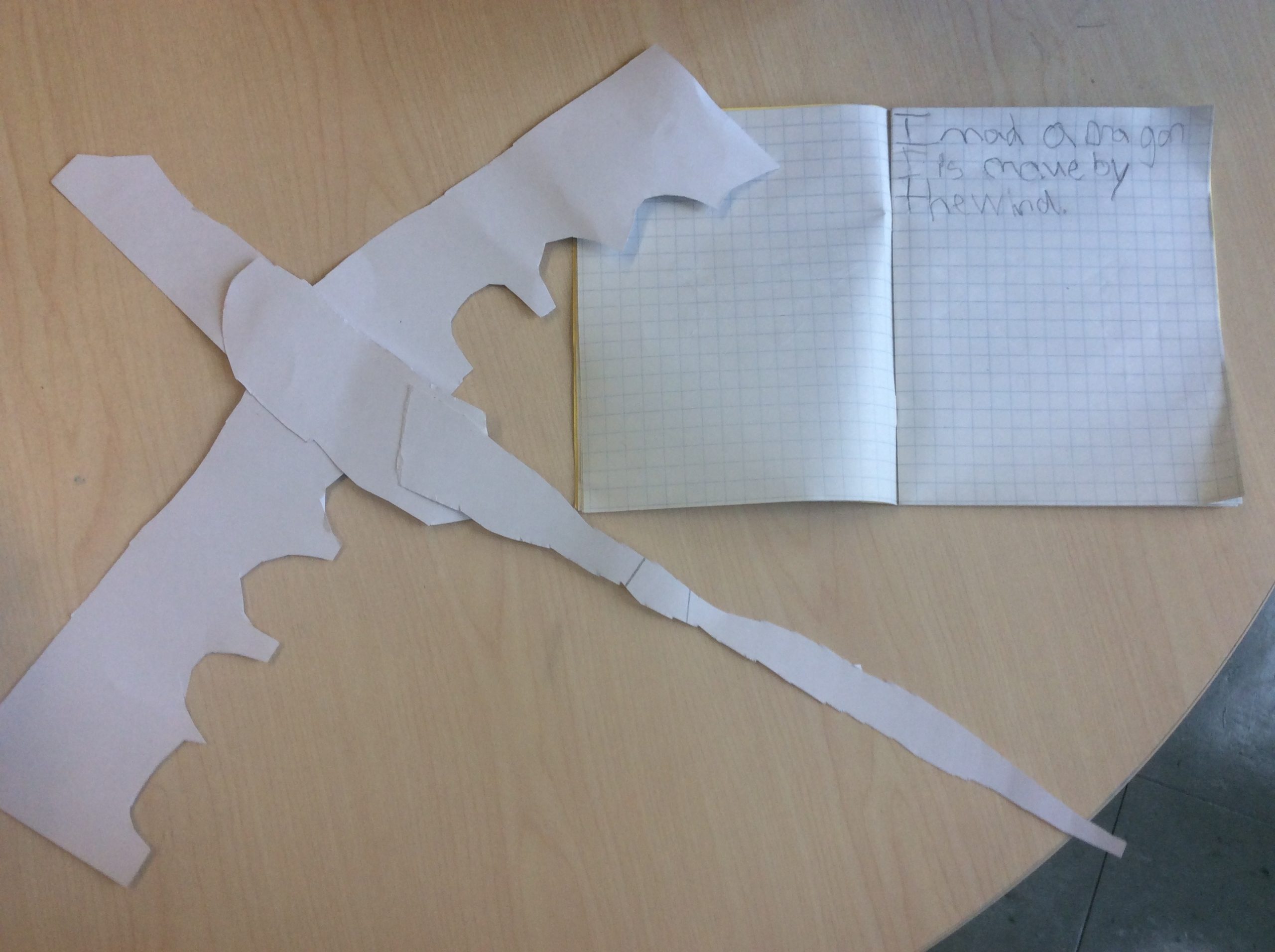
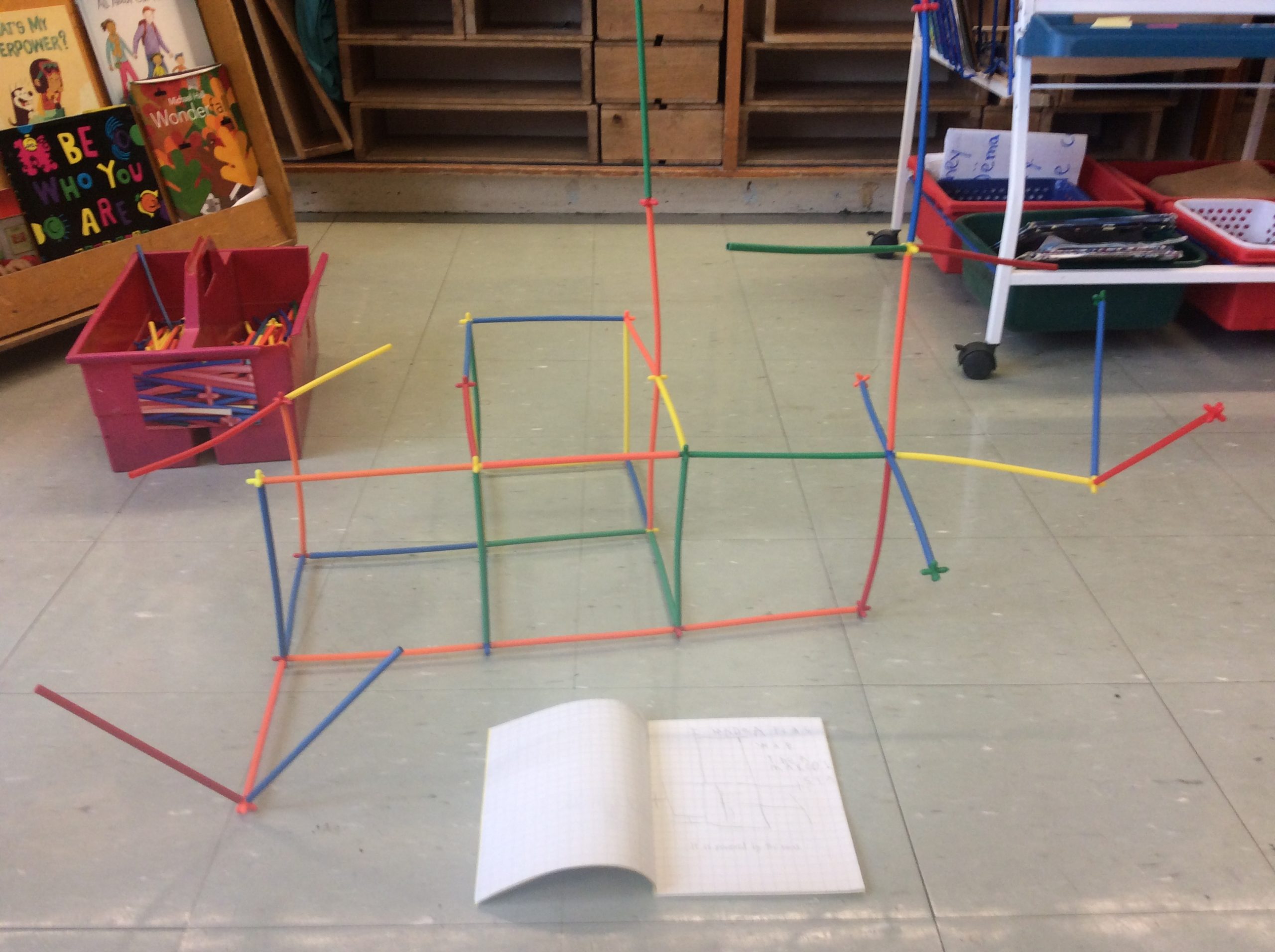
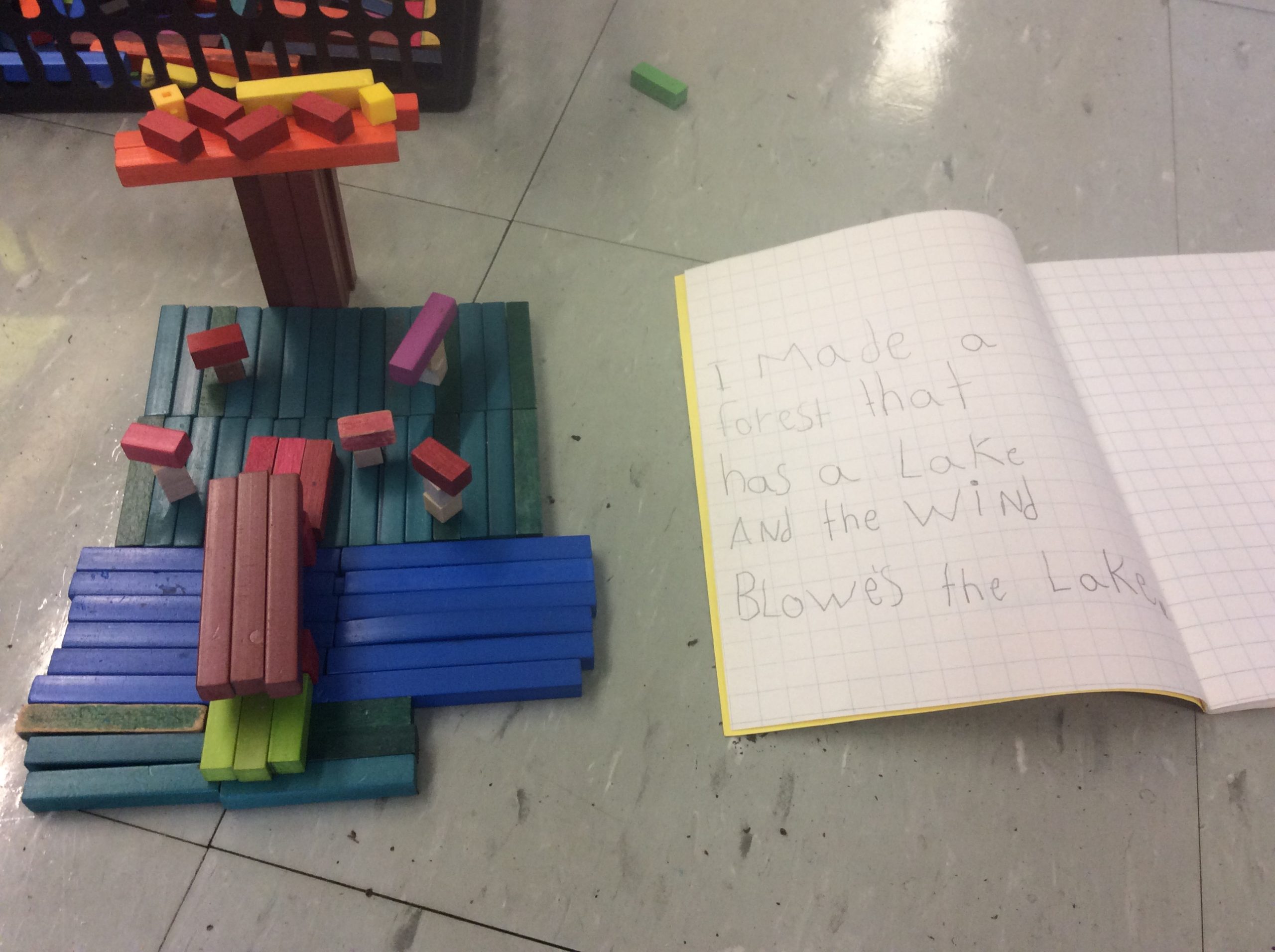
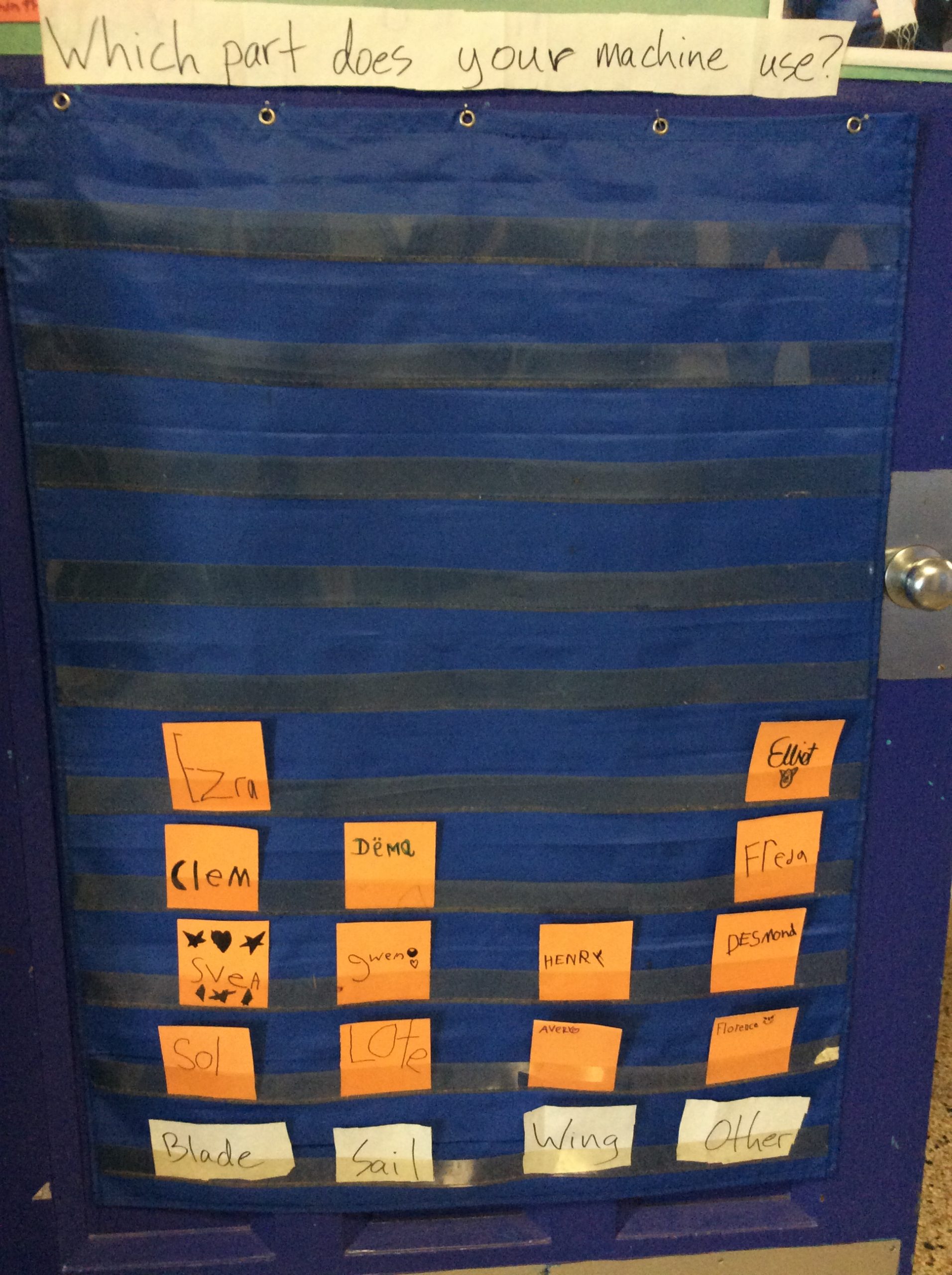
During MSI (Math-Science Investigations), I ask students to design and build a structure that is moved by the wind. Desmond made a dragon. Ezra made an airplane. Florence made a forest. Elliot made a structure that is powered by the wind. All of these activities provided diagnostic assessment and helped to guide the next steps in our inquiry journey.


The Boy Who Harnessed The Wind
We learned about the true story of William Kamkwamba, who used innovation and creativity to build a windmill out of recycled materials for his community in Wimbe, central Malawi. You can listen to “The Boy Who Harnessed the Wind” read aloud. You can find William telling his own story by searching his name. His brilliance has also inspired a movie. After reading the book, we made our own paper pinwheels and took them outside. Everyone loved running with the wind and making the blades spin! 

Paper Airplanes!
Ishai told us about the “Super Secret Mysteries of Flight”. We learned about thrust, lift, drag, and gravity, and their relationship to air. Then, he showed us how to make a ten-fold paper airplane. Here are the step-by-step instructions. It was challenging to listen and follow each instruction carefully. After folding our paper airplanes, we tested their flight in the school yard. We experimented by changing the thrust, and adapting the wings to make it fly straight and long. This was another active and fun activity!

Mr. W
After watching this short video, we had an interesting discussion about the main character. I asked: What do we know about this character? How does this character feel at the beginning and the end of the video? What kind of things do we see the character do? Why would they do these things? Who is this character? Why was this video made? This discussion encouraged students to think critically about media texts as part of our learning about Media Literacy.

This video also inspired us to begin writing our own Wind Stories. We used a graphic organizer to organize our ideas using time-order words, (First, Next, Then, Finally). Some students wrote from the perspective of Wind, and others described the movement and impact of wind. We used a collaborative editing and revision process to share our stories and improve our writing.

Testing our Theories:
This year, we are fortunate to be working with Doug Anderson, who is the co-author of Natural Curiosity 2nd Edition: The Importance of Indigenous Perspectives in Environmental Inquiry. After learning with Doug in the Rainbow Garden, several students wanted to know more about the relationship between the sun and the wind. Svea asked, “I wonder how the sun makes the wind?” 

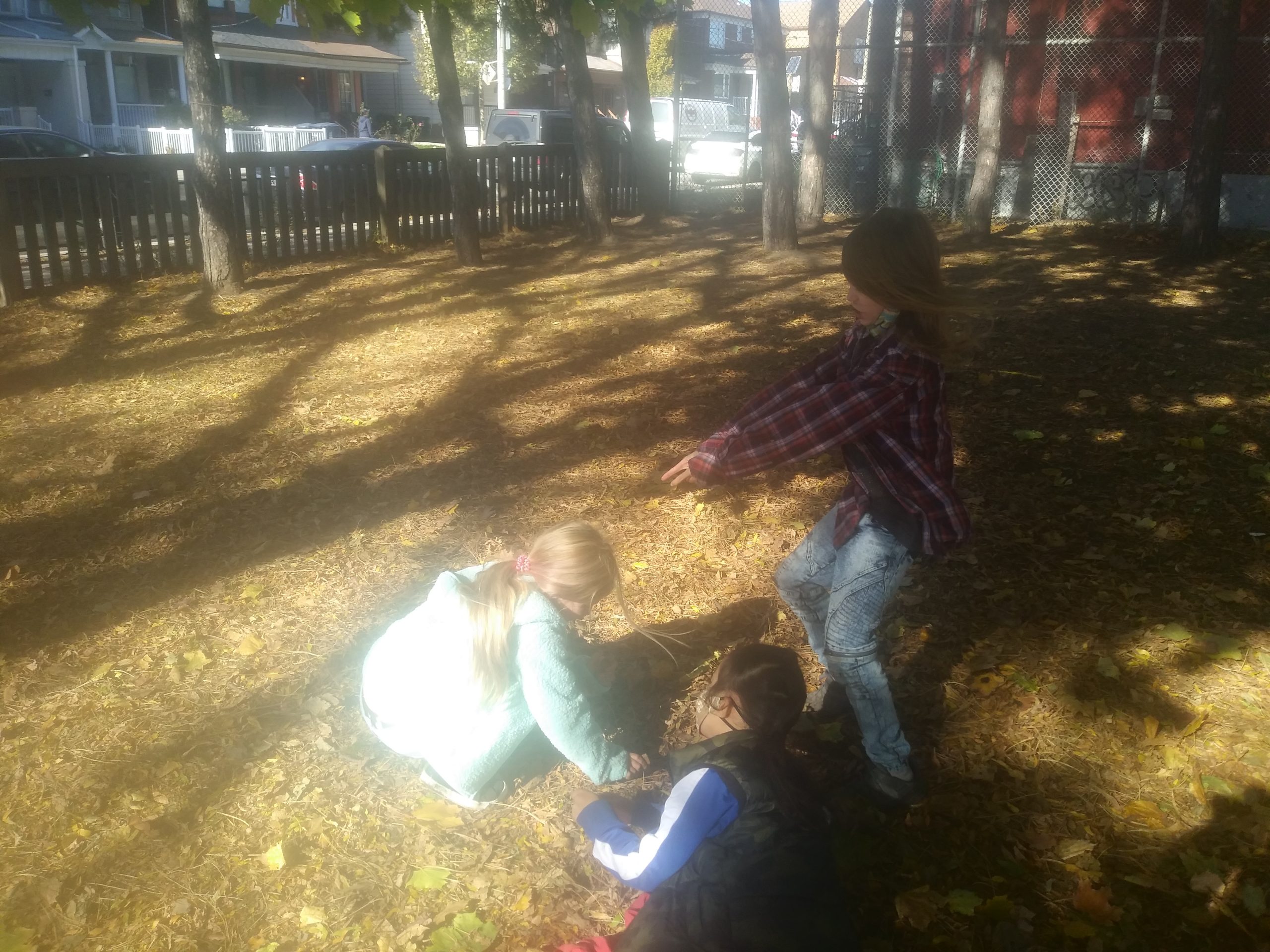
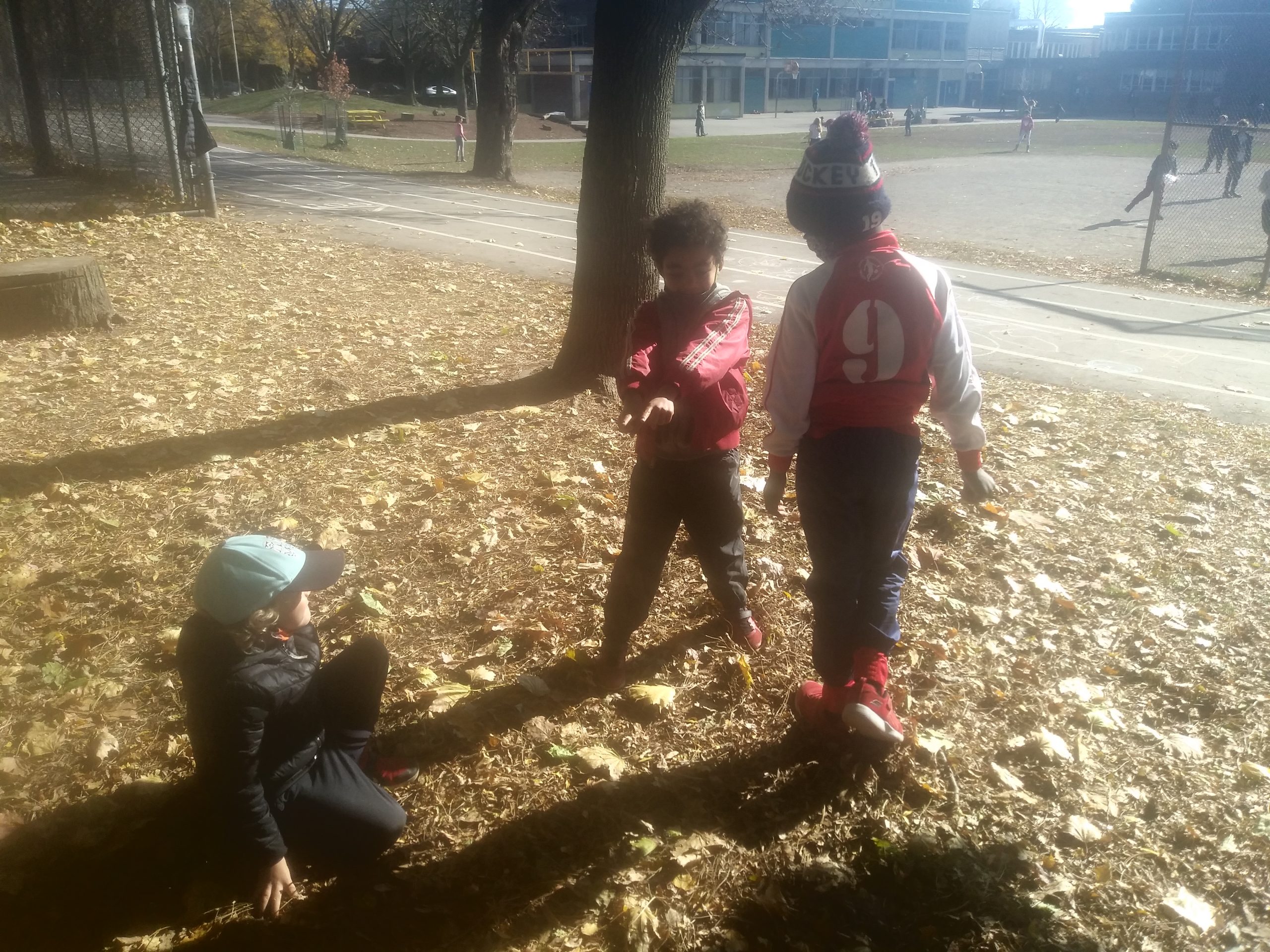
We talked about how we might find the answers to our questions. We could: read books, look on the internet, ask someone. After reading a book called “Air”, which explained some facts, Ishai asked how we might test what we learned from the book. The students had different ideas about how we could prove that warm air rises and cold air is heavy. We went outside to find out. The students worked in small groups and used movement to demonstrate how the sun makes the wind. It was a great opportunity to use our bodies to express our understanding.


Learning Through the Arts
As we explored the movement of wind, we read the book, “When I Get Older: The story behind ‘Wavin’ Flag’” by K’naan. We learned that the song was inspired by his grandfather’s poem. K’naan’s family journey story supported many thoughtful discussions about civil war and refugees, settlement and anti-Black racism, how schools might be more welcoming to new families, and the impact of poetry and music to create community.  We listened to the song many times and went outside with fabric “flags” to wave in the wind. We are hoping to choreograph a dance and embody the lyrics, “Love is the answer”.

We also learned about two artists who have created complex wind sculptures that are moved in the wind. We watched a few videos about the work of Theo Jansen and Anthony Howe. The students were mesmerized and inspired by the movement of these beautiful sculptures.

Another song that we learned was “Blowin’ in the Wind” by Bob Dylan. This is a song that we sing every year during Peace Week and on Remembrance Day. It is an opportunity to reflect on the “big ideas” of conflict and justice. In the past, we have written messages of hope and peace on leaves that are released from the third floor window.

This year, our Visual Arts teacher, Shannon Greene, made powerful connections to Treaty Recognition Week. After learning “A Treaty Poem” by Melissa MacLennon and students, Shannon encouraged the students to write promises of peace on paper leaves to keep in the classroom. Copy of Land Acknowledgement and Dish With One Spoon Resource

Squirrel Nests:
As the leaves continued to fall, the students began to notice piles of leaves in the branches. We learned that they were nests made by squirrels, and we started to think about how animals might protect themselves from the wind. We went on a walking excursion to a local park, and Ishai challenged the students to build their own squirrel nests with leaves, sticks and air.

After building with natural materials, we did a “Gallery Walk” and visited all of the squirrel nests. Students were asked to describe one thing that they were proud of and one thing that they might do to improve their nest next time. These “GLOW” and “GROW” comments allowed us to practice self-evaluation, and provided valuable formative assessment.

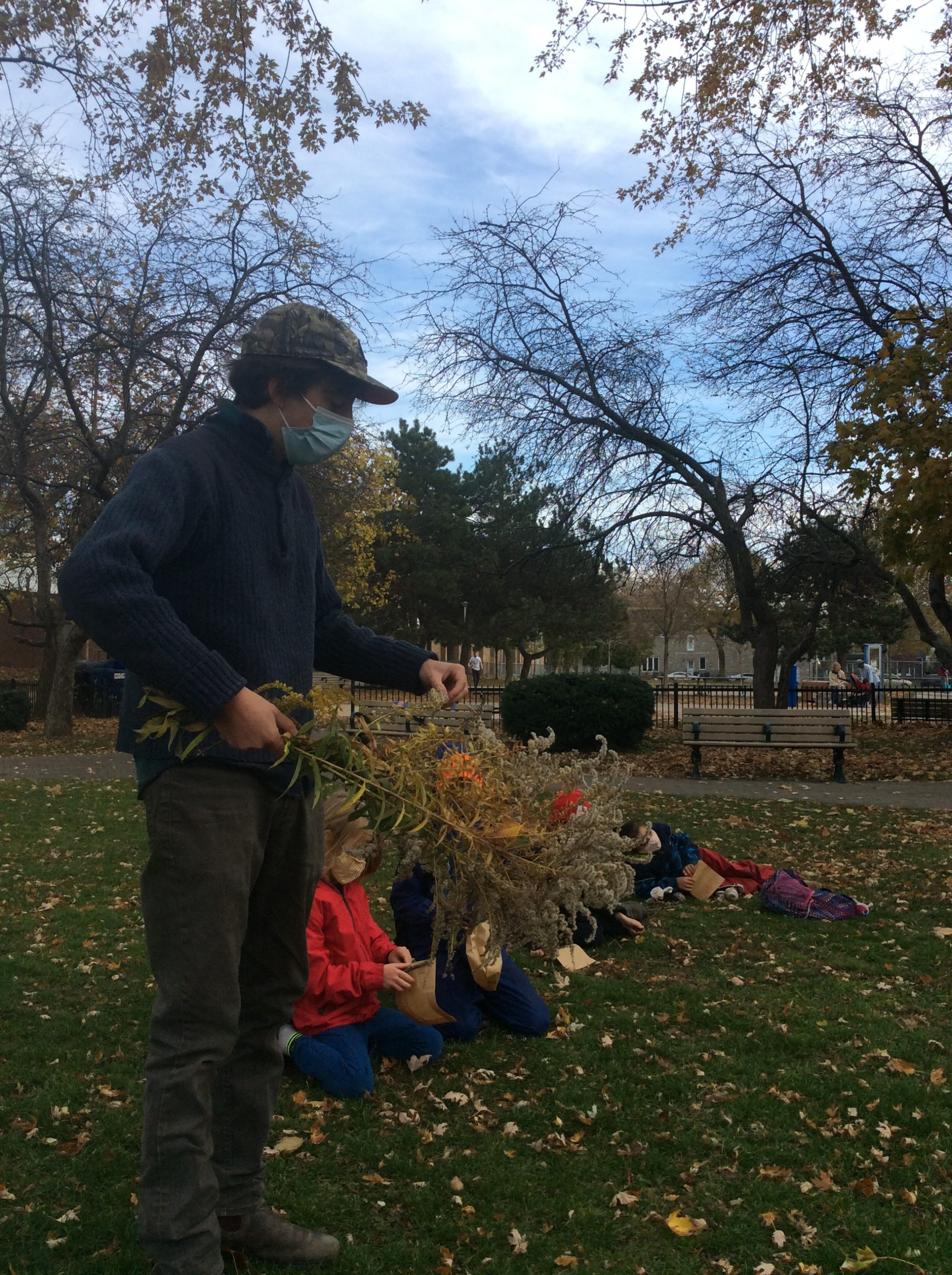
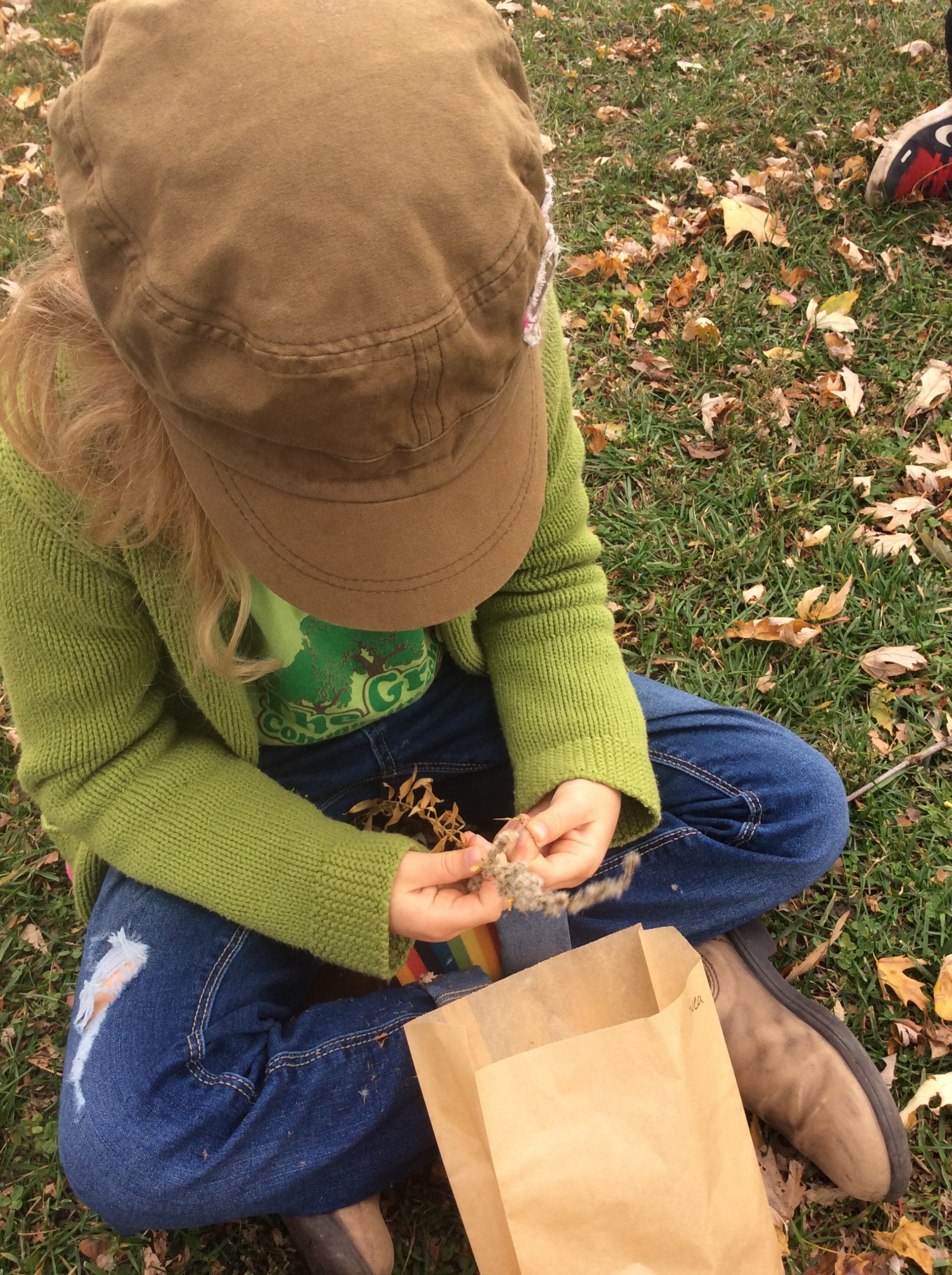
Finally, it was time to test our squirrel nests. Each student was given fluffy goldenrod seeds to represent the squirrel, which was placed inside the nest. We used straws to simulate the wind, and to test the strength of each structure. Everyone had an amazing experience learning outdoors together!


Wind Machines!
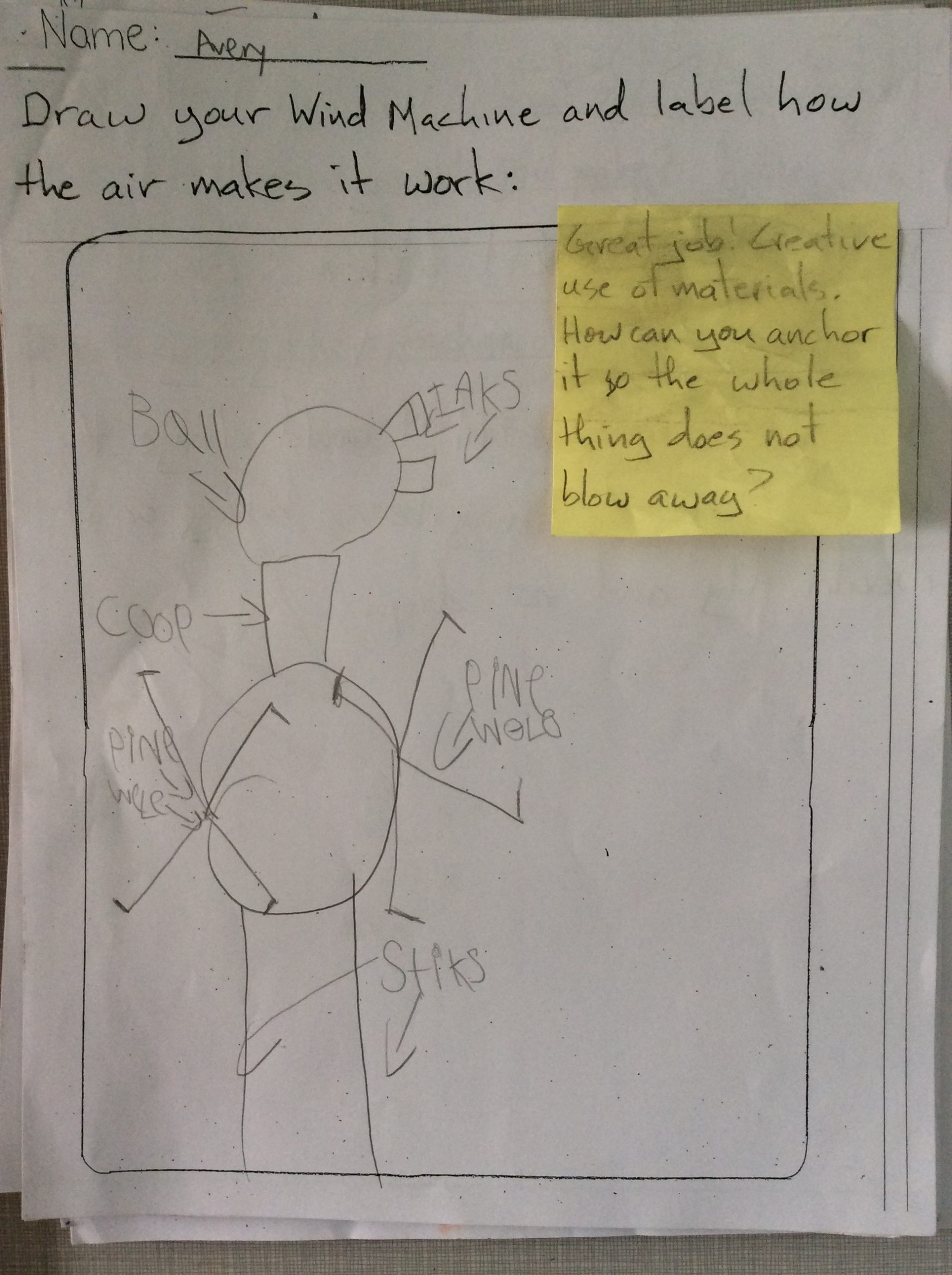
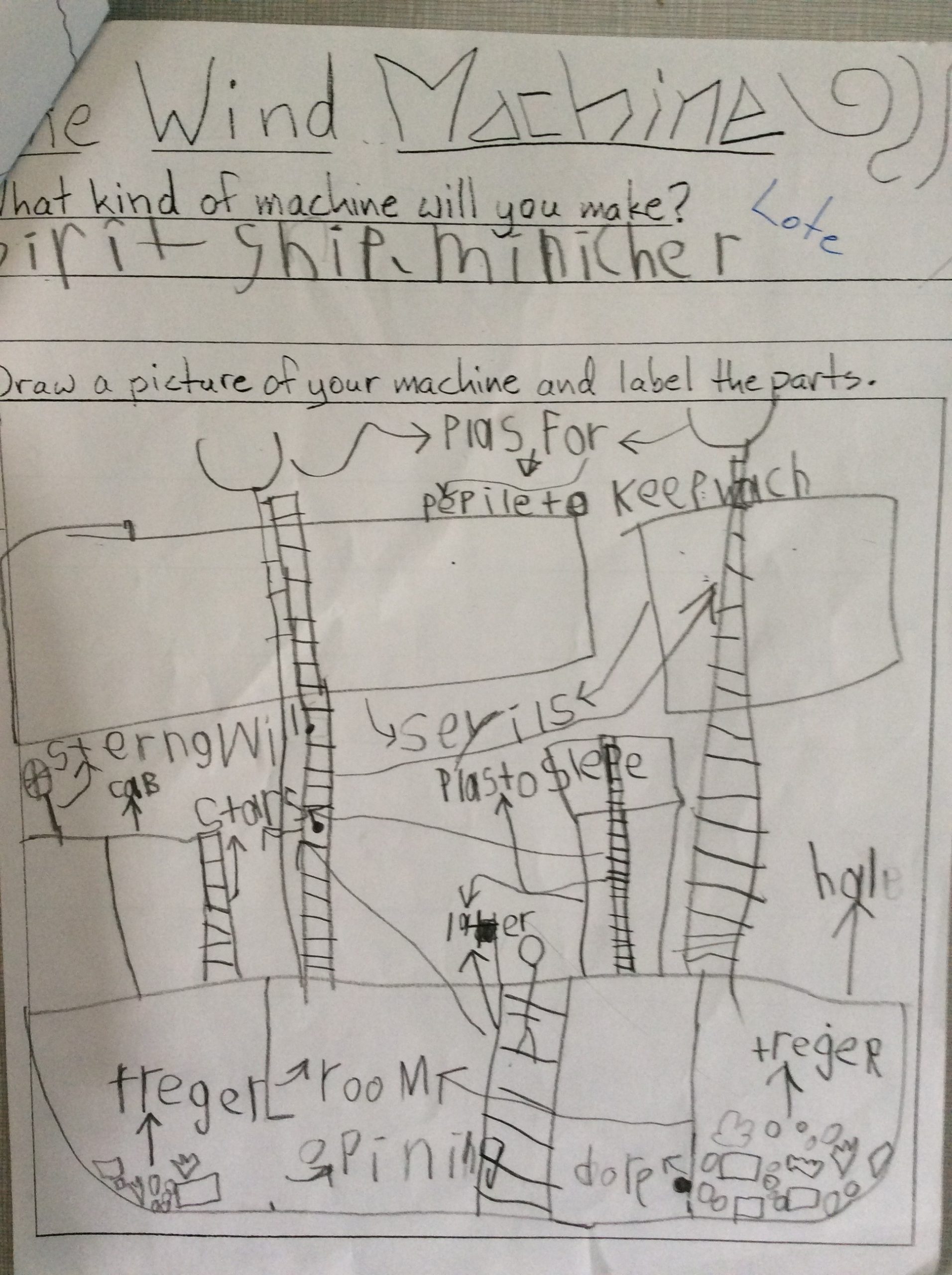
As our final summative task, the students were invited to plan, build and test a structure that can be moved by the wind. Before building, students were encouraged to think about what they had learned about wind and apply their knowledge to their structure. Everyone drew a plan and labelled the materials that they would need. We spent several days in the classroom building and revising our structures, based on descriptive feedback.


On the day that we tested our wind machines, each student had an opportunity to share their structure and make predictions about how it might move. After testing, Ishai conferenced with each student to document their thoughts and ideas about how successful their wind machine had been, and how they might improve their design next time. It requires more time to connect 1:1 with students, but conferencing provides strong summative assessment data, and supports every student to feel successful about their learning.

Journey through Inquiry
Working with a Teacher Candidate was refreshing and reminded me about the importance of play, storytelling and movement in our lesson planning. Throughout our inquiry about Wind, the students were very engaged, and they had multiple opportunities to explore and demonstrate their understanding.  As an experienced educator, I am still learning about how to integrate and make connections across the curriculum in creative ways.  I am also learning that when we trust our students and follow their natural curiosity, the journey through inquiry will be deep, meaningful and fun!

Home for the Holidays?

Santa wearing face mask holding Christmas gift on xmas eve using laptop

Due to the Covid pandemic, my partner and I have been thinking about how we will handle Christmas. We usually have several Christmas dinners with “the relatives” and then a dinner in our home. We have spoken to various cousins and siblings and have decided as a collective that Christmas dinners will be cancelled. Due to this, I made a point of sending Holiday cards to many friends and family members to spread some needed Holiday cheer.

Before cancelling Christmas (like the Grinch), we considered our daily contacts.

Too many contacts to count

My partner works for the Red Cross and is in contact with several people a week. My adult children have their own bubbles with many contacts. My son, who is a Bell Canada technician, is in contact with many people every day as he enters their homes to install telephone and internet services. To get an accurate picture, we’d need an algorithm to calculate the true contact numbers.

In my family, I am the person who has the most social contacts. I currently teach in a school with 4 cases of Covid-19. My direct contacts are 5 students who’s families also have their own bubbles and multiple contacts. I am personally exposed to over 400 people a day, regardless of how “socially distanced” we are, be it 6 inches or 6 feet!  

I wonder about the efficacy of social distancing as the Los Angeles Times recently published, “Infected after 5 minutes, from 20 feet away: South Korea study shows coronavirus’ spread indoors”.

Social distancing at school

In considering the role of social distancing, I ponder my own workplace environment. In my school, students are crammed into their classrooms along with winter coats and boots (i.e. these must stay in classrooms.) Social distancing in schools is a great challenge as it is against children’s natures to be distant from each other. As I am on duty at recess, I often wonder how students can social distance while wrestling or playing tag. It’s hard to prevent this play as this is how children play.

Almost every person in my school is wearing a mask. Teachers are also wearing visors. I find wearing visors challenging as it’s hard to see through the visor with glasses. I also have discovered that I cannot “raise my voice” as the sound does not escape my visor and goes straight to my ears.

In considering my family’s social bubbles within bubbles within bubbles, a Covid case is destined to impact at least one person. And with this we decided to cancel all holiday events. Due to the complexity of these bubbles, what we really need is an algorithm to calculate the contact numbers for each person!

Missing family, friends, and food

I spoke to my partner about all the things we will miss. I will miss “Japanese Christmas” dinner with turkey gravy served on rice and the rainbow Jello dessert my partners’ cousins make. I will definitely miss sushi appetizers.

My partner is an excellent cook, and his turkey dinners are amazing. I also realize that there are no tiny turkeys that come in serving sizes for two. My children will miss the dinner with its multiple sides and enough gravy for all.

Delivered, Christmas Dinner in a Box

So we would still have a Christmas dinner, we decided that we would make Christmas dinner and deliver it to my children, my mother, and some cousins. I’ll also make my famous carrot cake, which freezes very well.

While we deliver the “Christmas Dinner in a Box”, we will exchange and unwrap gifts out of doors. It won’t be like a “regular” Christmas but we will have some time, socially distanced outside, to visit.

Happy social distanced holidays

I know that if we are all careful with our social contacts over the holiday break, we will not have any regrets as we did everything we could to limit the spread of Coivid-19.

I leave you with a Covid Christmas – Festive Medley for 2020 parody of Carol of the Bells, Jingle Bells, Frosty & more It will cheer you up, for sure!

All the best to you and your friends and families,

Collaboratively Yours,

Deb Weston, PhD

PS: I wrote this blog as a person who is a Unitarian and celebrates secular Christmas. I considered leaving out the word “Christmas” to make this blog more inclusive to those who are not Christian. Instead, I wish all readers a peaceful and healthy winter holiday season.

More articles on the 2020m winter holidays during the pandemic

Avoiding the Holiday ‘Balance Traps’

Nearly one-third of Canadians plan holiday gatherings despite pandemic restrictions: poll

Santa Claus is coming to town. Try not to infect him.

T’is the season to be jolly careful

Christmas rules: What can you do in a Covid Christmas?

Occasional Teaching Online (part 1 of 3): My Realization

Full Remote Learning or FRL for short. 

A concept that I had never even imagined myself being a part of in the position of the teacher. Remote learning for post-secondary students was something I was familiar with. In fact, I was learning myself remotely as a Master of Professional Education student, but how would this be possible with children?

I applaud any and all people who have dedicated themselves to ensuring Ontario’s students are safe, engaged and happy during this extremely challenging school year. Educators have put in countless hours and ongoing efforts to reimagine their classrooms (whether they are virtual or face-to-face) all while keeping student’s needs at the forefront of their priorities. This pandemic has forced us all to stop and think and required us to view the world through a lens in which we never have before. Each person with their own perspectives, hardships, wins and realizations. Each person has their own narrative, each educator has a different experience. Personally, my emotions are running higher this year as I feel more nervous, uneasy, confused and overwhelmed than I ever have before. 


“The realization that life is absurd cannot be an end, but only a beginning” – Albert Camus


I am constantly reflecting on my teaching practice and how I can adapt to new changes, learn from them, grow with them and ‘realize’ from them.

In early October, I picked up my first supply call for FRL. I had no idea what to expect. How would I enter this classroom community and have a positive impact on these students? How do I ensure students are provided with chances for sharing? Collaboration? How do I ensure a safe space for students to take chances, ask questions and make mistakes in the era of ‘muting’ your microphones?

The resilience of children never ceases to amaze me. Here we are as educators feeling unsure, uncomfortable even, as students join in as though they have done this 100 times in the past. Teaching and learning online has reminded me to never underestimate the power of connection. Just a few days ago, I was teaching in an FRL grade 5 classroom where a new student had joined the class that same day. Before our scheduled ‘recess’ time, one of the students in the class asked me if he and the new student could remain online with me for a couple of minutes so he could introduce himself. When the rest of the class had left the Google Meet and the three of us remained, he said “Hey! Do you wanna be my friend?” and the conversation blossomed from there. 


THIS. 


It was at this moment I had a realization. It became apparent to me that we cannot stop children’s will to connect, drive for relationships and the innocence in their hearts. Nothing will stop this. Not removing them from the physical school building, not the transition to learning online, not wearing a mask, not social distancing, not a pandemic. Nothing.

Covid-19 Testing Privilege

The Story of COVID-19 Testing in Ontario | Public Health Ontario

Covid-19 Testing Privilege: Are we really all in this together?

After experiencing some symptoms on the Covid-19 list, I booked off school and set out to get tested. I wanted to make sure I would return to my school Covid free, keeping my students and my school safe.

First Test

This was my second time getting a Covid test. In April of 2020, it took 4 days of waiting before I was able to get a Covid test. It took me over a week to get the results as the website told me I needed to speak to a nurse several times … what! Did I have Covid? The answer was no as the website/system was not working properly. I hoped that the second time around would be easier and faster as I had to self isolate for 10 days.

Second Test

It took me a bit of time to figure out where I should go for a test as the available options were not evident. I found many websites with contradictory information as to whether I needed an appointment or not. After trying to book an appointment online with little success, I opted to book my appointment over the phone.

I wondered about a possible source of my undiagnosed symptoms. As I purposely keep my contacts to a minimum, only going to school and back home, I knew if I was infected the source would be my school. I also knew that if I was off, it was unlikely that I would have a supply teacher cover my class.

The person on the phone asked me if I had been in contact with an infected person. I responded that I was not sure as there were four cases of Covid in my school and two closed classrooms. I had no idea which classrooms were closed as staff were not told. I also had no idea which students were in these classes. As my classroom is near the Behaviour Teacher Assistant’s room, I interact with many students who pass by.

The person online stated that I should be fine since “students were learning with social distancing in place.” I almost peed my pants at the statement and corrected the person saying that students in my school were in crowded classrooms sitting about six inches apart … instead of six feet. I did not give the person on the phone a hard time as I knew they were just doing their job. After five minutes, I had an appointment the next day.

Waiting at the hospital

As my partner drove onto the hospital grounds, I noted a very small line for Covid-19 testing. It was easier than the first time as I had a short wait to get into the hospital to be processed. As I knew what to expect, the very long probe that was inserted into my nose (almost touching my brain) was not a big deal. The drive, test, and return home took 40 minutes.

While waiting in line, I spoke to a woman with her grandchild. It turned out that he was her great grand child! She told me that she spoke to her mother every night on the phone before they retired to bed. Wow, five generations in one family as the boy had a living and healthy great-great grandmother.

Privileged assess in health care

As I looked around, I noted that the people in the Oakville hospital, like me, had a great deal of privilege. The people all arrived to the testing location by car. Women could get tested without their children in tow, as they had adults to watch their kids. People had extra money to pay for parking their cars and access to Internet and/or a phone to book an appointment. Due to lower Covid outbreaks in Oakville, the testing lines were shorter than lines in Toronto, Peel, and York.

Challenges of Single Parenting

As I reflected, I remembered the days when I was a single parent. My children were four and six years old. My son, TWS, had undiagnosed ADHD and he was a tornado of a child, never able to stay still. As a single parent, it was taxing to take him anywhere.

Due to the challenges of both parents working, my children’s father and I decided that one of us would stay home to care for our children of 3 and 5 years old. As a result, I was the one to quit my well-paying marketing job. About a year later, my children’s father wanted a divorce. I was in an abusive relationship and I had to get away from this abuse.

I had no income, no vehicle, and few resources. As I could not afford a babysitter, I often took my children to my doctor’s appointments. While I attended an appointment, my son decided to rummage through my “talking “doctor’s reception desk resulting in him being covered with stamp impressions. Another time I had a PAB test done while trying to distract my daughter with a toy.

As a single parent, I could not afford cable TV and we made do with three channels using a “Rabbit Ears” antenna. I could not afford a cell phone until after I got a job as a teacher. I certainly would have not been able to afford internet.

Covid Testing as a Single Parent

As I have become more aware of the privilege I carry in my life, I considered my experience as a single parent going for a Covid-19 test. I imagined this experience through the lens of my own life as a single parent with my own children.

I know I would have had a challenging time booking a Covid-19 test as I only had a landline. It would have taken me time to figure out which location would be best for my circumstances. With no car, I would have had to take public transit which would have meant keeping my son, TWS, from not pulling the “stop request” cord. I would also likely have to transfer to another bus route making the journey more challenging.

Once at the testing location, I would have had to keep my children occupied while we waited. Further, I would have also decided to get my children tested. My daughter, KIS, would have complied to a test as long as there was some reward after. As I could hardly get TWS to agree to swallow medicine, I know he would not have agreed to have a very long probe shoved down his nose … he would have needed people to hold him down. The whole experience would have been a calamity.

After this ordeal, I would have had to get back on a bus to go home while giving my children snacks as a couple of hours would have passed. Exhausted with no extra support, we would have arrived home to have an early dinner and then bedtime.

Service Industry Workers

Most people in the service industry do not have many or any paid sick days. With testing, single parents and their children would have to self isolate until results were posted. This would result in a loss of pay for a parent and a loss of time in school for children. I could write an entire blog about the precariousness single parents face in their employment when dealing with their own health and the health of their children.

With privilege comes more available resources

I acknowledge that I have a great deal of privilege as an educated, employed, English speaking, non-immigrant, married, mobile (not physically disabled), White woman with resources like a car and working internet. As my children are now adults (now almost 27 and 28 years old), I am also relieved of the parental responsibilities of childcare and the monetary need to support them. Not all parents have these resources or privilege.

Are we really all in this together?

Regarding COVID-19, I’ve heard people say “we are all in this together” … but are we? The people who live with limited resources via housing, funds, and access to health care do not have the same privilege as people in higher socioeconomic circumstances. People who must work for minimum wage in service industries such as factories, warehouses, groceries stores or in long term care facilities do not share the same privileges. This community of people only share the disadvantage of being economically insecure which makes them more vulnerable to infection from the virus. As a result, they are not those with resourced privilege and this is likely why the virus is raging in their communities.

So, if you go for a Covid-19 test, remember how privileged you are to have easy access to getting this test.

Collaboratively Yours,

Deb Weston, PhD

COVID-19 test and testing location information