Balancing Slideshows with Active Teaching: A Reflection

My grade team partner made a comment about how often I used slides in my teaching (I use them a lot!). It prompted me to reflect on the changes to how we present information in this day of age, and whether the tools we use are truly serving our students. 

As a student, I recall watching my teachers using overhead and slide projectors to display content during whole group instruction. Today, we have simply shifted to slideshows or interactive touchscreens. The technology has changed, but the practice of presenting information has largely remained the same. The realization made me ask: Are my slideshows effective tools to help my students learn?

The answer I have come to believe is yes, but when only presented right. 

Slideshow Design

When I reflect on my own slide design, I find myself thinking about… 

  • The amount of text on the slide
  • The quality and relevance of visuals
  • How students can refer back to the content later

These three questions have shaped how I build and use slideshows in my classroom. 

The Benefits I’ve Experienced

Used thoughtfully, slideshows have genuinely improved my practice. Some include: 

  • Better structure in lesson delivery: having a clear flow of learning goals,  minds on, action, consolidation
  • Built in prompts and reminders for ME which is especially useful when I am exploring a new teaching strategy
  • Greater consistency across classes, which is particularly important  when teaching in a rotary model
  • More flexibility and responsiveness: since the structure is organized, it allows me to be more flexible and responsive to the students in front of me

The Disadvantages I am starting to notice:

The biggest concern I am finding is that it can make thinking invisible. By making sure I embed “non tech” aspects to the lessons (e.g., co-creating anchor charts), I embed the process of thinking, not just the finished product. I often ask questions or “write” on the slide to encourage more engagement. It invites students into the learning rather than positioning them as passive recipients. 

Moving Forward

My colleague’s comment wasn’t a criticism, it was a useful mirror. The real question was never how many slides I use, but whether my students are actively thinking during and between them. That distinction has shifted how I approach lesson planning.

Slideshows are a tool, not a teaching method. And like any tool, their value depends entirely on how they’re used.

Have you reflected on your technology use? 

My Top 5 Learning Experiences at Elementary School

Today’s blog features unforgettable classroom experiences that I had in elementary school. I benefitted from these rich learning tasks and in turn these memories spurred me on to design similar experiences for my students. I hope some of my students remember what I taught decades later!

This illustration shows a drawing of a child dressed as a large raindrop. He is wearing a no acid rain sign.

Cross Curricular Drama Lessons 

As a kid who loved to play and use my imagination, I have vivid memories of combining science and history with role play.  One year, we were allowed to include costumes with environmental presentations. One student came dressed as a raindrop as he explained acid rain.

 In French class we often performed skits to practice new vocabulary. The teacher would have children’s clothes or food on hand so we could pretend we were shopping.

In language class in grade 3 we read plays and were challenged to perform a scene. I remember being a mountain goat, kicking and bleating my heart out! Then in grade 7 English we studied Charles Dickens, “A Christmas Carol” and I got to take my performances to the stage.

Guest Speakers

A change from the routine made for a very memorable day in elementary school. Meeting artists and singers brought us joy and learning. In grade 2, one of the parents in my class came to teach origami and talk about her country of origin, Japan. 

In grade 5 we had a musician visit the class and play a variety of instruments that were not normally available to us. Rich learning experiences are easily created when teachers invite guests into the classroom. 

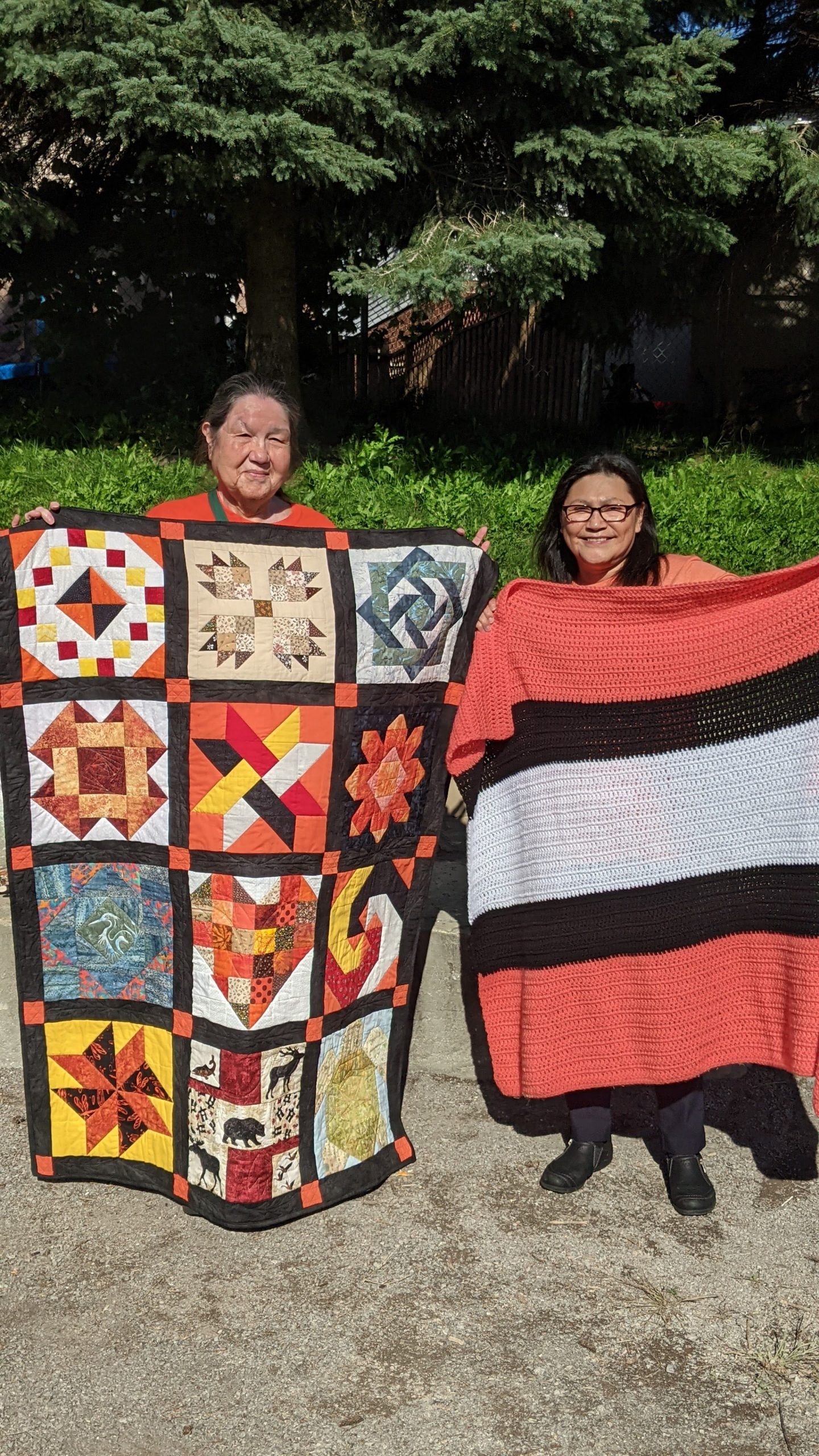
As a teacher, some of my favourite days have included bringing guest speakers, especially Indigenous elders or dancers/drummers/singers. It is a responsibility we carry as treaty people to build these relationships.  I also appreciate having older adults as guest speakers. Some students have no exposure to seniors and they may not realize the importance of a lifetime of experiences.

A photograph of two First Nations women is shown. They are standing outside and holding up a handmade blanket and quilt that feature the colour orange. The quilt has 12 squares including a heart near the centre.

Two First Nation guest speakers who were presented with a quilt and a blanket made by my colleague, ETFO member Shelley Miehe.

Hands-On Learning

Paper airplane making was the task we were given in grade 5 for a study of manufacturing. Our group members each had specific roles and responsibilities. My group did not make the most airplanes but we had high quality! 

Our grade 6 teacher had us create a relief map of Australia using salt/flour dough. We then painted the project. This was a fantastic way to help us interpret a 2D map.

Learning Outdoors

When I attended an urban school in grade 4, we walked through the area trying to find where the water traveled above and below ground. We looked for evidence of sewer grates and then mapped out  the nearby stream and reservoir. We also went around the area taking tree bark rubbings to use for collages in art. The idea was to cut out various shapes and glue them down to make a very eye-catching piece of art.

 By grade 6 I was in a rural school with more snowy winters. We were allowed to create snow sculptures as art. Colour was part of the experience, but I don’t remember if we had spray bottles or brushes. Was it paint or food colouring? I remember being very proud of our giant, snowy caterpillar.

Current events, Poetry and Sharing

From this top 5 list, you have probably gathered that I enjoyed speaking in front of a group!

In primary grades, my teachers used the show and share model to help students get used to public speaking. We were always encouraged to bring something to share that had educational value. For example, in grade 1, I brought in my corking tool and wool to show the class how to create a craft. 

Performing magic was a hobby I developed in grade 4 and my teacher allowed me to show the class some tricks and I had background music playing from my tape recorder.

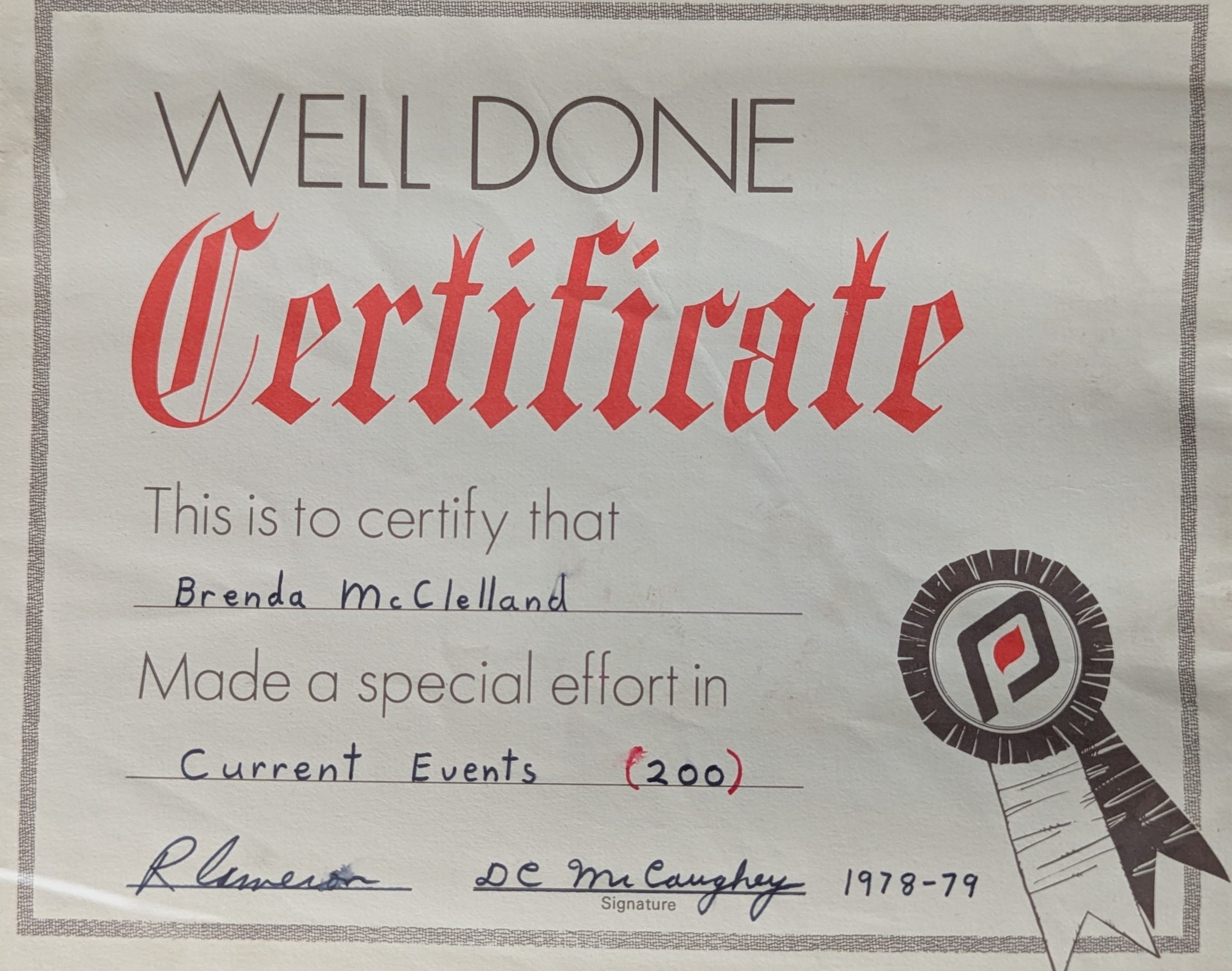
Sharing current events and poetry was encouraged in grade 5 and our teacher gave out a certificate if shared 200 times. Yes, I achieved that goal along with one other friend. If I were doing it today I might have a certificate for every 25 or 50 items shared to encourage more students to participate.

I hope you found some helpful ideas here. These tasks are easily adaptable among grades and appeal to many of our learners. 

What are your top 5 learning experiences? Do we have any in common?

Brenda

A photograph of a Well Done Certificate is shown from 1978-79. Brenda McClelland was completed 200 Current Events.

The Importance of Social and Emotional Learning for MLLs (Part 2)

Having a trauma-informed approach can be vital in Ontario’s diverse schools. Many students, particularly newcomer students, arrive in schools having experienced traumatic events: first-hand experience with armed conflict, family separation, or losing one’s home – just to name a few examples. These students may also be in the early steps of learning English, which adds to the challenge of understanding their unique needs.

Newcomer students that have experienced trauma may show up in school in a variety of ways. For example, they may be dysregulated, have hard time staying focused in their learning, be sensitive to different stimuli, or may not display any indication that they are traumatized at all. There is no single way a child will respond to trauma, but research indicates that prolonged exposure to trauma has a significant impact on the development of the brain.

I recall having multiple students that experienced the death of parents as a direct result of war in their home countries. One student was eager to engage with his peers and was open to communicating about his life experiences right away. Another student was distant and reluctant to interact with her teachers and classmates, and needed frequent breaks from her busy classroom.

Because the impact of trauma in children shows up in so many forms, it is important for educators to understand how to support learners, especially when they are emergent English speakers. These students typically a difficult time communicating their needs, emotions, and are likely also experiencing the stress that comes with learning in a new language and school environment. Adding to their unique student portrait may also be significant learning literacy and numeracy gaps from having missed years of formal schooling.

As an educator, it is not uncommon to feel underprepared and under-resourced when welcoming newcomer MLLs (multilingual language learners) that have experienced trauma into school. It’s important to know how to support these unique learners effectively, who to turn to for support, and what resources will be the most useful and practical in the contexts we work in.

In the first part of this blog, we looked at how Nara, an Ontario educator, used the “Discover – Connect – Respond” strategy to calm a newcomer MLL who was on the verge of having a bad day. Now, let’s take a look at some practical, trauma-informed approaches that can be leveraged as a starting point for helping students in this unique group.

Build a Detailed Student Portrait

Gathering information about the learner’s family background, prior experiences, and journey is an essential starting point for taking a trauma-informed approach. Take note that much of this information is highly personal and confidential, so discretion is key.

Often the first place to find out about the background of a student is through family interviews. Some boards may have a process in place to welcome newcomer students where an interpreter and settlement worker is available at the time of registration, and guardians may share information about their child’s experiences, including those that are traumatic.

When a newcomer initial assessment and orientation report is not available, sensitive information might surface through conversations with the student or family interviews. If you discover information about a student’s previous trauma through such interactions, it is important to share that information with an administrator and support team so it can be documented appropriately in your board’s student information system or the Ontario School Record (OSR).

One useful tool for gathering information is the “7 Factors Impacting Student Learning” table. Use it as a guideline for building a student portrait, or adapt it to suit your own workflow.

Create Safe and Supportive Learning Environments

There are so many ways educators can take a trauma-informed approach to managing the classroom that are good for all learners. For example, establishing predictable routines in the classroom not only makes the learning environment feel stable and organized – it helps students to feel safe and secure. Having timetables posted, routines for entry and exit times, designated areas where supplies and notebooks are kept, and clear expectations for behaviour that are consistently maintained will help students to feel supported.

When possible, create spaces in the classroom or the school where students can calm down, get quiet time, or have an alternative space to simply be in. Teamwork in the school can be critical for making this kind of space available for students and also developing guidelines for how it might be administered.

Provide Opportunities for Students to Communicate their Emotions

Newcomer students who are just learning English may need scaffolds to communicate what they are feeling and what their needs are when they are feeling dysregulated. As educators, we can facilitate communication by making translation devices accessible, teaching social emotional vocabulary, and providing aids that students can easily use to show how they are feeling.

Ultimately, taking a trauma-informed approach with newcomer multilingual learners is less about having the perfect strategy and more about developing a stance of curiosity, compassion, and shared responsibility. When we intentionally build student portraits that go beyond academic concerns, create predictable and supportive environments, and offer meaningful ways for students to communicate their emotions, we send an important message to the newcomers in our care: you are safe here, and you belong.

Part 1 may be found here.

Discover, Connect, Respond: The Importance of Social and Emotional Learning for MLLs
The Joys of Teaching: Part I, Witnessing Student Progress

For me, witnessing students’ progress in their learning is one of the clear joys of teaching. When I see the students I teach make progress, it helps me to remember that the time I put into my lesson planning, the energy I dedicate to providing explicit instruction, and the effort I give to sharing constructive feedback all work to help students grow in their knowledge and understanding of curriculum content.

This is the first of a three-part series of posts where I’ll share some of what I find to be the joys of teaching. The ideas for this and the proceeding posts emerged from witnessing several students whom I have the pleasure of teaching make clear progress in their learning and knowing that I performed some role in supporting their progress. This post will focus on the work I did with a group of students to help them further develop their vocabulary knowledge but will highlight the growth I witnessed in one student in particular. My hope in sharing these stories is that they help other educators reflect on what brings them joy in their teaching careers, then think of ways to use that joy to further fuel their passion for teaching and learning.

To review, in a previous post, I shared a plan to help students develop their vocabulary knowledge. In this post, I’ll share additional insights to my plan that includes the explicit instructions I provided, the constructive feedback I gave, and the impact of both on one student which brought me immense joy.

Each week for the last five weeks, I’ve been selecting 4 words to explicitly teach. The words I select come from a vocabulary wall that the students in my classes and I co-created. Our vocabulary wall is a collection of word cards. The word cards are divided into four quadrants. Each quadrant includes one of the following pieces of information: the word, a definition of the word, an image or symbol to represent the word, and a synonym for the word. Students selected the words from a series of fiction and non-fiction short stories they read earlier in the year. All the words they selected were new or vaguely familiar to them.

As I shared in my previous post, I found that simply having students select words and create vocabulary cards was an insufficient approach to helping them develop their vocabulary knowledge since I often saw students ineffectively use their new vocabulary in their writing. To rectify what I hoped would support their learning, I began explicitly teaching vocabulary words to better develop their vocabulary knowledge.

My process has been as follows. On Monday, I begin a three-part series of vocabulary lessons by sharing a learning goal and success criteria. My learning goal is, I am learning new vocabulary to support my reading comprehension and writing composition skills. My success criteria is, I can apply my knowledge of vocabulary words when reading and writing.  I then introduce the four words by providing a student friendly definition of the word, identify the part of speech to which the word belongs, model the pronunciation, and review the spelling of the word by explaining the sound symbol correspondence. I then share four sentences where I include one of the new words in each sentence. Before having students work in small groups or partners to create sentences using the new vocabulary, we co-create sentences, using the new words to scaffold instructions. Once each group of students complete their sentences, I have them share their sentences with me so I can check their use of the word and provide immediate constructive feedback to further support their leaning; my feedback often includes identifying something they did well, and a next step for further improvement.

On Tuesday, the lesson focuses on synonyms for the words. Using online dictionaries, I find three synonyms for each of the words introduced on Monday. I then place the words in random order in my Google slides presentation and have students work in small groups to match the vocabulary words with their three synonyms. To provide additional support, I review the meaning of the synonyms with students prior to having them engage in the matching activity. Once most students have matched the synonyms, I review the matches with them and have students work in partners to create two sentences, either complex or compound-complex using a synonym in each to practice using the synonym and different sentence structures.

On Wednesday, I repeat Tuesday’s lesson structure this time focusing on antonyms.

By the third and fourth week, I noticed more students using vocabulary words accurately in their sentences, and the quality of their sentence structures improved.

Prior to providing explicit vocabulary instructions, I vividly recall one student experiencing challenges acquiring and using new vocabulary effectively when I had her create vocabulary cards. I now better understand that having her learn words without support was a poor approach because while she strove to understand and use words effectively in sentences, her uses only occasionally worked. While reviewing some of her written work where I asked her to use her newly acquired vocabulary, I recall telling her that she selected great words and her sentence structures were strong, but her use of vocabulary impeded her ideas. I then proceeded to review the meaning of the word and the part of speech to which the word belonged then modeled how to use it effectively in a sentence.

Once I began providing explicit vocabulary instruction and utilizing the gradual release of responsibility model, I saw vast improvements her vocabulary use.

From this experience, I am reminded of how rewarding teaching can be when I get to witness the fruits of my labour by way of student progress and that these rewards help to further fuel my passion for teaching and learning.

Why Do We Organize for Public Education? 

Hello Fellow Travellers,

It is May and things are getting busier. Spring is being elusive. Dawn is dark and a bright day may end with a dull dusk. 

At this time, more than ever, when the waves of “What Just Happened in Ontario’s Education?” dash over me, I need something to look forward to and hope for. As do you, I am sure. 

 On my long commutes, I listen to podcasts and I recently turned to Elementary: A Podcast from ETFO once again. 

What always makes me smile on this podcast is listening to the voices of students because that is how each episode begins. This makes me sit up straighter and realign my purpose with the possibilities I can catalyze with students, colleagues and families, directly or indirectly.

 A Recent Podcast

One such episode that is extremely important especially as we move through May and June is the conversation on why we (must) organize for public education. It features the keynote speaker from ETFO’s Political Action Conference Dr. Lana Parker who speaks about protecting and defending public education. The title is “Why We Organize for Public Education

Key Points of This Podcast

  • Dr. Lana Parker holds a PhD from York University in Language, Culture and Teaching. Her research and writing focus on ethically informed pedagogy. 
  • The podcast highlights the reality that the underfunding of public education in Ontario did not happen suddenly and has “accumulated and accelerated over time”.
  • Beginning from Mike Harris’ government in the mid-1990s when Board funding models were changed there has been, Dr.Parker says, “a slow erosion of the education funding envelope”. 
  •  The podcast also highlights some effects of under-funding such as staff shortages, the nudge towards fundraising that school communities experience to make up the shortfall, the backlog of professionals such as support educators educational psychologists and other registered health professionals, as well as a decline in experiential learning and the arts. 
  • A demand for fees for extra curricular activities that make such important opportunities inaccessible for students based on their families’ means which widens the gap for their well rounded schooling. 
  • Educator burnout (we know this)

What stood out for me was the introduction of a critical idea of responsibilization → where beyond what you are responsible for, educators are made responsible for things that are out of our control due to underfunding.

Responsibility        →→ →→→→→→→→→→ →→ →→       Responsibilization                                (In this gap lie emotion, fatigue etc.)

The fatigue comes from being pulled between what one can do and what one is tasked to do due to underfunding.

 Why Does This Matter?

The website for Building Better Schools website has an Education Cuts Tracker

While there is talk out there in general about education cuts it is not until you type in the name of a neighbourhood school and see the numbers, does this harsh reality connect differently.

Although my children are no longer in school, I entered the names of schools in my neighbourhood.

I sat and looked at the screen for a long time. 

These are my neighbours’ children and grandchildren, these are the students who ride their bikes and wave to me as I walk in the park, these children are the future.

What Can You and I Do?

We can show up. We can participate. We can invite others to join us.

 You do not have to wait long because All Member Meetings are happening.

All Member Meetings

Find Your Meetings here, register to attend as needed, do tell your colleagues and friends from across the province, share on socials.

If you are a member of my ETFO local, I will see you there. 

Some Related Resources:

Class Action: How Ontario’s Elementary Teachers Became a Political Force

Labour Movement

Connect to your Labour Community 

Educator Organizations

Labour Organization Solidarity with Education Workers

ETFO and the Labour Movement

Let’s talk.

With You, In Solidarity.

Rashmee Karnad-Jani

Text Consideration

As part of the Equity and Inclusive Education department, one of the primary questions we get is often around text selection.  Educators are always looking for a great read aloud to share with their students – something engaging, something beautiful and inspiring, and often something that invites students to look into mirrors, peek through windows, or walk through sliding glass doors. 

After reading hundreds of books over the years, I’ve learned a lot about text selection, but I also feel like it’s something I explore more and more about each year. There are so many different factors to consider when choosing a story to share.  Let’s start with the students: 

  • Who are the children you share your spaces with?  
  • What do you know about their identities?
  • How are they prepared to learn about others’ identities?
  • What genres do they enjoy?  Or types of characters? Or authors they already read?

When I think about students first, it helps me to remember who I am centering.  Each book, text, or read aloud is an experience that we will share and hopefully learn alongside each other.  It’s important to think about the student experience first. 

The next thing I consider is the text itself.  We can often shortlist a few books together, but when I am previewing a new story I have a list of considerations that I use for myself. A few of those include: 

  • Who is this story about and who is it for? 
  • Is the author writing from their own lived experience?  From an adjacent experience?  Or from another perspective entirely? 
  • What am I hoping that the students will learn from this story?
  • How can I ensure our conversations lend themselves to that outcome? 

Educators are always running short on time, but I do recommend that you preview or pre-read a text before sharing with your class.  This will enable you to think about the book in a way that creates a safe and inclusive learning environment.  Some of the things you might consider are: 

  • What work would we have to do before reading this story? For example, we might have to build our background knowledge
  • Are there any difficult parts in the story?  Some particular characters or events that might need a gentler approach or which might revisit some traumatic experiences for students? 
  • How will I navigate questions and conversations with students about certain topics while not upholding stereotypes or biases? 
  • Is this the right story for this time of year?  For the current classroom climate?  

While there are many places to find your next great read aloud, my very favourite place to go is the library.  Librarians have such a wealth of knowledge of the authors, award winning titles, and popular texts with students.  Whether you ask the school librarian or pay a visit to your local public library, I guarantee you will find a number of options to help guide your decisions. 

As I think about my list of considerations when choosing or reviewing a new book, I’m wondering what you might add to these lists?  What are some questions that go through your own minds?