Rebound From Your Mistakes

Perfectionism seems to be a common character trait of teachers in that they expect to be perfect at everything they do. They must have perfect lessons, they have to have perfect classroom displays, they expect perfect interviews and so on and so on. If this level of achievement has not been met they often feel they have let down their students. They may feel guilt or embarrassment and tend to dwell on the negative aspect of the scenario. The reality is we are human and humans make mistakes even if they are teachers.

We are patient with our students. We expect them to make mistakes in their personal learning journey and offer formative feedback that allows them to reflect on their learning and move forward to the desired outcome. If this works with students, it will also work with teachers.

There have been many, many times over the course of my career that I made a mistake. Like when I said something I should have phrased a different way or when my reaction to a classroom situation was not handled in as professional a manner as it could have. Each time a situation occurs that I feel could have been handled a different way I complete a personal reflection that helps me move forward in my practice. All of those not so shining moments, have helped shape my learning and skill set for the present and future.

One of the Keys of Excellence in my classroom is ‘Failure Leads To The Sweet Smell of Success’. This foundational belief teaches my students that mistakes are inevitable and we can examine the error and turn it into a teachable moment so that future scenarios will result in success for all. An added bonus to this is that my students become more of a risk taker as it relates to ability to try new things. I live by this belief and it has helped me become a lifelong learner as well as a risk taker in experimenting with new pedagogical practices.


When Your Best Is Not Enough

I work with some very challenging students, who at their core, are really nice people. As I get to know them as people first and learners second, what surfaces quite rapidly is that many of their needs are beyond my skill set. I am not a counsellor. I am not a psychologist. I am not a physician. Yet the needs they bring to my classroom are very diverse and more complex than just literacy and numeracy. I find myself often saying, what can I do to help this child succeed and feel good about themselves. As you know, there is no simple answer to this question.

This year I have been faced with a dilemma that I have never before in my career been in. I do not know what to do for a child in my class. All of my efforts, strategies, consultations and professional readings have left me in the same place I started with this child over 6 months ago. This individual’s lack of progress (and at times regression) have been a huge stressful burden on me as I struggle everyday trying to figure out what to do to help this child stabilize and grow as a student should. My initial reaction was that despite my absolute best effort, I have failed this child.

I have a very good friend and colleague to whom I shared this belief about myself with. He was very quick to point out that I had not failed him. The student’s lack of progress is a result of many needs not being met. He began to query me about my approach with the student. The conversation went something like this:

Do you differentiate the work for this student so that it reflects his current academic level? Yes

Do you provide accommodations in his program that meet his individual’s learning needs? Yes

Do you work hard to make that student feel welcome and cared for each and every day in your classroom? Yes

Do you seek out additional supports within your school and/or board to assist you in creating a program for this student? Yes

Do you communicate your concerns in an ongoing manner to your school support team, principal as well as the student’s family? Yes

Do you smile and tell that student what a nice person they are and thank them for coming in everyday and putting forth their best effort? Yes

At the end of that conversation I came to realize that I had not failed this child. I had to the best of my knowledge and skill set did everything humanly possible to help this individual succeed and that despite my best effort, that progress was not occurring. I had not failed him, because I had not given up on him.

Advice for Starting Partway Through the Year

This particular post comes to you as I try to wrap my head around going back to work on Monday after fifteen months off. I left mid-October of 2014 after being placed on medical leave for the last few months of my pregnancy, handing off a lovely group of students to a great teacher for the rest of the year. That was difficult, but I knew they were in good hands. This time, I’m taking over a class someone else has been teaching for the first half of the year – something I find much more difficult.

This isn’t the first time I’ve taken over for another teacher. Having done this a few times now at different grade levels, I’ve learned a few things to help make the process a little smoother.

Introduce yourself! This might seem like a no-brainer to some of you out there, but communication with families is really important. No matter what time of year you’re starting, you should either send a letter home or invite families into the school to meet you. I actually like to do both. Your letter doesn’t have to be huge and really shouldn’t be your life story, but a little bit of background is nice to include – where you’re from, how long you’ve been teaching, that sort of thing.

Get to know your students. I start the first day by playing a few get-to-know-you games, then transition into a variety of activities meant to provide insight into where my students are with language. I’m a French Immersion teacher, and at my level I don’t teach math, but if I did I would include some activities to learn their problem solving/reasoning skills in that subject as well.

Find out your students’ goals for learning. This is the perfect time of year to talk about goal setting and have your students do a learning skills self-assessment (in fact, I do that every year already). Goal setting can tell you a lot about a student and where their strengths are. I find students are typically very honest when discussing their learning skills, too. Those two activities can give you a lot of insight into your students’ strengths and areas for improvement.

Don’t try to change the routine all at once. You don’t have to be stuck with the routine the previous teacher put into place before you arrived, but you really shouldn’t overhaul everything at once. Transitioning from one teacher to another is already stressful for students, so try to keep most of the routine familiar to them while you gradually implement your own ideas. It’s hard to rein in your excitement, I know, and sometimes you just have so many ideas you want to try them all right away before you forget them. Resist that urge – you don’t want to overwhelm your students.

Resist gossiping about the previous teacher, either with colleagues or students and their families. I’ve been there, I know all about it: people will try to engage you in discussing the previous teacher’s style, personality, and methods. Just don’t do it. I probably don’t have to tell anyone this.

Don’t take on too much outside the classroom. I love running extracurricular activities, but when I’m starting an assignment partway through the year, I try to limit how much I’m doing other than teaching my class. I need the extra time to plan and, I’ll be honest, unwind. You have lots and lots and lots of years ahead of you to do the drama club or sports team you love doing. Sometimes, it’s incredibly liberating to just have to worry about teaching your class every day.

Remember that students need time to adjust. Don’t take anything they say or do the first few weeks personally – I’ve had students decide on the first day that they hate me, only to have them declare me their favourite teacher by the end of the year. I’ve had students do a complete 180 in behaviour when I started. Students will react differently from one teacher to the next, and they need time to adapt to having a new teacher.

Finally, don’t be discouraged. I find starting partway through the year much harder than starting at the beginning. I feel lost for a few weeks every time, and I think that’s a normal part of the process. Just like at the beginning of the year, it will take time for you to find your footing and get into a groove with your new class. All you can do is show up and do your best every day.

Classroom Resolutions

New Year’s Resolutions are a time-tested tradition in which individuals make personal commitments to improve in some aspect of their life. I have used this activity in my classroom for over two decades and find it to be a wonderful, fun tool in helping both myself and my students set goals on how to make the most of their academic year.First and foremost I model this activity for my students by reflecting on my first four months of the school year. I determine what went well and what do I need to do to further enhance the success of my students. I set personal resolutions in the following areas:

  1. Continue – what practices are going very well and should continue in the new year
  2. Improve – what practices have not went as well as expected and what do I need to do to improve that area of my teaching
  3. Experiment – what new area or tool would I like to start to experiment with in my day-to-day practice

This year my resolutions are going to be to continue with the use of technology as an alternative option for demonstrations of learning. I will improve in my area to both understand and apply the concept of sensory accommodations in the room (especially around noise). I will start to experiment with social media and how it can become an option for my classroom pedagogy.

For my students it starts with a discussion around New Year’s Resolutions and how it is a part of their life. Most often they talk about how the adults in their life make resolutions around quitting smoking, losing weight or exercising more. The conversation shifts to what the purpose of a resolution is and why people make them. I pose the following question, ‘Should only adults make New Year’s Resolutions?’. Of course their answer is always no. That leads us to talking about the types of resolutions that children might make. It always generates a very rich discussion about how we are individuals with different strengths, different needs and different lifestyles. That focus in itself is a key vehicle in which our group comes to understand and accept the uniqueness of each other.

The final product that is used by my students is a graphic organizer that will focus on four different areas of their life. The first is personal health. What do they need to do in order to be healthier (exercise more, less screen time, eat healthier)? The second focus is on happiness. What will they do in order to be happier in their life? The third area is academics. What do they need to spend more time on in order to be successful? The final component will be on friendships. How will they be a better friend or seek out more friendships? For the month of January we review these resolutions every Friday. After that we look at them every 2-3 weeks and finally in our year-end celebration we examine how successful we have been in reaching our resolutions. Over time I have had the students put them in a time capsule that is opened up much later in the year as well as having them take it home and share with family or a close friend. Whatever way they are used, it is an enjoyable way to start the new calendar year off.

Tortoise Brained Learning and Students

In my last post I focussed on the philosophical belief that quality vs quantity of professional learning is a more effective way of enhancing pedagogical practice. What does that mean for my classroom instruction? As I grow to understand the presence of different learning styles in my class, the presence of multiple intelligences and the wide variety of learning rates it forces me to re-examine both the long term and short term planning that I set up.

In the earlier part of my career my long-range plans were reflective of an efficient way to ensure that all of the curricula was covered. This I now refer to as curriculum planning and not student centred planning. As my understanding of differentiated learning and assessment grew, so did the need to adjust the way my planning unfolded. What I had experienced was a short-term understanding of content and when that topic was revisited months later there seemed to be a regression in the level of understanding of my students. That forced me to ask myself as to how well they had really learned the content in the first place.

Through years of experimenting with both my long range planning and unit design there arose two aha moments for me. The first was the need to revisit big ideas (overall expectations) through a spiralling curriculum. This means that I would chunk the content into more manageable pieces and revisit the content several times over the course of the year (quality vs quantity).

The second profound understanding was in time management and how do I accomplish the ability to revisit overall expectations with so many demands on the school day. Thus came the desire to increase my skill set in integrating learning across a variety of curricula. The following is a direct reference from the 2006 Ontario Language Curriculum:

In cross-curricular learning, students are provided with opportunities to learn and use related content and/or skills in two or more subjects. For example, teachers can use social studies reading material in their language lessons, and incorporate instruction in how to read non-fiction materials into their social studies lessons. In mathematics, students learn to identify the relevant information in a word problem in order to clarify what is being asked. In science and technology, they build subject-specific vocabulary, interpret diagrams and charts, and read instructions relating to investigations and procedures. All subjects require that students communicate what they have learned, orally and in writing. Their studies in the different subject areas help students develop their language skills, providing them with authentic purposes for reading, writing, listening, speaking, viewing, and representing.

Needless to say, this is a spiralling learning experience for me as I continue to help my students consolidate the learning that they are a part of each and every day.

Tortoise Brained Learning

Do the best you can until you know better. Then when you know better, do better”. This quote from Maya Angelou holds true no matter what stage of  teaching  you are at. Too often teachers feel pressured to constantly be moving their best practice forward before the last component has been consolidated into their everyday practice.

Over the course of my career I have evolved from a Hare Brained Learner to a Tortoise Brained Learner. A Hare Brained Learner is one who is constantly delving into new areas without going through the process needed to implement theory into best practice. I attended multiple workshops, almost everyone our board offered. I would see so many good ideas in practice, take notes on them, put them in a file, give them a try for a week or two and then most often let them fizzle out in that file. I was off to the next workshop, new idea or teaching practice.

My life as a Tortoise Brained Learner is much more manageable and is producing a far greater change in my day-to-day pedagogical practice. I have learned that my personal learning cycle is about two years. From the initial exposure to a new idea (e.g. mind mapping) through further research, personal experimentation, classroom experimentation and finally a part of my practice where I no longer even think about it as a new idea it takes me about two years. Thus my shift from quantity to quality professional learning has resulted in me being a much more pedagogically sound teacher.

It is not possible, nor reasonable for teachers to be constantly in a state of change. My advice is to develop an Annual Learning Plan that focuses in on one or two key areas that you are both interested in and know will enhance your journey toward best practice.

Desks on the move

Christopher Sessums UF McCarty Desks
The only time my seats are arranged like this is for EQAO.

I did it. I rearranged the classroom. Strike up the band!

And I promise to do it again in the future. Even sooner if it suits the needs of our class. Admittedly, as a bonus, I enjoy seeing the reactions of students as they discover their new, albeit temporary, learning spots.

Our classroom is on its 4th layout since September*, and the response from students remains positive. In fact, for the past 5 years, I have intentionally reorganized every  -learning space. And what’s resulted has helped my class room management, provided necessary/preferential seating opportunities for some learners, and contributed to a greater overall sense of community in class.

I like the way that August (Sandy) Merz III explains strategic seating in her Edweek.org post. In it Merz writes about “power seats and safe zones” for students that are intended to “magnify a student’s presence or…downplay a student’s actions on class dynamics.” I find changing the physical space provides a not so subtle, yet effective way to allow students to bloom where they’re planted. All the while maintaining a mindful eye on the specific needs of learners.

I’ve observed that each time the desks get rearranged, there is potential for new conversations, collaborations, fresh perspectives, and even friendships. It can also be a strategic, and crucial component of effective classroom management. Changing the classroom layout also allows students an opportunity to develop problem solving and inter-personal skills. Although infrequent, whenever students are unable to work within an iteration of the seating plan it becomes a teachable moment.

Allowing students a voice in the process leads to advocacy skills too. If students are not taking to their new spots, or ask to move, they must be able to provide a good reason why. This includes some evidence of how they tried to resolve/overcome the issues before a request is considered.

After 3 months and 4 seating plans, with more to come, our class continues to evolve its own zones of power and safety where students are empowered to share, safe to collaborate, and grow as modern learners.


*To start the year students are allowed to choose their own seats from a pre-set arrangement of desks. This way I am allowed a glimpse at existing friendships, and the way the layout allows for sight lines to the various teaching spots(tech cart, whiteboard, middle of the class). This is especially important this year to provide a completely accessible space for a student using a motorized wheel chair. This means function must mesh with form like no other year. With 30 students in a class designed for 25, layout must be intentional, fluid and serve the needs of all students.

Getting the class ready in September

Over the summer I had a lot of free time. I found I had time to finally read a book I had received as a graduation gift called “The First Days of School” by Wong and Wong. This book taught me all about the things to do to get ready for the first days of school. It is now October and the things I found most rewarding and the things that really helped the most were:

1. Developing routines as a class and practicing them over and over again so that they were reinforced to all my students. The one routine I found we really needed to go over was stacking chairs and cleaning desks off before they went home.

2. Getting the classes attention was a very necessary act to demonstrate and develop. We came up with the clapping method which gets the students attention no matter what they are doing. I even asked that any student do it anytime they want the whole classes attention whether they are presenting from the front of the room or they want the classes attention from their desk.

3. It was also helpful to leave a lot of walls blank to add student work in the first weeks of school rather than cover it with inspirational posters or unnecessary paperwork.

4. Another thing I found really helpful was making red/green signs that students flip around when they need help at their desk. Red means they need your help and green means they are working independently and they are ok. This helps students stay focused because they do not need to raise their hand or wander around the class to get you.

All these things are more I all found in the amazing book I read and I continue to use tips from that book daily. It also offers great advice about lessons and how to focus them for maximum student success. I look forward to the next month of school!

Seven Reasons I Like to Gather My Students at the Carpet

I’m a little late getting this one posted. There was recently a death in my family, and my head just hasn’t been in the teaching game. I’ve been off work for almost a year, too, and man I can’t wait to get back. Staying home with a baby is cool, but I miss the madness of a busy Junior classroom! On that note, let’s just jump right in…

I rarely use my chalkboard. Sometimes a whole week will pass with the notes from Monday’s lesson still there, untouched but for spots where my students ran their fingers through the chalk on their way by. One section of my chalkboard is dedicated to reminders to be written in the agenda – but since I don’t assign homework (an issue for another post), even that is rarely used.

There is no “front” to my classroom, either. There isn’t one place where I stand while teaching, one spot where my students know to look for me if it’s lesson time. My desk and my computer are on opposite sides of the room. My students sit in groups/pods, not rows.

I am, I guess, what you would call a fairly non-traditional teacher.

When it comes time for whole class discussions, more often than not, I gather my students on the large carpet. (Okay, up until last year, my “carpet” was actually two giant rugs I bought from IKEA with my own money… but last year, RIGHT before I went on maternity leave, my principal let me know that I was getting my very own large rug provided by the board. Awesome! I’ve seen it. It’s great. I can’t wait to use it!)

Gathering students is awesome. It was something that was never really talked about during my teacher training, nor did I see a lot of my colleagues doing it. I started doing it in my Grade 5 class because I had set up a really lovely little reading corner and found that my students really enjoyed the space. We used it for read alouds at first, but since I saw the benefits of having them there, I expanded it to most lessons. Now, four years later, I pretty much only teach that way. Why is it so awesome? Let me tell you!

1) No desks, no random things to play with. We’ve all had students who just can’t keep their hands out of their desks or their chair on the floor during lessons. I got tired of telling my students to keep all four feet of the chair on the floor every few seconds. I got tired of trying to keep their hands out of their desks. When the class is gathered on the carpet, there are no desks to hold tempting trinkets and no chairs to lean back in.

2) Kids can move. I find it much easier to accommodate students who need to move around when we are gathered at the carpet. Kids who benefit from being able to walk around during lessons can sit on the edge of the carpet, giving them freedom to get up and move without disrupting their peers. When you want to give the whole class a body break, you don’t have to hear thirty chairs all screeching at the same time.

3) You can set up centres before class. Sometimes I set things up on my desk pods while my students aren’t in class. When they come in and see things on the desks – group work supplies, science experiments, etc. – they know to go straight to the carpet instead. From there, I can give all instructions and send students off to the desk pods without worrying about them touching things or having to set things up while they wait.

4) It’s easier to hear everyone. Students can hear me better, I can hear them better, and they can hear each other better when we’re all in a group on the carpet. It’s a smaller space, so even the quieter students can speak their minds without too much difficulty. I don’t have to project as much, which makes me seem “softer,” if that makes sense. Redirection doesn’t seem so harsh, reassurance seems even kinder.

5) Turn and talk is more varied. I find my students never sit in the same place every time, so when you ask your students to “turn and talk” during a lesson, suddenly they’re speaking with a wider variety of peers when they’re gathered on the carpet. In pods, they are always stuck talking to the same peers, and that gets a little stale.

6) Students need fewer reminders to pay attention. When you have students sitting in pods, the temptation to look across the desks to the person sitting in front of you is huge. You can make faces, pass notes, generally just not pay attention… and it’s pretty easy to get away with, too. Sitting on the carpet, everyone is facing one direction: the speaker. It becomes glaringly obvious when you turn to speak to the person next to you. When you aren’t paying attention, you get called on it immediately. Very quickly, students learn that during carpet time, they’re just better off paying attention from the get go.

7) It feels like a community. There’s something really nice about everyone sitting together as a group on the carpet. Instead of sitting in pods or rows, you’re sitting with all of your peers together. It feels different.

There are many, many more reasons why I like having my students gather on the carpet, but hopefully those gave you at least a few things to consider. If you never gather your students together (and you can do this even if you don’t have a carpet – the bare floor works, but you can always do it outside, too!) maybe think about trying it out for a read aloud one day. You might be surprised by how much your students enjoy it, even at the Junior level!

Photo of Tammy Axt

A music lesson inspired by the awesome BLUE JAYS!

If you are like me, you have been watching every Blue Jay game with excitement as they get closer and closer to becoming the AL East Champions. I decided instead of fighting the desire to spend every waking minute talking about them, I would incorporate this excitement into my music program for September and early October.

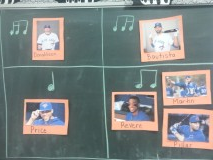
I started off by introducing my favourite player’s names and practiced saying the names to a steady beat. I chose different names according to the curriculum expectations for that grade. For Grade Three and Four classes I chose Tulowitzki, Price, Pillar, Smoak, Revere and Goins. For Grade Five classes I chose Donaldson, Bautisita, Price, Pillar, and Revere. The initial goal was to get the students to feel the rhythm of those names before they had to label them with standard notation.

In groups, students then chose their 4 favourite players from the list and put them into an order. Their first job was to get everyone in their group to say their players in unison to a steady beat. After they completed that task successfully, they took the player’s names and did it with body percussion. They could clap them, stomp them, snap them as long as they made the rhythm of the names to a steady beat. After that, they took their rhythmic composition and chose an instrument to perform their creation.

After the students could say those names comfortably we labelled them together. Tulowitzki represents 4 16th notes which is pronounced tikatika, Donalson represents 2 16th notes connected with an 8th note which is pronounced tikati and Bautista represents 1 8th note connected with 2 16th notes. All two syllable names represents 2 eighth notes which is pronounced titi and all one syllable names represent 1 quarter note which is pronounced ta.

Once we labelled their rhythms, each group made a final composition. They could use the names of the players, body percussion or instruments in any order they wanted. They were encouraged to add different dynamics and to use their different members of the group for solos or duos. Some of my groups added Beat Boxing or awesome stomping to get a good beat going. My instructions were to be as creative as they could be.

We then put all of their presentations together in a rondo form ( A B A C A D A E A F etc.). The A part of the song could be any short chant or baseball song. I took the song Alabama gal and changed the words to “Let’s hit a home run, Let’s hit a home run, Let’s hit a home run, Toronto Blue Jays”. Then I assigned each group a letter such as B, C, D, E etc.

I learned so many things about my students through this fun project. I learned that very few of my students know anything about baseball as they often compared the positions in baseball to the positions to something they were more familiar with, such as cricket. I also learned how passionate they are about sports. I feel like I have tapped into a whole new hook when I feel their energy is lacking later in the school year.

Next Friday, hopefully when the Blue Jays are getting ready to play their second game in the American League Division Series, I will be holding a kick ball tournament during the day at my school. The gym teacher and I decided to celebrate our students’ music by holding an opening ceremony where each class will share their creations followed by the game they have been learning in gym. I am sure we will probably even take some time to sing “Okay, Okay, Blue Jays, Blue Jays, Let’s Play Ball”.blue jays