Ontario Student Record Search

Wow, we are already into the second month of this school year and I am not sure I really know my students very well yet. I have a working idea of who they are as students and as people but need to gather more information to help me with my programming. That is where using their Ontario Student Record (OSR) can help you gather further data to assist me  in this process.

I typically do not complete my OSR searches until after the first month of school so that I can establish my own opinion about them as learners. The OSR is a cumulative record of them as a student since their entry into the Ontario education system. It is a legal document that travels with them from community to community and school to school in Ontario. It is a valuable tool for any educator who is working with a student.

There is a wide variety of information that exists in a student’s Ontario Student Record. First and foremost are the provincial report cards from their time at school. It is here that a teacher can gauge where a student has typically performed in the various curriculae. In addition there is often a wide variety of other sources of information specific to that student. For example, there could be documentation around outside supports such as occupational therapy, early intervention, psychological assessments, legal documentation around custody, Family & Children Services involvement, suspensions, Individual Education Plans and Safety Plans. When you look at the back of the OSR you can see a history of whether a student has had a stable education in one school or whether their circumstances show multiple schools with little or no stability. I have had one student who was entering into his 8th school and he was only in Grade 4.

There is a combination of hard data as well as data that has a subjective component and is based on the interaction and opinions of adults. It is important to differentiate between the two. I am not saying you should discount in any way or ignore that data, but rather understand that the circumstances in which that data was obtained may have been affected by many outside factors. For the student who was entering into his 8th school, his OSR showed that he had difficulty making friends. That data was accurate but was also impacted by his inability to be in a single place long enough to establish friendships or the fact he knew if he did make friends, he would probably be moving soon.

The OSR search is most valuable to me for my at risk students. Students who I know come with challenges either from an academic or behavioural standpoint are the first ones I search, as they demand my attention immediately. When I have a firm understanding of what level of achievement my students are displaying I then look at previous report cards to help me. If for example a student is obtaining a lower mark in mathematics then what has been previously reported it prompts me to further examine my assessment data to ensure my determinations are aligned with my criteria.

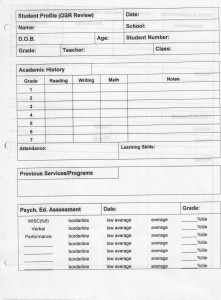
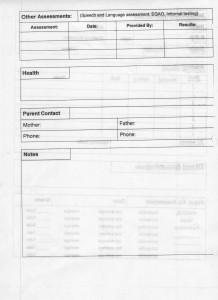
It is important to familiarize yourself with the proper protocol of what goes in an OSR, who can access an OSR, where that OSR can be viewed and the responsibilities a teacher has in regards to filing information in a student’s Ontario Student Record. A really rewarding aspect of doing my OSR searches is that I get to see how they have changed over the years with their annual photo. I have attached a template that I use when completing an OSR search.


scan

scan-1


Dear Teacher

This is an open letter to all teachers across the world no matter what your role. This past summer I was part of a campaign entitled ‘Project Hero’. Teachers and students from across Canada wrote to teachers in Sierra Leone celebrating the extraordinary courage and resiliency they demonstrated during the Ebola crisis in their country. My team and I were able to hand deliver over 300 letters to teachers from all regions of that country. In continuing with this campaign, I am sharing a letter from me to teachers around the world.

Dear Teacher,

What words describe a hero? One might say kind, super hero strong, courageous, resilient, compassionate, generous, self-sacrificing, trustworthy, gracious, fearless and loyal (only to name a few). Each and every day you demonstrate these altruistic characteristics in so many ways that make a difference for the students you are entrusted with.

Yet, your tireless efforts are not celebrated in books, movies or on the television. Your efforts are not worthy enough to make the evening news or local headline. There are precious few times when even a thank you is shared. That is what makes you a hero. You are not seeking public fame. You are not trying to get unlimited likes on social media and you do not seek out recognition of any kind. You simply do what you do because it makes a difference in the life of a child and ultimately the world in which we live in.

I have had the honour of being a teacher for thirty-one years and am ready to start another voyage in the life of a group of children. I am honoured and humbled to be in such a noble profession working with heroes like you each and every day. I wish you the best in this school year and will say thank you in advance for the many, many heroic acts you will carry out on behalf of children around the world.

Humbly yours,

Michael Beetham

https://www.youtube.com/watch?v=QDVECWcYtjc

P1060687   PS – please share this video with a hero you know

– this is the moment some of the Sierra Leone teachers

received their letters

School Spirit

What is it? Where do you buy it? How much do you need? Who is responsible for it? Several weeks ago I was part of a re-opening ceremony for a former school that I had taught at in the 90’s. That once old, archaic building had been transformed into an architectural state of the art learning environment. As I watched special guests, children and their families and community members arrive you could hear the oohs and ahs as they entered and saw the amazing interior of the school. If you have ever bought a new home, a new car or anything new, you know the excitement that comes with it.

This is where my post shifts gears. It was not the shiny new building. It was not the posh interior that I was in. It was not the formality of the ceremony, nor the speeches, nor the prestigious opening ceremony that had impacted me. What struck me that night was the immediate feeling I had as I entered the building of being a ‘Wildcat’. It had been almost two decades since I was a part of that staff and community. Yet, that feeling of belonging, that feeling of loving to be there and that feeling of comraderie immediately overcame me. Of course the culminating event that cemented that feeling was when a friend and former colleague lead the entire crowd in the long-standing Wildcat cheer. The building erupted into an atmosphere that resembled a pro sporting event.

When I went home that night still on an emotional high I sat and pondered why I had not had that feeling in such a long time. What was it? What caused it to resurface? I have been in many school settings over my career and not every place created that kind of feeling. According to Wikipedia, school spirit is defined as the emotional support for one’s educational institution. There is no curriculum to create it. There is no instruction booklet on how to teach it. There is only the passion and commitment that the teachers bring to their classroom and school.


The test

IMG_4870I am sitting in a room that silently waits for its students.

Merely by the way the desks are arranged, the world knows that it’s not going to be another normal day. Today is test day. Yup, that TEST.

With some trepidation, students will enter the classroom which has now been transformed overnight from a collaborative learning space into a scene from the ’50s. Today, the desks are in columns and rows that border on military precision with a healthy dose of compliance.

It’s go time, show what you know time because it’s standardized test time. So what’s all of the fuss about this time?

For months now something or someone somewhere has been planting seeds of anxiety in the hearts and minds of our learners. It has not come from inside of my classroom, but students are certainly arriving with it to school. As a result, it has led to some powerful conversations around mental health in education, problem solving strategies, and a debate over the logic(if any) of standardized testing. Nothing to fuss about here right?

The test has occupied the minds of some of our students it should be paying rent. Tim Urban might describe this state as a visit from the Panic Monster as he shared in his TED Talk from 2016. If we as educators didn’t put this monster into the minds of our students, then who did? Are there trolls handing out fliers off of school property? Is there a shadowy cadre of edu-data collectors directly marketing test score panic to families?

For the record, of course not. Yet, at the umpteenth time in a day I hear; “I’m nervous about EQAO”, “What if I do bad?” or ” AAAH! Evil questions attacking Ontario”, I know “the test” is having its affect on students and teachers too.

So how do we deal with the reality that this anxiety they’re feeling is real and students need our help/support to overcome it?

To combat these fears in our classroom, we have taken to increasing the physical activity level while differentiating tasks to maintain and broaden engagement. We move more. We laugh more. We work together more. Food helps too. I wrote a post about Test Crackers if you want to know more. For “the test” Samosas are on the menu in my class-veggie of course.

Instead of worrying, we have been developing our collaboration and critical thinking skills to work through challenges.  We’ve intentionally disrupted routines, not only to distract, but to shake things up. My grade 6s have been working hard for nearly 9 months. There is a lot going on at this age socially, emotionally, and  physically. They do not need to be burdened by external pressures or worry.

Since September, assurances and reassurances have been given to students so they know the marks from tests like these will not be seen by admissions committees at Harvard* or even good universities like Waterloo, MIT, and Stanford (lol). Students know that they have all of the tools necessary to succeed without obsessing over practice work booklets or past tests. I can only hope that our safe, and encouraging environment will help them if doubts start to creep in.

And so it begins, students file in, find their places, and standardized testing gets its butt kicked by samosa fueled class of critical thinking grade 6s.

* I’m sure Harvard is good too. I used it here purely for the absurd comedic value. Go Harvard!

Homework or No Homework?

This is a question that I have asked myself over and over. At different phases of my career I have given myself different answers ranging from they must have homework because that is what good teachers do, to homework is a vehicle that creates problems and turmoil for the families of my students and thus should not be a part of my program.

There is no answer that fits all classrooms or that fits all students. Like every other aspect of my program I have to differentiate according to the needs and circumstances of my students and their families. The following site pinpoints the top 5 reasons for assigning homework and top 5 reasons for not assigning homework ( http://www.teach-nology.com/tutorials/teaching/proandconhomework.html

I am going to share with you an event in my career where assigning homework created a very negative scenario and conflict for a student. This student was a very intelligent, friendly, polite young man who was a pleasure to work with in class. Over the first two months of school he excelled in class but habitually did not complete any home tasks. It got to the point where his lack of responsibility toward homework was seen as a behaviour concern. A few weeks later I became aware that his Mom was in a coma and that his family spent each night by her side in the hospital. My lack of awareness of my student and his home situation created undue and unneeded pressure on him and the family. As a result, homework was not a part of that student’s program.

On the other side of the coin, a student that I am working with this year spends time every night with his Mom reviewing the day’s work along with increased home reading. That has resulted in an accelerated growth in his area of academic deficits. In both cases, my decision to not assign homework to student A, and to assign extra homework to student B was the right thing to do. Homework for the sake of homework is not a productive component to any student’s learning. It must have a specific purpose that is helping meet the targeted academic outcomes of the classroom.

What does it mean to learn? What does it mean to teach?

What does it mean to learn? For me, learning is the trajectory between not knowing and arriving at new understanding. What, then, does it mean to teach? Teachers have long been grappling with this question and exploring the best way to define this through the study of pedagogy.  Pedagogy is the method one engages to facilitate learning. It makes the difference between those who know a lot of information (content knowledge) and those who know how to skillfully craft learning experiences that will facilitate the acquisition or construction of information. Thus, to teach means to employ pedagogy.

So beyond big words, what does good teaching look like? This is something that I consistently reflect on to see  how much I’ve grown and developed as an educator. Seven years ago, as a new teacher, my enthusiasm around teaching revolved around how much knowledge I could share with my students. This was usually demonstrated by how much I spoke. Since then, my vision of teaching and practice of pedagogy has drastically shifted in that now I believe a good day of teaching takes place when my students do much of the talking and we all engage in the learning. Effective teaching, though ultimately reflective of student learning, is the intentional construction of experiences that invite curiosity and nurture the construction of new understandings. In other words, good teaching nurtures the conditions necessary for learning to occur rather than the teacher saying a lot of “stuff”.

As a math teacher, I get excited when learning opportunities arise that provokes dissonance and ignites curiosity. The careful blend of the familiar and not yet known motivates students to embrace challenges that have a low threshold but a high ceiling. Students are engaged in a real life problem that causes them to arrive at many stumbling blocks of previous understandings and must harness perseverance in order to proceed forward in constructing understanding. In such cases, I often encourage my students to “embrace the struggle” as the the inverse reaction to dissonance is learning. This way, students become motivated learners not because of a sticker or a final grade, but simply for the joy of learning.  Bottle up this experience and you get good teaching – the intentionally crafted growth-opportunities nurtured by teachers. These experience don’t happen when teachers do all the talking, these things happen when teachers allow students to experience their own journey between what is known to that which is understood. This is what it means to learn.

Sunshine Calls

When my students arrive into my alternative behaviour classroom in September, so do their parents and families. The family’s beliefs and attitudes about school have been shaping ever since their child became a part of the formal school system. For the  family of my students, that means that most communication from the school has almost certainly been a negative scenario that had unfolded. So when I complete my first call home in September what do you think the response is from the parent who answers the phone? You are right, “Okay what did my child do now?”

Just as it takes time to build relationships with your students, so does it take time and effort to connect with families. This is especially true for families of students who have struggled in school or have had difficulty adjusting to school and classroom expectations. For me this starts with an onslaught of ‘Sunshine Calls’. A Sunshine Call is a strategy that I use to gain the confidence of my families by showing that I care about their child, I believe in their child and will balance the type of information that comes home and not dwell on the negative (attribute based approach).

The best analogy I can use to explain the benefits of this strategy is to compare it to banking. The more positive deposits that I put into my account (compliments, sunshine calls) the stronger that balance will be. When I do have to make a withdrawal (call home about a negative scenario) my positive balance will hold me over and the relationship will remain stable and the family will be more likely to support me knowing that it must be concerning for Mr. B. to be calling home about it.

What is exciting for me, is when my students start to understand and realize that their best efforts and positive changes will be shared often and ongoing with their family. I start by asking them if they would like me to cimagesall home and tell their parents about some positive scenario that took place that day. They 100% of the time say an astounding yes. As they come to realize this is a regular part of our classroom, they begin to ask me to call their family and let them know about their math work or reading. That is the time that I know why I will always look to see the glass as half full.

Rebound From Your Mistakes

Perfectionism seems to be a common character trait of teachers in that they expect to be perfect at everything they do. They must have perfect lessons, they have to have perfect classroom displays, they expect perfect interviews and so on and so on. If this level of achievement has not been met they often feel they have let down their students. They may feel guilt or embarrassment and tend to dwell on the negative aspect of the scenario. The reality is we are human and humans make mistakes even if they are teachers.

We are patient with our students. We expect them to make mistakes in their personal learning journey and offer formative feedback that allows them to reflect on their learning and move forward to the desired outcome. If this works with students, it will also work with teachers.

There have been many, many times over the course of my career that I made a mistake. Like when I said something I should have phrased a different way or when my reaction to a classroom situation was not handled in as professional a manner as it could have. Each time a situation occurs that I feel could have been handled a different way I complete a personal reflection that helps me move forward in my practice. All of those not so shining moments, have helped shape my learning and skill set for the present and future.

One of the Keys of Excellence in my classroom is ‘Failure Leads To The Sweet Smell of Success’. This foundational belief teaches my students that mistakes are inevitable and we can examine the error and turn it into a teachable moment so that future scenarios will result in success for all. An added bonus to this is that my students become more of a risk taker as it relates to ability to try new things. I live by this belief and it has helped me become a lifelong learner as well as a risk taker in experimenting with new pedagogical practices.


When Your Best Is Not Enough

I work with some very challenging students, who at their core, are really nice people. As I get to know them as people first and learners second, what surfaces quite rapidly is that many of their needs are beyond my skill set. I am not a counsellor. I am not a psychologist. I am not a physician. Yet the needs they bring to my classroom are very diverse and more complex than just literacy and numeracy. I find myself often saying, what can I do to help this child succeed and feel good about themselves. As you know, there is no simple answer to this question.

This year I have been faced with a dilemma that I have never before in my career been in. I do not know what to do for a child in my class. All of my efforts, strategies, consultations and professional readings have left me in the same place I started with this child over 6 months ago. This individual’s lack of progress (and at times regression) have been a huge stressful burden on me as I struggle everyday trying to figure out what to do to help this child stabilize and grow as a student should. My initial reaction was that despite my absolute best effort, I have failed this child.

I have a very good friend and colleague to whom I shared this belief about myself with. He was very quick to point out that I had not failed him. The student’s lack of progress is a result of many needs not being met. He began to query me about my approach with the student. The conversation went something like this:

Do you differentiate the work for this student so that it reflects his current academic level? Yes

Do you provide accommodations in his program that meet his individual’s learning needs? Yes

Do you work hard to make that student feel welcome and cared for each and every day in your classroom? Yes

Do you seek out additional supports within your school and/or board to assist you in creating a program for this student? Yes

Do you communicate your concerns in an ongoing manner to your school support team, principal as well as the student’s family? Yes

Do you smile and tell that student what a nice person they are and thank them for coming in everyday and putting forth their best effort? Yes

At the end of that conversation I came to realize that I had not failed this child. I had to the best of my knowledge and skill set did everything humanly possible to help this individual succeed and that despite my best effort, that progress was not occurring. I had not failed him, because I had not given up on him.

Advice for Starting Partway Through the Year

This particular post comes to you as I try to wrap my head around going back to work on Monday after fifteen months off. I left mid-October of 2014 after being placed on medical leave for the last few months of my pregnancy, handing off a lovely group of students to a great teacher for the rest of the year. That was difficult, but I knew they were in good hands. This time, I’m taking over a class someone else has been teaching for the first half of the year – something I find much more difficult.

This isn’t the first time I’ve taken over for another teacher. Having done this a few times now at different grade levels, I’ve learned a few things to help make the process a little smoother.

Introduce yourself! This might seem like a no-brainer to some of you out there, but communication with families is really important. No matter what time of year you’re starting, you should either send a letter home or invite families into the school to meet you. I actually like to do both. Your letter doesn’t have to be huge and really shouldn’t be your life story, but a little bit of background is nice to include – where you’re from, how long you’ve been teaching, that sort of thing.

Get to know your students. I start the first day by playing a few get-to-know-you games, then transition into a variety of activities meant to provide insight into where my students are with language. I’m a French Immersion teacher, and at my level I don’t teach math, but if I did I would include some activities to learn their problem solving/reasoning skills in that subject as well.

Find out your students’ goals for learning. This is the perfect time of year to talk about goal setting and have your students do a learning skills self-assessment (in fact, I do that every year already). Goal setting can tell you a lot about a student and where their strengths are. I find students are typically very honest when discussing their learning skills, too. Those two activities can give you a lot of insight into your students’ strengths and areas for improvement.

Don’t try to change the routine all at once. You don’t have to be stuck with the routine the previous teacher put into place before you arrived, but you really shouldn’t overhaul everything at once. Transitioning from one teacher to another is already stressful for students, so try to keep most of the routine familiar to them while you gradually implement your own ideas. It’s hard to rein in your excitement, I know, and sometimes you just have so many ideas you want to try them all right away before you forget them. Resist that urge – you don’t want to overwhelm your students.

Resist gossiping about the previous teacher, either with colleagues or students and their families. I’ve been there, I know all about it: people will try to engage you in discussing the previous teacher’s style, personality, and methods. Just don’t do it. I probably don’t have to tell anyone this.

Don’t take on too much outside the classroom. I love running extracurricular activities, but when I’m starting an assignment partway through the year, I try to limit how much I’m doing other than teaching my class. I need the extra time to plan and, I’ll be honest, unwind. You have lots and lots and lots of years ahead of you to do the drama club or sports team you love doing. Sometimes, it’s incredibly liberating to just have to worry about teaching your class every day.

Remember that students need time to adjust. Don’t take anything they say or do the first few weeks personally – I’ve had students decide on the first day that they hate me, only to have them declare me their favourite teacher by the end of the year. I’ve had students do a complete 180 in behaviour when I started. Students will react differently from one teacher to the next, and they need time to adapt to having a new teacher.

Finally, don’t be discouraged. I find starting partway through the year much harder than starting at the beginning. I feel lost for a few weeks every time, and I think that’s a normal part of the process. Just like at the beginning of the year, it will take time for you to find your footing and get into a groove with your new class. All you can do is show up and do your best every day.