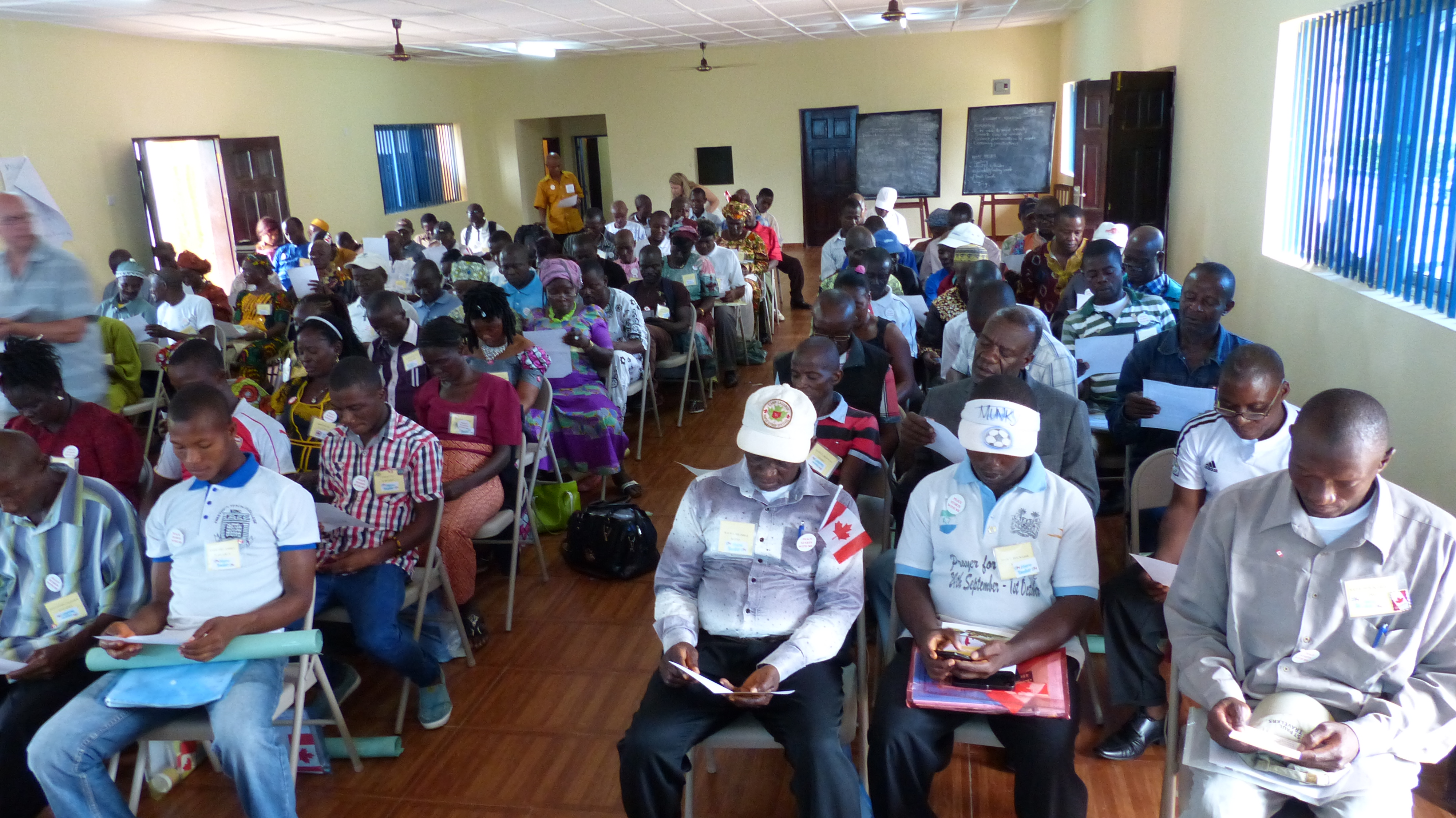
This is an open letter to all teachers across the world no matter what your role. This past summer I was part of a campaign entitled ‘Project Hero’. Teachers and students from across Canada wrote to teachers in Sierra Leone celebrating the extraordinary courage and resiliency they demonstrated during the Ebola crisis in their country. My team and I were able to hand deliver over 300 letters to teachers from all regions of that country. In continuing with this campaign, I am sharing a letter from me to teachers around the world.
Dear Teacher,
What words describe a hero? One might say kind, super hero strong, courageous, resilient, compassionate, generous, self-sacrificing, trustworthy, gracious, fearless and loyal (only to name a few). Each and every day you demonstrate these altruistic characteristics in so many ways that make a difference for the students you are entrusted with.
Yet, your tireless efforts are not celebrated in books, movies or on the television. Your efforts are not worthy enough to make the evening news or local headline. There are precious few times when even a thank you is shared. That is what makes you a hero. You are not seeking public fame. You are not trying to get unlimited likes on social media and you do not seek out recognition of any kind. You simply do what you do because it makes a difference in the life of a child and ultimately the world in which we live in.
I have had the honour of being a teacher for thirty-one years and am ready to start another voyage in the life of a group of children. I am honoured and humbled to be in such a noble profession working with heroes like you each and every day. I wish you the best in this school year and will say thank you in advance for the many, many heroic acts you will carry out on behalf of children around the world.
I write this post as a tribute and thank you to all educators who breathe inspiration into the lives of their students and into one another from September’s strong start to June’s stronger finish.
This post is the completion of a promise after a response reminiscent of a rant written to address comments in the media about educators. In the spirit of warmth and fuzziness I’ll keep my word(s) positive.
You did it!
10 months in the books, out of the books, torn away from the books, and complete with several second looks. From field trip bookings and to figurative (text)book burnings the school year sparked a 5/6s of a year long fire of growth. And now, as the embers cool, the ash settles, and the warmth fades another year of memories will linger as ember in the mind to be stoked again soon.
Does anyone else feel the same way? I do and know that I’m not alone on this one.
This year, my seventh, which I am privileged to witness many intellectual and life fires lit, fanned, spread wildly, and occasionally control burned. A feat, I am sure, that was accomplished throughout millions of classrooms around the world thanks to incredibly caring educators like you.
Imagine that you were part of the transformation, edification, and education of a student. You helped someone, or several someones, be a part of something, achieve something or realize something they’d never known before? Could there be a more noble calling?
When students arrived in your classroom last September, they were rough around the edges, unsure of what was to come, carrying some of the baggage from the previous year, and full of energy (nervous and otherwise). And from that you set out rough around the edges, unsure of what was to come, carrying some of the baggage from the previous year, and full of energy (nervous and otherwise).
There were times, too many to mention (reports, parent meetings, phone calls, bombed lessons, planning lapses, sick days, and life in general) that required us to dig deep into our vaults to rise above, resolve, and retain our raison d’etre.
And now?
Rest, raise a toast to one another, as I do to you because you started strong and you finished stronger.
Cheers! Santé! Gom bui! Kampai! Prosit! Djam! Mabuhay!
Thank you for the inspiration.
It is that time of year when I am able to enjoy the labours of my endless hours of worrying, endless hours of commitment and endless hours of planning for my students. We call it our harvest time.
At the beginning of every school year a new group of students come into our program with a variety of dysfunctional behaviours accompanied by a lack of success in school and we always start with the same story. I bring out a group of apples in various conditions and ask them which one would they choose. Of course all of their decisions are based on what they see on the outside. Is it bruised? Is it ripe enough? Does it have the right shape as compared to all the other apples? But yet the best part of the apple is the part that nobody can see, the inside. That is who my students are. They are completely judged by what people see on the outside and from what they have experienced from the outside. Often, past teachers have no opportunity to experience what a wonderful, young person they truly are due to the violent, aggressive behaviour they exhibit. My first question to the students is how do we show people what an amazing person you really are on the inside. How do we show them your best part?
That is the question that was first asked over 10 months ago and after a year of academic and behavioural programming we have arrived at harvest time. They are now being judged for who they truly are and not what they previously looked like. Both the adults and students in Room 16 take great pride and enjoyment during harvest time. In our daily circles we are preparing them for that transition back to the regular world. That begins by revisiting awkward or negative scenarios that took place in our room, except at this time of the year we are able to laugh about it. The students shake their heads in disbelief as they have come so far and changed for the good so much, those past behaviours seem incomprehensible to them (self evaluation at its best).
They then begin to identify which strategies or skills have worked best for them over the year. They make a list of their most effective strategies, expressions or visuals and we put that together into a laminated bookmark. That is taken with them as they transition back to their next academic setting and becomes the foundation for their next year’s success.
I hope you are taking the time to enjoy your harvest time!
What is it? Where do you buy it? How much do you need? Who is responsible for it? Several weeks ago I was part of a re-opening ceremony for a former school that I had taught at in the 90’s. That once old, archaic building had been transformed into an architectural state of the art learning environment. As I watched special guests, children and their families and community members arrive you could hear the oohs and ahs as they entered and saw the amazing interior of the school. If you have ever bought a new home, a new car or anything new, you know the excitement that comes with it.
This is where my post shifts gears. It was not the shiny new building. It was not the posh interior that I was in. It was not the formality of the ceremony, nor the speeches, nor the prestigious opening ceremony that had impacted me. What struck me that night was the immediate feeling I had as I entered the building of being a ‘Wildcat’. It had been almost two decades since I was a part of that staff and community. Yet, that feeling of belonging, that feeling of loving to be there and that feeling of comraderie immediately overcame me. Of course the culminating event that cemented that feeling was when a friend and former colleague lead the entire crowd in the long-standing Wildcat cheer. The building erupted into an atmosphere that resembled a pro sporting event.
When I went home that night still on an emotional high I sat and pondered why I had not had that feeling in such a long time. What was it? What caused it to resurface? I have been in many school settings over my career and not every place created that kind of feeling. According to Wikipedia, school spirit is defined as the emotional support for one’s educational institution. There is no curriculum to create it. There is no instruction booklet on how to teach it. There is only the passion and commitment that the teachers bring to their classroom and school.
Next to journaling and writing for the Heart and Art blog, resume writing is one of my favourite ways to reflect on my practice. The process of communicating my philosophy of education and demonstrating how this plays out in the day-to-day ignites my passion for teaching and learning and reminds me of why I do what I do as a teacher.
Shifting one’s role, whether it be changing schools or position or seeking new experiences, is one of many ways that educators can embrace new learning opportunities and refuel their energy for the journey ahead. Embracing the stance of reflection when composing one’s resume is essential in this regard as it distinguishes candidates amongst a large pool of applicants. The following suggestion are some of the tricks I’ve hid up my sleeves in order to present myself as a strong candidate for the mirage of opportunities within the education sector. Why am I telling you this? I don’t know. But perhaps after many years of my unofficial resumes consulting, these tricks will prove useful in your journey.
1. Use a relevant framework. The Ontario College of Teachers (OCT) governs the teaching profession in Ontario and as such, using the OCT Standard of Practice as a framework for designing your resume structures the narrative of your practice in ways that align with the directives and outcome of best practice. Using the standard heading, Education, Experiences, Interests, etc., may serve useful in less specialized sectors, but as a profession, teacher resumes should mimic the framework that serves to structure our professionalism.
2. Show, don’t tell. I have read countless teacher resumes that indicate that applicants planned and taught lesson. But starting this task that on a resume is not distinguishing at all. Every teacher seeking an opportunity in education must have planned and taught lessons. A more effective way of demonstrating the scope of your practice is to paint the picture of your practice in action. This is where reflection is essential. Rather than telling what you did, show it using an affect-oriented narrative. “Embraced proactive approaches to classroom management in order to nurture a positive learning environment and foster a sense of community” paints a more intentional picture of teacher practice than “Created a positive learning environment.” The latter tells what was done while the former shows how it was done and explains why. What sets the two statements apart? Reflection that articulates the desired outcome of the action being described.
3. Treat the page like limited re-estate. Though not every posting for teachers may stipulate a maximum page number for the resume, I tend to stick to the standard 2 pages rule when applying for teaching positions. With over 7 years of experiences that seems like an impossible endeavor but by being strategic in my articulation I can demonstrate the breadth and width of my practice while maximizing the limited space of 2 pages. Being intentional about what to say, how to say it and where to say it can be fruitful in staying within the page limit. The key is to avoid repetition. Though you may have many teaching experiences that you want to display, be sure to be succinct about only demonstrating a particular aspect of your practice no more than once, regardless if it was something that you employed in other experiences. There are better ways to demonstrate your strength as an educator other than repeating yourself multiple times. Likewise, many resumes are accompanied by a covering letter which structure is very different than that of a resume. It is in your covering letter that your prose can come out in ways that will allow you to delve deeper into your practice. But remember, if you said it in your resume, use the covering letter to say something else.
So there you have it. My 3 easy steps for educators to engage in reflective resume writing. However you decide to engage in it, your resume speaks first, often before you are invited to articulate your vision and passion in person. Write it well. Write it with intention. Write is as a way to stay reflective. In the process you may be reminded, again and again, of just why you truly are an educator.
What does it mean to learn? For me, learning is the trajectory between not knowing and arriving at new understanding. What, then, does it mean to teach? Teachers have long been grappling with this question and exploring the best way to define this through the study of pedagogy. Pedagogy is the method one engages to facilitate learning. It makes the difference between those who know a lot of information (content knowledge) and those who know how to skillfully craft learning experiences that will facilitate the acquisition or construction of information. Thus, to teach means to employ pedagogy.
So beyond big words, what does good teaching look like? This is something that I consistently reflect on to see how much I’ve grown and developed as an educator. Seven years ago, as a new teacher, my enthusiasm around teaching revolved around how much knowledge I could share with my students. This was usually demonstrated by how much I spoke. Since then, my vision of teaching and practice of pedagogy has drastically shifted in that now I believe a good day of teaching takes place when my students do much of the talking and we all engage in the learning. Effective teaching, though ultimately reflective of student learning, is the intentional construction of experiences that invite curiosity and nurture the construction of new understandings. In other words, good teaching nurtures the conditions necessary for learning to occur rather than the teacher saying a lot of “stuff”.
As a math teacher, I get excited when learning opportunities arise that provokes dissonance and ignites curiosity. The careful blend of the familiar and not yet known motivates students to embrace challenges that have a low threshold but a high ceiling. Students are engaged in a real life problem that causes them to arrive at many stumbling blocks of previous understandings and must harness perseverance in order to proceed forward in constructing understanding. In such cases, I often encourage my students to “embrace the struggle” as the the inverse reaction to dissonance is learning. This way, students become motivated learners not because of a sticker or a final grade, but simply for the joy of learning. Bottle up this experience and you get good teaching – the intentionally crafted growth-opportunities nurtured by teachers. These experience don’t happen when teachers do all the talking, these things happen when teachers allow students to experience their own journey between what is known to that which is understood. This is what it means to learn.
“We come to work for our students but isn’t it nice when we get along with the adults? (Heart and Art Book of Teaching and Learning, pg. 12)
As teachers, we are so careful to nurture positive learning environments for our students to learn and thrive in. We are mindful of the social, emotional, physical and mental well-being of our students and work diligently to ensure that they are safe and secure in our care. Our families are grateful for the love in which we care for our learners and they are resolved in knowing that the adults in the building are committed to their personal well-being of their children. How then, do we nurture this same kind of environment for ourselves and our colleagues? After many years of working with many different educators, I’ve come to realize that adults are super comfortable addressing the needs of students but act in ways that are incongruent with how we take care of ourselves. Collectively, we are intentional about teaching students to be respectful and cooperative, but how might we nurture these great habits amongst ourselves? The following, though not an exhaustive list, are some things we can try tomorrow to foster healthy working relationships amongst our colleagues:
Send a thank you note or email to express gratitude.
Visit the staffroom for lunch at least once a week. Sharing a meal lends itself to conversation that allows you to get to know those you work with and appreciate the diversity they bring.
Start a wellness club that encourages physical, social and mental well-being through physical activity and healthy eating.
Escape your “divisional cubical” and reach out to those you may not have the opportunity to work with. We have more in common than we think.
Start-up a book club. My favourite thing about reading a good book is talking about it. Why not explore a text together and see how much that ignites collegiality amongst the staff.
Say “please” and “thank you”. Manners just makes the world a better place.
Presume positive intentions but also be honest when an offence has occurred. Talking it out with the presumed offender will invite a learning opportunity, as opposed to engendering future conflict and harbouring resentment.
Smile wide and laugh loud. The radiance of a smile and the joy of laughter always makes for a welcoming.
As the adults in the building, we really need to take care of each other. We are growing the adults of the future and the model we set is read more nuanced than the one we say we expect. Let our actions speak volumes in our commitment to serving our learners. Let us serve the community. Let us serve each other.
This is the second post in my word series in spirit of circling the bases of baseball and education. I’m back at the plate to take another swing. Click here for an instant ‘read’play of my first at bat.
It’s the 7th inning, and your back at the plate, again. So far you have popped out to short stop, struck out looking, and are starting to regret getting out of bed today because you are sitting on 2 strikes already for this at bat; and the pitcher is feeling pretty smug about setting you down for the third time in a row.
photo by jcclark74 CC0
You shake off the crowd noise and focus on the pitcher itching to make you look bad, again. Here it comes. The moment that defines you, validates you, and proves to the watching world, and yourself, that you deserve to be here. Your focus is Zen like. You want to hit one out of the park so badly, and leave the doubters gawking in awestruck wonder of your talent, and requisite, albeit, controversial bat-flip.
Here’s the pitch! Muscles tensed, eyes trained to the ball, hips and hands executing the swing in a fraction of a second, and in your mind play the immortal words of Jerry Howarth, “There she goes!” But the sound you hear is more of a thunk! You make contact, and the ball leaves the bat with barely enough force to escape the infield. Somehow, you are on base with a blooper, and after 2 failed attempts to get on base, you take what you can get. Time to make the most of it.
The classroom, like the baseball diamond, is where learning gets ugly and messy. Mistakes are going to be made, and that’s ok. Thoughts of perfection on every play only lead to frustration and disappointment. They are also unrealistic and can come at the detriment of the learner/player.
In baseball, like education, the goal is to get better every day. Results may often not be a result of what was planned or prepared for, but they allow us immediate feedback to keep our heads in the game. Do we quit when things are not going our way? Of course not. A perfect lesson in education, like a home run in baseball or pitching a perfect game, may be moonshot goals that should not keep us from swinging for the fences anyway.
Funny how life is like that too. The sweetest victories usually come after the most difficult times. As long as we are willing to be learning we are capable of achieving something. Success will look different from day to day. Are we preparing our students to stay in the games, step up to the plate, and take their swings? How we prepare our students will make all the difference. This comes through coaching, practice, resilience, and confidence. There is only one way to make this happen and it comes from believing in our students.
In a sport loaded with statistics, it is easy to glean relevant information about everything in baseball. Did you know that the last person to hit 400 was Ted Williams of the Boston Red Sox. It was in 1941 and few players ever since have even come close to attaining, what is arguably, the most illusive achievement in professional baseball. Education has been known to keep stats too. Between government standardized tests, and need for assessment metrics from JK to infinity in the classroom, there is no shortage of data. But what of it? Are we using the data to its fullest? Are there better ways to measure success in the classroom like Sabremetrics I mentioned in my first post?
Baseball Player by Paul Brennan little paul – Public Domain
Imagine that since 1941, not a single player has been able to hit the baseball 4 times out of every 10 at bats. That’s a 40% success rate! What if we looked at our students that way. Would any of them be in the hall of fame with a success rate like Ted Williams? What would are world look like if our students were lauded for their swings and misses as much as their hits?
To some, it gets worse. In the modern era, if a player is able to hit the ball 3 times out of 10 over lengthy career he too has a good chance of being enshrined in the Baseball Hall of Fame*. That’s by being successful only 30%. This got me thinking. How are you celebrating the success of your students? Are you finding them stressing over their last at bat(test result, essay, project)? Are they able to learn each time they come to the plate and take a swing without losing confidence when they get out?
In her incredible TED Talk Every kid needs a champion Rita Pierson shared how important it was to celebrate success in learning, even if it was a failure by all standards. I often lose track of this myself and need to take stock of the little victories that happen in the process. As teachers, if we are greeting students heading back to the dugout after an out with disappointment or derision then we are missing a chance to build confidence in them, and a chance to help reflect and prepare for what needs to happen for success next time.
If we can share this with our learners then success is possibly only a few innings away. In this way we can encourage and equip students to be ready for when their turns in the batting order come around again.
Most of the learning I’ve experienced as an elementary school student is a blur. There are few moments, however, that stand out as pivotal and that have helped shape my experiences as an educator today. One of such moments was grade 7. It was in grade 7 that I learned the word mediocre. Before then, I had never encountered this word and once introduced, it was truly a powerful moment for me. In learning this word I was given language to express an idea that I didn’t even know had existed. This is the power of language and this is why I fell in love with words. My fascination with the ways in which words can be intentionally nuanced to convey ideas with such lyrical intensity fascinates me; not only because of the creative ways in which ideas can be constructed, but also because it is a tool for granting access to discourses that without them one would remain silenced. I experienced the power of language but also that language was power. This experience brought me to my journey of engaging my students in the politics of language and exploring ways I could grant them access to platforms of thinking simply by equipping them with the language of power.
More than mere vocabulary boosters, words of the day or word studies, when introduced in meaningful contexts, can not only enrich student vocabularies, but can also give volume to their voices as thinkers, activists and world changers. My journey toward empowering learners with the language of power began in my first year of teaching. It was a grade two class and I was terrified. I had no idea what to do or how to go about it. It seemed like all the learning from my formal teacher education went out the door as soon as the students walked in. I realized I was in trouble when I would speak to my students only to receive blank stares. What I wrestled with was whether or not to make what I was saying more child-friendly or to simply bring the children up to speed and create many teachable moments with the words that I used. The result was the latter and we began an anchor chart entitled “Ms. Nelson’s Fancy-Schmancy Words” where when students stopped me mid-sentence to seek understanding of a specific word I used and it would be added to the list along with its definition and the sentence in which it was used. Now, 7 years later, the anchor charts have evolved into a word wall in which students are constantly identifying not only new words that I used but also introducing ones of their own and adding words they find in the literature they read or listened to on a daily basis. The love for words became contagious and the thirst for learning new ones was intrinsic.
Students were then invited to use words, or the language of power, as tools in exerting voice to an authentic audience. Students were empowered by words when they interviewed all 5 Mayoral Candidates in the 2015 Mayoral Election. Students wrote speeches and presented them as great orators in front of invited community members that included the local crossing guard, a church pastor and family and friends. Students raised awareness by writing blogs about the impact of their social identities and shared these sentiments with the school community. Their words spoke to issues of social justice and coloured the imagination with distinct imagery, was a power to be wielded in the pens and voices of elementary school students.
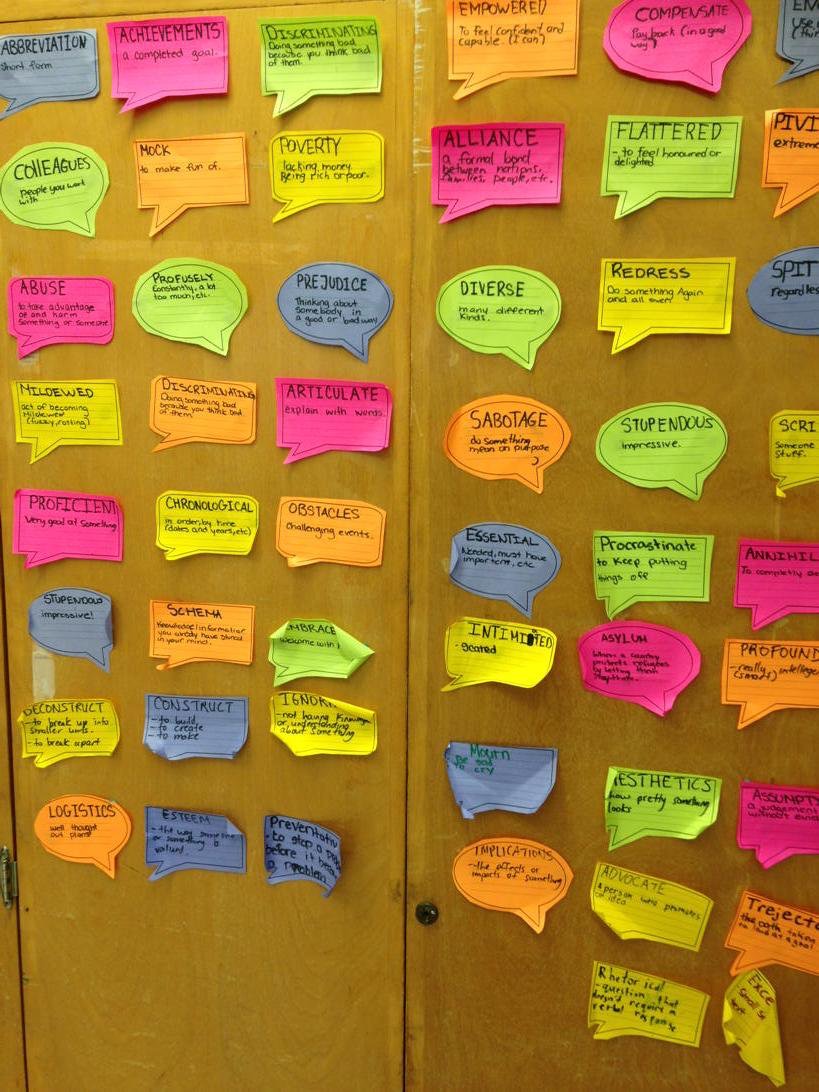
Word wall from my Grade 5/6 class: sabotage, aesthetics, logistics, schema, implications profound, trajectory, embrace, chronological, deconstruct, procrastinate, intimidated
I would like to share a new initiative my class is starting at our school Ancaster Meadow.
Our class realized the large need for technology in the classroom. We noticed that students are sometimes unfamiliar with apps that are available for completing work and for presenting learning. We are starting a new program called “Tech Talk” where as a class we travel to classrooms and instead of “Reading Buddies” we will assist the class one on one with apps of the teacher’s choice. We came up with a benchmark of five:
Explain Everything
Kahoot
Weebly
Pic Collage
Prezi
These apps will be explored in detail by my class so when we visit our first class after the break, the break off sessions will be smooth and very productive. We will offer this program to grades two-five and speak to teachers before regarding sign up. Students will be able to explore the apps, prepare a small task and then share it with the whole class. The sessions will be fifty minutes long as that is how long a period is in our school. We hope that students will learn from each other and that everyone will be able to use these apps in the new future. I hope it will be a meaningful experience for my class to teach younger students skills that they already have. I cannot wait for our first trial after the break. I encourage everyone to try this “Tech Buddies” program and share your experiences as well.

 PS – please share this video with a hero you know