Grade 4/5 Science in Minecraft: Education Edition

My students and I have really been enjoying exploring how we can use Minecraft: Education Edition to extend our learning. Last month, before we got sent back to the world of online learning, we spent some time diving into a Science task in class.

The basic premise of the task was similar between the two grades: research a topic and build a model of it within Minecraft. Grade 4 students would be choosing one of the animals from Minecraft and creating a viable habitat for that animal in the game, while Grade 5 students would be choosing a human organ system and creating a pathway that would bring visitors through the functions of that organ system. After building their model, they then presented their worlds to the class and talked about the different elements they included.

For Grade 4, they had to consider food chains, predators and prey, appropriate shelter, biomes.

For Grade 5, they had to consider which organs were part of the system, how they’d create them in the game, what their function is and how to show that with a path or railway.

I’ll admit that I wasn’t sure how it would go when we started down this road. I considered that it might be a bit to out there as far as projects go. I should know better by now than to question these kids, though – they dove into this project with excitement and went well beyond my expectations. They enjoyed them so much that today they asked me if they could do another project like this. I’ve never had French Immersion students so willing to do an oral presentation!

Here are a few of their projects that I’d like to share.

Grade 4 Habitats
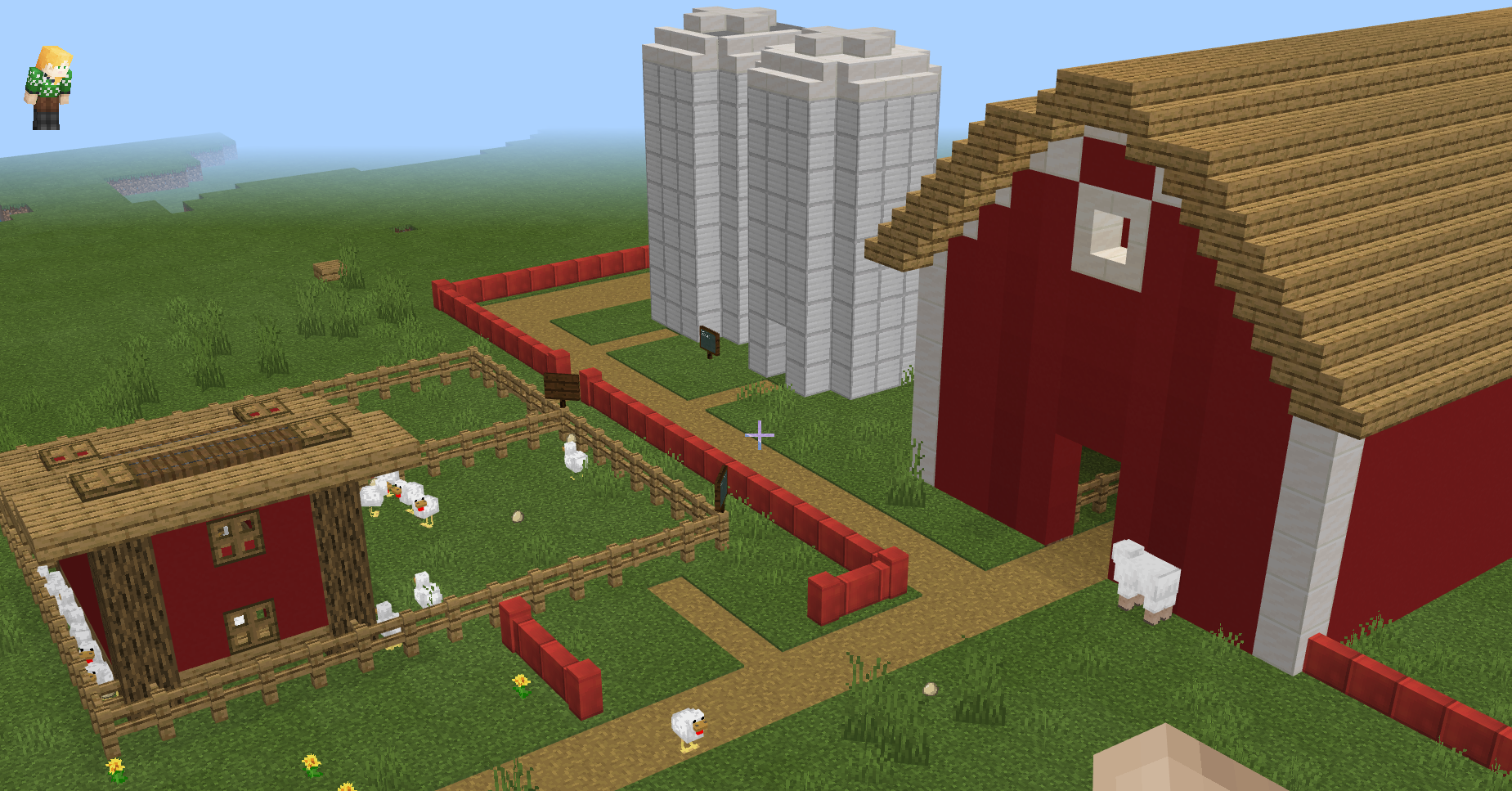
 

A farm habitat. The students who made this farm talked about the influence of human activity on the animals who live on the farm. There was a food chain demonstration around the side of the barn, with little pens containing different living things set up to walk visitors through the food chain.
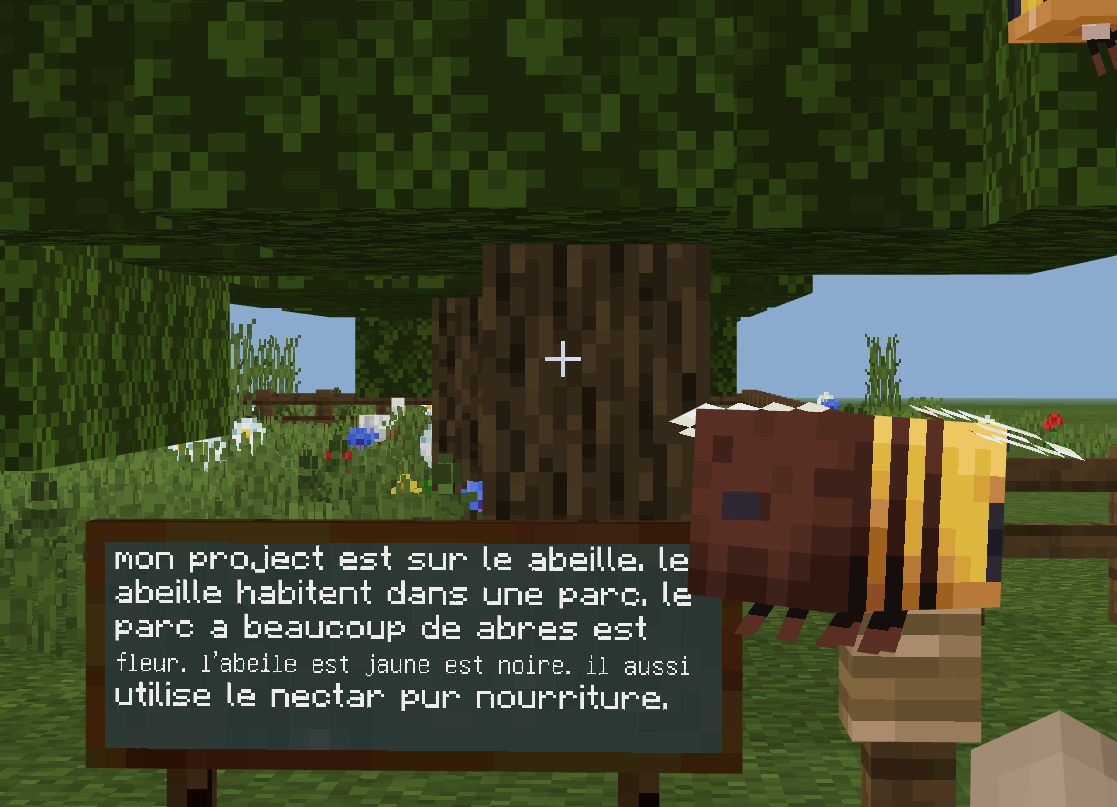
 

This project was on bees. The students created a park with several wildflower gardens. When you look at the level of French on these signs, consider that I teach middle immersion, meaning this is their first year in French Immersion – and for the student who did this project, it was their first year learning French at all!
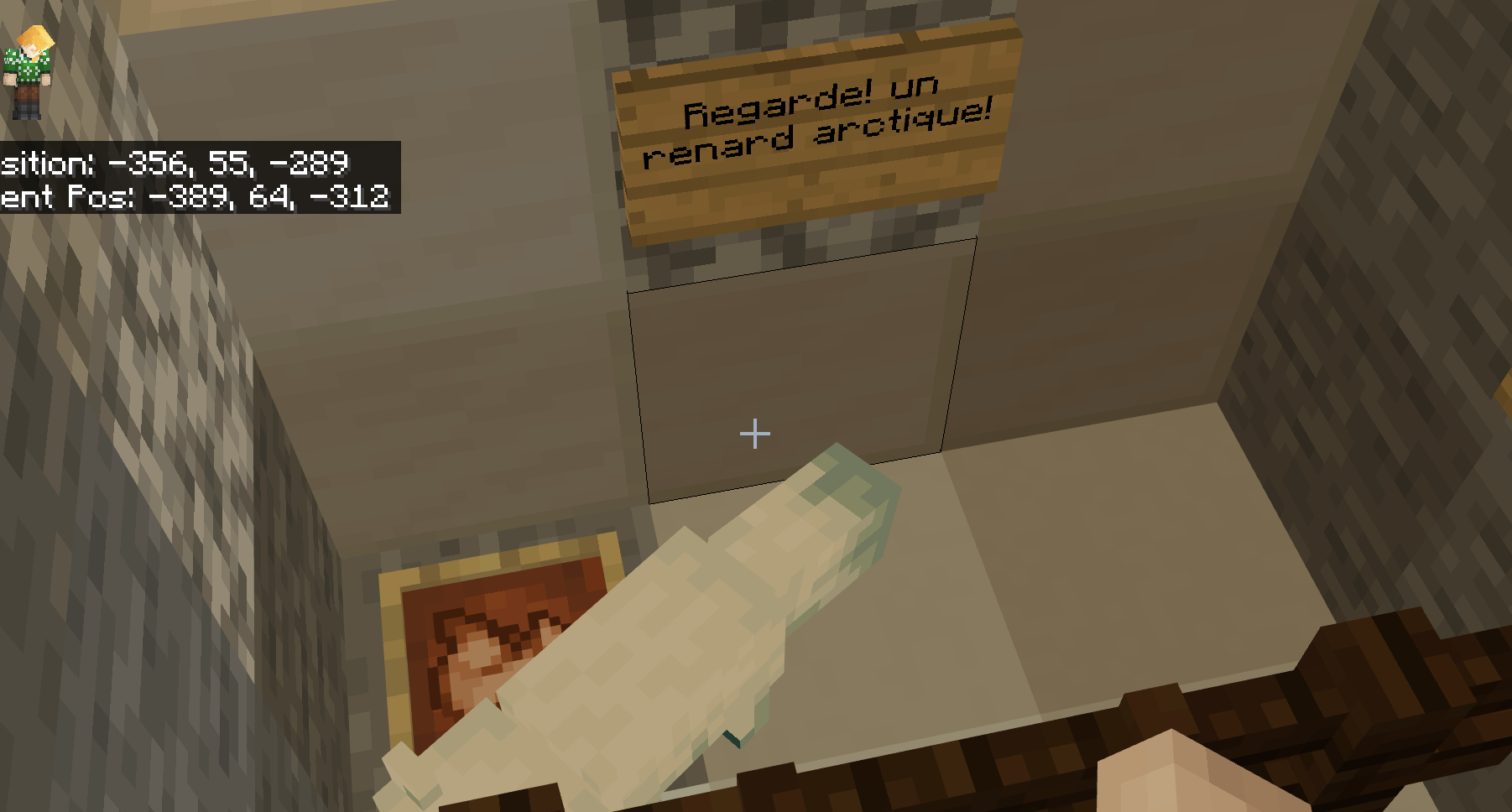
I loved how creative they got with showing what the animals eat. In this project, which was set up to resemble an artificial arctic fox habitat in a zoo, a student put an item frame on the ground and put raw chicken into the frame, making it look as though this arctic fox had been fed by caretakers.
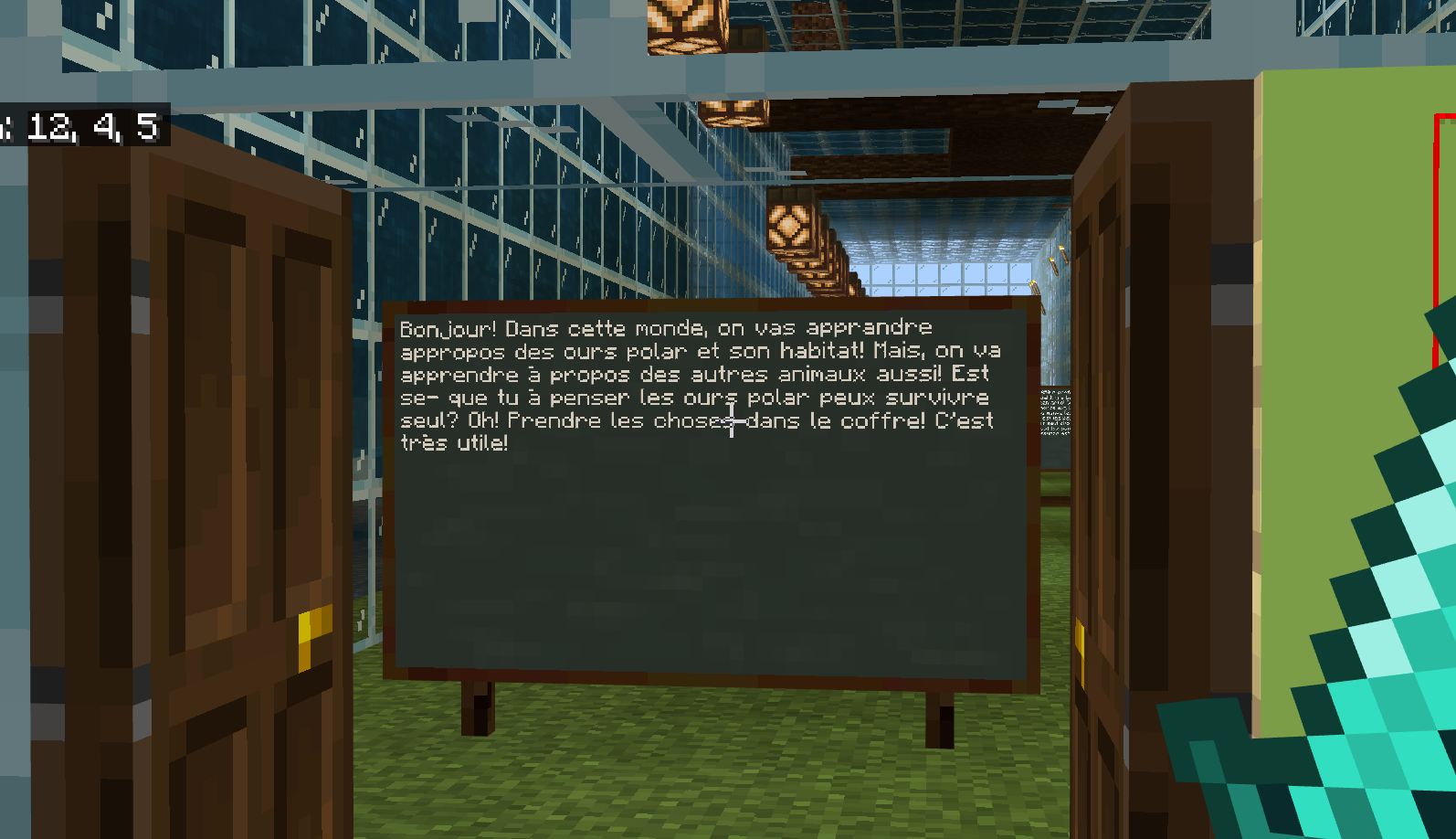
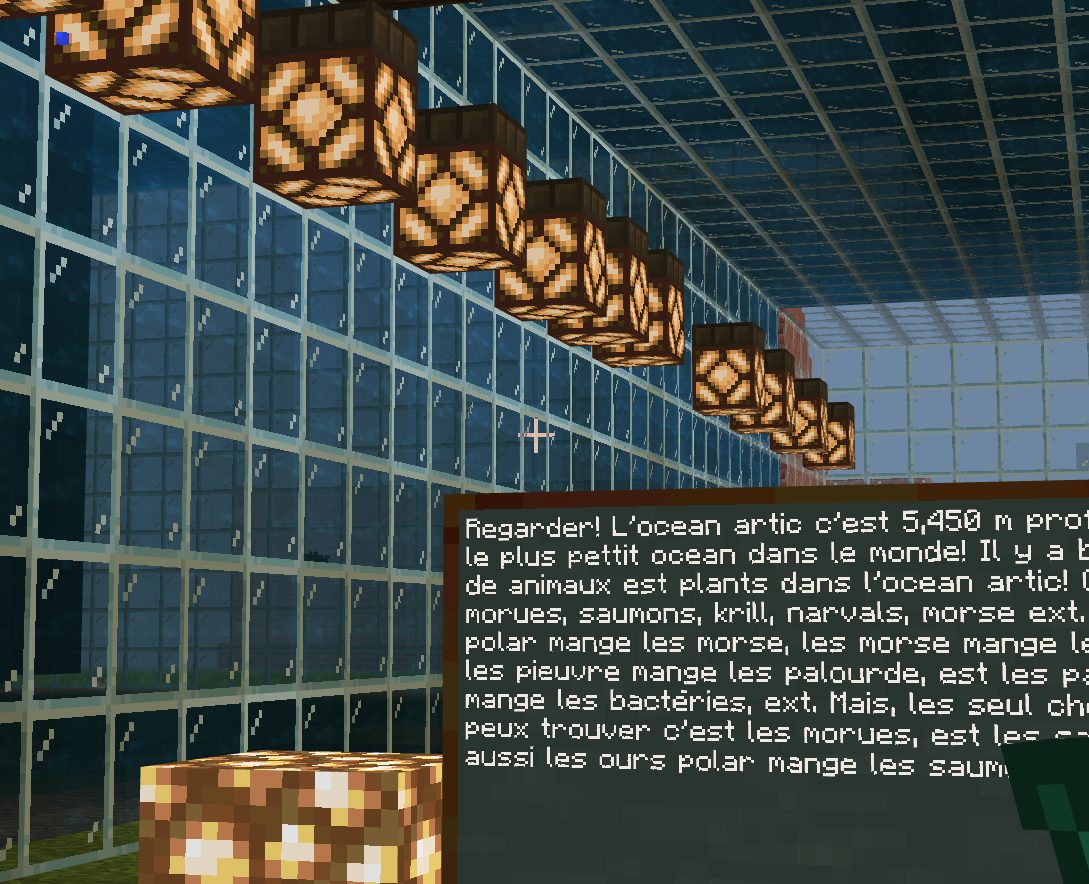
This project was extremely cool. The students wanted to show that a polar bear’s habitat includes both land and ocean. They created a glass tunnel that you could walk through, seeing into an ocean full of fish. In the tunnel, there was a point where you could drop into the water and swim out into the ocean, eventually surfacing in a polar biome where you could see polar bears on land.


Grade 5 Human Organ Systems

Sadly, I don’t have many images of the grade five projects, in part because some of them took a long time to complete and we didn’t have a chance to grab screenshots before we all wound up in online learning! I do have this one really great project, though:
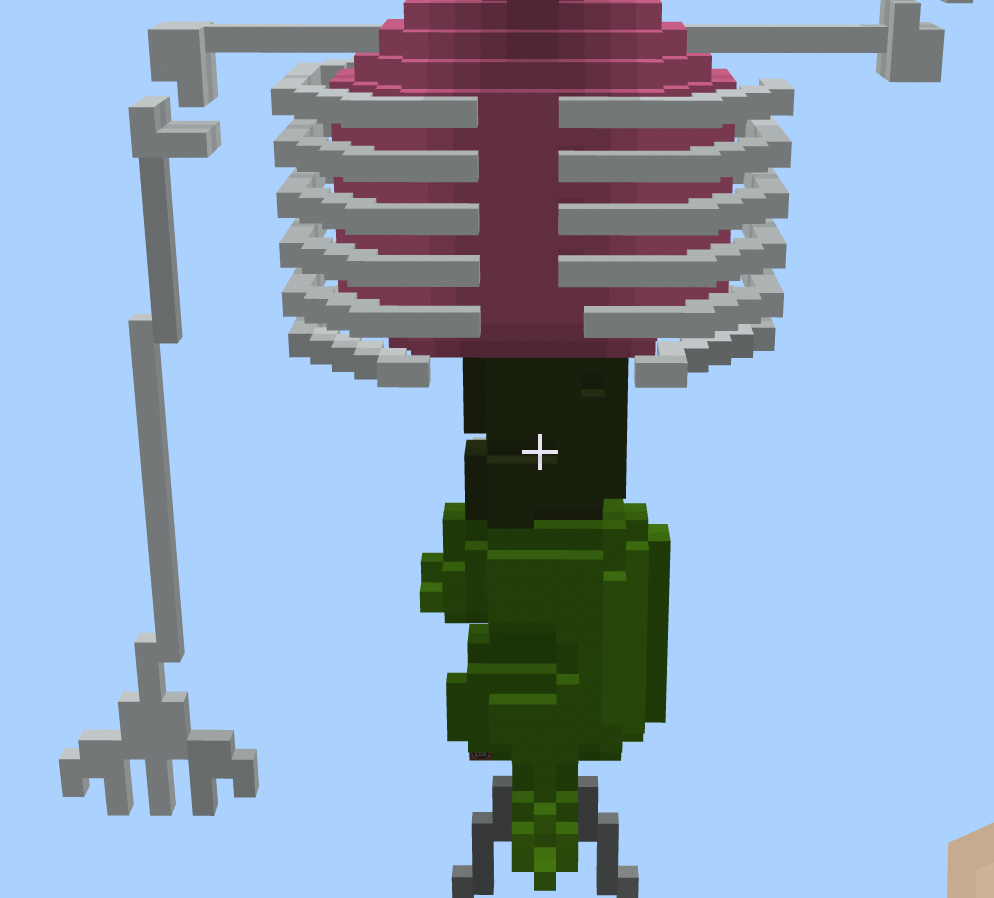
The Digestive System! For this project, you would start in front of a command block that was set to teleport you inside of a mouth full of teeth. Signs on the walls would explain where you were and what part of digestion happens in that area. Then, you’d follow the path down through the esophagus…
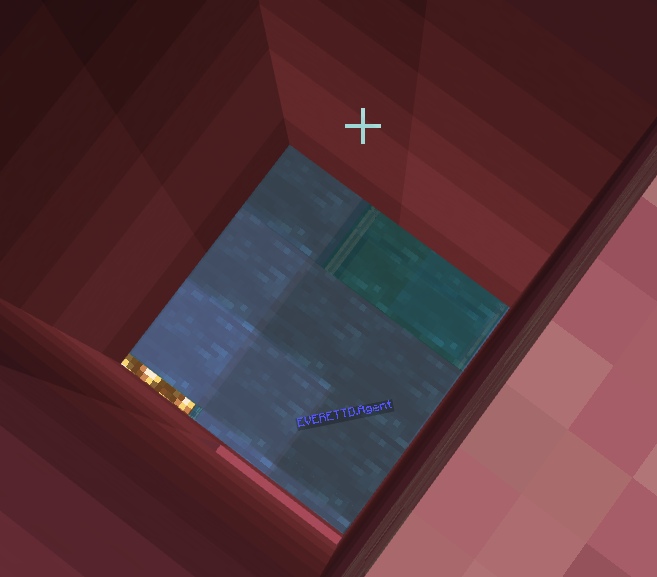
If you looked down through the esophagus, you could see liquid below – the stomach! You could then travel from the stomach through the digestive system until, eventually, you would drop out of the human body and into a (fake) toilet.

Another project took us through the nervous system. You started your journey in a minecart at the nose, where you would pick up a piece of paper meant to be a ‘message’ for the brain to tell it that the model’s nose was itchy. You’d hop in a minecart and travel to the brain, which would exchange your sheet of paper for a new message – instructions for the hand to scratch the model’s nose.

The grade 5 projects were a bit more difficult for them to wrap their heads around, admittedly. Still, they persevered and found some very cool ways to show us how human organ systems work.


Other projects we’ve taken on in Minecraft: Education Edition so far:

  • Building a class “town” where each student has a house, plus students are creating important community buildings like a school, a hospital, an apartment building, recreational facilities.
  • Retelling a fairy tale’s important events and places using NPCs.
  • Exploring an Anishinaabe community.
  • Doing a construction challenge with limited resources to learn about environmental impacts of human activity.
  • Regular old Minecraft fun. 😉


Hope you enjoyed this little tour of Minecraft in my classroom. I’m always happy to share more and talk about any of these projects. Now, onto my weekend planning, where I need to figure out how we’re going to use Minecraft: EE in our classroom next week!
I am happy you are here

As I was supply teaching one day in a full remote learning classroom, my wifi decided to take a short vacation. Now if you’re anything like me, technical difficulties feel like they come up at the worst possible times. Now that is a dramatic statement of course, but it really does feel like a “WHY NOW” situation. It can’t just be me?! 

Anyways, in the middle of our math lesson I was logged out of the google meet, leaving the students and their questions behind. I think my immediate reaction was “AHHH”. 

Upon taking a big breath, I was able to log myself back in after about 3 whole minutes. 3 minutes doesn’t sound like a long time, but in this short time frame I had convinced myself the students would have left the meet, had become overwhelmed with the math questions or upset with me for leaving mid conversation. I was cautious upon logging in again and unsure the atmosphere to which I was returning. 


I could hear one student say “she’s back”, as I started turning on my camera and microphone. I then started rambling on and began to apologize and explain why I had left mid conversation.


“We are just happy you’re here, Miss”, one student replied. 


We are happy you are here. 


What a simple, yet powerful way to welcome someone into a room or conversation. 


To this day, I am still applauding whoever taught this child to say that, whoever fostered empathy within that child, and ultimately applauding the child themself for being so brave and confident to voice such powerful words. 


I have adopted this saying and now use it daily in my practice. 

“I am happy you are here”.

This statement shows compassion, empathy, understanding and is welcoming, inviting and warm. 


It would never be my reaction to ridicule students for showing up late. As I really believe there is always a reason for this. Especially with my job as an occasional teacher, I typically do not know much about students’ lives outside of school other than what they have chosen to share. Prior to this profound moment for me, if a student had shown up late or at the wrong time I likely would have said “that’s okay!” or “no problem!”. Presently, those statements seem much less inviting and warm and lack appreciation for the presence of another person.

Now, when students arrive late to class I smile and tell them I am happy they have made it. Happy to see they are here. 

To all who read this post…

I am happy you are here.


A world at our fingertips

What world?
The first question that comes to mind when I think about the title of this post is, “Did I ask for this world at the end of my fingertips, and since its “wide web” pervades my life, how then, is it possible to feel so isolated when everything is at our fingertips? Food, clothes, household items, tech, and other diversions can be at our doors at the speed of our clicks, credit cards, and local couriers. The choices are non-stop, but there is one thing I haven’t been able to order online yet; a real in-person classroom and the bristling energy of its learners. I can’t even order a bus duty right now. 

Anyone else miss yard and bus duty?

I miss school so much that I was thinking of making a program to simulate being at school. I miss yard  and bus duty. I miss taking the long way to the office via the second floor. I even miss the First Aid calls for ice and band-aids. Even with a top dollar VR set up, nothing comes close to the completeness of an in-person educational experience; no matter how brilliantly it is delivered or repeated. For now, the best I can virtually do is be the best virtual version of myself.  

Despite everything these nimble digits can cull from the world wide web, the feelings, sounds, and yes, smells of school cannot be re-created online. You see our connectivity comes with a cost. Our eyes may be tethered to screens, but it is clear that our hearts and minds are looking for something else. Connection.

What’s keeping you connected?

In my last post Insert name(s) here I wrote about focusing on connections rather than curriculum with students first. As we continue learning during the lockdown, I am finding that connection is the single most important thing to preserve our wellbeing. When I read that teachers are feeling pressured to load students up with homework each day I get worried. It’s concerning to find hear of distorted and unrealistic expectations that learning is supposed to be like it was pre-pandemic. The only question I can ask anyone who thinks it does is, “Have you ever seen a Kindergarten Zoom class?” “Have you ever taught one?”

Imagine taking the wonderous living maelstrom that is known as the JK/SK class, and then compacting it onto a small screen replete with daily pet show and tells, spontaneous dancing, hasty exits for calls of nature, and unsanctioned nose touching? I am sure that does not happen solely in JK/SK either. In my class, there are some seriously funny faces that get made while someone preens in to the camera, or when they suddenly think someone said fart, or when they all decide to stuff couch pillows under their sweaters for DPA. This must be playing out everyday around the world right now. 

Sometimes the supporting cast gets into the main shot.

How about when you hear parents yelling in the background or when they are trying to negotiate with a client while walking too close to their child who happens to be answering a question at that moment? Upon reflection, these moments are probably the best things about virtual school during these times. It’s the humanity of our students shining through, and that is one of the single most important reasons for us to keep coming back day in and day out for our students. Making time for laughter  in my class has led to engagement and to learning. 

But seriously folx.

Hearing humorous stories from fellow educators has been crucial to my mental survival during such a trying time. Lockdown learning also comes with the knowledge that there are a number of educators who are struggling right now. I encourage you all to reach out to someone to check in on them. That includes those who always appear like everything is going great based on their social media posts. The truth is behind the curated photos is a lot of toil and hard work. This grind is hard on all of us. We need one another and the good thing is we have the entire ETFO community of educators to lean on. 

Take time to reach out. Even though we can’t order a cure for COVID yet, we can use this medium to send support to one another without the excessive packaging and credit card statements either. 

Technology Like in the Real World

This past February, I was honoured to be asked to present at ETFO’s Technology Conference for French as a Second Language(FSL). It was a great day of hands-on learning with educators across the province sharing ways in which to engage FSL students in learning the language, using technology, whether in the classroom or online. My presentation was geared towards providing teachers with ideas to support students in moving from consumers of tech to creators. During this session, I shared a variety of ideas that were shared with me over the years and that I found engaging for students. In this post, I’ll share 3 Google Tools that you might be able to incorporate in your FSL Classrooms. 

Jamboard

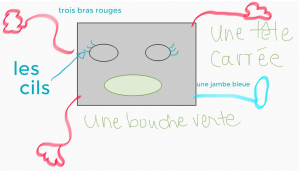
The Google Jamboard app is a digital whiteboard that offers a rich collaborative experience for students. I’ve used Jamboard for check-ins, brainstorming, listening and drawing activities, and more. One example of a listening and drawing activity comes from Chrystal Hoe who is an educator in the United States. Given their own frame in the Jam, students listen to instructions on how to draw their own monster and use the tools in Jamboard to draw. Through labeling the parts of the body, students are also able to demonstrate understanding of new and familiar vocabulary as well as spelling. When finished, each student has the opportunity to view the work of their peers, revealing that even though the instructions may have been the same, drawings may vary.  

Slides

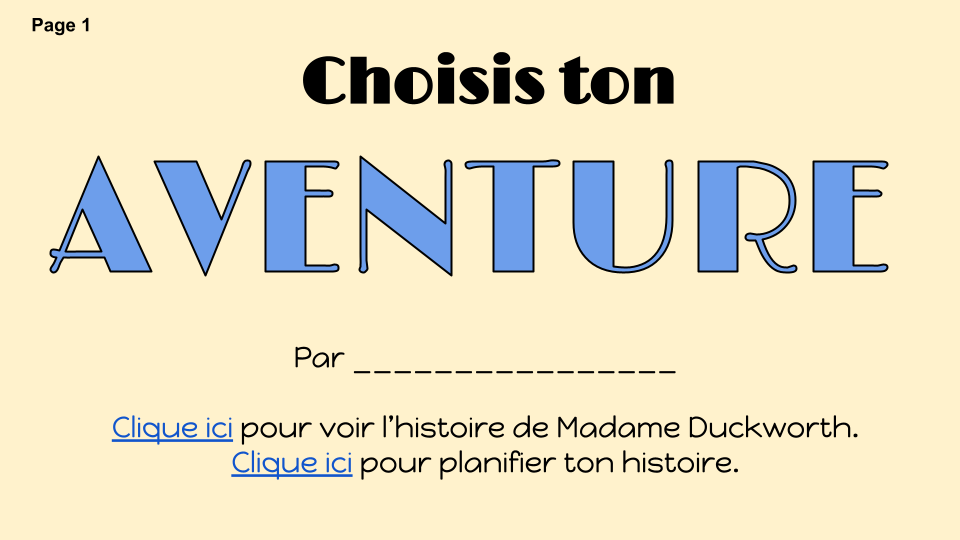
Google Slides is an online presentation app that lets you create and format presentations and work with others in real-time. With creative templates from Slidesmania and Slides Carnival, the possibilities are endless when creating exciting presentations. During my session, I shared the template for Sylvia Duckworth’s Choose Your Own Adventure Stories. Not only does Sylvia offer an example of a story, but she also gives a template to help writers organize the choices readers can make and how to include them on the correct slide in the Google Slides Template. Sylvia’s layout of the planner is clear and easy to follow. In my morning session, one participant completed their outline and was excited to share their story with the rest of us and the potential to share the activity with her students. 

Drawings

Google Drawings is the ultimate blank canvas. I’ve used it with students to create images, posters, infographics, timelines, and bioglyphs.  Simply put, bioglyphs are a symbolic representation of something in your life. Your collection of bioglyphs tells your life’s story without words. During our session, participants had the opportunity to use Google Drawings to complete their own bioglyph using instructions

Technology is an incredible tool that can be used to increase engagement while learning. These tools can be used in a variety of ways and I hope that this post helped spark some ideas of how you might be able to help students create, using tech.

Front Desk

I’ve always been a fan of Book Talks. Groups of students reading the same text; having the opportunity to ask questions and discuss themes within the novel. With rich texts, there’s no telling where these stories may lead and what actions students may take based on their learning. Sadly, libraries vary from school to school, and finding rich texts within libraries is often a challenge. Last year I decided to hold off in hopes that we might purchase some texts. This year, tired of waiting, I purchased novel sets to use in my class. One of the novels that I purchased was Front Desk by Kelly Yang. Now prior to purchasing novels for my students to read, I took the time to read the novel myself and I couldn’t put it down. Once finished, I reached for the sequel, Three Keys, which is an equally compelling read. Even if you don’t read the books with your students, I strongly recommend educators read them. 

Front Desk is the story of 10-year-old Mia who is a Chinese American immigrant who manages the front desk of the Calivista Motel while her parents clean the rooms. Along the way, she meets friends at her new school and it is through her interactions with others that she learns a variety of life lessons. As the students read, it was amazing to hear the reactions of students from across the classroom. Shouts of, “That’s racist” and, “How is any of this ok?” filled the room as students discussed some of Nia’s experiences and those of the residents of the motel. Reading the novel offered students opportunities to share their own experiences and to talk about some of the injustices they see in the world. I have to say, it was a novel that sparked many great conversations and for some students, got them thinking about ways in which to take action.

On her site, Kelly Yang offers teachers a variety of resources for both books. As with all my Book Talks, I usually prepare a variety of activities for students that might help support their discussions in their groups. Many of these activities are ones that I have adapted from lesson ideas shared with me in the past. In this post, I’m sharing 3 templates that you might consider using with students and that can be used with any novel.

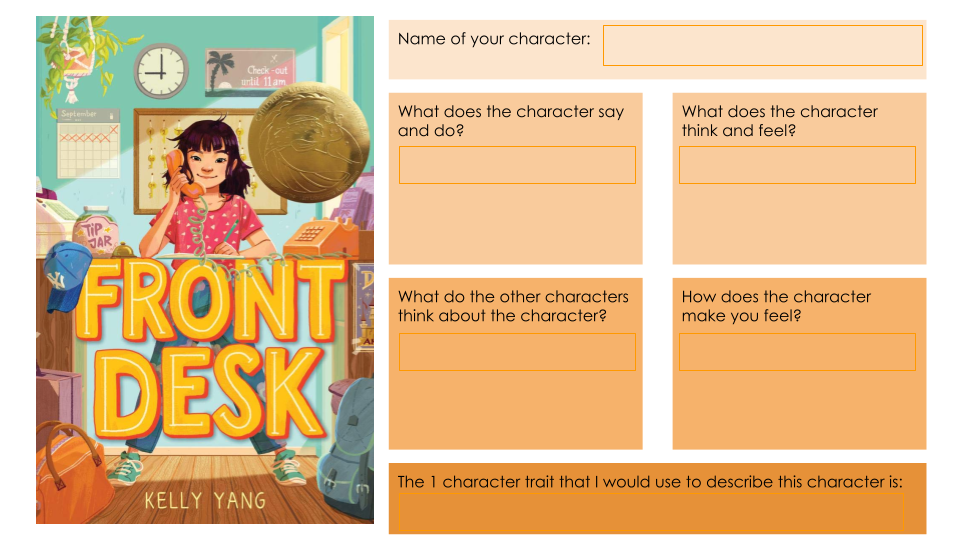
Character Analysis – Using this template, students are asked to pick a character and to answer a variety of questions about the character.  


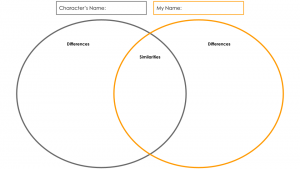
Comparing Myself to a Character – Using a Venn diagram, students compare themselves to one of the characters in the book. In the past, I have also had students compare themselves to 2 characters, creating a 3 circle Venn diagram. 


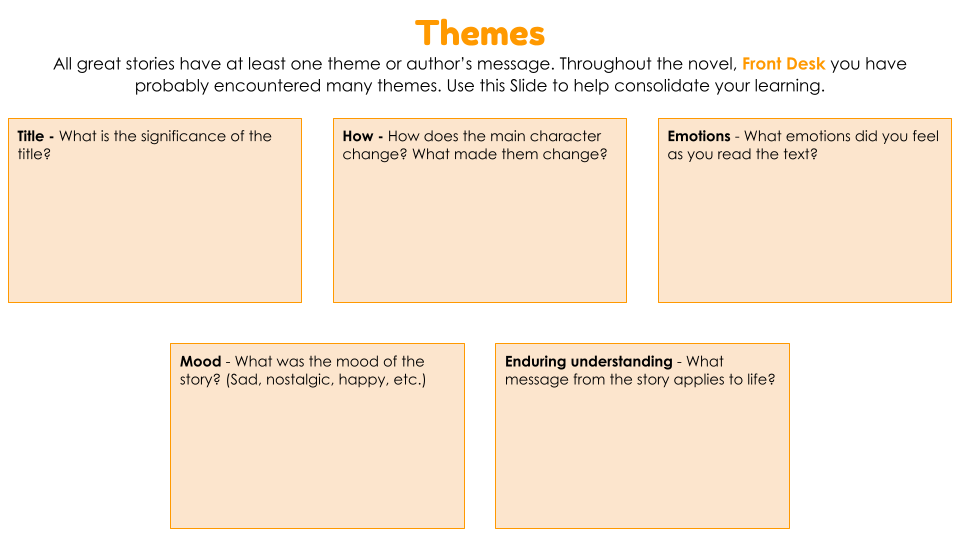
Themes – Authors often share valuable lessons and messages in their novels. We consider these to be the theme or themes of a novel. Using this template, students answer a variety of questions to get at the heart of the author’s message.

Texts can act as windows and mirrors as students read. Mirrors reflect the lived experiences of students and help them to build their identities. Windows are texts that offer a view into the experiences of others. It’s important for students to learn about others as they learn about themselves. Front Desk and Three Keys are incredibly rich texts that can act as both for students. Consider reading them with your students.

Thank you parents

We often reach out to our parents at the beginning of the year to invite them to be partners in their child’s learning. The communication continues as we share successes, struggles and information about school events.

This year, I have had to reach out to parents and ask for help during this switch to emergency online instruction and I have been so grateful for their response!

My students all require assistance in turning on computers and finding the link for their online classes. Many require an adult to stay in the room as they participate in activities throughout the day. Many parents are in meetings at their own job and helping their child to fix tech issues at the same time.

Below is a letter to parents that I will be sending them in June thanking them for everything that they have done for their child this year.

Dear parents,

Thank you.

When I met all of you three years ago, I asked you to partner with me to support your child’s learning. Little did I know that I was about to get the most amazing partners a teacher could ever ask for.  Every time I wrote or called and said, “I need help”. You answered, “what do you need and when you do you need it?” Because of your support and commitment to your child’s education, your children have learned so many new things and have grown into some of the nicest people I have ever had the pleasure to work with.

You are patient, loving and caring and your child feels it every day. Your children often share with us how much they love you and their family. I can see how much you are trying to support them in online learning, and I am so thankful for your help. You have become an IT support person, an expert in physical education and probably have some of our songs stuck in your head. For those students that are unable to communicate with words, it is obvious from the way your child looks at you that they gain comfort from your presence.

Before the pandemic came, I excitedly waited for your children’s bus to arrive every day. Every morning, your children would tell me about their events from their lives. They would tell me about their gardening and show me their new paint on their fingernails that you so lovingly helped them to do. I also loved seeing beautiful pictures of fun family times. You are truly amazing.

Thank you for taking the time to send supportive notes and emails. You do not know how touched I was that you took time out of your busy day to show your appreciation.

Three years ago, being the teacher of this class was my dream. What I did not know at the time, was that my time with your children was going to be a wonderful three years of my teaching career and how much I was going to miss all of you at the end of this time together.

It has been a profound honour to be your child’s teacher and I look forward to hearing about your child’s experience in high school.

Please keep in touch,

Mrs. Axt

Big Things

When I accepted the job as a self-contained DD teacher three years ago, a dear friend of mine explained that this job was going to be about the “big things”.  I did not understand what she meant at first and I asked her to elaborate. She told me that I would be spending my time with the students focused on things that will have a direct impact on their ability to be happy, healthy and contributing members of society. Your impact will go beyond the walls of the school and even the walls of their homes. The lessons you teach them will be “bigger” than any math or social studies lessons you have ever taught in your career.

Three years have passed, and I can say with absolute certainty that my dear friend was right. These past three years have been all about the “big things”.  As I come to the end of my time with the best class a teacher could ever ask for, here are the “big” lessons that we have learned over the past three years.


  1. Sometimes things are not going to be about you. For many of my students, they have had a lot of attention as a child in school and at home because of their unique learning profile. It has been important for them to think about others in their class, family, and community and how they can contribute meaningfully to all three places.
  2. A healthy body contributes to a happy outlook on life. Having a healthy body provides so many opportunities to participate in activities with families and friends such as riding a bike, playing sports, and going on a hike. It also provides students with a lot of independence in their life as they have the coordination and strength to do things like walk up the stairs and get up from a chair. It opens so many positive doors.
  3. A positive tone in your communication builds relationships. Some of my students have speech impairments and when I first met them, they would speak very harshly to me and others in the class. We have learned to take our time and speak kindly to others and it has opened the door to many new friendships.
  4. Losing is a part of life. “Good game” is our catchphrase in class that we say at the end of every game. It reminds us that no matter whether you win or lose, you are thankful for the time that you had with your friend or family member today.
  5. Independence in daily living gives us pride and confidence. Being able to do many daily living tasks such as ordering in a restaurant independently or selecting items for cooking really develops a sense of confidence and pride.
  6. Take Two! This is my most common catch phrase in class. I probably say it about 5 times every day and my students use it just as often. We use this phrase as a reminder to let the small mistakes role off of our back and to give it another try.
  7. Exceeding our own expectations is the best feeling in the world!


My students have learned a lot of big lessons over their time at middle school, but I also learned one very “big lesson” as an educator.

The energy that you bring into your learning space sets the tone for all who enter your class.

Working with kids with exceptionalities means working with a whole community of people to provide the best learning opportunities for the students. This may include, Educational Assistants, SERTs, Occupational Therapists, outside agencies etc… It is imperative, as the leader in the space, that you set the tone for everyone who enters. You will be amazed at how quickly people adapt to the positive environment and your students will have a more positive experience at school as a result.

You are not alone – and you aren’t a failure, either.

Here we are, midway through yet another week of remote learning. I’ve lost count of how many weeks we’ve done this now. You would think that by now, someone with as much teaching experience and technological know-how as I have would feel settled, but… I don’t.

If you’re a newer educator and you’re feeling like you don’t know what you’re doing, you suck at teaching online, your students aren’t learning anything, you don’t belong in this profession: you are not alone. Many of us are feeling that way, even with 10+ years of experience and a lot of tech savviness. 

My confidence with remote teaching vacillates even now, after so much experience and time with it. One day I’ll feel like I really rocked it – my students were engaged, everyone was learning, we had some fun, the day flew by. The next, I’ll feel like I have forgotten everything I know about teaching – everyone will seem disengaged and bored all day, I’ll sign off feeling like we didn’t accomplish anything, the day felt like it was somehow an entire week long.

Most days, if we’re being perfectly honest here, are somewhere securely in the middle of those extremes. Nothing special, but not bad.

Why, then, is it so hard to remember this from day to day? When I think about remote teaching, my first impulse is always to say that I’m out of my depth. Sinking. Ineffective.

The reality is that the vast majority of my teaching is fine. No, it isn’t the same as being at school in person, but I’m also not failing. My students are learning. We are making progress. They are engaged, albeit at a lower level than they normally are in class.

And still, almost every day, I end the day and sit down feeling defeated.

The imposter syndrome is real. I’ve always felt it to some degree, even before I was a teacher, but I find it’s at an all-time right now.

In my rational moments, I remind myself of a few things to try and chase that imposter syndrome away.

  • My students are safe at home.
  • Curriculum isn’t everything. Learning doesn’t have to mean curriculum expectations.
  • My students are not falling behind this year. We as educators need to adjust our expectations going forward.
  • My students genuinely enjoy each other’s company.
  • Everyone has made so much progress since September.
  • I am a good teacher. I belong in this profession.

I can’t say it’s a perfect system, but at least one of those points usually helps me remember that I shouldn’t be so hard on myself every day.

I hope that if you’re reading this and relate to any of it, you can come away from this post feeling a little less isolated, a little less worried about how you’re doing. Are your students safe? Have they made progress? Do you have moments of fun and connection? You’re fine. They’re fine. 

This isn’t the school year any of us wanted, but that doesn’t mean you’re a bad teacher.

You are not a failure.

Insert name(s) here

I hope this message finds you well. 
It has been a long time since we’ve been able to really; (circle one)
a. Chat
b. Catch-up
c. Connect
d. Collaborate
e. Other____________________________
f. All of the above (I circled this one)

I really miss the times when we were able to learn together, and to encourage each other in person too. Come to think of it, I miss a lot of things about the past year and a third. Most of all, I miss all of the joys, highs, lows, and in-betweens of being in our school. I’m not quite sure how all of these emotions built up so fast. Oh wait, COVID.

Our feelings are like CO2 being forced into a bottle and then put into a paint shaker to see what happens. I know what happens. It is messy. Other times its as if the soda bottle has been left out on the counter with the lid off all night. That sparkle and effervesence is long gone by morning. That was never the case when we were in school. 

Lately, it seems like all we do is view each other through layers of fiber optic signals and glass screens. Sometimes, I am not sure whether any of us feels like we are truly seen anymore. After all we miss the crucial dimension of proximity each time we meet in our virtual lockdown learning spaces. Well, at least our masks are off at home, yet somehow there is something really different, almost missing between being in each other’s presence and the telepresence we are forced to be engaging in right now. 

I know that it’s a struggle for me. I have meetings to teach now. I hear your voices, but our virtual interface might as well be a tin cans tied together with string like when we were kids. To me, it is becoming increasingly impossible to read small faces at 72 dpi. That’s if I see anyone at all after privacy and comfort levels are factored in. Decoding your complexity of emotions from what looks more like an animated postage stamp(gif) at best, or a motionless icon at worst never came with a training manual.

So I am writing my own. It starts every day with breaking down the digital walls that prevent us from proximity. COVID 19 may have moved our learning online for now, but it can’t prevent us from continuing the class community we have worked so hard to create. We’re chatting. We’re catching up. We’re connecting. We’re caring and then we are learning, but it is messy and it is draining. Everyone is bringing their best versions of their best selves to virtual school right now, and that looks different from day to day. 

I know you’re connecting because the little green metres rise and fall when you speak or type. Sometimes everyone is trying to answer at once and other times it is an awkward hush. How I cherish our variations from routine interactions and uniformity of it all. It is exciting to see the chat stream full of comments. I love it when the little virtual hands are raised up to respond. Each one not a pixel higher than any other. I know that there are others who want to say something, but are still feeling unsure about it and themselves too. There are even some who cannot participate because of limited tech/WiFi and that’s okay.

Whatever the reason(s) we will grow stronger and get through our days with:
Insert name(s) here, How are you?
Insert name(s) here, Would you like to share something with the class? 
Insert name(s) here, I notice you have been struggling with your tech. How can I help? 
Insert name(s) here, I wanted to let you know that you offered a really thoughtful answer in our discussion today, and I appreciated your perspective.
Insert name(s) here, I noticed you shared a lot of great ideas in the meeting chat today. I am glad you lead our class in that space.
Insert name(s) here, You are valued. You matter. I see you.

I know there is much more that follows, but everyday has to begin with our humanity before anything else. It may seem tough to give up that time at the start of each day, but the investment in knowing students, especially while we are in lockdown, will pay lifelong dividends in hearts and minds of your learners and self. It will make this time better than bearable while we prepare to return to our schools again soon.  


“Be vulnerable”

A message we are hearing as educators during a pandemic.

What does this mean to you and your practice?


To me, vulnerability seems scary, it seems raw – but, both human and necessary. 

Living through this pandemic has provided us with commonality of experiences. Although we are all experiencing different heartache during this time and no two stories are the same, we share a mutual feeling of exhaustion with our students, their families and our colleagues.


To create a deeper understanding of vulnerability I turned to the work of Brené Brown, researcher and psychologist who is best known for her work in the areas of shame and vulnerability. In her TedTalk from June 2010, ‘The Power of Vulnerability” (https://www.ted.com/talks/brene_brown_the_power_of_vulnerability?language=en), Brown summarizes her research on vulnerability quite beautifully with a powerful take home message:


“In order for connection to happen, we have to allow ourselves to be seen”. 


To show our true selves to our students is to offer them a window into our souls. This includes expressing our positive and contagious traits of joy, hope, perseverance, inspiration, and integrity. However, in order to find success in vulnerability we need to feel all of our emotions. As much as we would like to carefully select which emotions to feel, Brené Brown unveils, we cannot “selectively numb” undesirable feelings. In fact, in our attempts to ignore negative or undesirable emotions, we “numb” positive feelings – positive feelings that we wish to pour into our virtual classrooms. 


Stress, fear, anxiety, sadness, exhaustion.

To be vulnerable means we are human. 


When we work from a vulnerable place it allows for us to truly stop and listen to what students need, meet them where they are at, and support them with compassion while promoting their self-worth.


Brené Brown studied people who had a strong sense of love and belonging in their relationships. Brown states that the only difference between people who had a strong sense of belonging and people who did not, was the people who felt loved – “felt worthy” of this relationship. 


Vulnerability drives connection.

Connection promotes worthiness.

Worthiness equates belonging. 


Be vulnerable.