Blog

A Beginning Teacher’s Journey: Part One


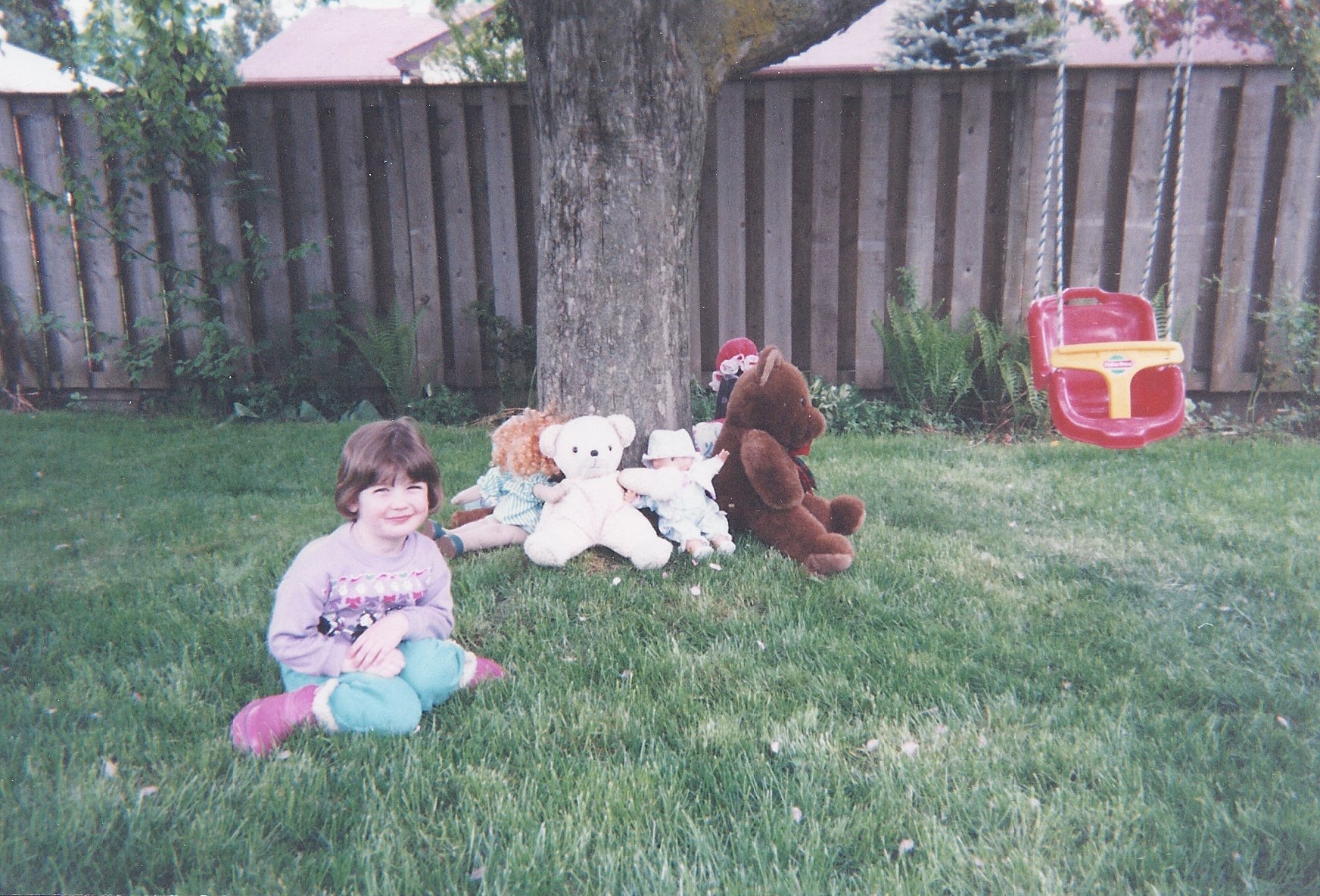
I can still remember the exact moment I found out that I was successful in landing my first LTO. I had only been on the supply list for about a month and was less than a year out of teacher’s college. On my drive home from the interview, my phone rang so I frantically pulled over and found myself accepting a position teaching Kindergarten for the rest of the year. This was the moment I had been waiting for since I was three years old. My childhood, teenage and adult dreams were all coming true. As a little girl, I used to arrange all of my stuffed animals, “my kids”, in assigned seating for circle time where I would recite the exact same songs and lessons that my daycare teachers did. As I got older, my stuffed animal students all had names and personalities, which I still remember to this day. I would teach them, make work sheets for them, complete them wrong, and then mark them with a red pen which I had borrowed from my mom’s office. Can you tell I was an only child?
SCAN0022

Here’s me, circa 1996 with my very first class. If you told this little girl she’d have her own class one day, she’d tell you she didn’t doubt it one bit. The resume building started as soon as I was deemed old enough to babysit. I spent most of my teenage and university years working with kids, loving it along the way and always knowing where I was headed.

Now I was 24 years old and it was all coming together. I was beyond excited to get started. Finally, I could put everything I’d learned in school, everything I’d practiced in teacher’s college and everything I’d pinned on my Pinterest boards into action! I’d have a place to call home, familiar faces every day and most importantly, students to call my own – even if just for a while.

As a new teacher, permanent employment seems so far in the distance that I often don’t even think about it. The reality is that our profession is one that many people want to be part of – and of course they do! Teachers get to change lives every day and our payment is to have our own lives changed by our students in return. It is this life-changing passion that we need to hold on tight to, even in times we feel discouraged. The road to permanent employment may be a long one, but the journey there is not one bit less important. For now, I’m proud to be an LTO teacher.

I began my first day as a Kindergarten teacher and immediately fell in love. I put everything I had into my planning, my classroom and my students. I woke up each morning feeling excited for the day ahead. I arrived early and stayed late after school. I spent hours thinking about what I could do next, do more or do better. I spent way too much money on things for the classroom, which my bank account can vouch for. I probably talked all my family and friends’ ears off about my class. Those kids became my kids. I knew them, I loved them and I genuinely cared for them. I lost sleep over them. I still think about them all the time.

As an LTO teacher, I will change lives and my life will be changed. Whether I spend three months or an entire year with a class, they become a part of my story and change who I am as a teacher and a person forever – and that’s what three-year-old me knew all along.
 

Hundertwasser, Spirals, and Lollipop Trees

One of my favourite artists is Friedensreich Hundertwasser (1928-2000), an Austrian artist, architect, and environmentalist whose work is colourful, playful, and unconventional – characteristics which make it perfect for any age to enjoy. Hundertwasser hated straight lines and the colour grey, but loved rain, trees, and the infinite beauty of nature.

Years ago, I happened to randomly look up “Hundertwasser Lesson Plans” on the computer and was thrilled to see that, because Hundertwasser had spent a lot of time in New Zealand, the country’s Ministry of Education had posted an art lesson plan for grade 2 students to learn about him and his whimsical style of painting. I immediately read through it and adapted it to suit my grade 6 students’ abilities as well as the limited art supplies I could find in my school’s stockroom – large cardstock paper (or bristol board), acrylic paint in primary colours, sharpies, white glue and sparkles.

Recently I adapted and introduced Hundertwasser to my kindergarten students. I started by showing them some of his work, taking particular notice of his ‘lollipop’ trees – painted with bright spirals. To encourage students to play with spiral lines, we set up a table with different colours of plasticine and a collection of white boards so that every student could roll out a plasticine ‘snake’, and then wind it up into a spiral on the whiteboard. Almost every student came to the art table that day. They seemed to be mesmerized by the action of rolling out long ropes of plasticine and then spinning them into spirals. Their creations were beautiful and all different; some were as tiny as a coin, others were large and irregularly shaped filling the whole white board, and yet others were delicately made with the finest, thinnest spirals in one continuous colour.

Our discussion about Hundertwasser spirals lead into an inquiry about where else we could find them. The students loved a book I read called, “Swirl by Swirl: Spirals in Nature” by Joyce Sidman. All through the day, they would come up to me and show me spirals they had found, drew, or created using materials in the classroom – blocks, loose parts, and toy animals, for example. Halfway through the day, we even fit in a spiral dance, holding hands as we moved around the classroom, winding up tightly and then unwinding while the music played – that way, they could actually feel the tight hug of a spiral. When it came to Writer’s Workshop at the end of the day, almost everyone wrote about spirals. As they were explaining their work, students would tell me where they found the spiral they had drawn – on a butterfly’s face or a seashell, the bodies of snakes and worms, or elephant trunks and spider’s webs. They had clearly begun to notice!

Exploring spirals is a first step into discovering more about Hundertwasser and his amazing creations. This week, my goal is to create a forest of Hundertwasser-inspired ‘Lollipop Trees” in the hallway leading up to our classroom. The students have already painted circles using cool colours (green, yellow, blue) of paint on circles of cardstock. When they are dry, they use a Sharpie and trace a spiral on top of the paint. Using warm colours (red, orange, yellow) on sheets of cardstock, the students will then cut and paste strips for the tree trunks. When I taught the grade 6s, they painted a poster where they recreated a town inspired by Hundertwasser by painting lollipop trees, onion domes, bright colours, wavy lines, and irregular windows into a rich street scene. With the kindergarten students, the grade 6 art project is a bit too ambitious and so instead, they will be isolating key elements of his work, so that they can feel as if they are IN one of Hundertwasser’s paintings with larger-than-life lollipop trees.

Next up, we will explore onion domes…

Welcome Boozhoo ᐊᕆᐅᙵᐃᐹ Bienvenue

front-entrance-v2Welcome Boozhoo  ᐊᕆᐅᙵᐃᐹ  Bienvenue مرحبا بكم  בברכה  欢迎  환영  स्वागत

It’s been over a year since Canada opened its doors and hearts to thousands of Syrian refugees. They, along with countless others from nearly every country, chose to make Canada their new home.

Along with the joy, angst, and tumult of moving must also come stress and bit of culture shock from so many new routines, signs, systems, official languages, and day to day decisions. Each of these are indeed daunting to any new arrival at our border including my own. Here’s my story.

In this post I wanted to parallel some of the memories, experiences, and feelings. Since the PM’s name hasn’t changed, I wondered if there were other things that still mirror the experience of moving to Canada nearly 40 years later. As the expression goes, “plus ça change plus c’est la même chose”. However, this time I’m not the nervous student stepping across the threshold of the unknown and into a new classroom. I am the smiling face that greets them on the other side. Here are three tips that help out in my learning space.

Firstly, remember immigration to Canada is nothing new. This can be a great chance for students to learn more about one another in the context that almost all of us have an arrival story to be discovered. That’s how my ancestors got here in the early 1900s.

Our nation was able to flourish because of the generosity of our its First Nations People, it is our privilege to continue making it greater by making room in our hearts and neighbourhoods for newcomers. This is not different in our classrooms whether it is by providing time to learn about a new arrival’s country, culture, and customs or a little extra ELL support. In doing so, teachers can plant seeds of cultural literacy in the classroom and foster an inclusive environment around everything we have in common.

Secondly, not everyone is equipped or able to embrace each new member to the community, but as a family of learners we can always be respectful, polite, and supportive. Whether it is having students initiate a brief conversation, offer help navigating the halls at school, or an invitation to play at recess – a bit of kindness goes a long way to making someone feel welcome. With a little time and encouragement, educators can turn this into an incredible mentorship opportunity that develops and empowers students into school ambassadors.

Thirdly, have students share classroom norms and expectations, not you. Instead, why not build in time for whole-class inclusion activities and ice breakers when new students arrive? Whether it is a game of Octopus, Hoedown tag(Chain tag), or Electricity students get to interact with one another through movement instead.

Over the past 4 decades, I have come to love our move back to Canada in 1978. Reflecting on this is what got me thinking about my own quasi-immigrant (repatriation actually) experience that prompted this post in the first place.* The lessons and lenses gained from all of this now guide my instructional practice and ensure that there is room in our hearts, minds, and classroom to welcome and support new citizens to Canada.

*It’s been a while since I’ve hauled these memories out of the vault – my first through the lens of an educator rather than student.

Who? What? Where?

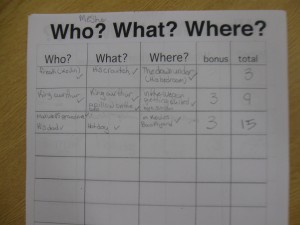
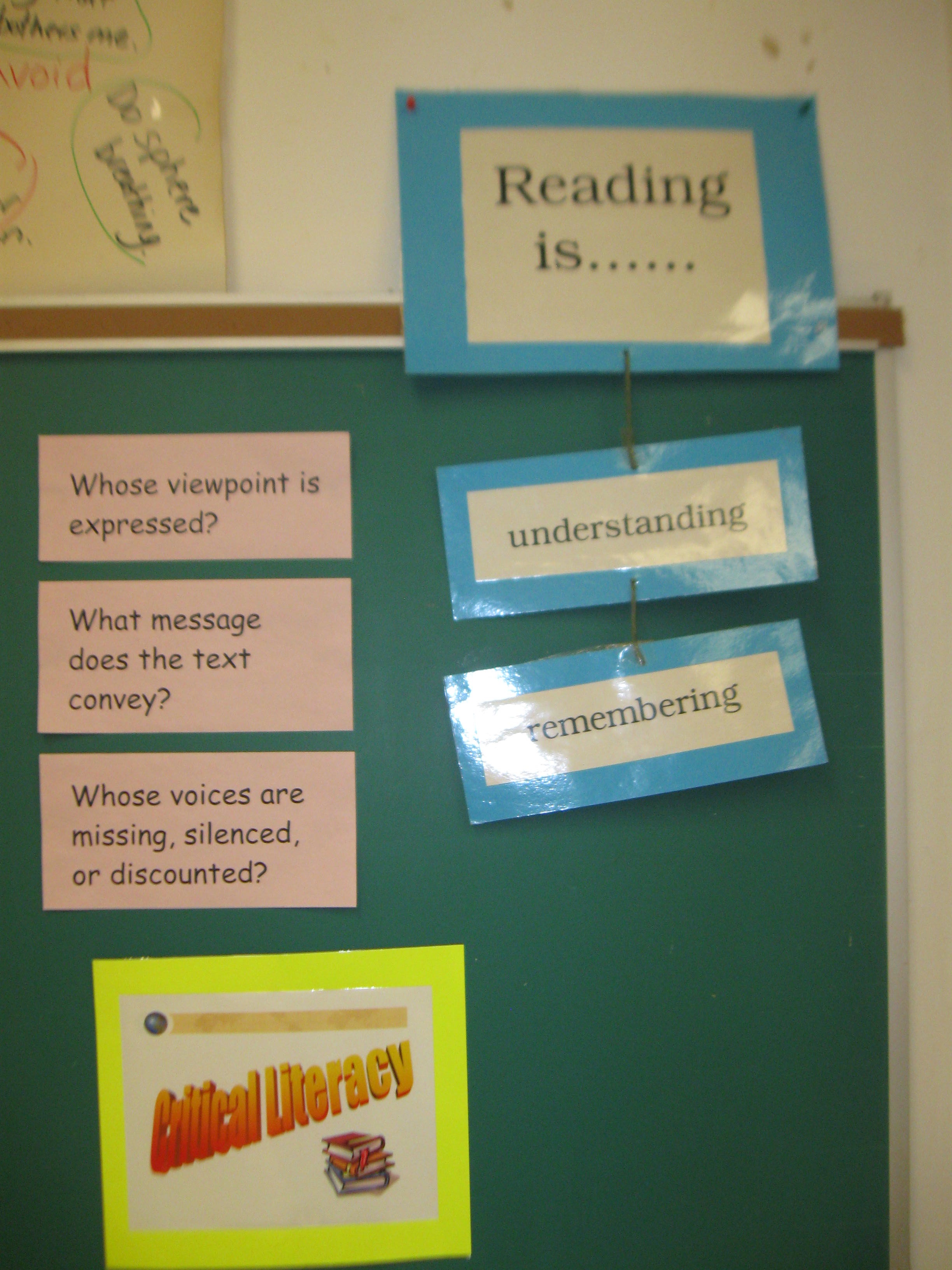
One of the anchor charts in my classroom states that Reading is… Remembering and Understanding. This is what I use to help students understand that good reading is so much more than word decoding. In my classroom I am often faced with trying to help students who have difficulty in their reading comprehension. They lack the ability to recall what they have just read or their recall is very generic and lacks specific details. I have developed a game to help improve a student’s ability to recall the specifics around characters, main events and setting. This learning task is called Who? What?  Where?

IMG_1794This is a three phase unit. The first step is to model it using a read aloud novel. After each chapter we pause and take a minute to review the characters that were a part of that chapter, what were the main events that occurred in that chapter and finally where did that part of the story take place. I do this for about two or three chapters into the novel. From there we move to a graphic organizer where they now have to answer questions I have created about a chapter after it has been finished. The questions are designed to elicit one or two word answers and thus can fit easily in the boxes on the page. The other purpose for the short answer is to focus on comprehension and not spelling or sentence structure. After each chapter I ask three questions, one of each type. As the chapters progress, the questions become more and more specific and thus a deeper recall gradually begins to occur with my students. The students earn points based on their ability to recall accurate information. For most students this is a motivator by itself.

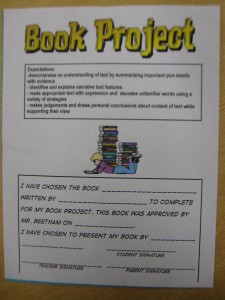
IMG_1795The final stage of this unit is to transfer the learning that has occurred to an independent reading task they complete. This is called their Book Project. They are able to select a book that meets the following two criteria:
  • It has to be at a level that is just right or challenging for them (teacher approved)
  • It has to be a narrative (thus focusing in on the three elements of a story characters, setting and main events)

From here they now have to read their novel, decide on a way to share their understanding of the story (that best fits their learning style) with their classmates and teacher. It is here during this summative task I find out what gains have been made by students in their reading comprehension as well as finding further gaps that need to be addressed in the upcoming reading lessons. A natural progression that occurs is also the move away from just basic recall and the move to more critical literacy questioning and answering. But as many students have taught me, they need to have well grounded foundation skills prior to moving into higher level thinking skills.

IMG_1796


Student surveys

If you haven’t had your students use google forms, the survey creator on google drive, then you must! Students will have the chance to create online surveys and administer them to anyone they want.

We took our data management project to whole new heights when they created a survey for a certain grade to answer. We were looking at student satisfaction in regards to clubs and teams available at school. The answers were shocking as sometimes 75% of  students in the grade were unhappy with the clubs and teams available to them. My 28 students were divided up among all the grades at school and each group surveyed the grade they chose to survey. We will now look at the results and try to accommodate to add the new teams and clubs to our school.

I also was able to survey my students using the same program, google forms. I asked them about the way I ran the math program, language program and drama program. They were able to check mark all that they enjoyed about each program. Here are the results for the math section:

  1. 11 students enjoy projects
  2. 9 students enjoy group work
  3. 8 enjoy math around the class
  4. 6 enjoy tests
  5. 5 enjoy lessons on the board
  6. 2 enjoy quizzes
  7. 1 student wants to learn taxes

This way, when I do my next math unit, I can plan for maximum student enjoyment. It is important to know how your students want to learn so that you can have the best learning environment possible.

Memories


I remember my first day of teaching as if it had happened yesterday and not 32 years ago. As my journey of teaching continues, there have been countless scenarios that have occurred that brought a smile to my face, made me cry, challenged me, taught me and humbled me. Those are the moments that inspire me each and every day I enter my classroom. About 13 years ago a very passionate and visionary principal I worked with started our year off by giving each teacher an empty box. She then went on to describe how it is up to use to fill that box with memories, moments in time that are like treasures not to be lost or forgotten. Ever since that time I have kept a memory box.


This box is filled with magical moments that I have been a part of in my teaching experiences with colleagues, students and/or their families. There are letters, cards, toys, photographs, trinkets, phone call summaries, thank you cards, trip mementoes, amazing accomplishments of individual students as well as class accomplishments. What goes into that box is anything that reminds me just how precious and important my efforts are and that no effort is wasted. I take the time to go and revisit my box in moments of self-doubt, challenging times or just when it seems that nothing is going right. After just a few moments of revisiting these wonderful experiences I can raise my head and once again forge on filled with confidence and positive energy. I look forward to the day (not too far in the future) when I can stop, reflect back on a career as I take the time to go through each item in my memory box, piece by piece, story by story.

I hope you take the time to stop and smell the roses in your everyday teaching and life. Make a pledge to start your memory box in 2017. Happy New Year!img_20170107_131253

Getting ready for 2017: Black History Month and Asian Heritage Month

In between sipping a coffee and reading your favourite book some of you may be doing some forward planning for 2017.

Many schools celebrate the upcoming months of February and May as Black History Month and Asian Heritage Month. Over the past five years, it has been my pleasure to be part of both of these committees at my school. We have worked hard to prepare our students and communities to honour Black Canadians and celebrate the contributions of Asian Canadians.

There are many criticisms that state that both of these celebrations limit the recognition of Asian and Black Canadians contributions to these designated months. The critics have a very important point. You can fall into the trap of having a classroom lacking in the celebration of diversity for 8 months of the year very easily. I look at Asian Heritage month and Black History Month as an opportunity for me as well as my students. I am not an expert on black history or Asian heritage. My family’s heritage is Acadian and I studied Theatre in University so I recognize that I have a lot of learning to do. In February and May, there are so many great resources put out by ETFO, the Government of Canada and the Archives of Ontario about Black Canadian history and contributions of Asian Canadians that have shaped this wonderful country we live it. There are also many great news stories written and programs on TV. We often have guest speakers in to the school and presentations for the staff.

My goal has been to take all of these activities and resources and use them as a springboard to carry with me throughout the entirety of the year as I make decisions about music, art, dance and drama to be used in my classroom. I listen just as intently as my students when we have special presentations in and engage in discussions with my colleagues who have a much deeper knowledge of this area of history. I still have a lot of learning to do and appreciate the hard work of those who have taken time to share the important role that Black and Asian Canadians have played in shaping our country.

Some fantastic resources and articles that have come out over the past couple of years that has supported my own knowledge are as follows:

a)       ETFO Voice had a recent article on Black Lives Matter. It explains how the movement began, the calls to action and a response to the All Lives Matter movement. I will be bringing this article in to use for discussion in January. http://etfovoice.ca/feature/black-lives-matter. Voice also had a great article about going beyond Black History Month. http://content.yudu.com/we1q1ji/0A1z2y9/voicespring2016/html/index.html?page=22

b) The Government of Canada has some information to get you started on both Asian Heritage Month and Black History Month http://www.cic.gc.ca/english/multiculturalism/index.asp

c) The Archives of Ontario has some great resources about Black Canadian history at http://www.archives.gov.on.ca/en/access/black_history.aspx

d) Virtual Museum of Asian Heritage http://www.vmacch.ca/beta/index.html

If you need some ideas of activities for Black History Month or Asian Heritage Month here are a few samples of events and activities we have had in the past.

Daily Announcements: Music will be played at the start of the school day. Students will announce any upcoming events and a quote for the day.

Display Cabinet: The display cabinet at the front foyer of the school will showcase images, quotes and books that focus on the Board’s Black History theme ‘Inspire Inclusion’.

Black History Month Movie Feature: My Friend Martin:

Assembly: A selection of student performances will be prepared for both the morning and afternoon assemblies including a play about Black History, songs, dances and poetry.

Spirit Day: The students and staff will be asked to wear, red, green, and black  (the colours of the Pan-Africa flag) to celebrate the end of Black History Month.

Black History Quilt Story & Activity: There will be two Quilt Making Activities. The story the Patchwork Path will be read before the activity.

DPA Activities: Various BHM activities will be placed on our shared drive.

Our Asian Heritage Calendar from a few years ago.

Monday Tuesday Wednesday Thursday Friday
    1 What: Origami When:  1st N.B. Where: Ms. Parmar’s Room (221) Who: Gr. 2-3 2 What: Asian Indoor Games When:  1st and  2nd N.B. Where: Ms. Parmar’s Room/ Ms. Hundal’s Room Who: Gr. 1-2  (Rm 221)      Gr. 4/5  (Rm  218)
5 What: Origami When:  1st N. .B. Where: Ms. Parmar’s Room Who: Gr. 1   6 What: Arts and Crafts When:  1st and  2nd  N.B. Where: Ms.  G a llant’s   Room (Noest/ Parmar) Who: Gr. 2/3   7 What: Bollywood Dance When:  1st  N.B. Where: Ms. Gallant’s Room (Rahim) Who: Gr.’ 4/5   8 What: Yoga When:  1st  N.B. Where: Ms. Gallant’s Room Who: Gr.  1/2 9 What: Asian Indoor Games When:  1st and  2nd N.B. Where: Ms. Parmar’s Room/ Mrs. Tariq’s Room Who: Gr. 3
12 What: Japanese  Calligraphy When:   2nd N.B. Where:  Forum Who: Gr.  3-5 BOOK RELAY (all grades) 13 What: Dance When:   2nd N.B. Where: Forum Who: Gr.  1-3   14 What: Bollywood Dance When:  1st  N.B. Where: Forum Who: Gr.  4/5 15 What: Henna When:  1st and  2nd N.B. Where: TBD Who: Gr. 4/5 16 What: Henna When:  1st and  2nd N.B. Where: TBD Who: Gr.  K-3Samosa Day!
19   VICTORIA DAY! 20 What: Asian Indoor Games When:  1st and  2nd N.B. Where: Ms. Parmar’s Room/ Ms. Hundal’s Room Who: Gr.  1-2  (Rm 221)      Gr. 4/5  (Rm  218) 21 What: Yoga When:  1st  N.B. Where: Ms. Gallant’s Room Who: Gr.  2/3 22 What: Bollywood Dance When:  1st  N.B. Where: Forum Who: Gr.  4/5 23   Staff Luncheon!
26 What: Arts and Crafts When:  1st and  2nd  N.B. Where: Ms.  G a llant’s   Room (Noest/ Parmar) Who: Gr.  4/5 27 What: Kite Making When:  1st  and  2nd  N.B. Where: Ms. Gallant’s Room  (Parmar) Who: Gr’s  1/2 Cultural Dress Up Day!   28 What: Dance When:   2nd N.B. Where: Forum Who: Gr.  4-5   29   Multicultural Mela (in gym from 3-4)       30  


The challenges during the holidays

My sister in law specializes in helping people with eating disorders. As we sat together over the holidays, I asked her how her patients were handling this time of year. She shared with me some challenges that are facing her patients such as: relationships with family are strained due to all the stress that is caused by the constant change in schedule, food is such an overwhelming center of many of the celebrations which makes this holiday season difficult and finally many support services are closed at the time when people need them the most.

It was a reminder to me that not everyone has a wonderful holiday experience. We went on to talk further about many of the challenges that are heightened at this time of year for many other people, which includes many families of the students we teach.

Some families have lost their jobs and are trying to make ends meet and feeling the pressure to buy gifts to put under a tree.

Some families have lost loved ones this year and their absence is heightened during family traditions.

Some families are far away from their loved ones this year and are missing them a lot.

Some families are struggling to get along and being in the same room for days on end is not helping.

Some families have mental health concerns that are heightened by all the visitors and the change in routine.

Some families have spent Christmas in a hospital this year with sick or dying family members.

Some families are just struggling to make it through the day.

The conversation that my sister in law and I had was not a pessimistic one at all. Just a reminder to me that some of our students are facing challenges over these two weeks off from school. I will be sure to remember that the holidays are not perfect for many people and that when the students come back to school they may need some support. I will be on the lookout for those students who need an extra smile or a divergence from the conversation about presents and festivities.

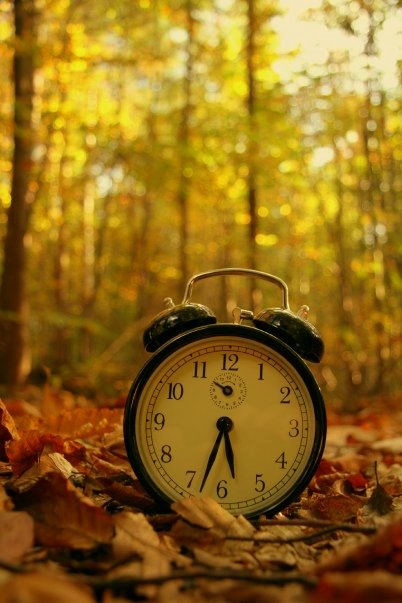
Time to Recharge

The way work slammed into the holidays this year explains why I find myself sleeping in late every morning. Phew! That just happened! Now the two weeks ahead seem like all the time in the world to do anything but work. So, what is the best way to spend this time off?

Some things are out of our control around these super-charged holiday periods – traveling, family time, weather, finances, health – but finding some time to shut down and recharge your energy supplies should be a priority before heading back to work in January. Things really start to gather momentum when we return to the classroom with end-of-term reports being the biggest extra-curricular activity for teachers at this time of the year. Not that I’m thinking about work. Well, maybe a little. I am finding it really hard to walk by recycling boxes in the city without glancing in to see if there is some cardboard – kindergarten gold – I can harvest. The holidays have already provided me with an abundance of recyclables for the Creation Station, so it is not as if I need to keep gathering items. I will just be super ready for our first Monday back and I’ve made sure I have some sturdy plans in place for the first week for a smoother re-entry.

Trying to shut off “work-brain” is not easy – in spite of all the distractions over the holidays – and in fact, distractions are often not quite enough if you want to really recharge your energy. Quiet time, time for self-reflection, is what this dark, cold season warrants, sort of like housecleaning for the brain. Whether it is by walking/skiing/snowshoeing in a forest, field or city park, listening to natural sounds, or while listening to your heartbeat as you bob around in a floatation tank filled with warm, salinated water (doesn’t everyone have one of these kicking around the house?), we all need time to ourselves. Hopefully, you will find the opportunity to gather some loose ends within your mind so that you don’t return to work frazzled and unrested.

Our jobs are stressful, no doubt about it, with a high rate of burnout, so that is why there are so many reminders, to new teachers especially, for the need to look after ourselves. Occupational burnout is a real thing and I recall a doctor friend, whose patients included police officers and teachers, who was fond of saying, “You guys are always on stage. If, for some reason, you aren’t able to perform, I will have to take your badge away.” With that in mind, we are lucky to have a break in between gigs, where we can slow down, take some things off our plates, stare into space and breathe deeply to recharge those batteries.

2016, seems like we were just getting started…

https://www.flickr.com/photos/orvalrochefort/2992146699 https://creativecommons.org/licenses/by/2.0/
https://www.flickr.com/photos/orvalrochefort/2992146699
https://creativecommons.org/licenses/by/2.0/

It’s too late. Whatever you wanted to share or teach in the classroom will have to wait until next year. I’d have liked a little more time. Was this the case for you too? Fortunately, a return date is just around the corner. Conversely, time away from routines can also restore mind, body, and spirit.

A break like this provides me with time to think about teaching and other pursuits. Usually, it’s catching up with family, over-caffeinating, reading, and blogging. With the school year already 40% complete, our time off serves as both restorative opportunity and cathartic challenge.

This December’s end, I wanted to reflect like it’s June. Think of it as part of my own personal development. I am trying to make sense of things now – in the moment. A resolution, pep talk, or plan of action if you please. This means there are a lot of questions to which the answers are either too simple, or underdeveloped.

Did I miss something? Could I have been more supportive? Did I make the curriculum come alive with relevance for my students? Did they have enough challenge, motivation, and opportunity to learn? Did I prepare enough? Did I assess too little? Too much? Did I give my students opportunity to succeed? Was I supportive to my colleagues? Did I give everything I could? Was my work-life balance maintained?

I am sure the answer to each one of the above questions could be yes. Even the one about work-life balance.

Now what?

Questions like these pervade my thoughts. I’m cannot be alone as a reflective practitioner in our profession. So how do you reflect at this time of the year? How are you de-stressing? Are you able to turn off your teacher brain for 2 weeks? How about checking your email or assessing student work?

Do you think that this changes over a career in education? After 8 years in the classroom, I am trying to see each season with fresh eyes, but still struggle with disconnecting entirely. Saying goodbye to 2016 and hello to 2017 will see me sharing, reflecting, learning, and unlearning as part of a process crucial to a professional pursuit of progress. How about you?

Keep the conversation going. Please share, respond, or retort.
I love hearing about your journey and heart for the art of education.

Happy 2017.

Will