Welcome to another year!!

My name is Tammy Axt and I am really excited to be blogging for the 2021-2022 school year. This is me:


I am fortunate, that for the umpteenth time in my teaching career, I am changing roles yet again! I started my career in the senior division with a grade 11 class, moved to intermediate, transitioned into junior and continued the shrinking trend by teaching a lovely primary class. After my primary days, I decided I needed a change and became a full-time music teacher and after that I taught an amazing self-contained class of students with Developmental Disabilities for three years. That brings me to this year, and I am excited to say that I am an English as a Second Language and Special Education Support staff at my very busy middle school. I feel so fortunate to be in a profession that has so many opportunities for learning and growth.

Throughout my blogs this year, I look forward to sharing my learning with you. I will be learning extensively about the role of an English as a Second Language educator and about best practices to support English language learners at school. I will also be excited to blog about my experiences supporting students with Autism and Learning Disabilities who I will be supporting in their classroom settings. It is going to be an exciting year of learning.

Throughout my career, I have also really enjoyed leading extra curricular activities at schools where I have taught. I’ve led everything from Taiko drumming, Step Club, Recorder Quartet, African drumming, Hip Hop dancing, Japanese Manga art and meditation. I thoroughly enjoy this time with students where we can co-create dance, art and music. It has been awesome. This year, I will be beginning my year by co-ordinating my school’s GSA (Gender Sexuality Alliance) and I look forward to sharing my experiences with you.

I have one piece of advice for those just starting out in the career that I have learned from all of these teaching assignments. Make relationship building your first priority.  The relationships I built with parents, colleagues, Educational Assistants, outside agencies, Principals and of course students have been the most important factor in the success in all my teaching assignments and educational endeavors. When you have a strong relationship built with students, they will come to you if they need help understanding a concept. Students will also feel safe in taking risks in their learning. When you have a strong relationship with parents, they will give you a heads up when their child has had a bad night and may need extra time on assignments at school. When you build strong relationships with every support person that works to make school accessible for all your students, you set your students up for success academically, socially and emotionally. Relationships are key.

I hope you are having a good start to the school year and that hopefully things are starting to settle into a nice routine at your school.

Survival tips

I am not talkative. I will share my voice in writing though. Perhaps it is more a function of selective participation rather than voluntary silence. Writing provides me with some permanence, albeit only in pixels, as much as it does a chance to reflect on the words I do choose to share. Instead of my mouth going off like a cannon. I can chew on my words a bit more before spilling my thoughts on a page. In short, it has been quite a month and if I am going to survive the next 9, I will need to get some things off my mind.

Most of this September felt like driving in the dark of night and every oncoming car had its highbeams on. I found it hard to see where I’m going and it hurts. With so much time staring at a screen now, the additional online professional learning is blurring my vision and I am starting to develop an aversion to screen time. It has me thinking twice about how much I want to integrate tech in my classroom right now too. 

I see your high beams are on, but do you have to drive in my lane?

I have been trying to make sense of the way the government ghosted education, the rising COVID case numbers in schools, and the unconscionable decisions being made by many school boards regarding hybrid learning

This is also what hurts:

Of course it has been completely safe to go back to school this year even though cases are nearly 5 times higher than September 2020.
We have HEPA filters in every classroom. Mine must be hidden somewhere.

Of course the hybrid model will work for families instead of dedicated Elementary Virtual Schools. “Teachers will figure it out.”
We have figured it out by the way. It sucks.

Of course the glaring gaps in equity and decisions made “for all” only benefit the privileged who have the wherewithall and choice as to whether their child stays home or not.
Here’s a terrible camera and headset so you can syncronously miss being present in your physical and digital classrooms. 

It is very clear that the “brain trust” tasked with these decisions declared, “We’ve tried nothing and we’re all out of ideas.” I can’t shake these questions: When was the last time any system leaders taught an online class on a daily basis? Where is their compassion, consideration, or consultation with current classroom educators? Why in good conscience would anyone with mental health as a pillar in their foundation allow this to happen? How did they lose their way so completely at the expense of their most valuable resources? It is dizzying. 

How about the feeling of knowing you are going to pass out just before passing out? That’s how it felt when the news of having to teach the hybrid model came down from the folx above. This decisive disconnect was dropped on us without a single consideration of the trauma it would cause in and out of classrooms. It was at that moment when I went into survival mode. I needed to “guard my heart and mind” from diving into dark spaces as it was very clear that no one else was going to do it for me. 

This realization got me thinking about what I needed to do to keep a grasp on my sanity and professionalism in order to do my job in these conditions. Here is what I have come up with so far:
1. Guard your heart and mind. Don’t get caught up in actions and activities that will only stretch you thinner. It’s okay to let someone else lead a meeting or division, run a club (when permitted), or welcome a student teacher. You are allowed to focus on you first. 

2. Resist through rest. I saw this in a tweet from @MsDhillon6A and it really resonated with me. Educators are notorious for taking on too much. We are doers and getters of things done, but we also need to pace ourselves. Teaching is a marathon not a sprint. It takes stamina and determination to maintain a steady pace. The 2021-22 school year is a great time to learn to say no and to let go of extra activities that drain the life out of your practice, body, and spirit.

3. Set boundaries with colleagues, students, admin, and families. There is nothing wrong with having office hours from 8 until 5 pm Monday to Friday. That email reply from the weekend will wait until Monday. You deserve work-life balance not work-work-life imbalance. 

4. Do something for yourself. Take a personal mental health day. Practice good sleep hygiene. Walk, yoga, play pickle ball, or call an old friend who you used to work with to touch base. I like to read, cook, and work on my not so secret goal to be a stand up comedian. As a primary teacher on occasion, I am used to tough crowds so I am half way there. 
And finally, 

5. Don’t silo yourself away. You do not have to go through any of this alone. Share your frustrations, joys, ups, and downs. It is another year unlike any other. Teachers need to know that there are tens of thousands cheering for each other to make it through the day in the service of our students. Tag me anytime via Twitter  if you are having a rough day and need to share. Watch how the #onted family is there to rally and offer kind words of support. 

I’m going to listen to Gloria Gaynor now? Feel free to join me.


Please note: ETFO’s position on in-person learning remains unchanged. The union firmly believes that the daily, in-person model of instruction and support best meets the educational, developmental and social needs of students, provides the best experience for support, and is the most equitable learning model for all students.

ETFO’s expectation is that elementary virtual learning in any capacity, including through hybrid models of instruction, will end once the pandemic ends.

3 things

It’s  the start of week 3 in most public schools, and it feels like we are in for some long months ahead. I have 3 things to share to start the year:
1. Hybrid teaching sucks
2. Your students have something to tell you
3. Did I mention that hybrid still sucks?

1. Despite the social, emotional, and physical toll of teaching and learning during a pandemic, I can’t shake the optimism I have when spending time with my students. Bar none, they are the only source of inspiration strong enough to power me past some medieval level system decisions made by our current government and local school boards.

The hybrid learning option is a stunted and thoughtless response to the educational needs of students and their families. It is an institutional cop out that is replete with a debilitating amount of sadism to demean the well-being of educators charged with making magic with little more than cheap tech, a perfunctory kudo, and a “Your wellness matters” memo. Countless educators have shared how this method of education does little to serve student or teacher yet it was still chosen as the “viable option”. #hybridhurtskids #hybridharmseducators

2. Have you checked in with students to see how they’re doing yet? I know it has been a hella couple of weeks already, but have you asked this year’s class how they feel, how they like to learn or what challenges they are facing being back in the classroom? If you did, were there any surprises? If you didn’t, no worries, it’s never too late.

My experiences with dedicating class time to conversations, Google forms, or free writing tasks to asking these questions are very insightful. Students have voices. They are honest and opinionated. Best of all, students will speak their truths as long as they have a safe, judgement free place to do so.

I have found this beginning of the year check-in to be a powerful way to build relationships of caring and understanding from the start. This comes by establishing the conditions from which they are safe to do so. That usually happens by listening first, holding back the urge to solve or fix or give unsolicited advice or admonishment. Trust me. It’s worth it in order to build trust with learners from the earliest days. This year, more than ever before, students whether in class, EVS or in syncronous hybrid pergatory need to know their teachers are there listening to them, seeing them, and willing to support them.

Here are a few things shared over the past couple of weeks

“I am stressed about getting good marks by my family.”

“I feel anxious when we do math and I get called on.”

“I do not like presenting in front of others.”

“I am bad at; math, art, french, english, science” etc.

“I don’t have any friends who understand the way I feel.”

“My parents are fighting at home and it bothers me and my sister.”

“Someone close to me or my family died, and I am sad.”

“My pronouns are he/him, she/her, they/them,”

Hearing and reading such honesty from students can evoke strong emotions. Their words speak truth into the role we all have in the lives of not only the academic learner, but the whole child. In short, relationship, mental health, trust, and wellbeing need to happen first before any lessons are shared.

Thankfully, these beginning of year conversations and questionnaires also yield a lot of optimism and hope from students too. They are thrilled to be back with their peers, in their school, and with their teachers. Student voice is often the only fuel I need to fuel my emotional fire to teach somedays. We all need something to get us through tough times when the system is designed counter-intuitively to the needs of the community it is tasked to serve.

3. As you read through the 2nd thing, I hope you did not forget that #hybridhurtskids and #harmseducators. As I start my 3rd week with a mic on my head, a mask over my face, and webcam on, I fear for the disconnect that is happening with my OGs(online guys). Now instead of devoting both ears to 26 students in class, I have one ear for 24 and the other for 2 hybrid learners. As age continues to take away my ability to hear, this concerns me. It’s exhausting and many times I am only able to hear a fraction of what I could when not divided and encumbered by tech.

First, how is this fair to any one child when I can only devote half of my auditory function to a room filled with students? How can students be expected to hear me clearly when I articulate a particular pronunciation to practice in reading or vocabulary when I can barely hear myself with a headset on? And then there are the visual content issues?

Not everyone has a document camera to share texts or show how to share thinking spontaneously or good lighting for hybrid kids to see what is being shared on the board. How are students expected to see what I am sharing when the camera does not focus or adjust? Anything projected to the whole class becomes washed in the worst possible lighting fluorescent bulbs can provide.

Then there is the whole OT and prep teacher transition piece. Connecting is not easy, especially when the tech does not always come with the proper cords from class to class. I now have an HDMI, USB-C, and VGA adapter, but know many educators do not. There are significant gaps starting to happen already and coupled with the emotionally taxing work that is happening, something is going to give. Does this seem familiar?

And yet, this is what is going to happen next…

I am going to teach like I am on a reality show tomorrow. I am going to give the performance of the day. I am going to go home defeated, drained, and desperate to believe that the next time back in class will go without a hitch. I will continue to listen to my students first, honour their voices and fight against the derogation of education by people who have not been in a classroom in decades.


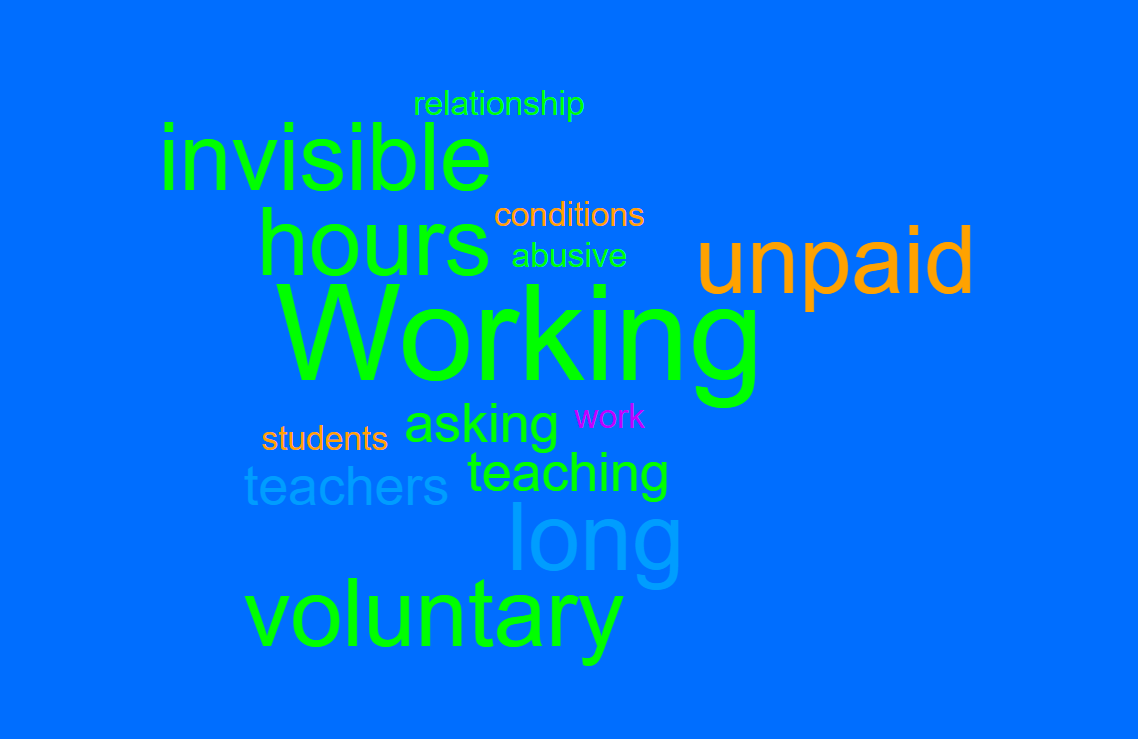
Invisible, unpaid, voluntary hours


Working long invisible hours


2020/2021 has been a very challenging school year for educators. We’ve worked thousands of hours to make the school year work for our students. It was exhausting, working through weekends with few real breaks away from school tasks.

Thousands of teachers worked long, invisible, unpaid, voluntary hours.

Why did teachers work so hard? It was to ensure students had the best possible education during these very challenging times.

After 21+ years in teaching, I’ve learned a great deal about how my work is valued by boards of education and the Ontario government.

  •  Teachers are expected to work long hours with few supports and even larger class sizes.
  •  Teachers are directed, by their boards and ministries of education, to provide supports that are not directly linked to education such as being responsible for students’ well being and mental health. Teachers are expected to deal with students who have significant behaviour needs with few supports while teaching a class of students. Note that teachers are not trained mental health therapists.
  • Teachers’ time is taken up due to the underfunding of students’ needs, resulting in working through breaks and beyond school hours.

During Covid, teachers were expected to make their online and hybrid classrooms function well. Teachers were given few or no resources to run a virtual classroom with teachers using their own money to purchase technology and curriculum materials (I personally spent a great deal of my own money on student workbooks and technology in which I was not reimbursed.)

The challenges of teaching through Covid were downloaded to teachers as we were left to figure it out on our own. The lack of resources went beyond teaching materials as some teachers were given no planning time during their teaching online (part of the collective agreement.)

Of course, administration praised teachers for their work in one breath, then started asking teachers to do more. It is like asking someone to clean the house on their own time and then asking them to do the windows next!
Teaching in the hybrid model was the most taxing job I’ve had in my entire history of work in 40+ years. I had to attend to students in class, students online, technology and the lesson in which I was teaching. With the addition of behaviour management, my skills were so strained that I became ineffective.

Healthy relationships require limits. Teachers’ working conditions are becoming abusive. If these working conditions are sustained, my relationship with teaching needs to end.

Working long, invisible, unpaid, voluntary hours, I will not stay in an abusive relationship.

Collaboratively Yours,
Deborah Weston, PhD

Note: The Covid-19 Pandemic has brought unique and unprecedented challenges to teaching. ETFO’s position on in-person learning remains unchanged. The union firmly believes that in-person instruction and learning in publicly-funded schools provides the best experience for learning, quality delivery and is the most equitable model for all students. In order to support educators during remote learning, several resources have been created to support members.

What I wish I had known three years ago

Three years ago, I moved to my current school in the role of self-contained teacher of students with developmental disabilities. When I applied for the job, I did not have extensive experience with self-contained programming or even special education for that matter. All I knew was that I loved working with students who had exceptionalities when they came to my music class. Three years later, I have learned so many important things.

Since I am unable to travel back in time, I hope what I learned will help you get started in supporting students with developmental disabilities in your inclusive or self-contained setting.

Set high expectations. My students achieved a lot in the past three years. Some of my students learned how to read at the age of 12, some were able to take care of their personal care in the bathroom for the first time at 13, and others greatly improved their social skills and empathy towards others. I truly understand the statement: “Just because the student never did something before, does not mean the student won’t be able to do it now.”. The students impressed me time and time again. We ran a business, hopped on a bus and went shopping, we led activities for others in the school and on one particular occasion, my incredibly shy grade 6 student walked up to the dunk tank and in front of 50 grade 8s, pitched and dunked my principal. The sky is really the limit. Expect a lot from your students and they will be able to do so many things!

Focus on the students’ strengths and build from there. Building a program for instruction that is strength-based will help the students achieve so many things!! It builds momentum and confidence with students when they achieve something and allows them to do their best learning. For example, once we connected numeracy activities to one student’s expertise of running, her counting really took off. We focused on the numbers she was confident with and added on from there. For another one of my students, he really enjoyed riding his specialized bike around the school. We learned that if we continued to build his gross motor skills during his bike rides, he would be more comfortable getting up and down from chairs, walking up and down the stairs, and dancing with his classmates. His physical strength carried over to so many areas of his daily routine.

There are many policies/Acts that you need to know. Find a comfortable chair and start reading. PPMs outline some the requirements of your job, especially those that focus on Special Education such as: PPM 81, 140, 149 and 156. There are also a lot of policies that impact your responsibilities such as the Ontario Human Rights Code- Policy on Accessible Education for Students with Disabilities, Ontario with Disabilities Act and Accessibility for Ontario with Disabilities Act. This is something easy that you can do now, before your job begins in September, but will have a big impact on what you’re required to do in your new job.

Ask for good assessment tools on day one. Information about your students is so important. We know this. In every classroom in Ontario, teachers are assessing students and making decisions about programming every day of the school year. The tricky part about students who are developing skills outside of the Ontario Curriculum is that many schools do not have really effective assessment tools that can capture their learning. If your school does not have a great tool for assessment of students with developmental disabilities, the FISH Functional Independence Skills Handbook and The Carolina Curriculum are a great place to start.

Read about Alternative Goals and Programming before your job begins. For most of us throughout our career, we have used the Ontario Curriculum as a measure of achievement for our students. For students who are focusing on skills outside the Ontario Curriculum, it is important as an educator that you have a deep understanding of Alternative Goals, Programming and Assessment. To get started, the website http://www.thea4ideaplace.com/ will introduce you to different goals that are outside of the Ontario Curriculum and how to assess students’ achievement of these goals.

Resources come in many shapes and sizes. Speech and Language Pathologists, Occupational Therapists, Physical Therapists and SEA Technology will often play an important role in your students’ success at school. Learn what is available to students and understand how SLPs, OTs and PTs can support your students. You will need to advocate strongly for your students to get the materials that they need.

It also helps if you are aware of some of the technology that can support your students’ learning such as:

· Core first board

· Clicker 6

· Switches

· Speech to Text

· Board Maker Online

· Read and Write for Google Chrome

· Go Talk

· Big/Little Mack Communicator

· Prologue2Go

· Big keys assistive key board

· Clicker Connect

· Abilipad

Make social skills a priority. I’d love to say I used some amazing social skills program and voila, we had an amazing community of learners. However, it required a lot of observation of students and creating lessons and resources that responded to my students’ needs. We used a lot of social stories and acted out situations so students could learn appropriate ways to respond in a variety of situations. Once I made social skills the most important focus of our class, the students developed a strong community and our learning really took off. It was like you had 13 cheerleaders rooting you on and celebrating every part of your day!!

Parents play an important role in their child’s education. This is a true statement for every child at school. What I didn’t know when I first started my current role, was how important I was to going to be to helping my students’ parents get the community supports that they needed.

That last thing that I wish I would have known three years ago:

That this was going to be the coolest, most awesome and incredible three years of my teaching career!

Thank You, Teachers!!

Thank you for everything that you have done this year.

Thank you for supporting students who felt isolated and alone.

Thank you for supporting students while you received unclear communication and direction from the Ministry of Education.

Thank you for becoming an expert in IT to support students and parents through device issues.

Thank you for your commitment to dismantling anti-Black racism.

Thank you for continuing to commit your precious free time to your own professional learning. I met so many of you in book talks, workshops, webinars and in AQs that I took this year. Your passion for learning is inspiring.

Thank you for self reflecting and acknowledging areas of needed growth.

Thank you for writing report cards, IEPs, transition reports etc. while at home and isolated from the usual support of your colleagues.

Thank you for supporting parents through this difficult time.

Thank you for working extensive hours to prepare for online learning.

Thank you for staring at a page of avatars for hours on end while teaching lessons enthusiastically.

Thank you for speaking out loudly against the hybrid model of instruction. I taught in a hybrid model this year and I can say from the experience that it is the absolute worst model for kids. No child or teacher should learn or instruct in this model.

Thank you for keeping 3-, 4- and 5-year-olds engaged during online learning.

Thank you for running online GSAs this year so our students who are members of the 2SLGBTQ+ community felt loved and supported.

Thank you for supporting your colleagues through some very difficult times with their mental health.

Thank you for teaching from home while trying to help your own children with online learning.

Thank you for everything that you have done this year. I am very proud to stand alongside you as a teacher in Ontario.

Before you click “End the call”

After 10 months of learning at the lag and speed of education during a pandemic, the end of this school year is at hand. Our students and fellow educators have been through so much. Considering the obstacles(emotional, physical, virtual), doubt, stress, isolation, frustration, and constantly shifting plans that elected and system leaders have laid before us, we made it. 

I guarantee that not a single soul wishes to do it over again either. It’s time to close the book on lockdown learning in a pandemic. We all get gold stars for our efforts along with some well earned time away from the screens to which we have stared and spoken too frequently. Although, the number of school days can be counted on one hand, I still need both hands and one of my feet to count the digital meetings ahead before logging out for a while. The thought of this got me very excited, perhaps my reward centre released some hormones in anticipation or something neuroscientific like that, but I think it is more likely a sigh of relief. An overdue exhale if you will. I wonder if CO2 levels will rise on the last day of school?

As joyous as this impending summer recovery and associated unstructured time will be for all of us, I wonder what that last day is going to be like for the hundreds of thousands of students we have been serving after we “end the call”? What are you going to do to celebrate? We have a lot to cheer about. I have been weighing that last Google meeting quite heavily this year, and it is understandable considering how many times we have all logged on and off this year.

For my class, I really want to spend time listening to the students, playing social games, and dancing out our time together. This is not unlike the last day at school in real life for me other than copious amounts of candy and snacks. Everything is on the table from Blookets to Buddy Board Games, and from Kahoots to Just Dance vids (see links below). I think that Karaoke (YouTube) might even be on this year’s schedule too. My class loves how well I can sing any song off key and not feel any shame. Anything to send the class off into their summer break with a smile. I want our last meeting to also make sure the students know how much they have been appreciated for their hard work and their commitment to making this year way better than bearable. 

So what’s your goto end of year guaranteed goodtime activity? Please feel free to share by adding your favorite to the comments below. However you choose to end your last online class of 2020-21 school, take an extra moment to reflect on what a year it has been for all of us. Celebrate the good that is in your students as you send them off for a safe and restful summer. I know that I am starting to miss my class already, but that we are all ready for a break to recharge our emotional and physical batteries. Before I click end the call maybe I’ll play one more song for us to dance out the year. 

Just Dance Choice Tracks
Turn Up the Love – Far East Movement

Dynamite – BTS

Old Town Road – Lil Nas X

Happy – Pharrell Williams

I’m Blue – Hit that electro beat

Animals – Martin Garrix

Note:

ETFO’s position on in-person learning remains unchanged. The union firmly believes that the daily, in-person model of instruction and support best meets the educational, developmental and social needs of students, provides the best experience for support, and is the most equitable learning model for all students.

ETFO’s expectation is that elementary virtual learning in any capacity, including through hybrid models of instruction, will end once the pandemic ends.

Top Ten Tips for Attending Virtual Professional Learning for Educators

So much learning is happening virtually now and it is amazing.  I recently attended a virtual EdTech Conference in Nebraska!  This is an opportunity I never would have been able to take advantage of before the pandemic.  I have attended a number of virtual conferences during COVID and I’ve also organized and facilitated virtual learning over the last year and it is a different way to get your learn on!

In order to really get the most out of Virtual Professional Learning here are my go-to suggestions:

  1.  Organize your time and your conference selections in advance.  If there are many choices, take the time to do the research on the session and on the presenter. If there are digital links for presentations on the conference site to add into a digital tote-do it before your sessions so that you aren’t tempted to leave the session in order to do so.  Thank you ISTE LIVE 21  for the digital tote feature!
  2. Be PRESENT.  Be mindful and intentional about your learning.  If it isn’t the kind of learning that you were expecting, hop over to another session otherwise you’ll be resentful of wasted time and learning.
  3. Put your “out of office” email message on and don’t check your email.  If you were in an in-person setting, checking your email would be rude. This is time for your learning so treasure and protect that time.
  4. When possible attend LIVE sessions not asynchronous or previously recorded sessions.  LIVE sessions have opportunities to engage and ask questions which makes the learning is deeper.
  5. Have a PLP (Professional Learning Partner) or two! No one really wants to go to a conference by themselves. Some of the best learning takes place when you share what you learned in a session that your PLP wasn’t able to attend! You double the learning!
  6. Participate in the learning.  If there is a chat feature then put who you are and where you are from in the chat.  Ask questions, engage and connect.  This is where you grow your Professional Learning Network.  In a face to face conference you would sit down and meet new people.  Think of how you would engage with others in a real conference setting.
  7. TWEET! TWEET!  Get the conference hashtag, follow it, retweet and tweet about your learning and the presenters.  Follow those presenters and give them a shoutout. Take a picture of the slide that they are sharing and post it (without people’s faces and names in it.)  It is awesome as a facilitator to see the tweets afterwards.  It is timely feedback and motivational for the presenter.
  8. Take notes.  My PLPs and I recently collaborated on note taking using a Google Slide deck while attending a conference.  We pasted links, took screenshots and put notes of important information into the slide deck so we have the learning for later.
  9. Participate.  As a presenter, it isn’t nice to present to the empty boxes on Zoom or Webex. Just as in person, it is nice to see the reaction of the audience to pace yourself and to know that they are still with you! That being said, if you are eating or dealing with your dog or family or have decided to multi-task, leaving your camera on can be distracting for the participants and the presenter.  If there is a question asked in the chat, respond! There is nothing like being a presenter left hanging.  If there is a poll, a word cloud, a Jamboard,or a Kahoot, play along! The presenter created these things in order to make the presentation interactive for the adult learner.
  10.  Take Breaks.  Make sure you look carefully at the schedule (and the time zone) in order to plan your screen, water, coffee, bathroom, movement or snack breaks.

The most important thing to remember is that the presenters put time and effort to share their learning and expertise with you.  It is nerve-wracking to present to a group of educators.  Tech savvy people have tech issues too.  Give presenters grace and remember to thank them and provide feedback for their work and expertise.  They will appreciate it!


Getting involved in your ETFO

Since this space is dedicated to encouraging new teachers it seems like a great time to share some of the important benefits that you can gain from getting involved early on in your careers in education. 

So here is a little list and some handy links for you to click on to get you started;

  1. Your voice matters and as such you should feel represented and included. Joining a committee and following your ETFO local news is a great way to connect and find opportunities to learn how things work as well as find ways to support and serve in your region. A quick glimpse through some of the provincial locals shows committees for social justice, political action, and new teachers. Make sure you also attend your annual general meetings too. Your votes matter too.  
  2. Find a mentor. This does not have to be someone in your building. Technology and social media have created excellent mentorship channels for new members. ETFO Provincial has a link and as mentioned above, local chapters have New Teacher Committees. New teachers might also want to check out The Mentoree website
  3. Don’t go it alone. Although many of us graduate from teacher’s college feeling we have to have it all together, the truth is that no one comes out fully prepared. Once you graduate, and enter the classroom as a teacher or occasional teacher, the real learning begins. ETFO offers the Survive and Thrive conference to new teachers within their first 5 years of their careers. Some school boards also offer summer sessions for teachers who are switching grades or taking on new roles. YRDSB has hosted its Great Beginning Conference for years and it allows attendees to meet others and gain valuable and practical resources from experienced fellow educators. 
  4. Remember you don’t have to reinvent the wheel. When you are new to teaching or even looking to update your own lessons, ETFO has curated an excellent set of resources for its members. Start with Teaching and Learning and click on a sub-topic and scroll down. ETFO members has many phenomenal resources for educators by educators. Check out:
    ETFO Action on Anti-Black Racism 
    Building a Just Society 2SLGBTQ+  
    Adressing Anti-Asian Racism resource booklet
    There are way more to share, but I will let you enjoy discovering them at your own pace. 
  5. Take ETFO AQ and other courses. They are incredibly relevant and well taught by fellow member educators. They are also affordably priced and designed to fit your schedule. 
  6. Get on social media and find other like minded folx in education. #onted is a great place to start.
  7. Subscribe to the Heart and Art of Teaching and Learning blog. 

Most importantly, don’t forget that we are a family of committed, creative, and caring professionals who share a common goal to maintain the best public education system in the world. If you would like to connect please drop a line in the comments section. Welcome to ETFO. 

Alternative Curriculum Reporting

It is that time of year again when everyone gets to do their favourite part of teaching….. Report card writing!! Woohoo!!

When I began my job as a teacher of students with Developmental Disabilities three years ago, I spent a lot of time trying to figure out what to write on my student’s reports. All of my students were working towards Alternative expectations on their IEPs and the reporting on the goals was much different than I was used to doing.  It was the first time that I developed Alternative Expectations (expectations that are developed to help students acquire skills that are not in the Ontario curriculum) and the first time I reported on them at the completion of first term. The ministry of Education explains that “for the vast majority of students, these (alternative) programs would be given in addition to modified or regular grade–level expectations from the Ontario curriculum.” In my students case, they have completely alternative IEPs.

In Ontario, there are five categories of Exceptionalities: Behaviour, Communication, Intellectual, Physical and Multiple. Some of these categories have more than one exceptionality under its umbrella, resulting in a total of twelve exceptionalities as outlined by the Ministry of Education. My students who have a Developmental Disability fall under the Intellectual umbrella along with Giftedness and Mild Intellectual Disabilities.

After consulting with parents, guardians, previous IEPs, Occupational Therapist reports, Speech and Language Reports, other staff and Psychoeducational Assessments,  I created goals that my students focused on for the first term of school. For some students, the goal changed many times throughout the term as we made it more challenging or complex because the child mastered the initial goal. For other students, the goal had to be altered completely to meet their changing needs. When preparing to write the report card, I gathered all the assessment that we as a team had gathered and used the evidence to write a comment that reflected the student’s progress.

After three years in my role, I am no expert by any means, but maybe the comments I have used may help give you some ideas of how to start.

Here are some comments for some areas of the Alternative Curriculum:

Communication:

_____ regularly initiates conversation with students online and in the classroom. ___ is working on listening closely to others responses and respond to questions that they have asked. ____ is beginning to be able to express her feelings in detail in the classroom.

_________continues to be able to communicate confidently with staff and students online and in person. ___ has improved in his ability to add his own thoughts and questions to conversations and no longer relies on a model to share his experiences and interests. _______ began Speech and Language online sessions in the Winter of 2020 with a focus on improving ______’s articulation. He has adjusted well to the format of the focused sessions and is very committed to improving.

_________ has improved a lot in her ability to express how she is feeling throughout the day at school. She is able to ask for breaks when she is tired or thirsty and confidently shares when she is having a difficult morning. Her ability to express her feelings has helped her to be more focused in class. ______ has gained more confidence throughout this school year and is now able to ask for assistance from multiple people in the classroom.

Behaviour:

_______ had a very successful term two. He was able to stay calm and focused by using his strategy board when he felt anxious with minimal prompting from staff. During online learning, he used some deep breaths when he felt overwhelmed and remained very calm and focused.

With minimal teacher support, ________ has made significant improvements in her/his self regulation when upset or frustrated.  The use of a calming space with student selected staff, allowed ______ time to use tools to help manage her emotions throughout the day. Using a first then choice board, _______ was beginning to comply with more requests throughout the day.

Fine Motor/Gross Motor:

________ printing has improved this term. It is more clear and easy to read. ___ spent much of the term writing for specific purposes such as letters to all of her friends at home. ____ is able to use scissors well to cut paper activities and is working on completing lacing activities accurately. Currently, he is able to lace straight lines consistently and is working on lacing curved shapes.

________ is completing 3 to 5 laps of the interior of the school every day on his bike. He rides the bike with fluid motion and lots of energy. _______ with consistent support and encouragement is beginning to go up and down the stairs of the school 3 times a week.

Functional Academics:

______ can count to 100 with 80% accuracy. She sometimes need assistance with the numbers 60, 70 80 and 90. She is able to demonstrate one-to-one correspondence up to 20. When __________takes her time, her accuracy increases and she is able to demonstrate one-to-on correspondence up to 20

____ has expanded his list of words that he can recognize in a variety of texts. The words include, but are not limited to: a, and, big, blue, can, funny, go, here, I, is, in, it, jump, little, look, me, my, play, red, run, said, see, the, to, up, we, yellow, you. ____ is also able to sound out unfamiliar short words with 86% accuracy. _____ loves to write and happily learns new words to write every week.

______  showed great commitment to learning some new sight words this term. She identified them 90% of the time using the Olwein method of instruction which worked very well for her. She also thoroughly enjoyed playing games with the words. She can identify the 5 sight words Cars 3, school, colour, her name and run in a variety of contexts. ______ was also able to trace and copy many personally relevant words for a variety of purposes such as writing letters to her friends who are learning at home.

______ can say the numbers in order from 1-12. She can recognize the numbers 1, 2 and 3 100% of the time and can identify 4 and 5 50% of the time. She is able to demonstrate 1- to-1 correspondence on the numbers 1, 2 and 3 with 50% accuracy.

Social Skills:

_________ requires consistent redirection and cues to treat others with respect and kindness. With these supports has begun to show improvement. She continues to respond well to reminders and will use phrases such as “thank you or you’re welcome” when prompted.

_______ awareness of personal space has improved consistently this year. ______ has used visual tools/cues to check how close she can sit beside someone during whole class gatherings